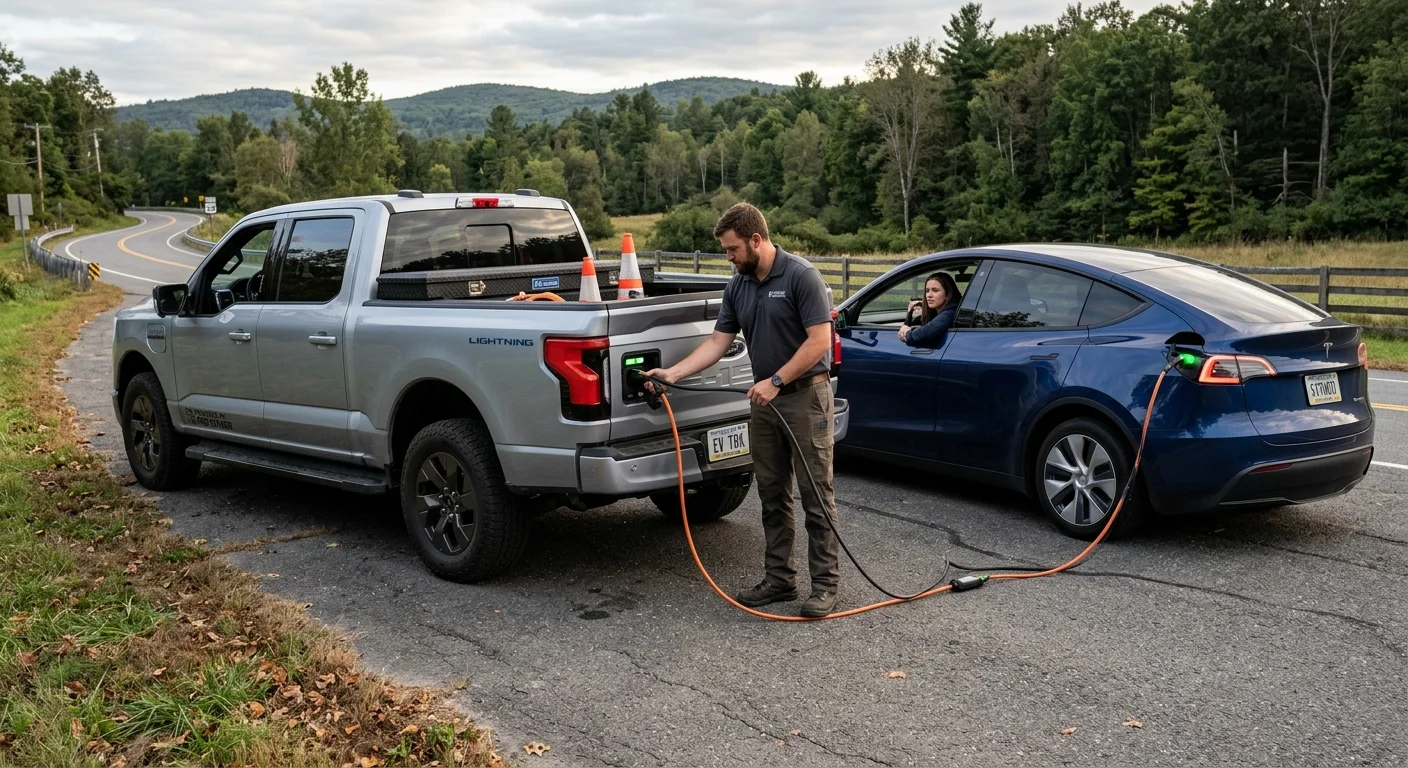
A Ford F-150 Lightning can charge a second EV through Pro Power Onboard. It’s not a highway fast charger in the bed. You need a 240-volt outlet, a portable Level 2 unit, and time for a slow AC fill. On Tampa Bay roads, that last part is usually the problem.
What Pro Power Onboard actually is
Ford added Pro Power so the truck can run tools, a camper, or a house when the grid drops. Higher trims put 240-volt outlets in the bed and cabin. Those outlets put out AC, the same kind of power a wall box uses. They don’t tap the Lightning’s DC fast-charge port.
You’re running a Level 2 station off your traction pack. You’re not cloning a Supercharger. Vehicle-to-load is the name for this. The truck inverts high-voltage DC into household AC. Then the other car’s onboard charger turns it back into DC. Every conversion wastes a little energy. In this climate, that waste shows up as your own range.
Trims aren’t equal. The base Pro Power setup is 2.4 kW. Many trucks step up to 7.2 kW. The top setup is 9.6 kW. Those figures are Ford’s onboard ratings, not a local shop’s claim.
Why Lightning owners here keep asking
Tampa, St. Petersburg, and Clearwater sit in a dense EV mix. Teslas, Rivians, Mach-Es, Ioniq 5s, and Bolts share I-275, I-75, and I-4. Heat is the range story, not hills. The metro is flat and near sea level. Grade never gives miles back.
Recurrent Auto’s published research finds an EV loses only about 5 percent of range at 90°F. Loss jumps to 20 to 30 percent above 95°F. It’s roughly 17 to 18 percent near 100°F. Cabin AC runs from spring into late fall. A friend who left home with a buffer can sit empty after a long bayfront day.
Vaisala’s National Lightning Detection Network ranks Florida among the most lightning-dense states. Treat Tampa Bay as one of the most lightning-prone metros in the country. Storms cut public sessions short. After Hurricanes Helene and Milton in 2024, more people started asking a neighbor with a truck for electrons, not just a 12-volt jump.
The impulse is decent. The cable still has to match.
Gear that has to be in the bed
A hardware-store extension cord won’t handshake with another EV. The Lightning’s 240-volt outlet is typically a NEMA 14-50. You need a portable EVSE, the brick and cable that talks to the other car. It needs a 14-50 plug on the wall side.
Without that EVSE, the truck is a generator with no EV protocol. The other car won’t start a charge from a raw outlet.
Match the EVSE rating to your Pro Power trim. A 2.4 kW truck won’t feed a 9.6 kW brick at full tilt. A higher-rated brick on a smaller outlet only pulls what the outlet allows, if it starts at all.
Keep cables dry, un-nicked, and fully seated. After rain or salt spray, look at the pins before you plug in. Don’t force a wet connector into a port.
Tesla plugs versus everyone else
Most non-Tesla EVs in North America still take J1772 on the AC inlet. A Chevy Bolt, Hyundai Ioniq 5, Kia EV6, or Volkswagen ID.4 will usually take J1772. So will a Mustang Mach-E on a portable Level 2 unit.
A Tesla on AC wants NACS. If your EVSE ends in J1772, add a J1772-to-NACS adapter on the Tesla. Skip it and you’re holding two plugs that don’t meet.
CCS on the other car is a DC fast-charge inlet. Pro Power is AC. You can’t feed CCS from the bed outlet. The stranded car has to accept AC on J1772 or NACS.
That’s the same limit as one EV charging another. The Lightning is simply the EV that ships with a serious AC inverter.
How many miles you add per hour
Set the expectation before you roll the tonneau.
A 2.4 kW Pro Power setup sits in Level 1 territory. A typical EV might gain about 8 to 10 miles of range per hour.
A 7.2 kW setup is a modest Level 2. Figure about 20 to 25 miles per hour on a typical car.
A 9.6 kW setup is the most the truck offers. That’s about 30 to 35 miles per hour. It’s still AC. You’re still sitting still.
Those numbers are charging time, not a promise you’ll be rolling in a few minutes. Heat, the other car’s onboard charger, and pack level all change the result. A car at true zero may also need 12-volt help before the charge port wakes. If the Lightning itself won’t start, that’s usually the truck’s own 12-volt, not the big pack. Start with F-150 Lightning 12-volt help.
On the shoulder of I-75 near Wesley Chapel, an hour for 30 miles is a long sit. The same is true on the Selmon reversible lanes. The Selmon REL is a roughly 10-mile elevated run between Brandon and downtown Tampa. There’s no local surface shoulder on that segment. THEA clears the lanes before each reversal. Don’t tie two EVs together up there.
Operators in the referral network bring a 240-volt Level 2 source to the bumper. They typically add 10 to 20 miles of range in 15 to 30 minutes of charging. That’s charging time, never an arrival time. They carry a native NACS plug, plus CCS or J1772 adapters for non-Tesla cars. How a mobile charging truck works walks through the sequence.
When a Lightning assist makes sense
A driveway in Westchase, Fish Hawk, or Lakewood Ranch isn’t a live interstate. Newer master-planned housing there usually has 240-volt home charging. A neighbor whose overnight charge failed may only need a few miles to a working outlet.
Camping, a job site, or a parked car during an outage is the use Ford designed. TECO, Duke Energy Florida, and Withlacoochee River Electric Cooperative run the meters here, depending on the county. Their charger credits and home-EV pages don’t help a car already sitting on I-275.
When it’s a poor plan
Don’t stage a Level 2 session on the Sunshine Skyway. The main span sits 432 feet over the shipping channel. Florida Highway Patrol closes the bridge at sustained 40 mph winds. It also closes when fog drops visibility below about 100 feet. There’s no useful place to sit two vehicles and a live cable on that span.
Use the same caution on I-4, I-75, and I-275. FDOT Road Rangers in District 7 patrol those roads and the airport interchange. A motorist reaches them by dialing *347. They publish flat-tire help, a 12-volt jump, fuel, water, and two local calls. They can also move a disabled vehicle to a safer spot. Their published list doesn’t include charging an EV. A Lightning owner who stops still occupies the shoulder with two vehicles.
Florida Statute 316.194 covers a disabled vehicle on the paved highway. You can stop there when you can’t get off the roadway. That covers the stranded car. It doesn’t make a long charge session wise. Put the hazards on. Stay out of the travel lane. If you can roll into a lot, do that first.
Don’t treat the Lightning pack as a daily donor. Vehicle-to-load is a tool, not a second career. Repeated deep pulls cost you range in this heat. Lightning charging time already stretches when the truck is hot.
The 12-volt lookalike
Plenty of dead-EV scenes aren’t an empty traction pack. The 12-volt battery runs computers, contactors, and door latches. When it dies, the car looks bricked even with miles on a recent drive.
Pro Power won’t fix that. Filling the high-voltage pack doesn’t revive a failed 12-volt. If screens are dark and the charge port won’t unlock, start with a 12-volt check. Skip the 14-50 cable until the car wakes. Operators in the network can jump or replace a 12-volt on site. They handle Tesla and other major EV brands.
What to do instead of sitting on the shoulder
If the other driver is on a surface street in Tampa, St. Petersburg, or Clearwater, stay with them. Do it only if you can stay safe. Keep them off the pavement. Then call for a dedicated mobile EV charging visit. The operator quotes before any work starts and bills the driver directly. Charge Pro TPA is a referral line. We don’t own the truck that shows up.
Tampa International Airport is a different kind of stranded. The airport publishes that EV charging is free at the on-airport garages and the cell phone lot. A car that sat a week and won’t wake is often a 12-volt failure, not a pack at zero. A Lightning in the cell phone lot can’t unlock a Tesla in the Economy Garage.
For the gear a rescue truck actually carries, see what roadside EV rescue trucks bring.
When to call for a mobile charge
If the car is on a shoulder, a causeway, or a toll road, skip the neighbor experiment. Call (813) 536-4545 and we’ll connect you with a local operator. They quote before they start. You get a Level 2 charge at the bumper, or a 12-volt jump if that’s the real fault.