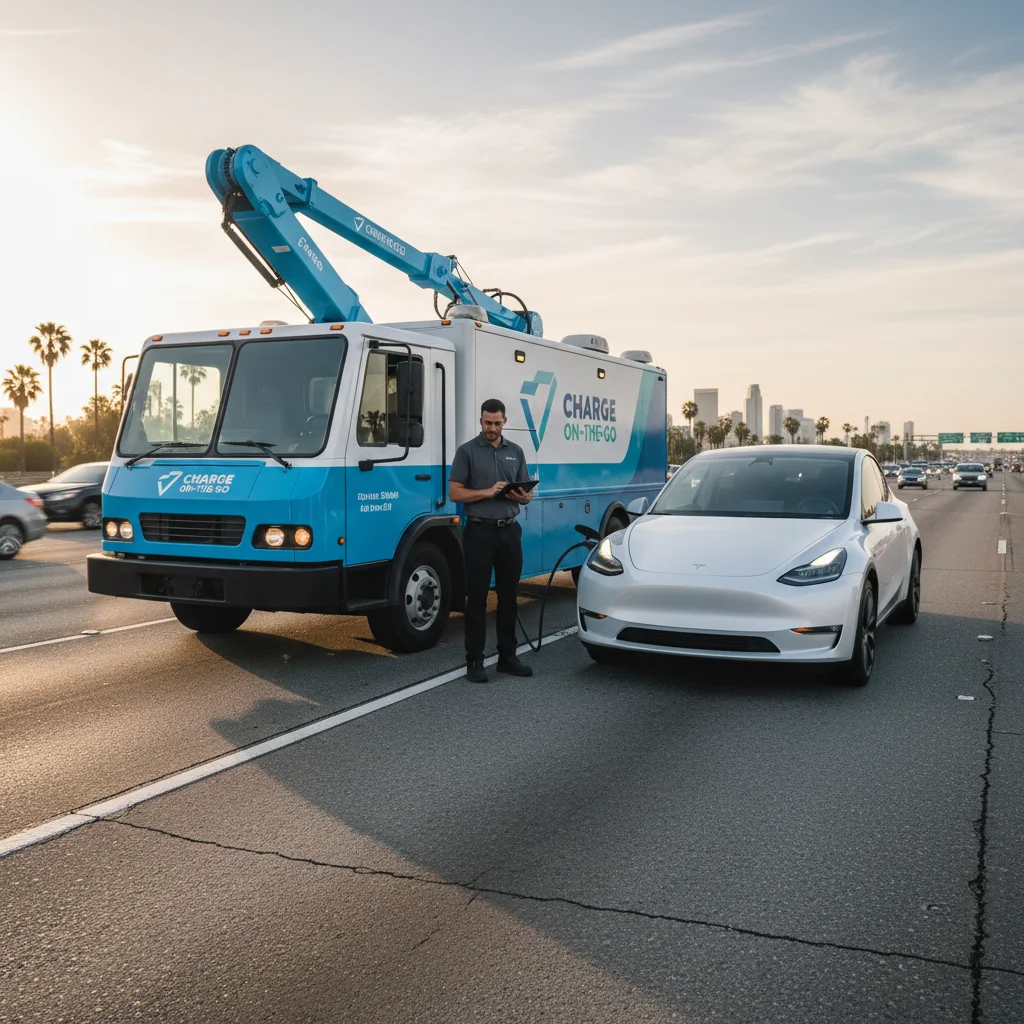
A mobile EV charging truck brings a 240-volt Level 2 source to a car that’s already stuck. In Tampa Bay, Charge Pro TPA doesn’t own that truck. We don’t employ the person who plugs in. We refer you to an independent local operator. That operator quotes you before any cable goes on, then bills you directly. Typical charging time is 15 to 30 minutes. That usually adds about 10 to 20 miles. That’s charging time, never an arrival time.
The truck isn’t a Supercharger on a pickup
People type “ev charging truck” when the dash is already at zero. They want to know what actually rolls up. It isn’t a DC stall bolted to a pickup. It’s an independent operator’s van or truck with a 240-volt source on board.
Native NACS handles Tesla and other NACS cars. CCS or a J1772 adapter covers non-Tesla EVs. You stay with the car. The operator parks, sets cones, and connects. They aren’t filling you to 100 percent. They’re giving you enough range to reach a public stall or your driveway.
A Supercharger or a mall DC stall still does the long fill. The truck solves the shoulder, the garage, and the deck with no runoff. Then you drive the rest of the way yourself.
We match stranded EV drivers with those operators. We don’t hold a trade license, and we own no fleet. We don’t set prices. The pros we connect you with are licensed and insured. The person at your bumper isn’t us.
Empty pack or a dead 12-volt
From the curb, both failures look the same. Screens stay dark. Handles may not wake. One problem is a high-voltage pack at zero. The other is a 12-volt battery that’s dropped out. Operators jump or replace a 12-volt on site. They can also feed the pack through that Level 2 cable. Tell them what the dash said before it died. That split decides the kit they pull first.
Tampa International Airport is the sitting-car version of this. The airport publishes free EV charging in the on-airport garages. The cell phone lot has charging too. Level 1 J1772 is in the Economy Garage and the Long-Term Parking Garage. Level 2 is at the Cell Phone Lot. Exact stall counts weren’t confirmed on the live airport page at research time. Check tampaairport.com/parking/electric-charging before you count on a numbered stall. A car that sat on free power for a week may still not unlock. That’s usually the 12-volt, not an empty pack.
Heat, AC, and roads that don’t give range back
Tampa Bay sits flat and near sea level. Grade never hands range back on the way home. Recurrent Auto’s published research finds an EV loses about 5 percent of range at 90°F. Loss runs 20 to 30 percent above 95°F. It’s about 17 to 18 percent near 100°F, and it varies by model. Cabin AC runs from spring into late fall. That’s the range story in this climate.
The Lee Roy Selmon Expressway adds a geometry problem the truck has to solve. THEA’s reversible express lanes run about 10 miles between Brandon and downtown Tampa. They’re an elevated deck with no local surface shoulder. Westbound into downtown runs from about 5 a.m. to noon. Then the lanes go east. THEA clears every vehicle before each reversal. If you hit zero on the REL, coasting to a surface street isn’t a plan. You need an operator who can meet you on that deck.
The Sunshine Skyway on I-275 is a different trap. The cable-stayed main span sits 432 feet above the shipping channel. The crossing is about 4 miles with no place to stop. Florida Highway Patrol closes it at sustained 40 mph winds. It also closes when fog cuts visibility below about 100 feet. High-profile advisories often start around 20 mph gusts, per local reporting of FHP practice.
The Suncoast Parkway runs north through Pasco with widely spaced exits. US-19 in coastal Pasco and the Veterans Expressway through Westchase are the weekday version. I-75 by Wesley Chapel and I-4 at Plant City see the same empty-pack call. Florida 511 will tell you about backups. It won’t charge the car.
What Road Rangers publish, and what they don’t
FDOT Road Rangers in District 7 patrol I-4, I-75, and I-275. They also cover the airport interchange. Dial *347 from your phone. Published help includes a flat tire, a 12-volt jump, and fuel. They also list water, two local calls, and a move to a safer spot. The Tampa Bay SunGuide Center is District 7’s regional traffic desk. District 1 runs Rangers on I-75 through Manatee and Sarasota. Florida Highway Patrol Troop C covers disabled vehicles on the interstates.
The Road Rangers materials reviewed describe fuel and a 12-volt jump. They don’t mention charging an EV pack. That’s an observed absence in the written list. It isn’t a claim that Rangers can’t help an EV. Call them for the scene and a 12-volt jump. Call a mobile charging operator for the high-voltage top-up.
Florida Statute 316.194 bars stopping on the paved highway outside a city. That applies when you can get the car off the roadway. Subsection (2) exempts a vehicle that’s disabled and can’t be moved. An empty EV on a shoulder fits that exemption. Pull as far right as you can. Stay belted until help is beside you.
If a lot already called a wrecker, the paper trail matters. Florida Statute 715.07 covers private-property tows and required lot signage. Hillsborough and Pinellas both cap non-consent rates at the county level. Hillsborough uses the Tax Collector’s vehicle-for-hire authority. Pinellas uses Ordinance 19-39 and Code Chapter 122. Current maximum dollar figures weren’t confirmed against the live filed schedules. Don’t treat a blog number as the cap. Ask the tower for the rate on file.
A flatbed still wins after a crash or a flooded pack. It also wins if the car won’t go into Neutral. That’s the split in When you need a mobile EV charge, and when you need a tow.
Your utility doesn’t power the rescue truck
Tampa Electric serves the City of Tampa and most of Hillsborough County. It also serves parts of Pinellas and southern Pasco. Duke Energy Florida serves Pinellas County and much of Pasco. Withlacoochee River Electric Cooperative serves northern and central Pasco except the Dade City area. A household in Holiday, Trinity, or Bayonet Point is often a WREC member. Don’t send that driver to TECO.
Duke publishes a Charger Prep Credit and an Off-Peak Charging Credit for homes. Confirm the current credit amounts on Duke’s own pages before you budget around them. TECO’s Drive Smart program is a commercial and public-station rebate. A named TECO residential home-charger rebate wasn’t found on a primary page. Florida has no state EV purchase rebate.
Lakewood Ranch, Fish Hawk, and Westchase are new housing. Census figures put pre-1980 stock at 0.7 percent, 0.8 percent, and 1.0 percent. 240-volt home charging is near-universal in those tracts. Lealman is 56.6 percent built before 1980. St. Petersburg is 51.5 percent. Older panels and street parking change how often you need the truck. Pinellas condo owners can install under Florida Statute 718.113(8) in an assigned space. You still pay for the gear, the meter, and the power.
Plugs, adapters, and what 15 minutes buys
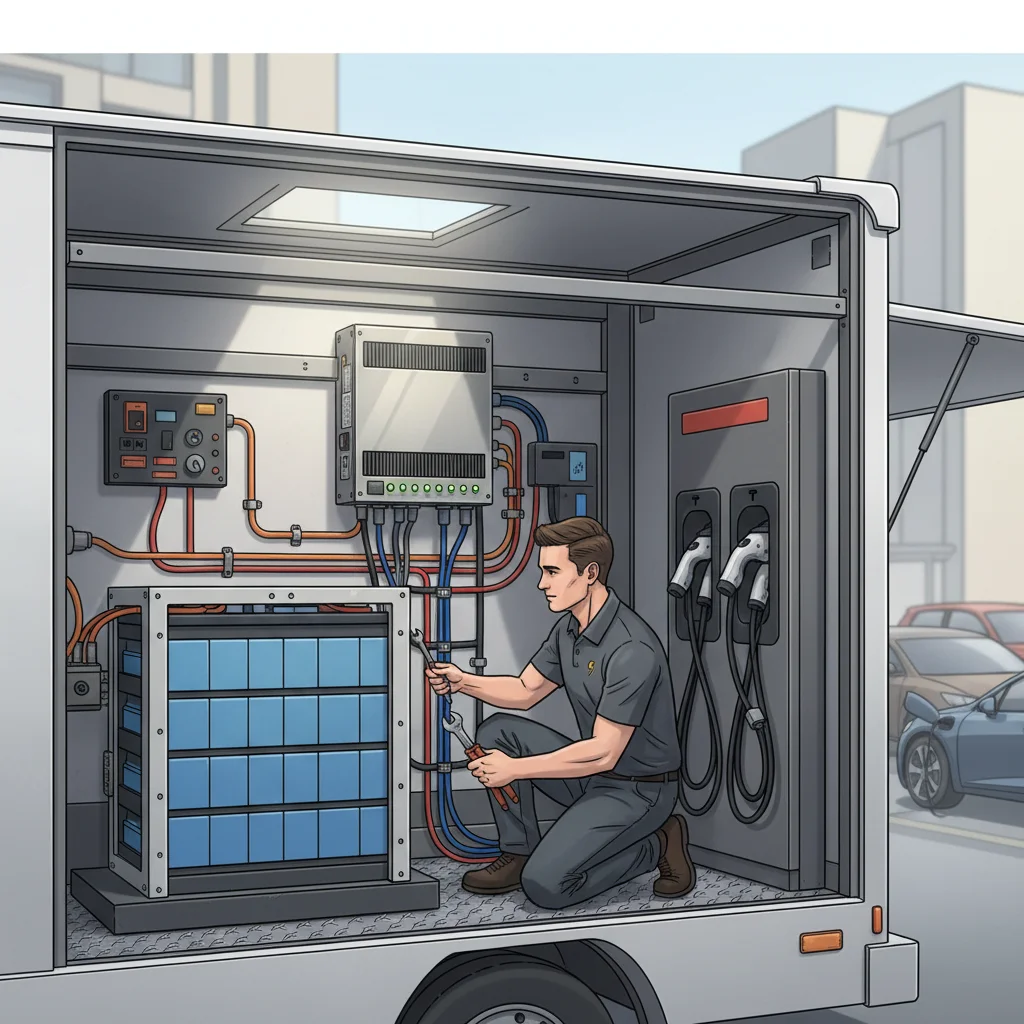
NACS is Tesla’s connector. Newer Ford, GM, and Rivian models use it too. Operators carry a native NACS cable. Most older non-Tesla cars use J1772 for AC charging. CCS1 adds DC pins for public fast stalls. This rescue is Level 2 AC. CCS or J1772 adapters cover those inlets. Tesla, Hyundai, Kia, Chevy, Ford, and Rivian all sit in Tampa Bay lots. One operator has to cover that mix.
Typical charging time is 15 to 30 minutes. Typical added range is about 10 to 20 miles. Efficiency moves with heat, speed, and AC. Treat that band as the working range, not a promise for every model. You use it to reach a DC stall or home. You don’t start a Lutz-to-Sarasota hop on the leftover.
Some units store energy in a battery bank and invert it to 240 volts. Some make that power with a generator on site. Charge Pro TPA doesn’t spec the hardware. Independent operators do. Ask what’s on the truck if noise matters on your street. A quiet block in Carrollwood isn’t the same workplace. Neither is a shoulder on I-75 near Wesley Chapel.
For the kit itself, read What a mobile EV rescue truck brings to your bumper. Level 1, Level 2, and DC are unpacked in EV charging levels, explained for a driver who’s already stranded.
Storms, salt water, and when you shouldn’t plug in
Hurricane Helene in late September 2024 drove record storm surge at Tampa Bay tidal gauges. St. Petersburg faced a forecast of 5 to 8 feet. Pinellas barrier islands from the Dunedin Causeway through Tierra Verde were closed. Hurricane Milton in early October 2024 largely spared Pinellas a second surge. It still dropped at least 18 inches of rain on parts of St. Petersburg. It also tore part of the roof off Tropicana Field. Ruskin, Apollo Beach, and Gibsonton sit in south Hillsborough evacuation zones.
Federal and fire-service guidance warns about salt-soaked EVs. A lithium-ion battery fire can start days later. Keep that car away from structures and other vehicles until it’s inspected. Don’t ask for a roadside charge into a flooded pack.
Vaisala’s National Lightning Detection Network repeatedly ranks Florida among the most lightning-dense states. Call this one of the most lightning-prone metros, not a fixed crown. If lightning is overhead, stay in the car.
How the referral actually runs
You call and say where you are. Name what you drive and a number that rings. A pin on the Courtney Campbell Causeway works. So does northbound Skyway or an I-4 ramp in Plant City. We connect you with an independent operator. They quote the job. They bill you. They own the truck.
We don’t promise when they’ll arrive. We don’t publish business hours. If they can’t take the work, you hear that before anyone rolls. When the pack is the problem, start with mobile EV charging. If you’re at true zero, use out-of-charge recovery. A Tesla that won’t wake may need Tesla roadside rescue or a 12-volt jump. The metro map starts at EV charging in Tampa Bay.
When you’re stuck, call (813) 536-4545. We’ll refer you to an independent operator who quotes before they plug in.