Two EVs sharing a Carrollwood driveway still can’t pass miles between them. The same limit holds in a Largo condo lot. Passenger Teslas and most commuter EVs don’t export traction-pack power. A few trucks and Hyundai or Kia models can, and they do it slowly. When that car is already empty, a mobile 240-volt charge is the practical fix.
Your second car isn’t a charger
A traction pack stores a lot of energy. Sliding some of it into a second EV sounds obvious. The pack is high-voltage DC. The empty car expects AC at the charge port, or a DC fast-charge handshake. You need an inverter, an outlet, and a cable the dead car will accept. Miss any piece, and the energy stays locked in.
Most dual-EV homes from Carrollwood through Citrus Park bought two commuter cars. Model 3s, Model Ys, Mach-Es. Those cars take power in. They don’t send it back out. Driveways along the Veterans Expressway look perfect for a neighbor-to-neighbor save. The hardware in those cars isn’t.
Carrollwood sits in Hillsborough, mostly on Tampa Electric. Largo sits in Pinellas, on Duke Energy Florida. TECO’s home EV pages cover installation guidance and an [email protected] contact. Duke publishes a Charger Prep Credit toward wiring upgrades. It also publishes an Off-Peak Charging Credit for home charging. Confirm both programs on the utility sites before you count on a credit. None of that lets one parked EV fill the other.
Westchase, Fish Hawk, and Lakewood Ranch hold some of the newest housing here. Census figures put pre-1980 stock at about 1.0 percent, 0.8 percent, and 0.7 percent there. 240-volt home charging is near-universal on those lots. Two new EVs in one of those garages still can’t share a pack. Not unless one of them is a truck with real outlets.
What charging another EV actually requires
Three things have to exist on the car that’s donating miles.
An inverter that can run in reverse at useful power. A physical outlet, or a V2L adapter on the charge port. A cable the empty car will take, NACS or CCS.
Every EV already makes some AC inside, for climate and the 12-volt system. Almost none of that power reaches a plug you can grab. If the manual never names V2L or Pro Power, assume the car can’t export.
Which local EVs can export, and which can’t
Trucks sold to job sites and campers are the exception. Commuter crossovers aren’t.
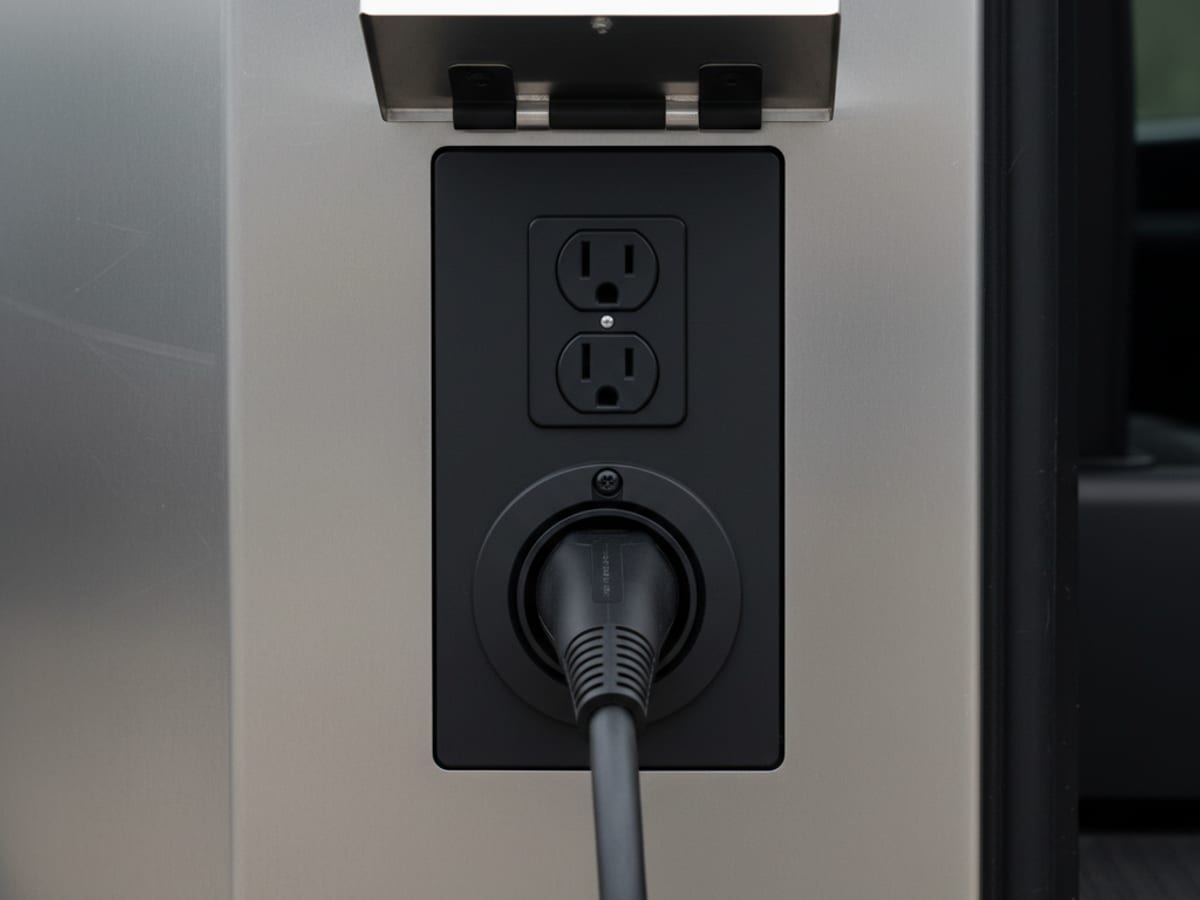
Ford’s F-150 Lightning can feed outlets in the bed and cab. Standard Pro Power Onboard is 2.4 kW. The extended setup is 9.6 kW at 240 volts. That’s enough to run a portable Level 2 charger into another EV. A sibling post covers whether a Lightning can charge another stranded EV.
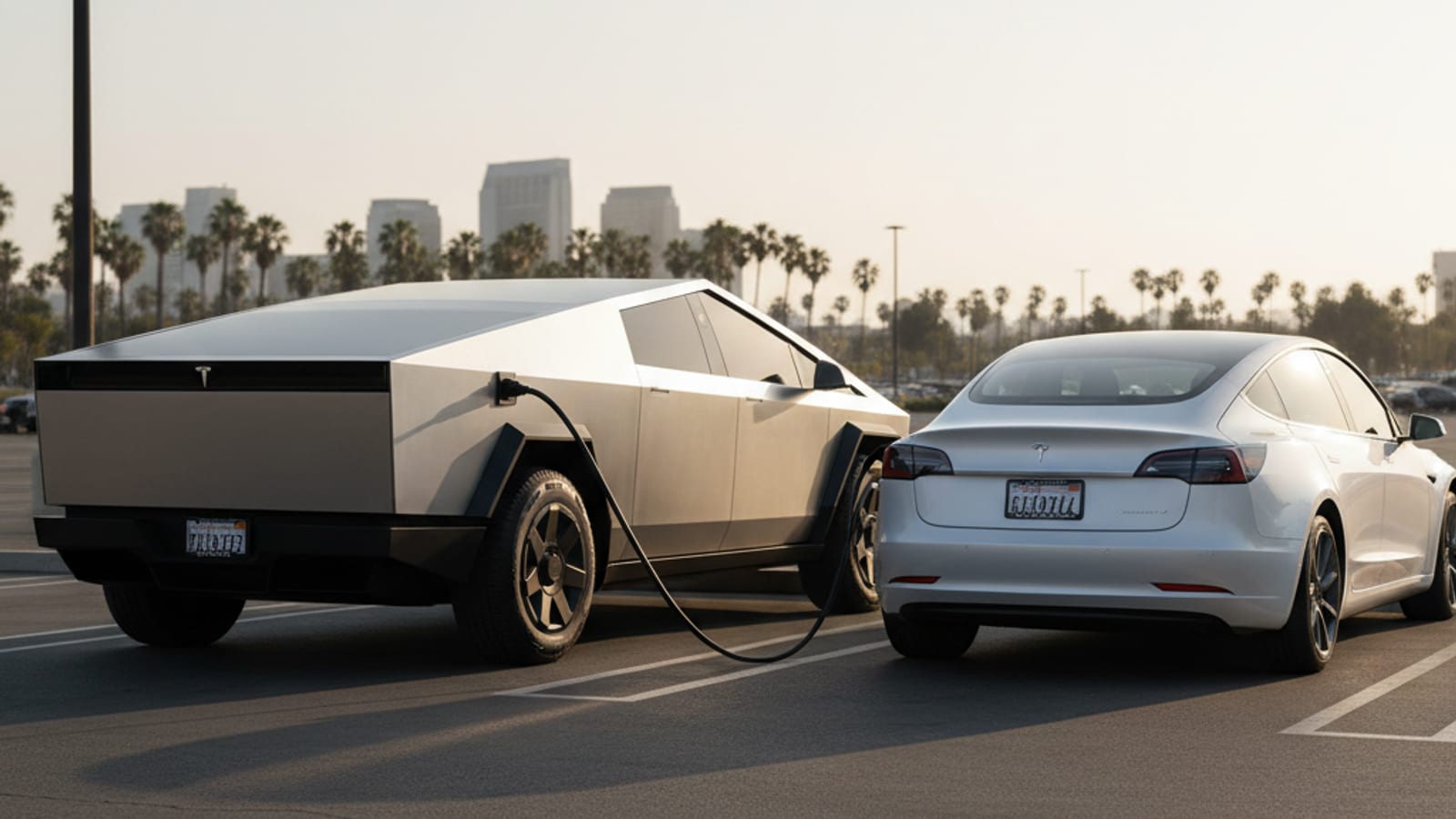
Tesla’s Cybertruck puts Pro Power in the bed and the frunk. The bed-wall outlet is a 240-volt NEMA 14-50. It’s rated up to 9.6 kW continuous. Hyundai’s Ioniq 5 uses a V2L adapter on the charge port. Kia’s EV6 and EV9 do the same, at about 3.6 kW. Chevrolet’s Silverado EV lists power takeoff around 10.2 kW. Rivian R1T and R1S with the Camp Package add 120-volt bed outlets around 1.4 kW. That’s coffee-maker power at a campsite. It’s not a range rescue.
Tesla Model 3, Y, S, and X don’t export. Lucid Air doesn’t export on current hardware. Mustang Mach-E and Polestar commuter models follow the same pattern.
Tesla has shown bidirectional charging in lab footage and investor events. The Teslas already parked from Carrollwood to Largo don’t ship that feature. The 12-volt pigtail at a Tesla tow eye can wake another 12-volt battery. It can’t charge a traction pack. That’s a separate question, covered in whether a Tesla can jump-start another car.
How slow a car-to-car transfer really is
Even when the donor car can export, the clock is the constraint.
A Lightning or Cybertruck at 9.6 kW adds about 30 miles per charging hour. A mobile Level 2 source at the bumper typically adds 10 to 20 miles in 15 to 30 minutes of charging. That’s bumper time with the cable in, never an arrival window. At 3.6 kW, an Ioniq 5 or EV6 is closer to 10 miles per hour. Rivian’s 120-volt outlets crawl at about 4 miles per hour.
A Supercharger is a different class of tool. Those stalls run 150 to 250 kW. That’s many times faster than any passenger EV can export today. Car-to-car charging is a bridge to a public stall. It’s not a fill-up.
Heat, and why the second pack still sits unused
Tampa Bay’s air-conditioning season runs from spring into late fall. Grade never gives range back here. The metro is flat and near sea level. Recurrent Auto’s published research finds an EV loses about 5 percent of range at 90°F. Above 95°F the loss is 20 to 30 percent. Near 100°F it’s roughly 17 to 18 percent, and it varies by model.
A dual-EV household can almost make it home to Carrollwood on a hot afternoon. The pack is often closer to empty than the morning display suggested. The second car in the driveway still can’t top it off.
Pinellas condo owners have a longer-term path, not a tonight path. Florida Statute 718.113(8) covers condo EV chargers. A unit owner can install one in their limited common element or exclusive space. A board can’t block a properly submitted request. The owner pays for install, metered power, maintenance, and insurance. That fixes the next overnight charge in a Largo garage. It doesn’t let the second EV donate miles after dinner.
What actually shows up when you need miles, not a jump
FDOT Road Rangers in District 7 patrol I-4, I-75, and I-275. Dial *347 from the shoulder. Published services include a 12-volt jump, fuel, and tire help. The Tampa Bay SunGuide Center runs that desk. Those materials don’t mention charging an EV.
A dead EV on a paved shoulder is a disabled vehicle under Florida Statute 316.194(2). That covers stopping off the travel lane when you can’t avoid it. It doesn’t put a traction-pack charger on the Ranger truck. Florida Highway Patrol Troop C covers disabled vehicles on the interstates. Florida 511 is the traffic feed. None of those replace 240 volts at the bumper.
Charge Pro TPA matches you with independent local operators. The brand owns no trucks, employs no technicians, and sets no prices. Operators in the network bring a 240-volt Level 2 source to the car. Native NACS for Teslas. CCS or J1772 adapters for everyone else. They quote before they start, and they bill you directly.
If the pack is empty, that’s out-of-charge recovery. If you still have a few miles, that’s mobile EV charging. For the hardware on the truck, see what a mobile EV charging truck actually does.
Leave the dryer-cord idea in the garage
High-power AC between two vehicles isn’t a weekend project. Ground bonding, cable rating, and the car’s onboard charger protections all matter. A dryer extension plus a store-bought Level 2 brick isn’t a properly rated setup. You can trip a GFCI, melt a connector, or get hurt. Let the operator who quotes the job carry the right cable.
Plan around the cars you already own
Ford already sells vehicle-to-home backup on the Lightning with a partner kit. Kia, Hyundai, and GM have shipped V2L or V2G hardware on select models. Tesla has demonstrated vehicle-to-home. Count on export only if the second vehicle is a truck. A V2L Hyundai or Kia you already own counts too. For every other pair, keep a mobile charge in the plan.
If you’re already sitting with an empty pack, call (813) 536-4545. An independent operator quotes the job before any cable goes in.