You’re already stranded on a Tampa Bay shoulder or a dead garage stall. EV charging levels only matter now as what can still reach the car. Level 1 is the slow 120-volt household trickle. Level 2 is 240-volt AC, and that’s the class a mobile rescue brings here. DC fast charging is a public stall, not a truck you can summon. Independent operators typically add 10 to 20 miles in 15 to 30 minutes of charging. That clock is charging time, never an arrival window.
The three levels a stranded driver actually meets
Most charging charts start in a quiet garage. A stranded driver should start with what can still move the car.
Level 1 uses 120-volt AC from a normal household receptacle. The Department of Energy treats it as the lowest charging class. It can refill a short commute on a known, dedicated circuit. It won’t refill a dead pack on I-275 while traffic rolls past. For the driveway version of this, read what a Level 1 charger is here. That page is about a house outlet, not a live lane.
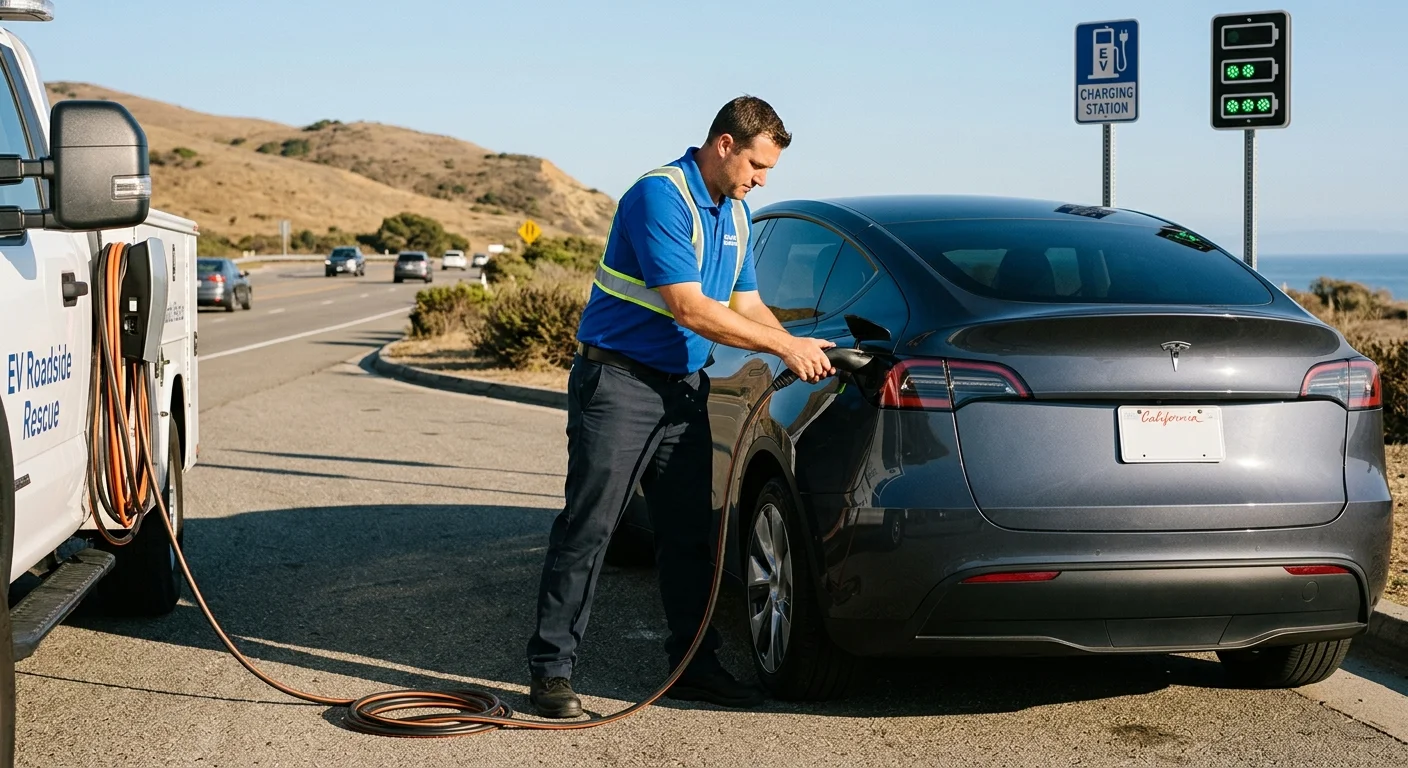
Level 2 uses 240-volt AC at a house. Many commercial panels run the same class at 208 volts. This is the class the pros we connect you with actually bring. They roll up with a Level 2 source and a native NACS plug. CCS or J1772 adapters cover non-Tesla EVs at the same session.
DC fast charging is the high-power public stall. Tesla Superchargers and CCS cabinets sit in this class. Power arrives as direct current, not household AC. Those cabinets stay bolted to a paved public lot. A roadside operator doesn’t drag one onto the Selmon REL.
The car still decides how much current it will accept. Heat, state of charge, and the onboard charger all cap the session. Tampa Bay’s long AC season makes that cap feel real. Recurrent Auto’s published research finds about 5 percent range loss near 90°F. Loss rises to 20 to 30 percent once it’s above 95°F.
Level 1 on the road is an outlet, not a rescue
A travel cord in the trunk doesn’t make a random receptacle safe. You still need a known circuit and a place you’re allowed to park.
That setup can fit a Pinellas condo lot after an install is already done. Florida Statute 718.113(8) covers a condo charging station in your exclusive space. The same right applies to a limited common element. A board can’t deny a properly submitted request. Many Pinellas and beach owners still live on public charging because that install never happened. A slow 120-volt cord isn’t the backup they hoped for.
Westchase, Fish Hawk, and Lakewood Ranch are newer master-planned tracts. Home 240-volt charging is near-universal in those streets. Lealman and St. Petersburg hold much older housing stock. More of those owners live on public charging or a 120-volt cord.
Home Level 2 is the daily fix, and the utility depends on where you live. TECO serves Tampa and most of Hillsborough County. It also reaches parts of Pinellas and southern Pasco. Duke Energy Florida covers Pinellas and much of Pasco. WREC serves northern and central Pasco except the Dade City area. A Pasco driver shouldn’t assume they’re on TECO. Confirm any current charger credit with the utility before you count on it.
What 240-volt Level 2 does at the bumper
Mobile EV charging is the roadside version of that same 240-volt class. The independent operator confirms the plug and the pack state. They also confirm whether the car will accept a charge. Then they quote you before they start, and they bill you directly. Charge Pro TPA doesn’t set that operator’s price.
The goal is usually enough miles to reach a public stall. Session results vary by vehicle, heat, and how empty the pack already is. There’s no single published number that fits every Tampa Bay stop.
Tell the operator the make, model, and what the dash says. Name the port if you know it: NACS, CCS, or J1772. Say whether the car is truly empty or just won’t wake. A dead 12-volt battery is a different job. The same operators can jump or replace that 12-volt on site. A traction pack at zero needs energy, not a jump.
See how a mobile EV charging truck works for the equipment at the bumper.
DC fast charging stays at the station
People call DC fast charging Level 3, but that name is informal. The hardware isn’t portable in any useful roadside sense. CCS, CHAdeMO, and NACS, also called J3400, all show up in this class. Your CCS or NACS port still has to match the cabinet.
If the pack is empty, you can’t drive to that cabinet. If the car won’t accept a charge, more power won’t fix the port.
Tampa International Airport is the local site you should know by name. The airport publishes free EV charging at on-airport garages and the cell phone lot. Level 1 J1772 sits on the Economy Garage first floor and in Long-Term Parking. Level 2 is at the Cell Phone Lot. Confirm the current layout on tampaairport.com before you count stalls. A car left for a week that won’t wake is usually the 12-volt. Our TPA charging note walks that garage scene.
Connectors still decide whether anything starts
Level names don’t prove the plug will fit. J1772 is the common AC connector on many non-Tesla cars. NACS, also called J3400, is native on Teslas and spreading. CCS adds DC pins on top of the AC inlet. CHAdeMO is another DC standard, still on some older cars.
Adapters exist, and support still varies by model year. Check the owner’s manual, then let the operator confirm against their leads. A familiar-looking port still isn’t a guarantee of a live session.
Give the operator a clear location, not a vague cross-street. A car on the Veterans Expressway isn’t the same call as a Westchase garage. A stall on the Selmon reversible lanes is worse. THEA’s REL is about 10 miles of elevated deck between Brandon and downtown Tampa. There’s no local surface shoulder on that segment. Lanes reverse through the day, and THEA clears every vehicle before the flip. If you die on the REL, stay with official instructions. Read out of charge on the Selmon REL before you guess at a missing shoulder.
I-275 across the bay sits in FDOT District 7. So do I-75 through Wesley Chapel and I-4 at the airport interchange. If you’re empty on I-275, start with this I-275 empty-pack note. The Sunshine Skyway is its own stranded-car problem. It’s about 4 miles of bridge with a 432-foot main span. FHP closes it in high wind or heavy fog.
What Road Rangers publish, and what they don’t
District 7 Road Rangers cover I-4, I-75, I-275, and the airport interchange. You reach them by dialing *347 on a mobile phone. Published help includes a jump-start, fuel, and a flat. They also offer two local calls and a move to a safer spot. The free state patrol carries fuel and can jump a 12-volt battery. Its published services don’t include charging an EV. Florida Highway Patrol Troop C covers disabled vehicles on those interstates.
Florida Statute 316.194 covers a disabled vehicle outside a city. If you can’t get off the pavement, that stop is a temporary exception. Don’t stand in traffic, and don’t drag cables across live lanes.
When charging is the wrong next step
The dash message matters more than the charging-level chart. An empty traction pack points to out-of-charge recovery. A car that won’t wake often needs the 12-volt first. The same is true if it won’t lock or take a charge. A port that won’t latch may need transport instead of a session. The independent operator evaluates access before they unroll a cable. A parking garage with a low ramp can rule out a charge. So can a blocked charge door or an elevated lane with no shoulder. The operator should say so before you authorize work.
Don’t invent a tow method from another model’s manual. Confirm the transport steps with the operator who’ll move the car.
Charge Pro TPA doesn’t own trucks, hold a trade license, or perform the charge. We match stranded drivers with independent local operators across Tampa Bay. The operator quotes the job, does the work, and bills you.
If you need a local operator on the line
If the pack is empty and reachable, a 240-volt Level 2 rescue may fit. If it isn’t, the operator can talk through recovery or a tow. Call (813) 536-4545 and we’ll connect you with a local EV rescue operator.