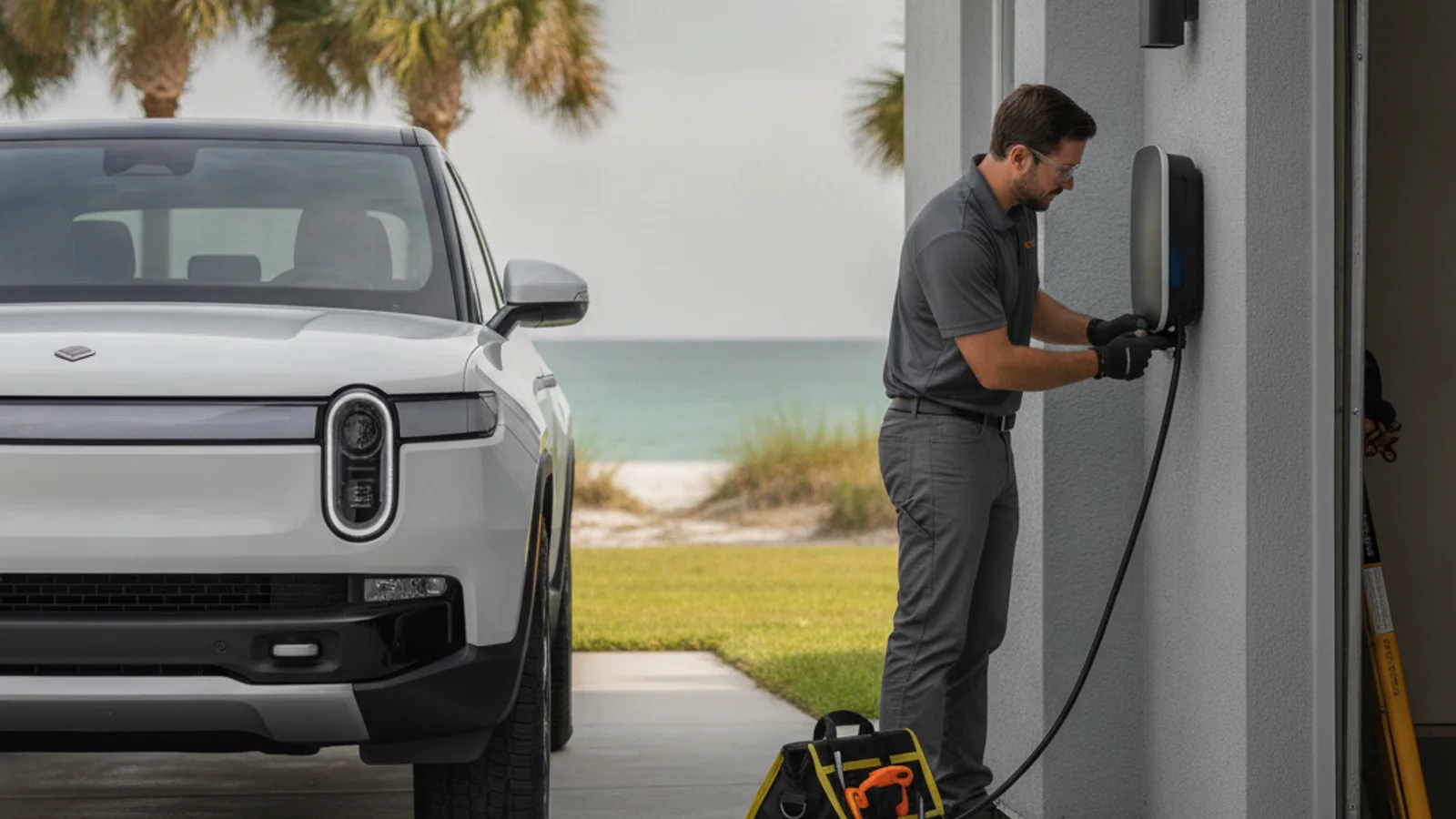
Bayonet Point is a coastal Pasco community between Hudson and New Port Richey along US-19. Most homes here predate 1990. Many streets have narrow lots and older electrical service. Drivers charge at home on a 120-volt outlet, which works for short daily trips but not much else. The pattern is the same one Recurrent Auto documents in the rest of Florida. Heat and short trips age the small 12-volt battery faster than the traction pack. A Bayonet Point driver who finds a black screen in the driveway usually needs a 12-volt jump, not a tow.
What the streets here look like for an EV
US-19 is the spine. Side streets feed back to the coast or to State Road 52. A car that lives here often does short hops to the grocery store, a beach access, or a doctor’s office. Each trip is under 30 minutes. The pack rarely cycles fully. The 12-volt, by contrast, never gets a long recovery window between trips. Heat adds the wear.
A driver who leaves a Mach-E or ID.4 in the driveway for a week and returns to a black cabin is seeing the 12-volt failure, not an empty pack. Heat in this part of Pasco runs well into the 90s from late spring through early fall. A garage without climate control keeps a small battery hot even overnight.
If a stall happens on US-19, the shoulder varies. North of the State Road 52 intersection, US-19 has wide shoulders in places. South toward New Port Richey, it narrows. Pull off where you can and put the hazards on.
Which utility and why that matters
WREC, the Withlacoochee River Electric Cooperative, serves central and northern Pasco. Duke Energy Florida serves much of Pinellas and parts of southern Pasco. The line between them cuts through streets that look the same on a map. For an EV driver, the utility is mostly a home-charger concern. For a stranded driver, the utility identity tells you which adapter set the operator brings. Most carry both NACS for Tesla and CCS or J1772 for everything else.
What a Bayonet Point rescue looks like
A local operator brings a 240-volt Level 2 source for an empty pack. Typical added range is 10 to 20 miles from 15 to 30 minutes of charging. That is charging time, not an arrival time. For a 12-volt no-start, the operator brings a lithium jump pack and clips the small battery directly. Lead-acid and lithium 12-volt batteries want different jump profiles, so model and year matter on the call.
For the longer view on coastal Pasco, see our US-19 stranded EV guide. For Holiday, which sits just north, the Holiday and coastal Pasco non-Tesla guide walks through cross-brand calls.
Why the referral line and not the brand hotline
Brand hotlines dispatch a contractor who may or may not know the local streets. A Pasco operator on the referral roster already knows the US-19 mile markers and which intersections have cell service. The line itself takes no fee. The operator quotes before work starts and bills the driver directly.
What to say on the call
State the model, year, and trim. Say whether the cabin is fully dark or if the screen still shows a range number. Say how long the car sat and where. If you are on US-19, share the nearest cross street. The operator uses that to bring the right gear and quote before work starts.
Charge Pro TPA is a referral line. It matches stranded drivers with independent local operators. It does not own trucks, employ crews, set prices, or promise an arrival time. The operator quotes you before starting work.
When to make the call
Call from a safe spot the moment the warning light comes on. Call from the driveway if the car will not wake. On US-19, pull off the travel lane first, then call. Stay with the car if it is safe to do so.
Charge Pro TPA connects Bayonet Point drivers with local operators. Call (813) 536-4545 and we will match you with an independent EV rescue operator who already works Pasco roads.