Your Ford F-150 Lightning sat through a hot Town ‘n’ Country afternoon. Now the truck won’t start. The fob is mute. The screens stay black. The Ford app still shows yesterday’s range. You don’t need a flatbed for that. You need the 12-volt battery revived so the truck can wake.
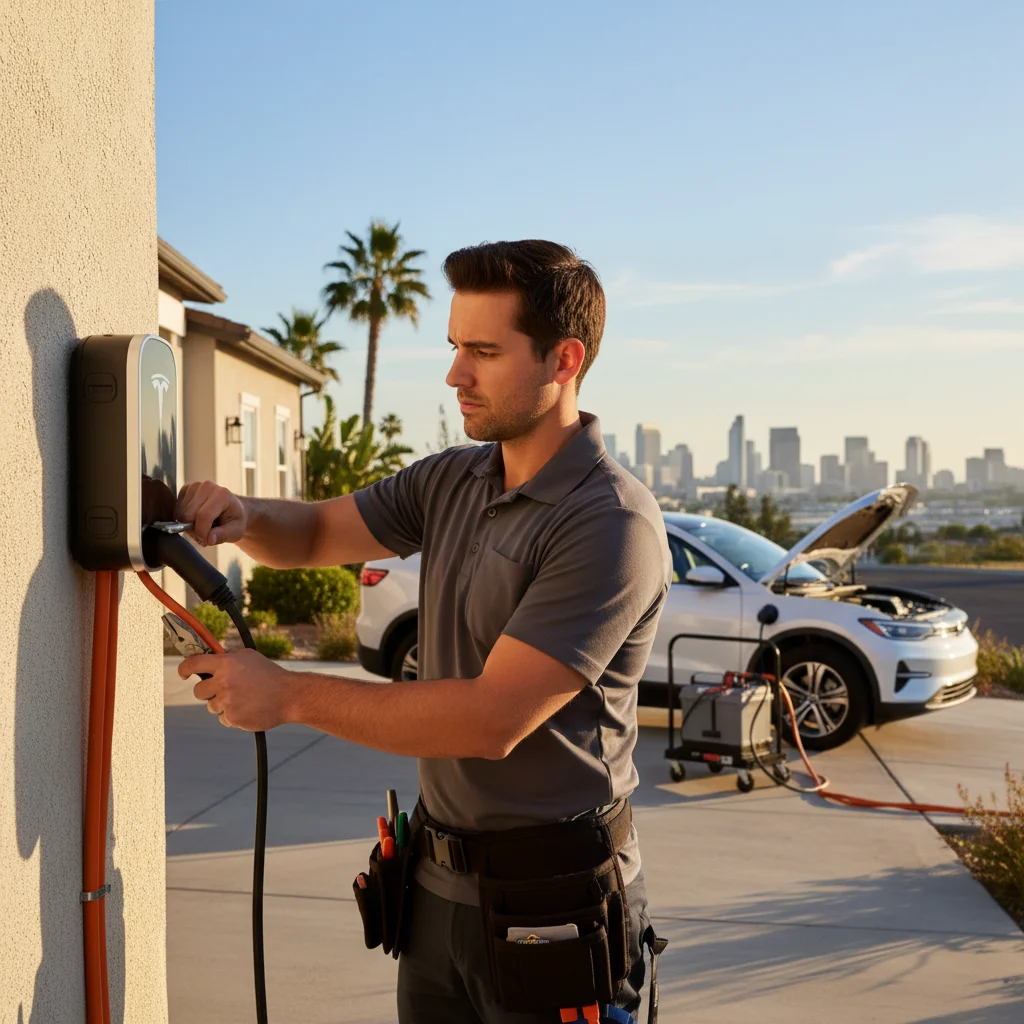
A dark truck can still hold a full pack
The Lightning runs on two batteries, not one. The traction pack under the bed moves the truck. The 12-volt is a small lead-acid battery. It’s the same idea as a gas F-150 starter battery. It powers computers, locks, lights, and pack contactors.
The truck can’t tap the big pack until that 12-volt is alive. When the small battery quits, the Lightning goes dark. The pack can still hold a long trip’s energy. You just can’t reach it from the cab. This is the usual Ford F-150 Lightning won’t start call in Tampa Bay.
Heat, sitting time, and where the truck slept
Tampa Bay cools cabins from spring into late fall. The metro is flat and near sea level. Heat and the AC compressor write the range story. Recurrent Auto finds about 5 percent range loss at 90°F. Loss climbs to 20 to 30 percent above 95°F. Near 100°F the loss is about 17 to 18 percent, and it varies by model.
That’s traction-pack range, not a 12-volt lab test. The small battery still lives in the same heat. Short hops from Carrollwood to a job never let it rest. A door left cracked in Citrus Park keeps modules awake. Coolers and onboard outlets can draw current while the truck looks off.
A Lightning left for a week at Tampa International Airport can come back dark. TPA publishes free EV charging in on-airport garages and the cell phone lot. A week-long sit that returns a dead truck is almost always the 12-volt. It’s not a depleted pack.
Newer streets in Westchase, Fish Hawk, and Lakewood Ranch usually have 240-volt home charging. A Lightning on a Level 2 plug can still die on a tired 12-volt. The wall unit can’t wake a truck that won’t close its contactors. St. Petersburg has 51.5 percent of homes built before 1980. Lealman sits at 56.6 percent. Many of those streets never planned a 240-volt circuit. The 12-volt still fails first when the truck sits dark.
TECO serves Tampa, most of Hillsborough, and parts of Pinellas and southern Pasco. Duke Energy Florida serves Pinellas and much of Pasco. North and central Pasco is often Withlacoochee River Electric Cooperative. None of those utilities jump a dead Lightning. Read our Tampa Bay EV battery care notes for the climate side.
Signs it’s the 12-volt, not the pack
Watch the cabin, not the range bubble.
- The fob and phone app won’t unlock or wake the truck.
- The center screen and cluster stay black, or they flash once and die.
- The power frunk won’t pop, because the latch needs 12-volt current.
- Cabin lights are dim or gone. Relays click. There’s no ready chime.
- A plugged-in charge session never starts. The truck can’t initialize.
An empty traction pack looks different. Screens usually come up. You get a low-range warning or limp power. You may not be allowed to shift into Drive. If the truck lights up and still won’t roll, split the diagnosis. Start with what happens when an EV 12-volt dies.
A dead 12-volt also explains a Lightning that “won’t charge” at a public stall. The cable can click in. The session never begins. The pack was never the bottleneck.
Stay put, stay legal, skip the wrecker if you can
Florida Statute 316.194 covers stopping outside a city on the highway. Get off the paved travel lane when you can. Subsection (2) treats a disabled vehicle as an exception when you can’t. A dark Lightning on a shoulder is a disabled vehicle under that rule. Put on hazards.
On I-4, I-75, and I-275, District 7 Road Rangers patrol for disabled vehicles. Dial *347 from a mobile phone. The Tampa Bay SunGuide Center runs that desk. Published help includes a 12-volt jump, a tire, fuel, and water. They can make two local calls and move a disabled vehicle. Their materials don’t list charging an EV. Ask for the jump if the 12-volt is the issue. Don’t expect a mobile charge from that patrol. Florida Highway Patrol Troop C covers these interstates.
The Selmon Reversible Express Lanes are a special case. THEA runs that elevated median between Brandon and downtown Tampa. Westbound into downtown runs from about 5 a.m. to noon. Then the lanes turn eastbound. Crews clear every vehicle before a reversal. There’s no local surface shoulder on the elevated segment. If the Lightning dies on the REL, stay in the truck with hazards on. Don’t walk the structure.
The Sunshine Skyway is worse if you stall on the span. It’s about 4 miles of bridge with no place to stop. FHP closes it at sustained 40 mph winds. Fog below about 100 feet can close it too.
Private lots follow Florida Statute 715.07. A posted tow-away can remove an unauthorized truck. Hillsborough and Pinellas cap non-consent tow rates at the county level. Current dollar caps were not confirmed against the live schedule. Read why towing a dead EV is the last resort before you wave down a wrecker.
Opening the frunk when the truck is dark
Ford put the 12-volt and the jump points in the front trunk. That’s a problem when the truck is dark. The powered frunk latch won’t release without 12-volt current.
The Lightning has a manual frunk release for this. It’s a mechanical pull, a tab, or a cable, depending on year. Check the owner’s manual for your build before you tug random panels. Once the lid is up, look for dedicated jump terminals. Don’t clamp the battery posts if Ford marked separate studs. The positive post sits under a red cap. The negative is a nearby ground stud or body bracket.
You’re only waking the 12-volt system. Never clip onto orange high-voltage cables. If the labels are unclear, stop. Jump-start steps for an EV cover clamp order and the usual mistakes. A gas-truck jump pack still works on these terminals. Keep sparks off the battery box.
When the pack is actually empty
Sometimes the Lightning really is at zero. A jump won’t put miles in the traction pack. The truck needs energy. Then it needs a path to a CCS stall or a home plug.
Charge Pro TPA is a referral line. It matches you with an independent mobile operator. The brand doesn’t own trucks, employ techs, or set a price. The operator quotes you before work starts and bills you directly. The pros we connect you with are licensed and insured.
For a Lightning, the operator brings a 240-volt Level 2 source. They use a CCS or J1772 adapter on a non-Tesla. You typically gain 10 to 20 miles. That’s in 15 to 30 minutes of charging. That’s charge time on the bumper, not an arrival window. That bump is often enough to reach a public CCS stall or your driveway. For charge-time context, see how long an F-150 Lightning takes to charge here.
Don’t wait on a Tesla Supercharger for this truck. The Lightning takes CCS. Pick a CCS stall once you have the miles to roll. If the pack is empty, out-of-charge recovery is the service page to open.
Operators can also jump a weak 12-volt. They can replace it on site when the battery won’t hold. They don’t install home chargers. A licensed electrician handles panel work. Non-Tesla EV rescue is the call when the truck is a Lightning.
Where these trucks actually sit dead
Work trucks live on the I-4 edge through Plant City. They also run I-75 through Wesley Chapel, Valrico, and south Hillsborough. Pinellas owners leave them in St. Petersburg and Clearwater lots, then fly out of TPA. Pasco owners run the Suncoast Parkway, a long, fast run north with widely spaced exits. A dark truck can sit far from home.
Hurricane Helene in late September 2024 drove record storm surge at Tampa Bay gauges. Pinellas barrier islands from the Dunedin Causeway through Tierra Verde were closed. Hurricane Milton in early October 2024 dropped at least 18 inches of rain on parts of St. Petersburg. A truck that sat through those outages can wake with a dead 12-volt. If the truck took salt water, get it inspected first. Follow federal and fire-service guidance before you jump it.
What happens after you call
You describe the truck. A dark cabin with a healthy range reading points to 12-volt. A lit dash with zero miles points to the pack. If the 12-volt is only discharged, the operator jumps the Ford terminals. Once the truck wakes, the DC-DC converter can recharge that small battery from the pack. If the battery won’t hold, they can replace it on site. If the pack is empty, they connect Level 2 and add those 10 to 20 miles. Charge Pro TPA doesn’t set the price. The operator quotes you before they start. We serve Tampa Bay.
If the Lightning won’t start, call (813) 536-4545. You’ll get matched with a local operator. They quote before they touch the truck.
Frequently asked questions
Why won’t my Ford F-150 Lightning start with a full charge?
The full number lives in the traction pack. The truck still needs a healthy 12-volt to boot. If that small battery is down, computers stay off. Contactors stay open. A jump on the frunk terminals usually brings the truck back.
How do I open the Lightning frunk with no power?
The powered latch needs 12-volt current. Ford put a manual release in the truck for a dead 12-volt. It’s a pull, tab, or cable, and the spot changes by year. Use the manual. Then use the marked jump posts, not the orange cables.
Can I jump a Ford Lightning the way I jump a gas F-150?
You can jump the 12-volt the same way. You can’t jump the high-voltage pack. Use the red-capped positive post and the ground point in the frunk. A 12-volt jump pack or a running donor car is enough. If you can’t find the posts, wait for the operator.