A Ford F-150 Lightning’s charge time isn’t one number in Tampa Bay. On home Level 2, a full fill commonly runs about 6 to 10 hours. Ford lists about 41 minutes from 15 to 80 percent on Extended Range. Heat is what changes those windows here. The metro’s air-conditioning season runs from spring into late fall. Recurrent Auto finds an EV loses about 5 percent of range at 90°F. Above 95°F, Recurrent Auto finds 20 to 30 percent range loss. Near 100°F, the loss sits around 17 to 18 percent. You burn more of the pack on ordinary errands. The same wall charger then has more energy to put back.
Heat is why a Lightning’s overnight window gets tighter
Tampa Bay sits flat and near sea level. A grade never hands range back on the drive home. Heat and cabin AC do the whole job of eating miles. That bite is sharper on a truck this heavy than on a small EV. A February commute can land you lower on the pack by August. The overnight session then has farther to go.
Westchase, Fish Hawk, and Lakewood Ranch are mostly new housing. In that stock, 240-volt home charging is near-universal. About 56.6 percent of Lealman’s homes were built before 1980. About 51.5 percent of St. Petersburg’s stock is that old too. A 240-volt circuit isn’t a given in those houses. A 120-volt outlet isn’t a daily plan for this pack. See what a Level 1 charger does here.
Pinellas condo and HOA owners often can’t put a charger in an open driveway. Florida Statute 718.113(8) lets a unit owner install a charger in their designated space. The owner still pays for installation, metered power, and upkeep. Until that station exists, overnight charging is a public Level 2 or DC stall.
Highway miles make the same point. A run on I-75, I-275, or the Suncoast Parkway keeps the cabin cold. The Veterans Expressway does the same for Westchase and Town ‘n’ Country commuters. You don’t get a downhill gift on the way in. You arrive warmer, with less buffer, and you plug in sooner.
Two battery packs, two different home clocks
Ford sells the Lightning with two batteries, and they don’t fill on the same clock. The Standard Range pack is about 98 kWh total, with roughly 89.5 kWh usable. The Extended Range pack is about 131 kWh total, with roughly 120 kWh usable. The bigger pack takes more hours on Level 2.
Ford’s Charge Station Pro, on a dedicated 80-amp circuit, is the spec-sheet home setup. From empty, Standard Range often fills in about 6 to 8 hours. Extended Range often needs about 8 to 10 hours. A 48-amp wall unit can stretch a full charge toward 12 to 14 hours. They still feel the extra hours when heat has already pulled the pack down.
If the panel can’t feed 240 volts yet, that’s a wiring job. It isn’t a truck setting. A licensed electrician should confirm capacity before anyone picks a wall unit. Our panel-upgrade guide for Tampa Bay homes walks through that path. Charge Pro TPA doesn’t do installs. We connect stranded drivers with independent operators when the truck is already stuck.
Your utility shapes when those hours land
TECO serves the City of Tampa and most of Hillsborough County. It also serves parts of Pinellas and southern Pasco. Its home EV pages point owners to charging and installation guidance. A named residential home-charger rebate amount wasn’t on the primary pages we checked. Confirm any current offer with TECO before you plan around it. TECO’s Drive Smart program is a commercial and public charger incentive.
Duke Energy Florida serves Pinellas County and much of Pasco. It publishes a Charger Prep Credit toward Level 2 wiring. That credit doesn’t cover the charger hardware or permit fees. It also publishes an Off-Peak Charging Credit. Duke’s 2025 weekday off-peak windows were 10 a.m. to 6 p.m. A second window ran 11 p.m. to 5 a.m. Weekends and holidays counted as off-peak all day. Confirm current windows on Duke’s page before you shift overnight charging.
A driver in north or central Pasco is often a Withlacoochee River Electric Cooperative member. Don’t call TECO or Duke for a WREC house.
Shifting a Lightning onto off-peak hours doesn’t change physics. It can change when those 8 to 10 hours sit on the clock. In a long AC season, that overnight window is already the whole recovery plan.
DC fast charging when the pack is already hot
Ford lists about 41 minutes from 15 to 80 percent on Extended Range. Standard Range is about 44 minutes. That’s on a stall that can feed the truck its rated power. Those figures assume a mild pack temperature and a stall that’s actually delivering. Heat, not winter cold, is the usual variable here.
A hot pack still follows the same curve as nearly every other EV. Power comes in fastest through the middle of the session. That’s why a trip stop is more efficient if you leave around 80 percent. The last 20 percent can take nearly as long as everything before it. Towing or a loaded bed can leave the pack warmer still.
A busy public stall can also run below its rated output. Your session then misses the spec sheet even if the truck is ready. Tampa International Airport publishes free EV charging in on-airport garages and the cell phone lot. Level 2 is at the cell phone lot. A Lightning left for a week that won’t wake is often a 12-volt failure.
Storm weeks, surge, and a wall charger that goes dark
Hurricane Helene in late September 2024 drove record storm surge at Tampa Bay tidal gauges. Hurricane Milton followed in early October 2024. Parts of St. Petersburg saw at least 18 inches of rain. If the house is dark, the wall charger is dark. A Level 2 time estimate doesn’t help until power is back. Ruskin, Apollo Beach, and Gibsonton sit in low-lying south Hillsborough. An evacuation at low charge is a real local scenario. Get to a safer inland plug while you still have range.
Federal and fire-service guidance warns that an EV soaked in salt water needs inspection. Keep it away from structures and other vehicles until that’s done. Don’t guess at a distance or a wait time from this page.
When the clock isn’t the problem
If the Lightning isn’t charging at all, you’re not in a slow-session problem. A truck that refuses a plug is often the 12-volt battery. Start with what to check when a Ford F-150 Lightning won’t start. Don’t assume the big pack is empty. We cover it in can an F-150 Lightning charge another EV. Our guide to Tampa Bay heat and salt air on EV batteries covers pack wear.
Out of range on a Tampa Bay road
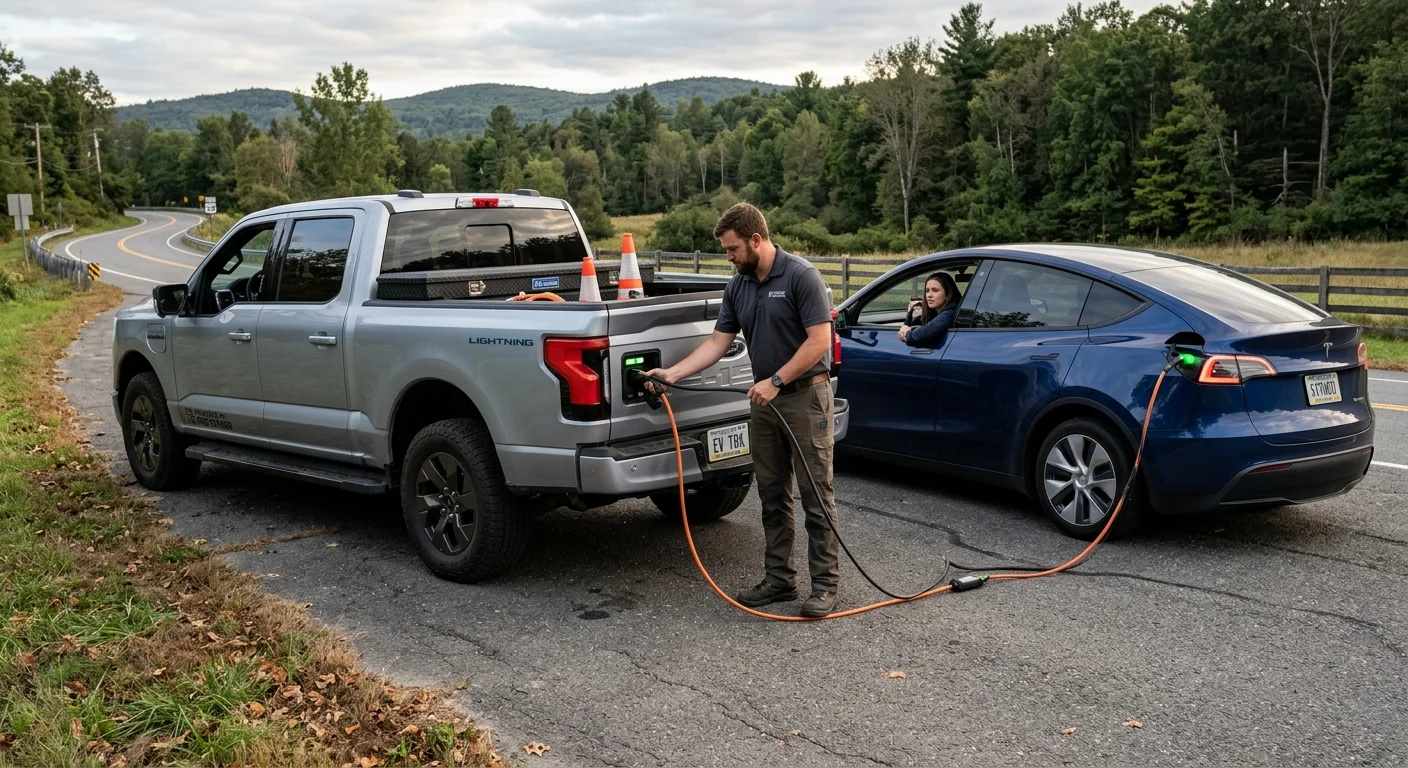
If the truck can’t reach a station, Charge Pro TPA is a referral line. We match stranded EV drivers with independent local mobile rescue operators. We don’t own trucks or employ technicians. We don’t set prices or arrival times. The operator quotes you before starting and bills you directly. The pros we connect you with are licensed and insured. They can bring a 240-volt Level 2 source to the bumper. That typically adds 10 to 20 miles of range in 15 to 30 minutes. That’s charging time, not a promise of when someone shows up. They also jump or replace a dead 12-volt battery on site.
Use the mobile EV charging line or the non-Tesla EV rescue line. We serve every city in Tampa Bay. Florida Statute 316.194 covers a disabled vehicle on the pavement. FDOT Road Rangers in District 7 patrol I-4, I-75, and I-275. Dial *347 for Road Rangers. Published services include jump-starts, fuel, and tire help. The materials we reviewed don’t list EV charging. The Selmon reversible lanes run between Brandon and downtown Tampa. The elevated segment has no local surface shoulder. Get to a safe spot if you can, then call.
If you’re stranded and the truck won’t take a charge, call (813) 536-4545. We’ll connect you with a local independent operator who can look at the vehicle.
Frequently asked questions
How long does a Ford Lightning take to charge at home here?
On Ford’s Charge Station Pro, Standard Range often needs 6 to 8 hours from empty. Extended Range often needs about 8 to 10 hours. Tampa Bay heat and AC often mean you start that session lower. The same charger then runs longer than a mild-weather spec sheet.
How fast does a Ford Lightning charge on DC fast charging?
Ford’s published specs list about 41 minutes from 15 to 80 percent for Extended Range. Standard Range is about 44 minutes on a charger that can match the truck. Real sessions often run longer when the pack is hot.
Does the bigger Lightning battery take longer to charge?
On Level 2, yes. There’s more energy to replace. On DC fast charging, the Extended Range pack also accepts a higher peak rate. The 15-to-80 times stay close even though the pack is larger.