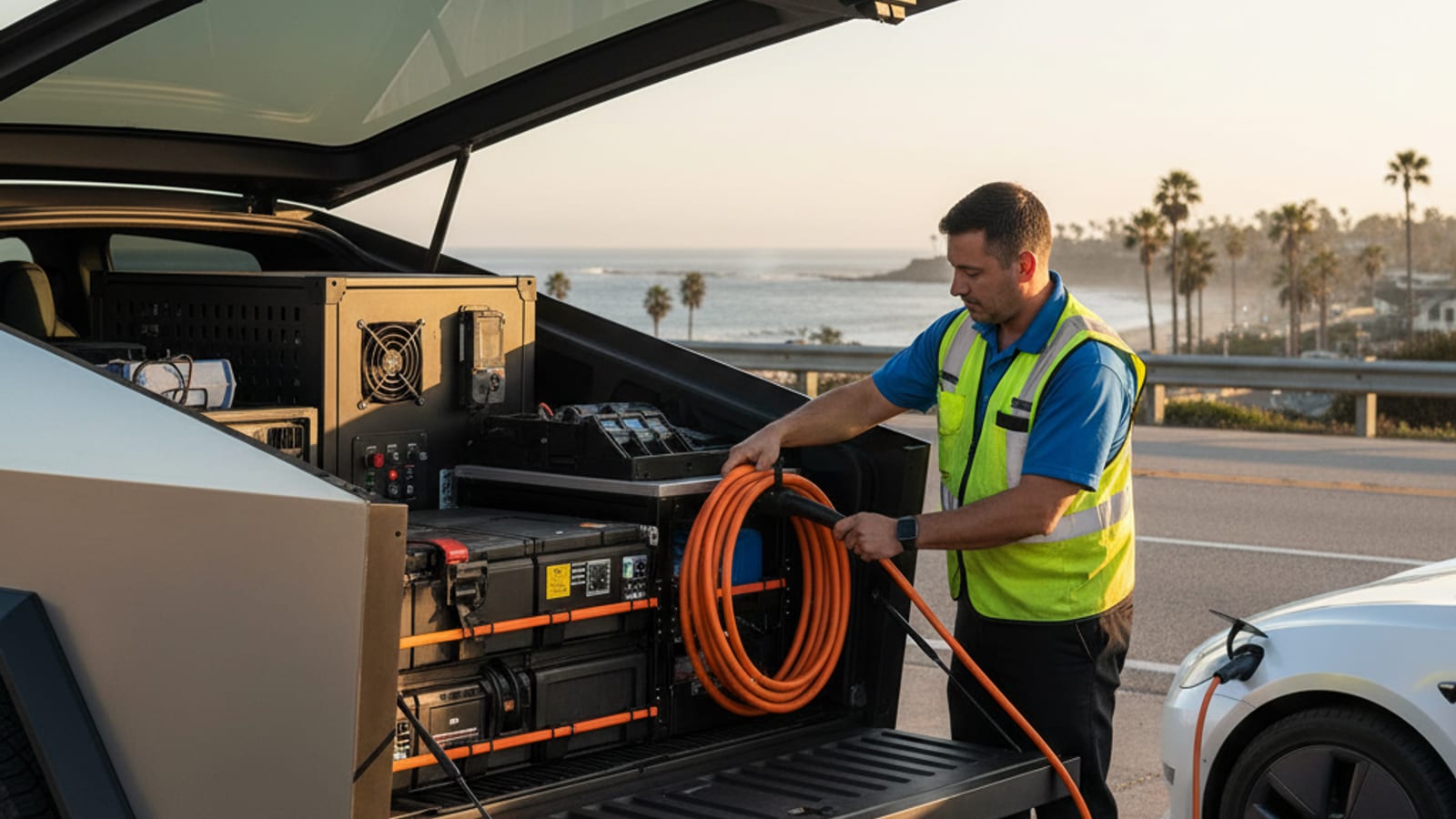
A mobile EV charger truck brings a 240-volt Level 2 source straight to your bumper. Independent local operators roll that power with a native NACS plug and CCS or J1772 adapters. Tesla and every major EV brand can take a charge without waiting on a wrecker. You get enough range to leave the shoulder, not a full pack.
Charge Pro TPA is a referral line for Tampa Bay. We match stranded EV drivers with independent mobile rescue operators. We don’t own the trucks. We don’t employ the technicians. We don’t set prices or promise an arrival window. The operator quotes you before any cable goes in, then bills you directly.
What’s actually sitting in the bed
People still picture a tow truck with a winch. That’s the wrong mental model. This vehicle exists to deliver electricity. The useful gear lives in the bed, at the bumper, and in a 12-volt kit on the side.
A 240-volt Level 2 source
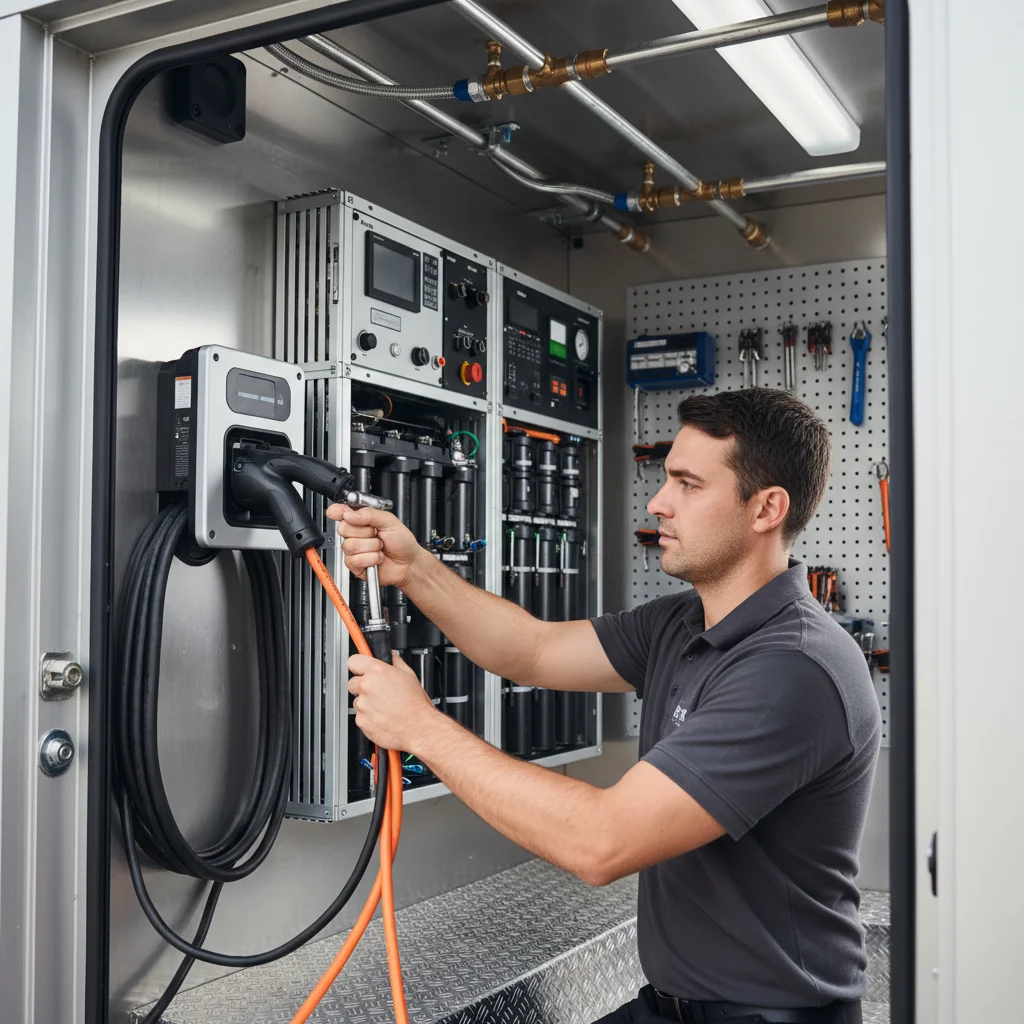
Operators in this network carry a 240-volt Level 2 source. That’s the same voltage class as a strong home charger. It’s not a 120-volt household outlet on a long cord. Level 1 trickle charging is too slow for a live shoulder. A roadside Level 2 session typically adds 10 to 20 miles of range in 15 to 30 minutes of charging. Treat that figure as charging time only. It isn’t a promise about when help shows up.
If the levels still blur together, read EV charging levels, explained for a driver who’s already stranded.
Native NACS, plus CCS or J1772
Tesla ports take a native NACS plug. Most other EVs take CCS or J1772 through an adapter the operator brings. The person on scene should confirm your port before they uncoil the cable. A Model Y in Tampa, an ID.4 in St. Petersburg, and a Rivian in Wesley Chapel don’t share one plug. The truck is supposed to cover that mix. For a car that isn’t a Tesla, start at non-Tesla EV rescue.
The 12-volt kit next to the charger
A lot of “dead EV” calls aren’t an empty pack. The small 12-volt battery runs the computers, locks, and high-voltage contactors. When that battery sags in Tampa Bay heat, the car looks bricked even with miles left. Operators also jump or replace a dead 12-volt on site. If the dash never wakes and the handles won’t pop, that’s often the 12-volt, not the pack. Tesla owners can start on our Tesla 12-volt battery jump page.
How a bumper charge actually runs
The search is “mobile ev charger truck,” but the stop is a sequence. It starts with a call, not with a cable.
You share your location, the car’s make, and whether the dash is alive. That last detail matters. A silent Tesla in a Tampa garage and an empty pack on I-75 are different jobs. We pass the call to an independent operator. That operator quotes the work before they start. If you don’t like the quote, you don’t have to proceed.
On scene they park with lights, set cones if the shoulder allows it, and check the charge port. Then they plug in and let Level 2 do its work. You’re watching a charge session, not a tow. When the car has enough range to move, they unplug and you drive to a charger you can sit at. The mobile EV charging page is the service that matches this stop.
Where this truck earns its keep around Tampa Bay
Tampa Bay isn’t one commute. Coastal Pinellas, the Hillsborough core, East County, and the Pasco growth belt all strand cars in different ways. The truck doesn’t care which county you’re in. The road does.
Interstates the patrol already knows
FDOT Road Rangers in District 7 cover I-4, I-75, and I-275, plus the airport interchange. You reach them by dialing *347. They can jump a 12-volt battery, handle a flat, bring fuel, and move a disabled vehicle to a safer spot. The published service list does not include charging an EV. Florida Highway Patrol Troop C covers disabled vehicles on those same interstates. Florida 511 is the state’s traffic feed.
Florida Statute 316.194 generally bars stopping on the paved travel lane outside a municipality when you can get off the roadway. Subsection (2) exempts a vehicle that’s disabled and can’t be moved. A dead EV on a shoulder is a disabled vehicle under that exemption. Hazard lights on. Stay out of the travel lane.
The Selmon reversible lanes
The Lee Roy Selmon Expressway is all-electronic, SunPass or toll-by-plate. Its Reversible Express Lanes run about 10 miles on an elevated bridge between Brandon and downtown Tampa. They run westbound into downtown from about 5 a.m. to noon, then reverse eastbound. The Tampa Hillsborough Expressway Authority clears every vehicle before each reversal. There’s no local surface shoulder on the elevated segment. If the pack hits zero up there, you’re not pulling onto a grass strip. You’re occupying a reversible lane that has to empty on a clock. That’s a Selmon REL out-of-charge problem. A mobile charge is often the way off without a wrecker blocking the span.
Skyway, Veterans, and the Suncoast
The Sunshine Skyway on I-275 is a four-mile bridge. The main span sits 432 feet over the shipping channel. FHP closes it when sustained winds hit 40 mph, or when fog cuts visibility below about 100 feet. High-profile vehicles often get an advisory around 20 mph gusts. A bumper charge on the approaches beats a dead car on that span.
The Veterans Expressway and the Suncoast Parkway are Florida’s Turnpike Enterprise roads with all-electronic tolling. The Suncoast is a long, fast run north through Pasco with widely spaced exits. Land O’ Lakes and Wesley Chapel drivers feel that spacing on a low pack. I-75 through Wesley Chapel and south Hillsborough is the other long pull. I-275 stitches Tampa to Pinellas. SR-60 carries East Hillsborough. US-19 runs the Pasco and Pinellas coast.
Airport garages and a car that sat too long
Tampa International Airport publishes free EV charging at all on-airport parking garages and the cell phone lot. Level 1 J1772 sits in the Economy Garage on the first floor and in Long-Term Parking. Level 2 is at the Cell Phone Lot. SkyConnect ties the main terminal to the Economy Garage and the Rental Car Center. An EV left for a week that comes back dead is almost always a 12-volt failure, not a depleted pack. The garage charger didn’t fail you. The small battery did. That’s still a bumper job, just a jump instead of a charge.
Heat, storms, and why the pack drains faster here
Tampa Bay sits flat and near sea level. Grade never gives range back. Heat and air conditioning are the whole story. Recurrent Auto’s published research finds an EV loses only about 5 percent of range at 90°F. Loss climbs to 20 to 30 percent above 95°F, with roughly 17 to 18 percent near 100°F. The effect varies by model. That’s Recurrent Auto, not a Tesla spec sheet.
The air-conditioning season here runs from spring into late fall. A commute that worked in January can come up short in August with the cabin on high.
Lightning is part of the climate, not a freak event. Vaisala’s National Lightning Detection Network repeatedly ranks Florida among the most lightning-dense states. Bay News 9 reporting on Vaisala data put Florida around 285 lightning events per square mile in 2022. The Four Corners stretch on the Tampa-Orlando I-4 corridor was among the densest in the country that year. Tampa Bay is one of the most lightning-prone metros in the country. A strike on a charger or a lot can scramble a trip. You may need power brought to the car.
Hurricane Helene in late September 2024 drove record storm surge at Tampa Bay gauges. Pinellas barrier islands from the Dunedin Causeway through Tierra Verde were closed. Hurricane Milton in early October 2024 dropped at least 18 inches of rain on parts of St. Petersburg. It also tore part of the roof off Tropicana Field. Low-lying Pinellas, the barrier islands, and south Hillsborough places like Ruskin, Apollo Beach, and Gibsonton sit in evacuation zones. Federal and fire-service guidance warns that an EV soaked in salt water can suffer a lithium-ion battery fire later. Keep that car away from structures and other vehicles until it’s inspected. A mobile charge isn’t the right call on a flooded pack.
Charge in place, or wait on a wrecker
Towing a dead EV is a last resort for a reason. Many cars need a flatbed. Some won’t go into Neutral without 12-volt power. Private-property tows in Florida follow Statute 715.07. Hillsborough and Pinellas both cap non-consent tow rates. Hillsborough does it through the Tax Collector’s vehicle-for-hire authority. Pinellas does it by ordinance. Confirm the live schedule with the county before you argue a bill. A consented roadside charge is a different product. You’re paying an operator to add miles, not to take the car.
When the pack is empty and the car can still accept a charge, stay put if you’re safe. Compare that choice in when you need a mobile EV charge, and when you need a tow. A suitcase Level 1 charger in the frunk is not the same tool. Those units sip from 120 volts. They’re built for an overnight trickle on a household outlet, not for a shoulder. They won’t match a truck-mounted 240-volt source.
Older condos, new subdivisions, and who has 240 at home
Housing age shapes how often this truck gets called. Census figures put some of the oldest stock in Lealman and St. Petersburg, where more than half the homes were built before 1980. The newest master-planned growth is in Lakewood Ranch, Fish Hawk, and Westchase, where 240-volt home charging is near-universal. Florida Statute 718.113(8) gives a condominium unit owner the right to install an EV charging station in their limited common element or exclusive parking space. The board can’t deny a properly submitted request. The owner still pays for install, power, and insurance.
Utilities split the metro. Tampa Electric serves the City of Tampa, most of Hillsborough, and parts of Pinellas and southern Pasco. Duke Energy Florida serves Pinellas and much of Pasco. Withlacoochee River Electric Cooperative serves northern and central Pasco except the Dade City area. A driver in Holiday or Bayonet Point is often a WREC member. Duke publishes a Charger Prep Credit and an Off-Peak Charging Credit. TECO publishes Drive Smart for commercial and public sites. None of those programs is a roadside truck. Home 240 still fails in a storm. That’s when the bumper source matters.
Safety on the shoulder, then you drive away
High-voltage cables need a trained operator. You stay clear of the charge port while it’s live. You don’t stand in the travel lane to watch the screen. On I-75 or I-275, keep passengers behind a barrier if one exists. The operator manages traffic around their vehicle. You’re responsible for your people.
After the session, you should have a short, boring drive to a charger you can sit at. Ask the operator which direction still makes sense. Heat, a bridge, and a reversible lane all change that answer. Then go.
When to call, and what we won’t claim
If the pack is at zero, call. If the car is silent and the 12-volt is the suspect, call. If you’re on the Skyway approach, the Selmon REL, or a thin Suncoast shoulder, call sooner rather than later. We still won’t promise a clock. The operator who takes the job gives you their own window.
Call Charge Pro TPA at (813) 536-4545 when you need that match. We’ll pass you to an independent operator who quotes the work first.
What does a mobile EV charger truck plug into?
A native NACS plug for Tesla. CCS or J1772 through an adapter for most other EVs. The operator confirms the port on scene.
How much range does the roadside charge add?
Operators in this network typically add 10 to 20 miles in 15 to 30 minutes of charging. That’s charging time, not travel time to you. It’s meant to reach a stationary charger, not to finish your week.
Can the same truck help if the 12-volt is dead?
Often yes. Independent operators jump or replace a dead 12-volt on site. A silent dash with miles still showing in the app is a classic 12-volt fail. An empty pack needs the Level 2 cable instead.