An EV can jump-start a gas car in a narrow sense. The current doesn’t come from the traction pack. It comes from the small 12-volt that runs computers and locks. That battery wasn’t built to crank a starter. Tampa Bay owners learn this in a parking lot, with two dead cars.
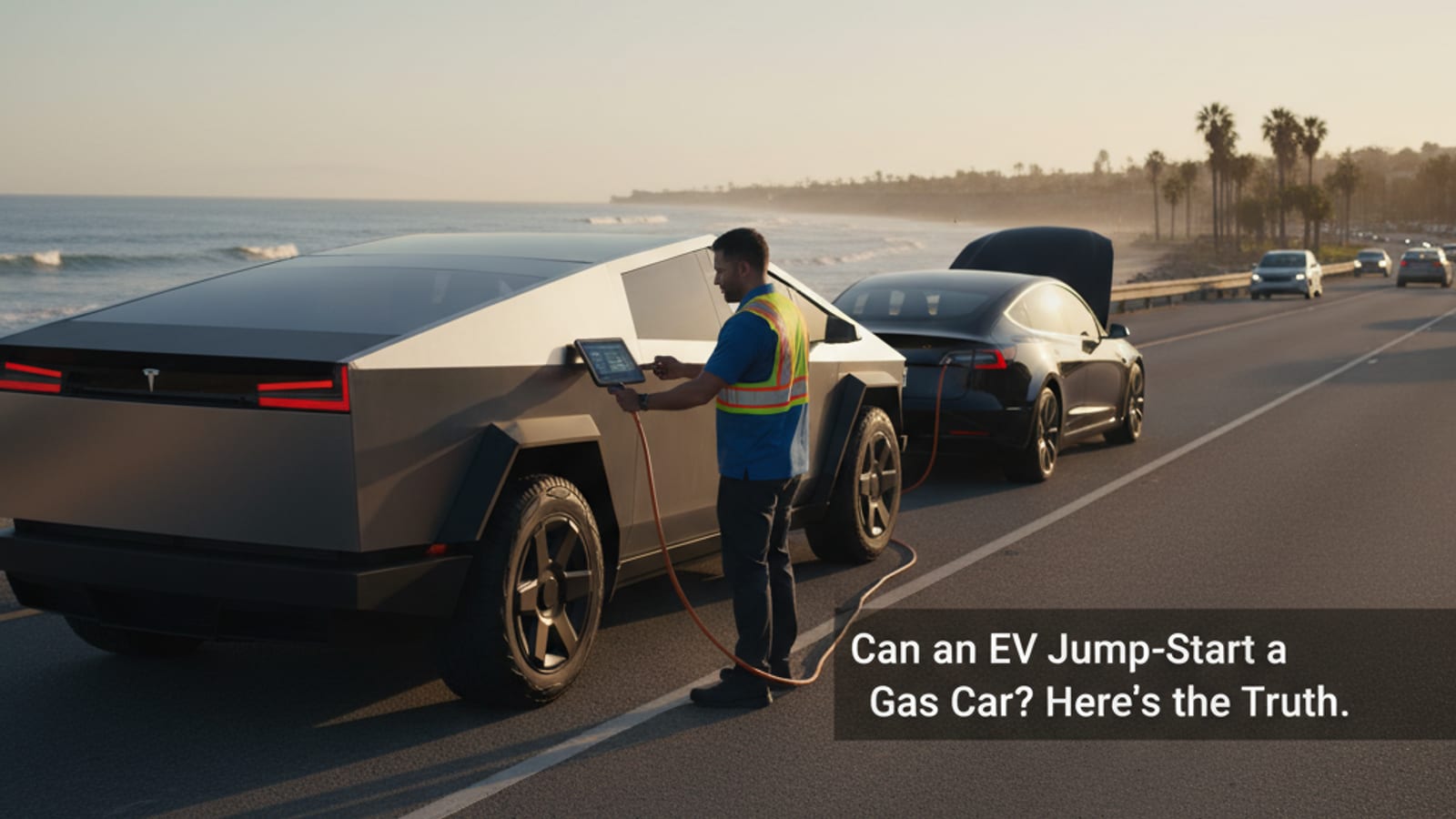
The floor pack is not a jump box
Friends look at an EV and see a giant battery. They assume it can loan power like a generator. It can’t. Every EV still carries a 12-volt auxiliary battery. That battery wakes the computers that close the high-voltage contactors. It doesn’t spin a starter. A DC-DC converter tops it up from the pack once the car is awake.
A gas car works the other way. Its 12-volt exists to dump a burst into the starter. The alternator takes over once the engine fires. Jumper cables only tie the two 12-volt systems together. The traction pack stays out of the circuit.
Summer heat around Tampa and St. Petersburg weakens that small battery. A 12-volt that sat in a lot all afternoon has less to give. Recurrent Auto finds about 5 percent range loss at 90°F. Loss runs 20 to 30 percent above 95°F. That study is about the drive pack, not the 12-volt. The same heat still cooks the auxiliary battery. Owners in older housing in Lealman and core St. Petersburg hit it. So do owners in newer Westchase and Fish Hawk streets. The build year doesn’t change the wiring.
What a starter actually asks of the donor
A starter wants a short, heavy surge. An EV 12-volt is sized for modules, lights, and locks. It’s closer to a compact accessory battery than a truck starting battery.
Many EVs still use a lead-acid 12-volt. Those can sometimes survive one careful jump. Newer Teslas and other late models use a lithium 12-volt. Protection circuits can open under a starter load. The donor EV then goes dark. Doors, screens, and contactors can all drop.
Tesla’s published guidance tells owners not to use the car as a jump donor. That’s about protecting the low-voltage system. It isn’t about being unhelpful in a lot.
How a Tampa Bay parking-lot jump goes wrong
The mess usually starts as a favor. A gas car sits dead outside a Tampa International Airport garage. Or it sits at Tropicana Field after a game. Or it sits in a stall off I-275. A friend in a Model Y or Ioniq 5 pulls up with cables. Clamps go on. The gas car clicks, starts, or does nothing. Then the EV won’t wake.
TPA publishes free EV charging in on-airport garages and the cell phone lot. A car that sat a week and won’t wake is often a 12-volt failure.
On a highway shoulder the picture gets worse. Florida Statute 316.194 covers stopping on the paved highway outside a city. You may stay only when the vehicle can’t be moved off. A dead EV after a botched jump is that disabled vehicle. Road Rangers in FDOT District 7 patrol I-4, I-75, and I-275. Dial *347 for a published jump-start on those roads. Their materials don’t list charging an EV. They can still jump a gas car’s 12-volt on those roads. They aren’t a mall-lot service.
Damage you won’t see from the stall
A bad jump can do more than drain the EV. Voltage spikes can hit the DC-DC converter. They can also hit the battery management system. Reverse polarity or a spark at the posts can cook modules. Those repairs are a bad trade for a favor in a lot.
If the gas car starts and then dies, its 12-volt may still be failed. If the EV wakes then dies, the donor 12-volt took too much. An EV that dies again after a jump follows that pattern.
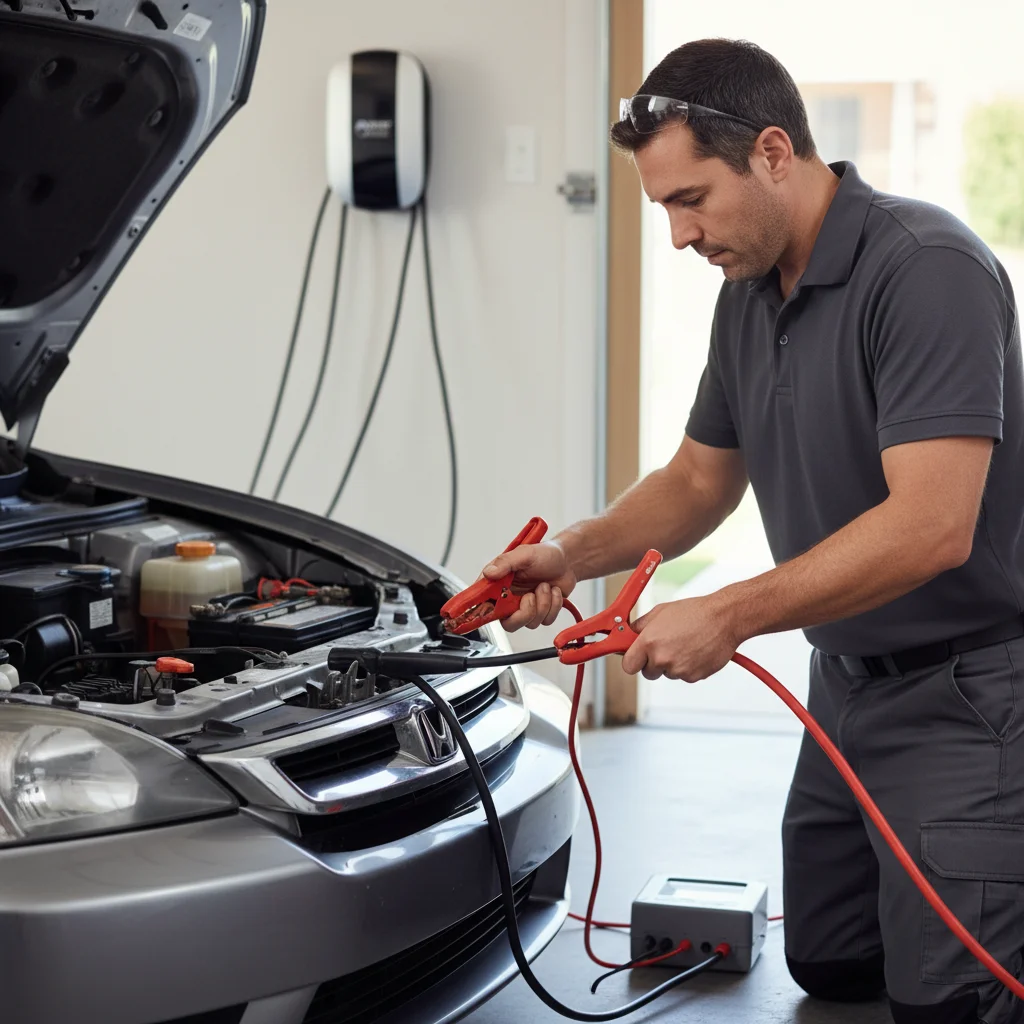
Clamp order still matters if you ignore the warning. Positive to positive. Negative to a clean ground on the dead gas car, away from its battery. Wrong order can spark. It can also dump current into the EV’s electronics. NHTSA publishes general jump-start safety at nhtsa.gov.
Don’t use the EV as the donor. Use a dedicated jump pack rated for the gas engine. Or call a service that jumps gas cars.
What to do instead of using the EV
Treat a dead gasoline car as a gasoline problem. A compact jump pack lives in a glove box. It doesn’t raid your EV. On I-4, I-75, or I-275, Road Rangers may jump that gas car’s 12-volt. In a private lot, Hillsborough and Pinellas both cap non-consent tows. Signage has to meet Florida Statute 715.07. Don’t sit in a posted tow-away stall waiting for a jump.
If your EV is the car that won’t wake, stop guessing. A dead 12-volt on an EV looks like a brick even with a full pack. That’s a different job from cranking a gas car. The Tesla 12-volt jump path is for the EV, not the gas car beside it. How to jump an electric car without damage walks the EV-side steps. Whether roadside help can jump an EV covers what a typical truck actually does.
Tesla owners have a tighter rule. A Tesla should not jump another car. Why you shouldn’t jump a gas car from a Tesla is the longer version of that no.
If the EV is now the stranded one, call (813) 536-4545. Charge Pro TPA matches stranded EV drivers with independent mobile operators. Those operators can jump or replace a dead 12-volt. They can also bring a 240-volt Level 2 charge. They typically add 10 to 20 miles in 15 to 30 minutes of charging. That’s charge time, never an arrival time. The operator quotes you before work starts and bills you directly. What happens when an EV 12-volt dies in Tampa Bay is the checklist. Heat on a Tampa or Clearwater lot doesn’t wait. On the Selmon reversible lanes there’s no local surface shoulder. Don’t try this favor on the Sunshine Skyway either.