Roadside assistance for EV Tampa Bay drivers splits on one fact. FDOT Road Rangers can still help on the interstates. They jump a 12-volt, fix a flat, and move a disabled car. Their published services do not include charging an empty pack. If you are sitting on I-275 with no range left, that is the difference that matters.
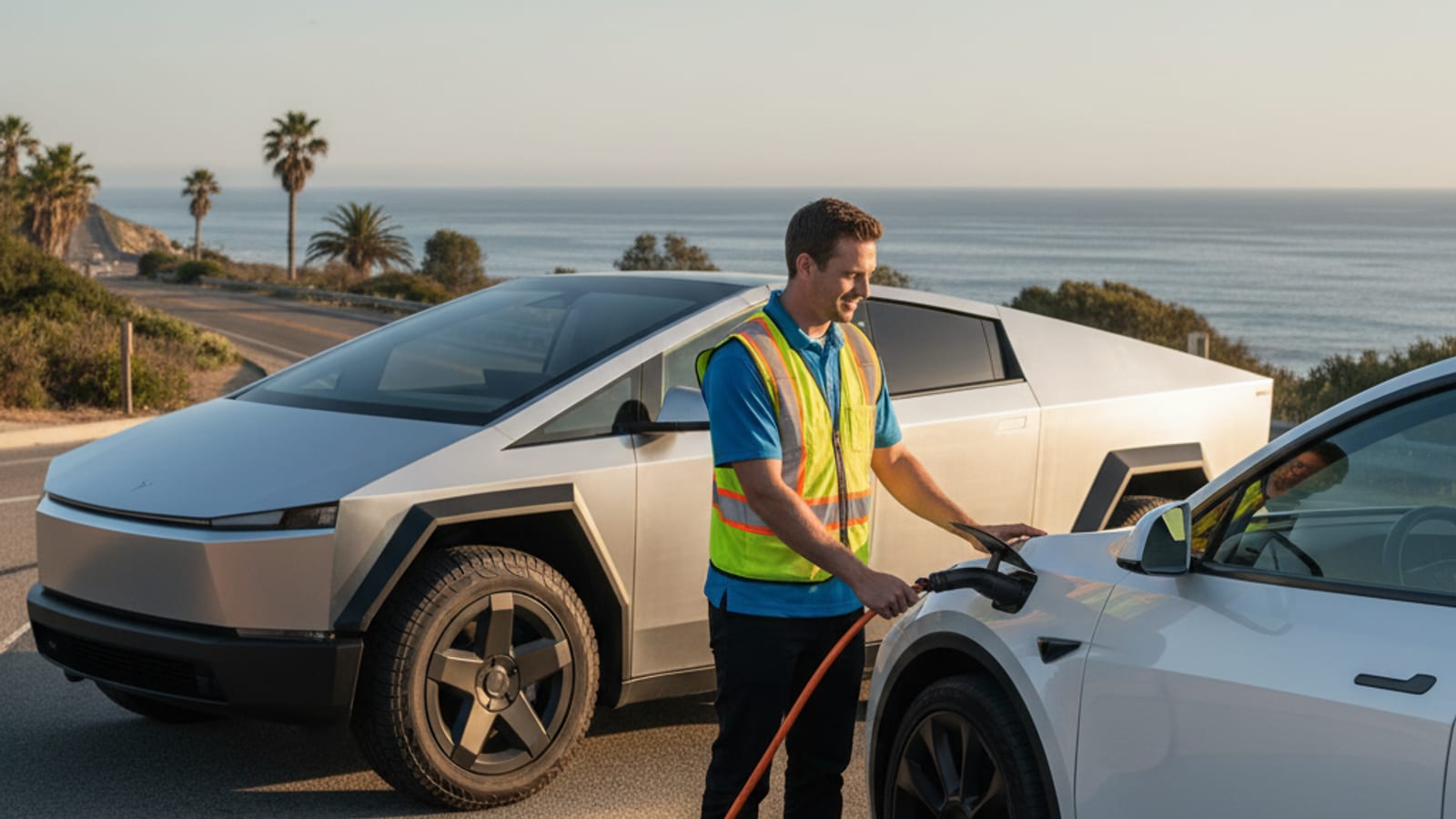
Road Rangers help. They don’t list an EV charge
District 7 Road Rangers patrol I-4, I-75, and I-275. They also cover the Tampa International Airport interchange. You reach them by dialing *347 from a mobile phone. Dispatch runs through the Tampa Bay SunGuide Center. District 1 runs its own Road Rangers on I-75 through Manatee and Sarasota.
The free menu is real, and it is specific. Rangers bring fuel for a gas car. They jump-start a 12-volt battery. They help with a flat tire. They give two local calls. They can relocate a disabled vehicle to a safer spot. They also hold traffic around the scene.
None of those published items is a charge into the traction pack. Do not hear that as “Road Rangers will not help an EV.” They can still jump the 12-volt. They can still get you off the travel lane. They simply do not advertise EV charging as a service they carry.
Florida Highway Patrol Troop C covers disabled vehicles and incidents on the same interstates. Florida 511 is the state’s traffic system. Use it when the lanes are already a mess.
Florida Statute 316.194 is the shoulder rule. Outside a municipality, you cannot stop on the paved travel lane when you can get off it. A disabled vehicle is the exception. Subsection (2) covers a car that cannot keep moving. A dead EV on the shoulder is a disabled vehicle under that exemption. Get out of the travel lane when you can. Stay belted inside if the road is too fast to stand beside.
The screens are dark. That is often the 12-volt
A lot of “the EV died” calls are not an empty pack. They are a 12-volt failure. That small battery runs the computers, the contactors, and the door hardware. When it fails, the car looks fully dead. Screens stay black. Handles may not work. The high-voltage system never wakes, even if the pack still holds energy.
Sitting cars show this first. Tampa International Airport publishes free EV charging in its on-airport garages and the cell phone lot. Level 1 J1772 stations sit on the first floor of the Economy Garage. Level 1 charging is also in the Long-Term Parking Garage. Level 2 is at the Cell Phone Lot. SkyConnect links the main terminal to the Economy Garage and the Rental Car Center. A car left for a week in those garages often comes back with a dead 12-volt. The pack may still have range. The accessory battery aged in the heat anyway.
Cruise parking can produce the same sitting-car failure. Terminal lots and any charging there were not verified on a primary page. Check the 12-volt first. Do not assume the pack is empty because the car will not wake.
An empty pack has a different story. Range fell during the drive. The car still woke until it did not. You were stretching the last miles on purpose. That is an out-of-charge event. It needs a mobile EV charge, not a jump.
If you cannot tell which failure you have, start with the 12-volt. Can roadside assistance jump-start an EV walks through that split in plain steps. The operators we connect you with can jump or replace a dead 12-volt on site. They handle Tesla and every major EV brand.
Where you stall changes the job
Tampa Bay is not one commute. The core city, Pinellas, East Hillsborough, Pasco, and the South Bay strand drivers in different ways.
Downtown Tampa and Brandon share the Selmon Expressway. THEA’s Reversible Express Lanes run about ten miles on an elevated segmental bridge in the median. Direction reverses through the day. Westbound into downtown runs from about 5 a.m. to noon. Then the lanes go eastbound. Crews clear every vehicle before each reversal. There is no local surface shoulder on that elevated segment. If you hit zero on the REL, you are not waiting on a wide berm. Out of charge on the Selmon REL is the page for that exact stall.
I-275 across the bay is the other unforgiving run. The Sunshine Skyway is four miles of bridge. The cable-stayed main span sits 432 feet above the shipping channel. Florida Highway Patrol closes it when winds hold at 40 mph. Fog that cuts visibility below about 100 feet can close it too. High-profile vehicles usually get a wind advisory around 20 mph gusts. There is no place to stop on that span. An empty EV there is a traffic problem. Empty pack on I-275 covers the Tampa and Pinellas approaches.
The Veterans Expressway and the Suncoast Parkway are all-electronic Turnpike roads. You pay with SunPass or toll-by-plate. The Suncoast is a long, fast run north through Pasco. Exits sit far apart. A driver on that road is often a Withlacoochee River Electric Cooperative member, not a TECO or Duke customer. Do not assume Tampa’s utility when you live in north or central Pasco.
US-19 through coastal Pasco, SR-60 through East Hillsborough, and the Courtney Campbell Causeway each create their own stall. Heat and air conditioning do more than hills. The metro is flat and near sea level. Grade never gives range back.
Housing stock shapes how often you even need a shoulder charge. Lakewood Ranch, Fish Hawk, and Westchase are among the newest places in scope. Home 240-volt charging is near-universal there. Lealman and St. Petersburg hold some of the oldest housing. Many of those streets never got a wall connector. Pinellas condos and beach HOAs add another layer. Florida Statute 718.113(8) gives a unit owner the right to install a charger in a limited common element or an exclusive parking space. A declaration cannot ban it. The board cannot deny a properly submitted request. The owner still pays for install, operation, maintenance, insurance, and separately metered power. Plenty of beach drivers still live on public charging because the lot never got a plug.
Tampa city had 393,389 residents in the ACS 2019-2023 count, and 414,547 in the 2024 estimate. St. Petersburg sat at 260,646 and 267,102. Clearwater sat at 117,075 and 116,811. Those three cores, plus the East County and South Bay suburbs, are the map Charge Pro TPA serves as a referral line.
Heat, lightning, and last year’s storms
Recurrent Auto’s published research is the range figure to trust here. An EV loses about 5 percent of range at 90°F. Loss jumps to 20 to 30 percent above 95°F. Near 100°F, the hit is roughly 17 to 18 percent. The spread by model is wide. Do not treat a dashboard estimate as a promise on a still, hot afternoon.
Tampa Bay runs air conditioning from spring into late fall. That load is the range story. It is not elevation.
Lightning belongs in the same climate. Vaisala’s National Lightning Detection Network repeatedly ranks Florida among the densest lightning states. Bay News 9 reported Vaisala data of about 285 lightning events per square mile in Florida in 2022. The Four Corners stretch on the Tampa-Orlando I-4 corridor was about 474 per square mile that year. The “lightning capital” title moves. Vaisala named Shady Grove, Oklahoma in its 2025 report. Call this one of the most lightning-prone metros in the country, and stop there.
Hurricanes make a low charge worse. Hurricane Helene in late September 2024 drove record storm surge at Tampa Bay tidal gauges. St. Petersburg faced a forecast of 5 to 8 feet of surge. Pinellas barrier islands from the Dunedin Causeway through Tierra Verde were closed. Hurricane Milton in early October 2024 largely spared Pinellas a second catastrophic surge. It still dropped at least 18 inches of rain on parts of St. Petersburg. It tore part of the roof off Tropicana Field. Low-lying Pinellas, the barrier islands, and south Hillsborough towns like Ruskin, Apollo Beach, and Gibsonton sit in evacuation zones. Leaving on a low charge is a local failure mode, not a hypothetical.
Federal and fire-service guidance warns about salt water and EVs. A pack soaked in salt water can fail later, including with fire. Keep a flooded EV away from buildings and other cars until it is inspected. Do not quote a distance or a timer. Those specifics were not confirmed on a readable federal page.
What specialized EV roadside assistance actually does
Traditional clubs are built around fuel, a 12-volt jump, and a tow. That toolkit still matters. It does not refill an empty traction pack. A Supercharger is a fixed DC fast site. It is not a truck that comes to your bumper.
EV roadside assistance here means a local operator who works on EVs. Charge Pro TPA is a referral line. We match stranded drivers with independent mobile rescue operators. We do not hold a trade license. We do not own trucks or a yard. We do not employ technicians. We do not set prices. We do not promise when someone arrives. The operator quotes you before work starts. They bill you directly.
A 240-volt charge at the car
The operator brings a 240-volt Level 2 source to the bumper. Tesla uses a native NACS plug. Non-Tesla EVs use a CCS or J1772 adapter. In 15 to 30 minutes of charging, you typically gain 10 to 20 miles of range. That clock is charging time. It is not an arrival time.
Ten to twenty miles is usually enough to reach a public DC fast charger or to get home. It is not a full pack. It is a rescue charge so the car can move.
A 12-volt jump, or a swap in the lot
If the car is dark and silent, ask for the 12-volt first. A correct jump wakes the contactors. The high-voltage pack may still be full. If the battery will not hold, many operators can replace it on site. That is often the difference between driving away and waiting on a dealer tow. What happens when an EV 12-volt dies covers the signs before you are stuck.
A tire, then a flatbed only if you must
EVs are heavy. Tires wear in their own pattern. Many cars have no spare. A puncture can still be plugged or inflated on the shoulder. Road Rangers can help with that on the interstates they patrol. If the tire is done, the car needs a flatbed. Drive wheels on the pavement can damage the motor. Charge Pro TPA does not run a tow fleet. When a flatbed is the honest next step, the operator will say so.
Towing from a private lot is its own statute. Florida Statute 715.07 covers non-consent removal from private property. Required signs use light-reflective letters not fewer than 2 inches high. “Tow-away zone” must be in letters not fewer than 4 inches high. The tower’s name and current phone number must be on the sign. The sign sits 3 to 6 feet above ground. Hillsborough and Pinellas both cap non-consent tow rates at the county level. Hillsborough uses the Tax Collector’s vehicle-for-hire authority. Pinellas uses Ordinance 19-39, Code Chapter 122, Article II.5, section 122-42. Current maximum dollar figures were not confirmed against the live posted schedule. Ask the tower for the filed rate before you pay. In a county of 500,000 or more, a towed vehicle must be stored within a 10-mile radius. Hillsborough and Pinellas both qualify. Smaller counties use 15 miles.
A frozen screen or a stuck cable
EVs are computers on wheels. A frozen infotainment stack can look like a dead pack. A restart sometimes clears it. A charge cable that will not release is another common stall. That is a latch, not a range problem. Do not yank the handle. You can break the port.
Home charging is daily insurance. It is not a shoulder tool
A working home charger is still the best way to avoid an empty-pack call. It does nothing for you on I-4.
Tampa Electric serves the City of Tampa, most of Hillsborough County, and parts of Pinellas and southern Pasco. Residential schedules include standard Residential Service and RSVP-1 time-of-use. TECO’s Drive Smart program is a rebate for non-residential Level 2 and DC fast stations. A named residential home-charger rebate and amount were not found on a primary TECO page. Confirm current offers with TECO before you budget a panel job. Their home EV pages point owners to [email protected].
Duke Energy Florida serves Pinellas County and much of Pasco. In 2025 it launched three EV programs: Charger Prep Credit, Off-Peak Charging Credit, and Fleet Advisory. Charger Prep is a one-time credit toward wiring and electrical upgrades for a Level 2 charger. It does not cover the charger hardware or permit fees. Off-Peak Charging Credit is a residential monthly bill credit for charging in off-peak windows. Confirm the current credit and hours with Duke before you plan around them.
Withlacoochee River Electric Cooperative serves northern and central Pasco, except the Dade City area. A Land O’ Lakes or Suncoast driver is often a WREC member. Do not call TECO or Duke for a WREC account.
Peace River Electric Cooperative and Florida Power & Light serve parts of the Manatee and Sarasota ring. Exact boundaries and EV programs were not verified on a primary page. Check the service-area page for that address before you name a utility.
Florida has no state EV purchase rebate or tax credit. Utility programs are the local incentive layer. Confirm each one on the utility’s own site. Neighborhood charging context lives on the Tampa Bay EV charging hub.
If you are already on the shoulder
Get out of the travel lane if you can. Hazard lights on. Belt on if you stay in the car. On a fast road, do not walk the pavement.
Name the failure. Dark screens and silent locks point to 12-volt. A car that drove until range hit zero points to the pack. A shredded tire is a tire.
On I-4, I-75, or I-275, *347 still belongs in the sequence. Rangers can jump the 12-volt and protect the scene. Their published list still does not include charging the pack.
Then call for EV-specific help. Give the operator the road, the direction, and the nearest exit. Name the make and model. Say whether the car still wakes. Say whether you already spoke with Road Rangers.
Stay with the car. Turn off climate if the pack is truly empty. Save what little power remains for lights and locks.
Manufacturer programs vary by brand and by year. Tesla, Rivian, and others publish their own roadside rules. Those plans can include a jump, a tire, or a tow. They do not always include a 240-volt charge at your bumper. Keep the app. Keep a local backup too.
Look for a Level 2 source on the truck, not a promise of a tow. Ask whether they carry NACS and a CCS or J1772 adapter. Ask whether they quote before they start. Ask who bills you. The operators we connect you with are licensed and insured. They quote before they start. They bill you directly.
Charge Pro TPA serves Tampa Bay. That includes Tampa, St. Petersburg, Clearwater, and the rest of the mapped service area. If you need that match, call (813) 536-4545. It is a referral line, not a clock.
Frequently asked questions
Can Road Rangers charge my EV on I-275 or I-75?
District 7 Road Rangers patrol I-4, I-75, I-275, and the airport interchange. Dial *347. They can jump a 12-volt, help with a tire, and move a disabled car. Materials reviewed for this page list fuel and those services. They do not list charging an EV. Use Rangers for scene safety and a 12-volt jump. Use a mobile Level 2 operator for an empty pack.
If the screens are black, is the traction battery empty?
Often no. A dead 12-volt can keep the whole car dark even when the pack still holds energy. Airport and other long sits make that failure common in this heat. If the car drove until range hit zero, treat it as an empty pack. If it sat and then would not wake, start with the 12-volt.
How much range does a mobile 240-volt charge add?
Operators we connect you with bring a 240-volt Level 2 source to the bumper. In 15 to 30 minutes of charging, you typically gain 10 to 20 miles. That is charging time, not a promise of when the truck arrives. It is usually enough to reach a public DC fast charger or to get home. It is not a full pack.