Your EV woke after a jump, then went dark again. That second no-start means the 12-volt is finished. A battery dying after jump start in Tampa Bay is almost never an empty pack. It’s the small battery that wakes the computers, the locks, and the contactors.
The first jump only borrowed a few minutes
A successful jump proves one thing: voltage reached the low-voltage system. It doesn’t prove the 12-volt can hold a charge on its own. If screens came back, then died, that battery already showed its limit.
Tampa heat shortens that borrowed window for every EV on this coast. Recurrent Auto’s published research is blunt about heat. An EV loses about 5 percent of range at 90°F. Above 95°F the loss runs 20 to 30 percent. A weak battery can wake in a Carrollwood driveway. It can fade before you merge onto I-275.
Don’t treat the brief wake as a repair. That fade is the diagnosis.
The traction pack usually isn’t the problem
Owners often assume the car is out of range. Check what you saw before the second fade. A range number on the display still matters as an observation. So does a recent plug-in at home or at a garage.
Tampa International Airport charging is published as free at on-airport garages and the cell phone lot. A week in the Economy Garage usually takes the 12-volt, not the pack. SkyConnect gets you to the terminal. It doesn’t keep that small battery healthy while you’re gone. Level 1 J1772 sits on the first floor of the Economy Garage. Level 2 is at the Cell Phone Lot. Exact stall counts weren’t confirmed on the airport page for this article.
The same sitting-car pattern shows up after a Tropicana Field night. Florida Statute 718.113(8) lets a condo owner install a charger in an exclusive space. Many buildings still leave cars on a wall outlet. A finished 12-volt doesn’t care which setup you had.
Copy the dashboard wording as it appeared. Look for 12V, low voltage, or a propulsion notice. Don’t translate it into your own theory.
Heat and salt air wear the small battery first
Tampa Bay sits flat and near sea level. Heat and air conditioning carry the range story, and they age the 12-volt. Salt air along the gulf and the bay adds corrosion on terminals and grounds.
If floodwater reached the car during Helene or Milton, don’t jump it again. Federal and fire-service guidance warns that an EV soaked in salt water can be unsafe later. Keep it away from other vehicles until a shop inspects it. Exact setback distances and wait times couldn’t be confirmed on a readable federal page. Follow the shop and your insurer.
Write the timeline while you still remember it
A second fade only helps if the next person gets a clean account.
- Make, model, and model year
- Exact warning text, in the order it appeared
- Whether doors, screens, and the app still responded
- Who did the first jump, and with what gear
- Street, garage level, gate notes, or highway direction
Full-display photos beat a cropped warning. If the screen is dark, an app screenshot still helps. Don’t clear messages to make the dash look tidy. If someone else did the first jump, ask what they used. If they don’t know, write that it couldn’t be confirmed.
Location has to be more specific than Tampa. An operator reaching a car on I-4 needs the direction and the nearest exit. A stall on the Selmon reversible lanes is a different problem. THEA’s REL is an elevated median run between Brandon and downtown. Those lanes reverse through the day. Crews clear them before each switch. There’s no local surface shoulder on the elevated segment. Say REL, direction, and the nearest landmark you can see.
On I-275, I-75, or the Veterans Expressway, name the route and the travel direction. Florida Statute 316.194 says you stay off the paved travel lane when you can. A disabled EV on the shoulder falls under the statute’s disabled-vehicle exception. Put hazards on. Florida 511 and the Tampa Bay SunGuide Center carry traffic updates.
Don’t make a second jump your default
A battery dying after jump start is the 12-volt saying the first boost was temporary. Repeating the jump is often the wrong next step. Connection points and allowed tools change by model year. This page won’t give a generic second-jump recipe. Those steps weren’t confirmed for every EV.
Open the owner’s manual or the official app for your exact car. If the maker says stop after a failed hold, stop. If a neighbor already jumped it with unknown clamps, don’t recreate that setup.
FDOT Road Rangers in District 7 patrol I-4, I-75, I-275, and the airport interchange. Dial *347. Published help includes a 12-volt jump, a tire change, and fuel. They can also move a disabled vehicle to a safer spot. Their materials don’t list charging an EV. A second no-start after that jump is the same signal. The 12-volt is finished, and you still need a plan for the car.
Florida Highway Patrol Troop C covers incidents on the interstates. If there’s smoke, a burning smell, or visible damage, stop. Call emergency services. Don’t let a bystander improvise around the pack.
Pick roadside help, a shop, or both
Roadside help fits when the car won’t wake or won’t shift. It also fits when you’re blocking a lane, a garage, or a gated lot. Ask whether the operator handles your exact model. Ask whether they handle a 12-volt that already failed after a jump.
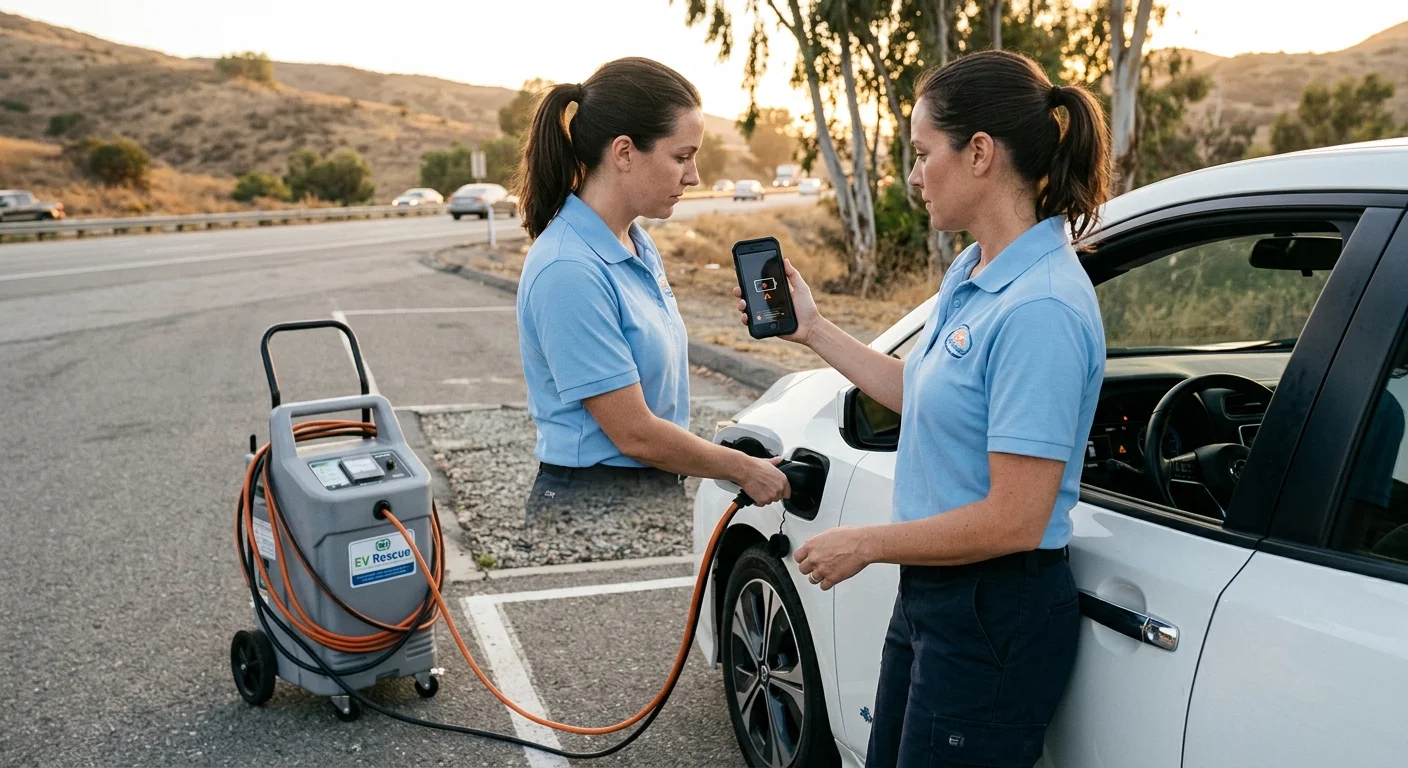
The pros we connect you with are licensed and insured independent operators. They jump or replace a dead 12-volt on site. They also bring a 240-volt Level 2 source when the pack is empty. That typically adds 10 to 20 miles of range. Charging time is 15 to 30 minutes. That’s charging time, never a promise of when someone arrives. The operator quotes you before work starts and bills you directly.
A service center fits when you need testing, a programmed replacement, or follow-up after repeated failure. Talk through what EV 12-volt replacement involves for your model year.
A mobile operator can get you off the Suncoast Parkway or out of a TPA garage. The shop then finds why the 12-volt wouldn’t hold. If a tow comes up, follow the maker’s current towing steps. Hillsborough County caps non-consent rates through the Tax Collector’s vehicle-for-hire authority. Pinellas County sets caps in Ordinance 19-39. Confirm the current cap with the county before you pay.
Where this shows up around the bay
A finished 12-volt doesn’t pick one ZIP code. In the City of Tampa, TECO is the utility. Duke Energy Florida covers Pinellas and much of Pasco. North and central Pasco often sit on Withlacoochee River Electric Cooperative. Don’t tell a WREC member to call TECO.
Newer streets in Westchase, Fish Hawk, and Lakewood Ranch usually have 240-volt home charging. Older stock in Lealman and St. Petersburg often doesn’t. Housing age doesn’t change the second-fade diagnosis.
On the Sunshine Skyway, a stall is uniquely bad. The main span sits 432 feet above the channel. Don’t walk the deck.
What to say on the call
Keep the handoff to five facts.
- This is an EV. Power returned after a jump, then died again.
- Here’s the exact warning text.
- Here’s the make, model, and year.
- Here’s the pin: garage level, gate, REL, or I-75 shoulder.
- I haven’t attempted a second jump.
For the low-voltage pattern, see what happens when an EV 12-volt dies in Tampa Bay. Tesla owners can review Tesla 12-volt battery jump. Other brands should start with non-Tesla EV rescue or EV roadside assistance. For a first jump that hasn’t failed twice, see how to jump start an electric car without damage.
Charge Pro TPA matches stranded drivers with independent local operators. The brand doesn’t hold a trade license, own trucks, or do the work. If the car is dark again after that first Tampa jump, skip the repeat boost. Call (813) 536-4545 and we’ll connect you with a local operator.