Yes. Every Tesla on Tampa Bay roads still has a 12-volt battery. It’s separate from the traction pack under the floor. That small battery runs the computers, handles, and contactors. When it dies, the car can go fully dark. The last range number you saw can still look healthy.
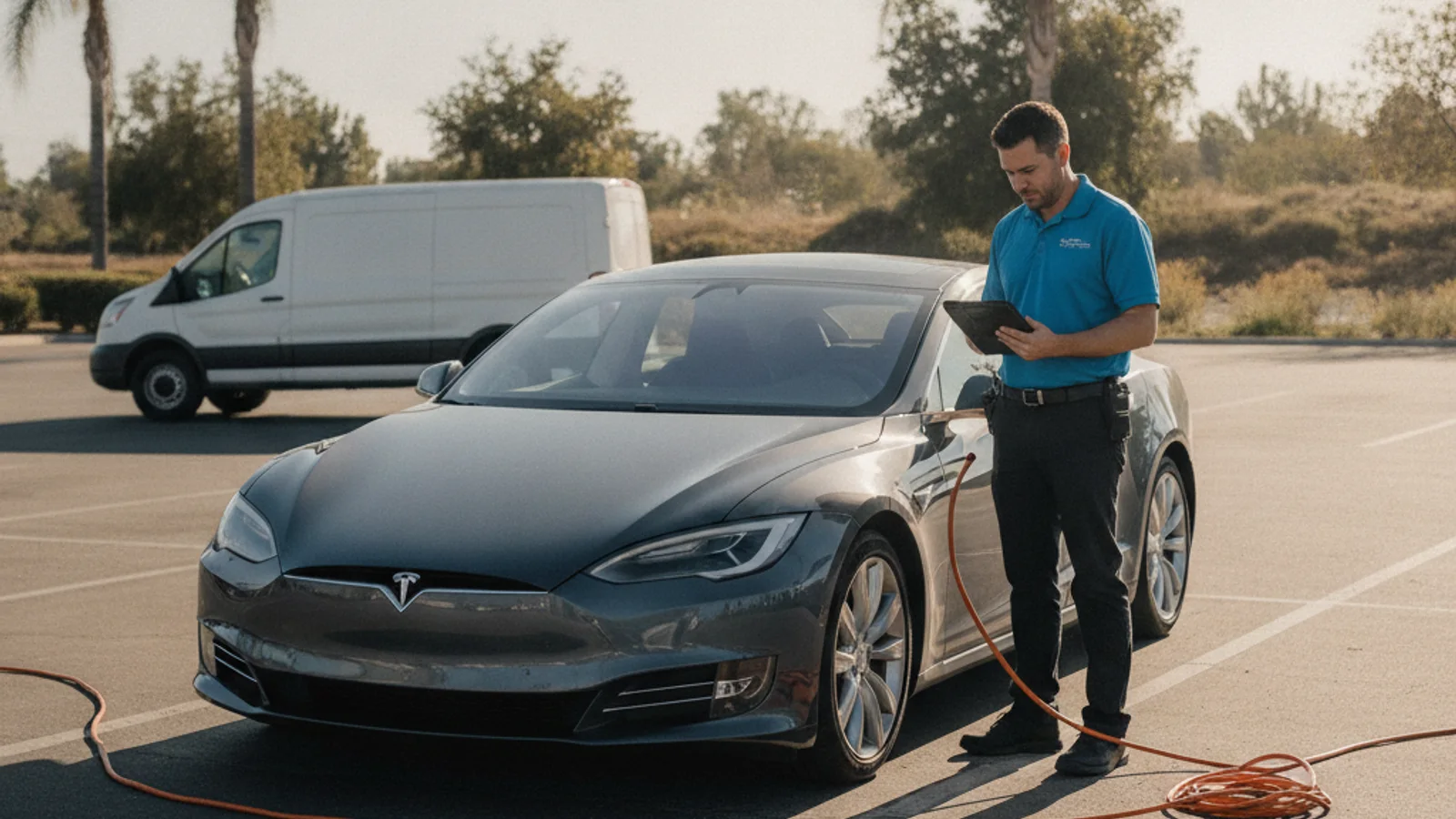
The 12-volt is the wake-up battery
Your Tesla runs two electrical systems, not one shared pool. The traction pack moves the wheels and sets the range number. The 12-volt battery is the wake-up circuit for everything else. It feeds the screen, cameras, locks, computers, and contactors.
Contactors are heavy relays that connect the pack to the motors. They need low-voltage power before they can close. That’s why a full pack plus a dead 12-volt still means silence. The high-voltage system can’t boot itself without that small battery.
Tesla uses contactors and a DC-DC converter the way a gas car uses a starter. The idea isn’t new, but the hardware is electric.
While you drive or plug in, the DC-DC converter tops off the 12-volt. Once the car sleeps, that small battery carries the background load. Sentry Mode, cabin overheat protection, and the app all draw from it. A parked Tesla in this heat isn’t sitting idle.
The U.S. Department of Energy explains this two-battery layout in its EV overview.
Why owners still get surprised
Tesla markets the car as electric and rarely spells out the second battery. Every Tesla in the lineup still has that low-voltage battery. Model S, Model 3, Model X, Model Y, and Cybertruck all carry one. Other production EVs keep a low-voltage battery too. It’s how high-voltage cars keep small electronics off the traction pack.
What changes is chemistry, placement, and how a technician reaches it. That’s the model-by-model part of this guide. It isn’t one brick in one hole across the lineup.
Heat, TPA garages, and a car that sat
Tampa Bay’s air-conditioning season runs from spring into late fall. Recurrent Auto’s published research finds about 5 percent range loss at 90°F. Above 95°F, that loss is 20 to 30 percent. Near 100°F, the hit is roughly 17 to 18 percent. Recurrent notes the effect varies widely by model. Those figures describe traction-pack range, not the 12-volt. The same heat still sits on a small battery in a closed garage.
Vaisala’s lightning data puts this metro among the most lightning-prone in the country. Storms cut garage power, and cars sit longer than you planned. A weak 12-volt can fail before morning.
Gulf and bay salt air adds corrosion risk for parked cars. Hurricane Helene in late September 2024 drove record storm surge at Tampa Bay gauges. Pinellas barrier islands from the Dunedin Causeway through Tierra Verde were closed. Hurricane Milton in early October 2024 dropped at least 18 inches of rain on parts of St. Petersburg. If saltwater reached an EV, follow federal and fire-service guidance. Keep the car away from structures and other vehicles until it’s inspected.
Tampa International Airport publishes free EV charging in the on-airport garages and the cell phone lot. Level 1 charging is in the Economy Garage and Long-Term Parking. Level 2 is at the Cell Phone Lot. Leave a Tesla there for a week, then find a dark cabin. That’s almost always the 12-volt, not an empty pack. Our airport charging guide walks through those garages.
In Lakewood Ranch, Fish Hawk, and Westchase, almost no housing predates 1980. Home 240-volt charging is near-universal in those planned communities. If a Tesla still won’t wake in that driveway, start with the 12-volt. Lealman and St. Petersburg hold the oldest housing in this metro’s scope.
Chemistry and access change by model
Tesla has used lead-acid 12-volt batteries across parts of the lineup. It’s also used lithium low-voltage batteries on later cars. They don’t age, fail, or service the same way.
Access isn’t shared across Model S, 3, X, and Y. Some cars put the battery where a driver can picture it. Others hide it behind trim or under the body. A clip filmed on one model year can be wrong on the next.
This page won’t print a year-by-year chemistry chart. Tesla makes running changes in the middle of a model year. Wrong chemistry sends you to the wrong replacement part. Your owner’s manual for that VIN is the first source. Tesla’s current service documents override this page every time.
Newer Model 3 and Model Y lithium units have their own notes. Read our lithium 12-volt guide for Model 3 and Model Y. For physical placement on a Model 3, see where the Model 3 batteries sit.
The Cybertruck still has a low-voltage battery too. If that truck won’t wake in a Tampa or Brandon lot, start there.
Dark cabin versus an empty pack
A dead 12-volt usually means total silence in the cabin. The screen stays black and the handles don’t present. The mobile app usually can’t reach the car. You might still remember a healthy range number.
An empty traction pack usually still wakes the car. The screen comes on with a low-range warning, not a black cabin. The car still talks to you but won’t go far.
A silent Tesla on I-275 is a different job than an awake low-range car. One wants a 12-volt jump, and the other wants a charge. Florida Statute 316.194 covers a disabled vehicle that can’t leave the paved highway. Get off the travel lanes when you can, then put the hazards on.
The Selmon Reversible Express Lanes run about 10 miles from Brandon into downtown Tampa. There’s no local surface shoulder on that elevated segment. The Tampa Hillsborough Expressway Authority clears every vehicle before each reversal. Westbound into downtown runs from about 5 a.m. to noon. After noon, the lanes reverse and run eastbound. A dark Tesla up there needs a rescue, not a wait.
The Sunshine Skyway on I-275 runs about 4 miles with no place to stop. The main span sits 432 feet above the shipping channel. Florida Highway Patrol closes it when winds hit a sustained 40 mph.
District 7 Road Rangers patrol I-4, I-75, I-275, and the airport interchange. Dial *347 on your phone to reach them. They publish jump-starts, tire help, fuel, water, two local calls, and moving a disabled vehicle. The materials reviewed don’t mention charging an EV. A 12-volt jump may fit what they already do. A traction-pack charge isn’t in that published list. District 1 runs Road Rangers on I-75 through Manatee and Sarasota.
For a closer symptom walkthrough, open our Tesla 12-volt diagnosis guide. Jump steps by model are in the Model 3, Y, S, and X jump guide.
What to tell the operator
Tell the operator the model, year, and trim. That trio sets the chemistry and the access path. Say whether the cabin is fully dark now. Say whether the app still sees the car. Say how long it sat, and say where. Don’t guess lithium versus lead-acid on the call. If you aren’t sure, say you aren’t sure.
Charge Pro TPA is a referral line only. It matches stranded EV drivers with independent local mobile rescue operators. It doesn’t perform the work, own trucks, or employ technicians. It doesn’t set prices or promise an arrival time. The operator quotes you before starting and bills you directly.
Network operators can jump or replace a dead 12-volt on site. If the pack is empty instead, they bring a 240-volt Level 2 source. Operators bring a native NACS plug for Tesla. Other EVs use a CCS or J1772 adapter. Typical added range is 10 to 20 miles. That takes 15 to 30 minutes of charging. That’s charging time, not an arrival time.
For a confirmed 12-volt job, use Tesla 12-volt jump service. If you only know the car won’t start, use Tesla roadside rescue.
When to call for a match
Call when the Tesla is dark and unresponsive. Call even if the last range reading looked fine. Call after a week in a TPA garage. Call after a heat-soaked sit in a Tampa, St. Petersburg, or Clearwater driveway. Call from the Selmon REL, an I-275 shoulder, or the Veterans Expressway. The Suncoast Parkway through Pasco is the same kind of sit. Stay with the car if it’s safe to do so. On a limited-access road, get behind a barrier when you can.
Charge Pro TPA connects Tampa Bay drivers with local operators for this failure. Call (813) 536-4545 and we’ll match you with an independent EV rescue operator.