A Tesla can’t jump-start another car. That answer doesn’t change on a Tampa street. It doesn’t change in a Town ‘n’ Country lot. It doesn’t change on the I-275 shoulder. Your 12-volt battery wakes the car’s computers. It isn’t a donor for a neighbor’s starter. Leave the cables in the frunk.
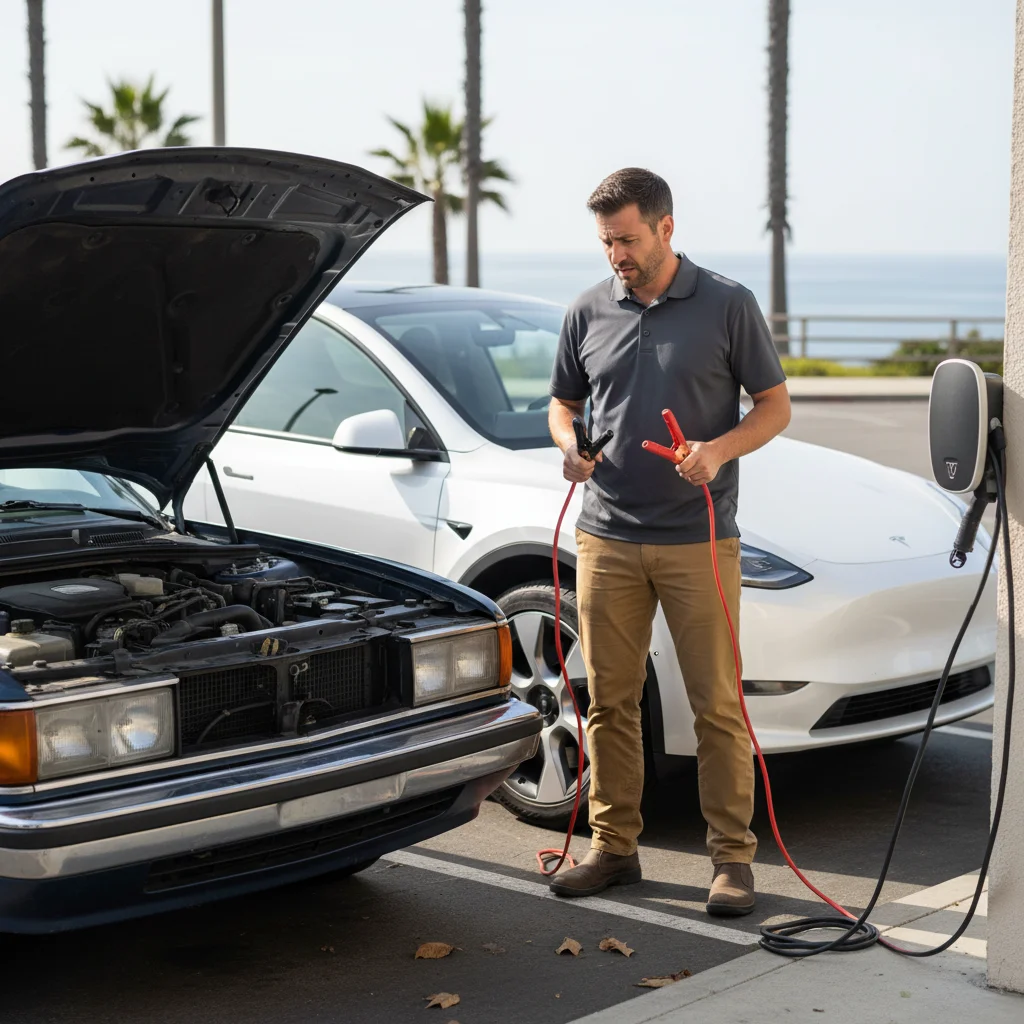
The ask hasn’t gone away here
A hood goes up, hazards blink, and someone looks stuck. You drive an EV with a 12-volt battery, so the old habit kicks in. For years, a jump was how neighbors helped. It was two gas cars, two clamps, and one crank.
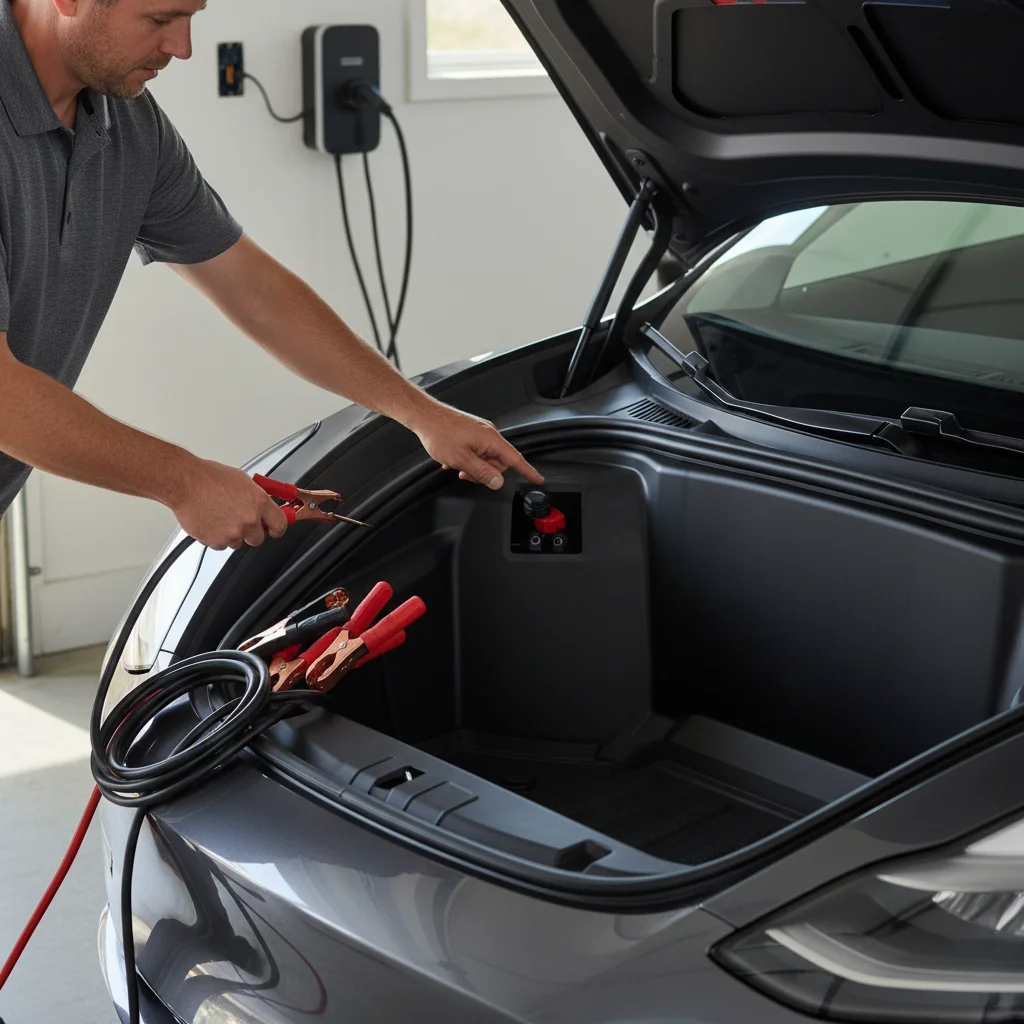
Teslas still have that small 12-volt battery. People see the posts in the frunk. They think those jumper points work both ways. Do Teslas have a 12-volt battery isn’t the open question. They’ve got one. What that battery is for is the part that gets missed.
A gas car’s 12-volt pack exists to crank a heavy starter. A Tesla’s 12-volt pack is a low-voltage key. It runs locks, lights, and the screen. It closes the contactors that connect the high-voltage pack. It isn’t a starter motor. It isn’t a gift you owe the next sedan.
The setting doesn’t change the wiring. Fish Hawk, Westchase, and Lakewood Ranch are newer tracts. 240-volt home charging is near-universal there. Lealman and St. Petersburg hold some of the oldest housing in this metro. On either driveway, a Tesla still shouldn’t donate current.
Heat makes the mix-up more common. Tampa Bay’s air-conditioning season runs from spring into late fall. Recurrent Auto’s published research finds about 5 percent range loss at 90°F. Loss climbs to 20 to 30 percent above 95°F. Grade never hands range back here. The metro sits flat, near sea level. People run the pack harder, then sit in lots. A 12-volt that cooked in that climate can make any EV look fully dead. That still doesn’t make your Tesla the jumper.
Help that doesn’t clip your car to theirs
You can still be useful. You just don’t become the power source.
A portable jump pack is built for starter current. Keep one in the frunk if you want to help gas cars. Clip the pack to their battery, not your Tesla. If you don’t carry one, help them place a call from a safe spot. A ride off a shoulder is worth more than a risky pair of cables.
FDOT Road Rangers in District 7 patrol I-4, I-75, and I-275. They also cover the airport interchange. Dial *347. Published help includes a 12-volt jump, fuel, and a flat. It also includes two local calls. Rangers can move a disabled vehicle to a safer spot. The Tampa Bay SunGuide Center is the District 7 traffic hub. The materials we reviewed describe fuel and a 12-volt jump. They don’t list charging an EV. If the other driver has a gas car, Rangers may be the fit. If they have an empty traction pack, charging is a different call.
Florida Highway Patrol Troop C covers disabled vehicles on those interstates. Florida 511 is the traffic system. District 1 runs its own Rangers on I-75 through Manatee and Sarasota. None of that turns a Model 3 into a donor battery.
Florida Statute 316.194(1) covers stopping outside a municipality. Don’t sit on the paved travel lane when you can get off it. Subsection (2) exempts a disabled vehicle that can’t reasonably move. A dead car on the shoulder is that case. Get as far right as you can. Hazards on. Stay out of the lanes.
The Selmon reversible express lanes are a worse place to try this. THEA’s REL runs about 10 elevated miles between Brandon and downtown Tampa. Direction reverses through the day. Westbound into downtown from about 5 a.m. to noon. Then eastbound. Crews clear the lanes before each flip. There’s no local surface shoulder on the elevated segment. Don’t stand there with cables. You need a way off before the reversal.
The Sunshine Skyway is the other place not to play electrician. The main span sits 432 feet over the shipping channel. FHP closes it when winds hold at 40 mph. It also closes when fog cuts visibility below about 100 feet. It’s about 4 miles of bridge with nowhere good to stop. Same idea on the Veterans Expressway and the Suncoast Parkway. Call, don’t clip.
Private lots have their own trap. Florida Statute 715.07 covers tows from private property. An owner or lessee can remove an unauthorized vehicle when the sign rules are met. Letters, height, and the tower’s phone all have to be on the sign. Hillsborough and Pinellas both exceed 500,000 people. In those counties, a towed vehicle must be stored within 10 miles. Hillsborough County caps non-consent tow rates through the Tax Collector’s vehicle-for-hire authority. Pinellas County sets them by Ordinance 19-39. We could not confirm the live dollar caps against the current schedules. Check hillstaxfl.gov or the Pinellas Code before you treat any figure as current. Helping someone move, or call, beats watching a tower hook the car.
Why the 12-volt system can’t donate
The voltage number is the trap. Both cars say 12 volts. The jobs aren’t the same.
A starter battery is built to dump a huge pulse. Thick cables feed a motor that wants amps for a few hard seconds. The Tesla 12-volt side is a small, quiet supply. Older Teslas used a small lead-acid unit. Newer ones use a small lithium 12-volt pack. A DC-to-DC converter keeps topping it off from the high-voltage pack. The whole loop assumes a steady, low draw.
Use that loop as a donor and you invert it. Current spikes, and voltage sags across the bus. The converter can take a reverse hit it wasn’t sized for. The small battery can be ruined. Control modules can brown out. You’re tying a delicate gateway to a heavy starter circuit.
Tesla’s owner’s manuals cover a 12-volt boost when your own car won’t wake. They also tell you not to jump another vehicle with the Tesla. Damage is the stated risk. The frunk posts are an inbound connection. They’re there so an outside source can wake your low-voltage system. Then the contactors can close. Then the main pack can come online. Outbound starter current isn’t the design.
We unpack that same mismatch in why you shouldn’t jump a gas car from a Tesla. Can an EV jump-start a gas car is the wider version across brands. A clip of someone who tried it isn’t a procedure. Skip the experiment.
Your Tesla also isn’t a rolling charger for another EV’s pack. That’s a different myth. We cover the limit in can one EV charge another. The 12-volt posts won’t fill a traction battery.
When your Tesla is the dead one
Giving a jump is the wrong move. Needing one is common.
A failed 12-volt can make the whole car look bricked. Handles may not release. The screen stays black. The phone app goes quiet. You may have seen a 12-volt service warning first. Heat and a long sit show up in this metro. So does a week in a garage.
Tampa International Airport publishes free EV charging at on-airport garages and the cell phone lot. Level 1 J1772 is in the Economy Garage and the Long-Term Parking Garage. Level 2 is at the Cell Phone Lot. Confirm stall counts on the airport’s own parking page before you plan around a number. Free charging is what TPA states. A car left for a week can still come back dead. That’s often the 12-volt, not an empty pack. SkyConnect takes you between the terminal, the Economy Garage, and the Rental Car Center. The car can sit longer than you think.
Multi-day cruise parking around Port Tampa Bay produces the same sit. We could not verify terminal stall counts or charger types on a primary port page. Treat those details as unconfirmed. Check the port’s own parking information before you count on a specific stall. Hurricane Helene in late September 2024 pushed record surge onto Tampa Bay gauges. Milton in early October 2024 dropped heavy rain on parts of St. Petersburg. It also tore part of the roof off Tropicana Field. Cars sat through both storms. Federal and fire-service guidance warns about EVs soaked in salt water. A lithium pack can be a fire risk later. Keep a soaked EV away from structures and other vehicles until it’s inspected. Don’t jump a soaked pack. A dry Tesla that simply won’t wake is usually the small battery.
If you want the receive-side procedure, use how to jump a Tesla Model 3, Y, S, or X. Match the steps to your model. Reverse the clamps and you can still hurt the car. Many owners would rather not guess in a Westchase driveway or a Clearwater lot.
Who to call when the 12-volt is yours
Charge Pro TPA is a referral line. We don’t hold a trade license. We don’t own trucks or a yard. We don’t employ technicians, set prices, or promise an arrival time. We match stranded EV drivers with independent local operators. The operator quotes you before starting and bills you directly. The pros we connect you with are licensed and insured.
What those operators typically bring is a 240-volt Level 2 source to the car. Native NACS on Teslas. CCS or J1772 adapters for other brands. Charging time is usually 15 to 30 minutes for about 10 to 20 miles of range. That’s charging time, never an arrival time. They can also jump or replace a dead 12-volt on site.
If your neighbor needed a crank, that still isn’t a Tesla job. If your Tesla is the dead one, ask for a Tesla 12-volt battery jump. For a stall in the core, EV roadside assistance in Tampa covers the local version of the call.
Call (813) 536-4545 when you want that match. Talk price with the operator before any clamps go on.
Frequently asked questions
Can a Tesla jump start another car?
No. Don’t use a Tesla as the donor vehicle. The 12-volt system isn’t built to start another car.
Can you jump a Tesla with another car?
A Tesla can receive 12-volt power from an outside source. Follow your model’s owner’s manual. A dedicated pack or a trained operator is the safer path.
What should I use instead of my Tesla?
Use a portable jump starter made for engines. On I-4, I-75, or I-275, *347 reaches Road Rangers. That’s for a published 12-volt jump on a gas car. For your own dead Tesla, call a local EV operator.