You can jump-start an EV when the 12-volt battery has failed. You can’t jump the traction pack that actually drives the wheels. On Tampa Bay interstates, FDOT Road Rangers publish a free 12-volt jump. Their published services don’t include charging an EV.
Road Rangers will jump a 12-volt. They don’t list EV charging
FDOT Road Rangers in District 7 patrol I-4, I-75, and I-275. They also cover the Tampa International Airport interchange. Dial *347 from a mobile phone to reach them. Dispatch for District 7 sits at the Tampa Bay SunGuide Center.
Rangers will handle a flat tire. They’ll jump-start a 12-volt battery. They’ll bring fuel, diesel, or water. They’ll place two free local calls. They can move a disabled vehicle to a safer spot. They also maintain traffic at incidents.
Those materials describe fuel and a jump. They don’t mention charging an EV. That’s an observed absence in the published list. It isn’t a claim that Rangers refuse electric cars. A Ranger can still jump your 12-volt on I-275. An empty traction pack is a different job, and it isn’t on that list.
District 1 runs its own Road Rangers on I-75 through Manatee and Sarasota. Florida Highway Patrol Troop C covers disabled vehicles on those same interstates. Florida 511 is the state’s traffic feed.
Florida Statute 316.194 still governs where you stop. Outside a municipality, stay off the paved travel lane if you can. Don’t stop on the pavement when you can pull off. A disabled EV on the shoulder falls under the statute’s exception.
Tesla drivers ask this on those same roads. Tesla flat tire help versus Road Rangers compares the published lists.
The 12-volt and the pack aren’t the same call
Every EV here has a small 12-volt battery. It wakes the computers, locks, and contactors. The traction pack sits under the floor. That pack is what moves the car.
A jump can restore the 12-volt on many models. It doesn’t put miles back into an empty pack. If you only ask for a jump, the operator may prepare the wrong kit. Say what the display showed before the car went quiet.
Don’t diagnose the pack on the phone. Report facts: last range or percent you remember, and each warning word for word. Say whether the screen lights, whether the key is recognized, and whether Drive will engage.
Make, model, and year change the procedure. Posts aren’t in the same place on every brand. Some manuals restrict a roadside jump. The independent operator reviews your exact car before cables go on.
Tesla 12-volt jobs often start as a Tesla 12-volt battery jump. For the wider failure pattern, read what happens when an EV 12-volt battery dies.
Heat in this metro disguises which battery failed
Tampa Bay runs air conditioning from spring into late fall. The land is flat and near sea level, so grade never gives range back. Recurrent Auto’s published research is the range-loss source to cite. An EV loses about 5 percent of range at 90°F. Loss runs 20 to 30 percent above 95°F. Near 100°F, Recurrent puts a typical hit around 17 to 18 percent.
That same heat wears the 12-volt while the car sits. Older housing in St. Petersburg and Lealman often means driveway parking. Newer tracts in Westchase, Fish Hawk, and Lakewood Ranch more often include garages. Either setting can kill a 12-volt after a hot week. The traction pack may still hold charge. The car still won’t wake.
A week in a Tampa International Airport garage is the same pattern. TPA publishes free EV charging at on-airport garages and the cell phone lot. Level 1 J1772 charging is in the Economy Garage. It’s also in the Long-Term Parking Garage. Level 2 is at the Cell Phone Lot. Confirm current stall details on the airport’s parking page. A car that won’t start after a trip is often the 12-volt.
If you truly ran the pack to empty, say that. If miles were still on the display, say that too.
Pin the location tighter than Tampa Bay
Operators can’t stage from a metro name. Give the road, the direction, and the nearest exit. I-275 through Tampa and Pinellas isn’t I-75 through Wesley Chapel. The Veterans Expressway and the Suncoast Parkway are Florida’s Turnpike Enterprise facilities. Suncoast exits sit farther apart than city ramps.
THEA’s REL runs about 10 miles in the median. It links Brandon with downtown Tampa on an elevated segmental bridge. Westbound into downtown runs from about 5 a.m. to noon. Then the lanes reverse eastbound. THEA empties the REL of all traffic before each flip. There’s no local surface shoulder on the elevated segment. If you’re disabled up there, say you’re on the REL.
The Sunshine Skyway on I-275 is the other hard stop. The cable-stayed main span sits 432 feet above the shipping channel. FHP closes the bridge when sustained winds reach 40 mph. Fog that cuts visibility below about 100 feet can close it too. If you’re on the Skyway, lead with that.
Parking structures need the same precision. A stall in TPA’s Economy Garage, reached by SkyConnect, isn’t a curb job. Gated HOA lots, condo decks, and tight ramps change what equipment fits. Florida Statute 718.113(8) covers a condo owner’s charger right. They can install one in their exclusive space. That right doesn’t wake a car that’s already dark.
For a car that isn’t a Tesla, start with non-Tesla EV rescue. The matched operator still checks the exact model.
Skip the jump when it can’t help
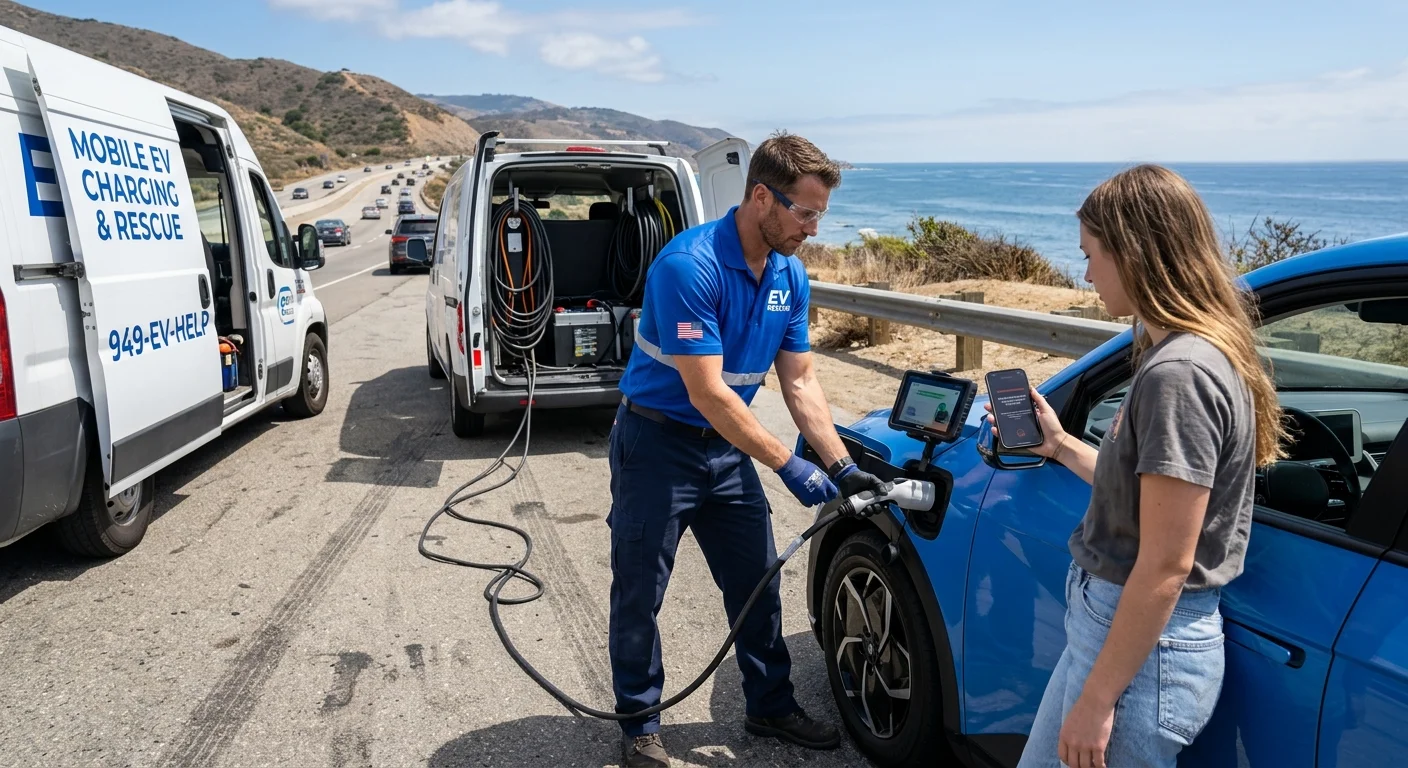
A jump doesn’t refill a traction pack. If the car showed zero before it quit, describe an out-of-charge EV. Independent operators bring a 240-volt Level 2 source to the bumper. They use a native NACS plug. Non-Tesla cars get a CCS or J1772 adapter. Typical charging adds about 10 to 20 miles of range. That takes 15 to 30 minutes of charging time. It isn’t an arrival time.
Mobile EV charging is the request to start with in that case.
When the warning doesn’t match a 12-volt failure, skip the jump. Water, salt spray, a storm soak, or a collision changes the call. Federal and fire-service guidance is clear on salt water. An EV soaked in salt water can face a delayed lithium-ion fire risk. Keep it away from buildings and other vehicles until it’s inspected. Don’t ask for a jump in that condition.
After Helene in late September 2024, Tampa Bay gauges recorded record storm surge. Milton followed in early October with heavy rain on St. Petersburg. If the car took salt water, say so before anyone connects a cable.
Name visible damage, smoke, heat, or odd smells up front. Those are conditions, not a diagnosis.
Low-clearance garages, stacked parking, and gated lots may need a different operator. The independent pro decides after they hear the details.
If the car can’t be made safe to drive, transport may be what’s left. Hillsborough and Pinellas both cap non-consensual tow rates at the county level. Hillsborough posts its cap through the Tax Collector’s vehicle-for-hire authority. Pinellas sets its cap in Ordinance 19-39. Exact dollar figures weren’t confirmed against the live schedules. Ask the tower for the filed rate. Check the county source before you pay.
Charge Pro TPA refers. The operator does the work
Charge Pro TPA is a referral line. We match stranded EV drivers with independent local mobile rescue operators across Tampa Bay. We don’t hold a trade license. We don’t own trucks or equipment. We don’t employ technicians. We don’t set prices. We don’t promise when someone will arrive.
You describe the car and the scene. We pass that request to an operator who can review it. The operator quotes you before any work starts. They bill you directly.
That operator may jump or replace a dead 12-volt on site. They may roll a Level 2 charge to the bumper. They handle Tesla and every major EV brand. They still need your model year and the warning text. Add the last charge reading and a pin-drop.
Keep the owner’s manual handy if you can. Model-specific jump steps live there. Our guide to jumping an EV without damage is background only. It doesn’t replace the book for your car.
For the wider roadside picture, use EV roadside assistance. Confirm the work, the price, and the terms with the operator before you approve anything.
If your EV won’t start and you need that match, call (813) 536-4545. Have the model, the warning, the last percent, and the exact road ready.