Your EV sat in a Tampa International Airport garage for a week. You come back and the screens stay black. Door handles don’t click, and the app won’t wake the car. The traction pack likely still has range left. That’s a dead 12-volt battery, not an empty pack. Here’s how to jump start an electric car without damage. You’re waking the small 12-volt system, not charging the pack.
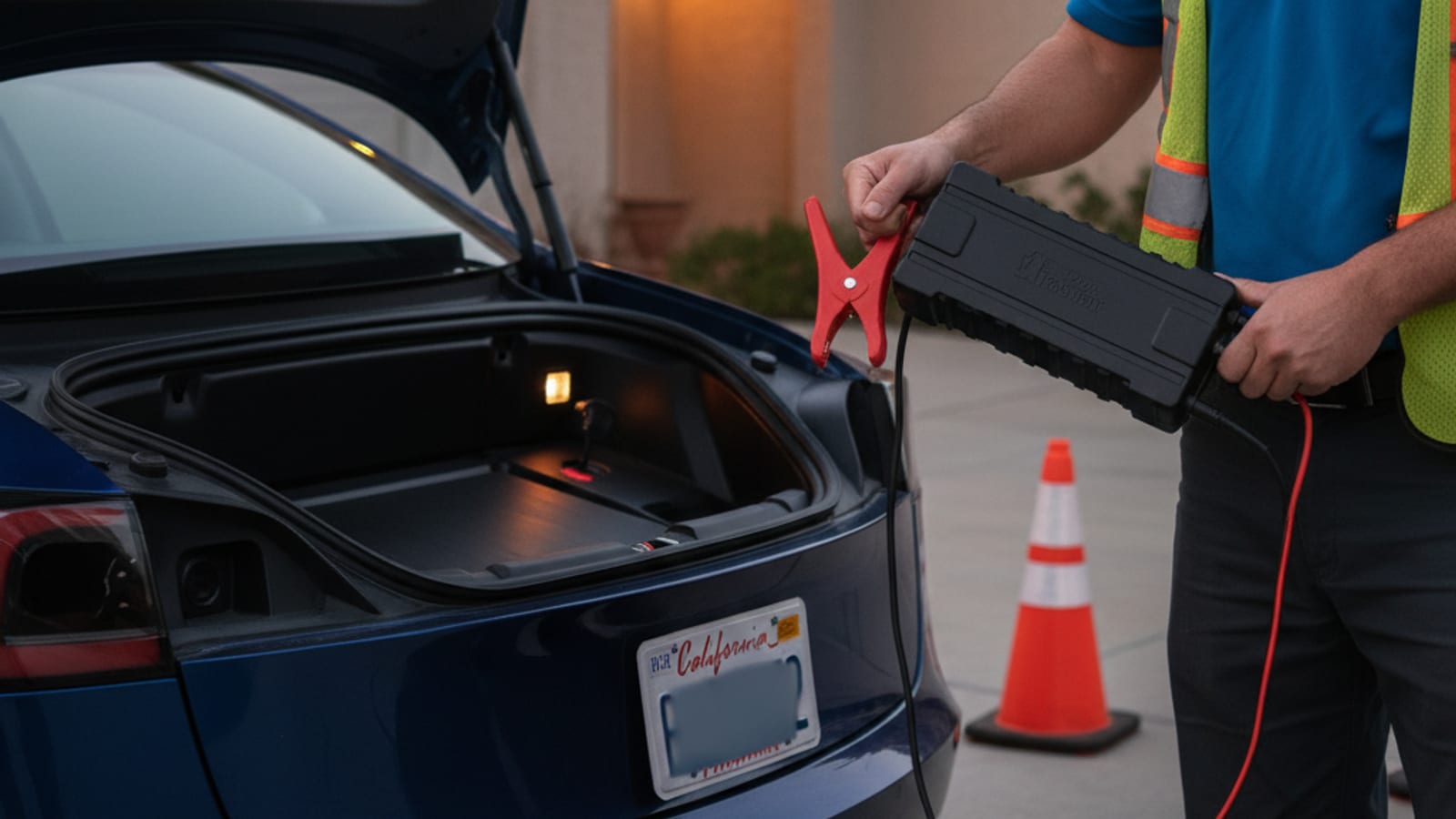
A week in a garage usually kills the 12-volt
Tampa International Airport publishes free EV charging at every on-airport garage. It’s in the cell phone lot too. The Economy Garage has Level 1 J1772 stations on the first floor. Long-Term Parking has Level 1 as well. Level 2 sits at the Cell Phone Lot. SkyConnect links the terminal to the Economy Garage and the Rental Car Center. Airport garage charging is the follow-up once the car will wake.
A car that sat through a flight is rarely out of charge. The 12-volt is the one that quits. The same week-long sit shows up after cruise parking at Port Tampa Bay. A hot parked sit in a driveway does it too. Westchase, Fish Hawk, and Lakewood Ranch have newer homes with 240-volt charging. That still doesn’t save a 12-volt that sat too long. Older housing in St. Petersburg and Lealman sees the same brick-car moment after a quiet week.
Tampa Bay’s air-conditioning season runs from spring into late fall. Recurrent Auto finds an EV loses about 5 percent of range at 90°F. Loss rises to 20 to 30 percent above 95°F. That figure is about the traction pack. A parked car in Tampa, St. Petersburg, or Clearwater cooks the small 12-volt even when the pack is full.
What that 12-volt actually does
There’s still a small 12-volt battery in every EV. That battery powers the screens, the door locks, and the computers that boot the car. It also closes the contactors that connect the traction pack. When it dies, the car won’t wake even with a full pack. A jump start is the right first move. What happens when an EV 12-volt dies maps that failure in more depth.
Don’t borrow a jump from a running gas car
A running gas car pushes about 13.8 to 14.8 volts from its alternator. Spikes can run higher across jumper cables. Gas 12-volt systems tolerate that surge. EV 12-volt systems feed a DC-DC converter, body modules, and the battery management system. A spike or reversed leads can damage those parts. Tesla’s published guidance warns against jumping from another vehicle. Don’t clamp onto a truck in a parking garage and hope.
Use a lithium jump pack, not cables to another car
The tool you want is a compact lithium pack with its own clamps. It feeds a controlled 12 volts at modest current. That’s enough to wake a dead 12-volt without an alternator spike. Pick a pack with reverse-polarity protection, and keep it in the frunk or cargo area. Keep it charged, and use one that refuses to fire if the clamps are backwards.
How to jump start an electric car
The sequence is the same on Tesla, Hyundai, Ford, and the rest. Only the access points change.
- Confirm the jump pack itself is charged. Charge it first if the status lights look weak.
- Find the EV’s marked 12-volt posts.
- Clip the red lead to the positive post. Wait for a good-connection light if the pack has one.
- Clip the black lead to the marked ground. Don’t clamp the negative battery post the gas-car way if a ground stud is labeled.
- Give it about 30 seconds to settle.
- Wake the car. Press a handle, try the app, or open the driver’s door.
- Once it wakes, leave the pack connected about two minutes so the DC-DC converter can take over.
- Pull the black lead first, then the red.
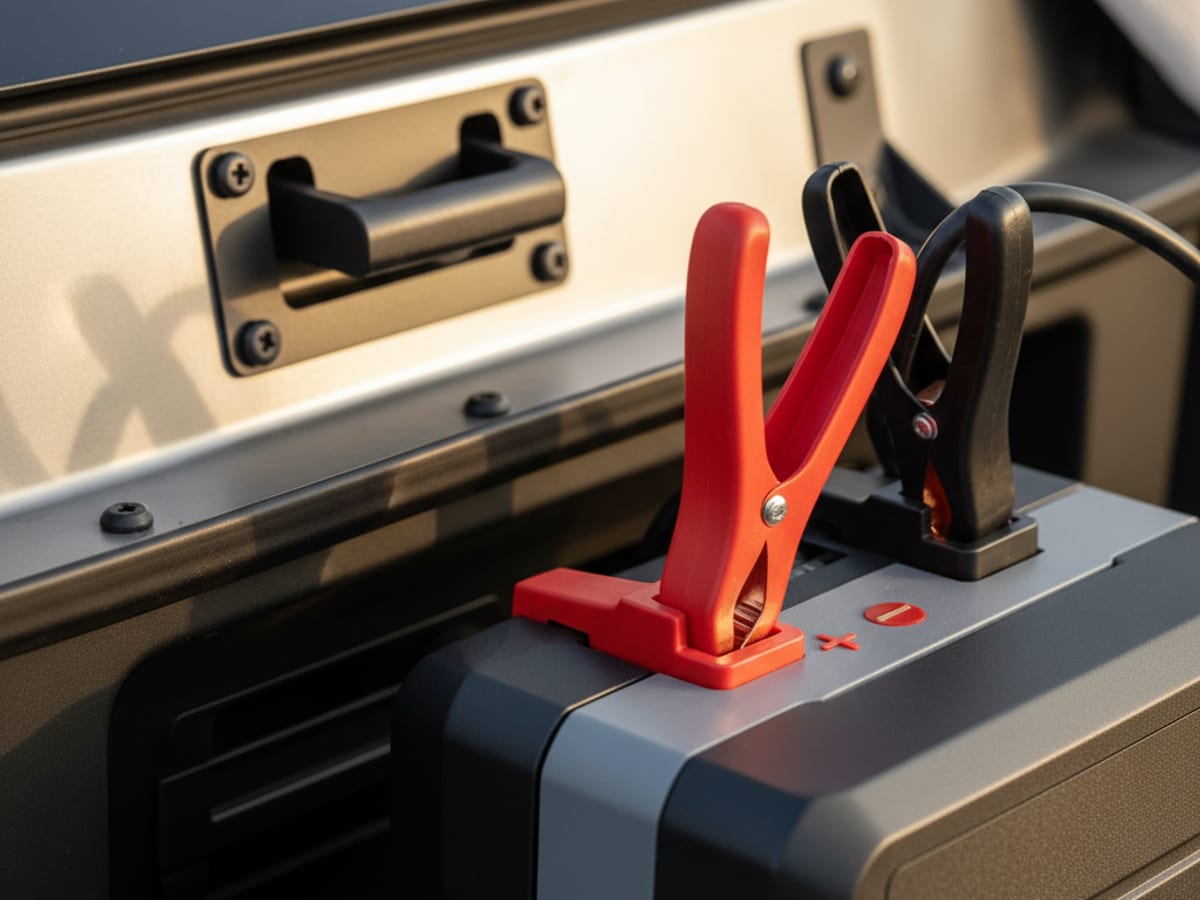
Red goes to the positive post, and black goes to the marked ground. Reverse that and you can destroy the converter that keeps the 12-volt alive. A modern pack should refuse to send current if the leads are backwards. Older cables won’t stop you, so check the labels twice before you clip.
Where the jump posts sit on common EVs
Hyundai Ioniq 5, Kia EV6, and Kia EV9
The 12-volt lives under the rear cargo floor. Jump posts sit up front in the under-hood bay. Use the red positive post and the marked ground bolt.
Ford Mustang Mach-E
The 12-volt is in the rear cargo area. Labeled jump posts are in the frunk. Open the frunk from the app if it still responds. If it doesn’t, use the manual cable behind a kick plate on the driver’s floor.
Tesla Model 3 and Model Y
On the driver’s side of the front bumper, pull the tow-eye cap. Two pigtail leads sit behind it, one red and one black. Clip the jump pack to those leads. After the frunk releases, you can open it and reach the real 12-volt. Tesla-specific jump steps walk through each model. A Tesla 12-volt jump from a local operator is the backup if you don’t have a pack.
Tesla Model S and Model X
On 2021 and newer cars, use the front door manual releases. Inside, pull the frunk release under the carpet and jump on the 12-volt terminals. Older Model S and X cars use tow-eye access on the front fascia, the same pigtail idea as the Model 3 and Y.
Rivian R1T and R1S
If the 12-volt is dead, the fob won’t pop the frunk. There’s a manual pull cord behind the grille. A small cover comes off with a Phillips screwdriver. Once you’re in, the 12-volt is under a panel on the passenger side. Clip to the positive post and the marked ground stud. Non-Tesla EV rescue covers Rivian, Ford, Hyundai, and the rest.
Ford F-150 Lightning
A dead 12-volt also kills the powered frunk release on the Lightning. The mechanical release is a pull loop under the front bumper. The 12-volt sits on the driver’s side once you’re in, with standard post terminals.
After the car wakes
Drive it, or plug it in at home. Either path lets the traction pack’s DC-DC converter recharge the 12-volt the right way. Don’t shut it down in the driveway and walk inside right away. If the 12-volt dies again the next day, it needs replacement. A jump is a temporary wake-up, not a repair. Watch for a dash message that the 12-volt needs service, or an app that drops the car while it’s parked. Replace that battery on your schedule, not after a week in the Economy Garage.
If you’re already on the shoulder
Florida Statute 316.194 lets you leave a disabled vehicle on the paved highway when you can’t get it off the roadway. A dead EV on a shoulder counts as disabled. Get it as far right as you can, and stay out of the travel lane.
FDOT Road Rangers in District 7 patrol I-4, I-75, and I-275, plus the airport interchange. Dial *347 from a mobile phone. They can jump-start a 12-volt battery, help with a tire, and move a disabled vehicle to a safer spot. Their published services include fuel, but they don’t list charging an EV. Use them for the 12-volt and for traffic safety, not for a traction-pack charge.
The Selmon reversible lanes are a worse place to sit. The Tampa Hillsborough Expressway Authority built that elevated segment with no local surface shoulder. It clears the lanes before each reversal. If the car is a brick there, treat it as a disabled vehicle and call for help. Don’t try a DIY jump in the travel path. Can roadside assistance jump-start an EV explains the 12-volt versus pack split.
When to call a local operator instead
Call if you don’t have a jump pack with you. Call if you jumped it and it won’t hold. Call if the traction pack is low too and you need a charge after the 12-volt wakes. Call if a Rivian or Lightning frunk is locked and you can’t find the manual release.
Charge Pro TPA is a referral line. It matches stranded EV drivers with independent local operators. The brand doesn’t own trucks and doesn’t send employees with tools. Operators bring a 240-volt Level 2 source to the car. They typically add 10 to 20 miles of range in 15 to 30 minutes of charging. That’s charging time, not an arrival time. They can also jump or replace a dead 12-volt on site. They quote you before they start, and they bill you directly.
For the broader help menu, see EV roadside assistance. If you’re stuck and you need a person with a pack, call (813) 536-4545.