A Hyundai Ioniq 6 that sat in Tampa Bay heat, or in a closed garage, and then won’t start is almost never an empty traction pack. The 12-volt auxiliary battery is what boots the computers. When that small battery is flat, the sedan stays dark. The key fob, the start button, and the door handles all go quiet.
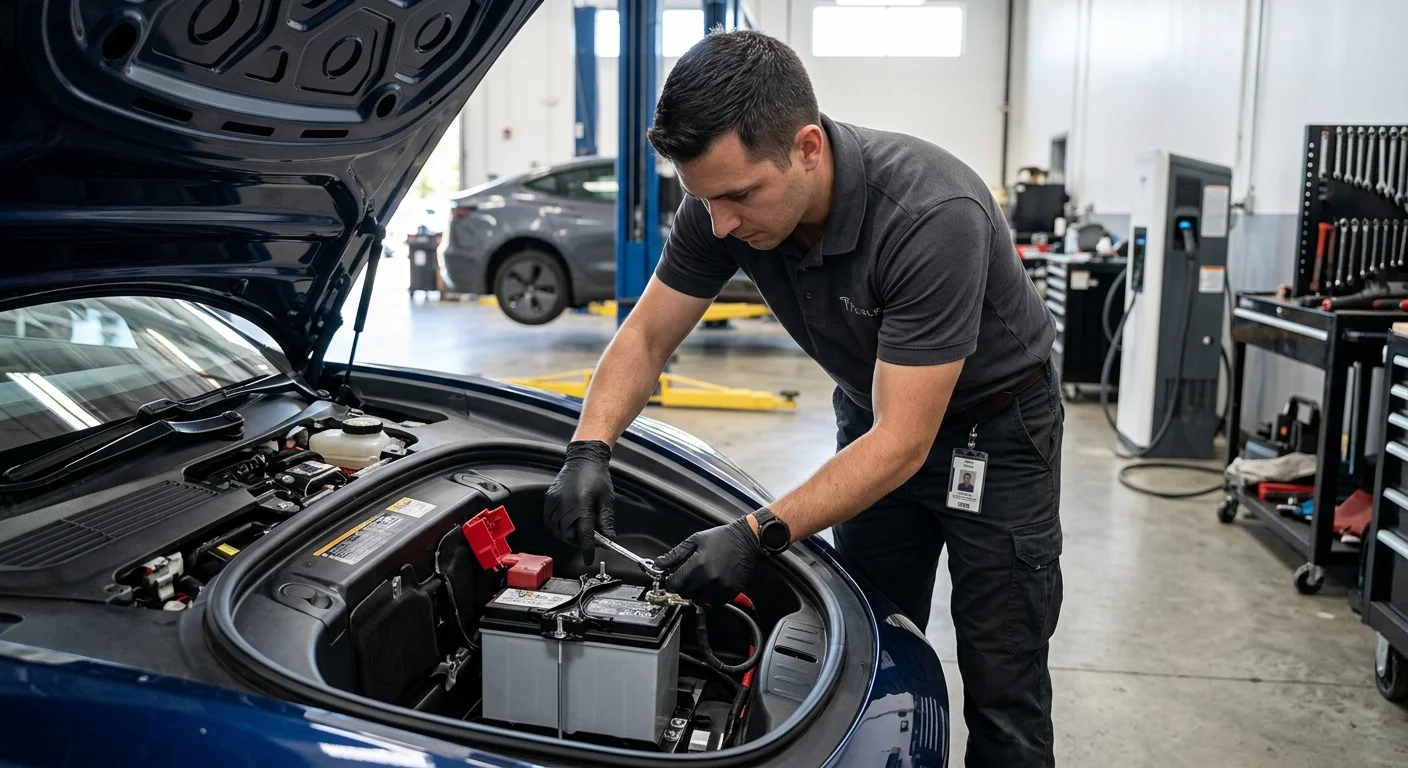
The 12-volt is what actually starts the car
The Ioniq 6 runs two electrical systems that owners mix up. The high-voltage pack under the floor turns the motors. A small 12-volt AGM battery runs locks, screens, and lights. It also powers the modules that talk to each other. Without that 12-volt feed, the high-voltage system never gets a wake-up command. A pack with range left doesn’t save you.
This sedan shares Hyundai’s E-GMP architecture with the Ioniq 5. The crossover hits the same dark-car moment. The sedan stores the 12-volt in a different place, covered below. You park, the auxiliary battery drains, and the vehicle goes mute.
Hyundai’s battery management can stop topping off the 12-volt. That happens when the traction pack is critically low. A few days of sitting then finishes the drain. You return to a car that looks bricked. The pack still holds energy the computers can’t use.
What happens when an EV 12-volt battery dies covers the full cascade.
Why Tampa Bay heat makes this worse
Recurrent Auto’s published research is the range figure people cite. An EV loses about 5 percent of range at 90°F. Above 95°F the loss jumps to 20 to 30 percent. Near 100°F it’s roughly 17 to 18 percent, and it varies by model. Cabin cooling is the rest of the daily story. Tampa Bay’s air-conditioning season runs from spring into late fall. That load hits the pack on every drive. It also keeps the 12-volt in a hot trunk.
Inland Hillsborough runs hotter than the gulf side. A driveway in Plant City or Valrico cooks an AGM battery. Coastal salt air is a second wear factor. How Tampa Bay heat and salt air wear down an EV battery covers that climate wear.
Florida is one of the most lightning-prone metros in the country, per Vaisala. Storm weeks mean more days the Ioniq 6 sits unused. Hurricanes Helene and Milton in 2024 left cars sitting through surge and heavy rain in St. Petersburg. A 12-volt that already lived in heat doesn’t like long idle time.
If salt water reached the car, treat it as a safety issue. Federal and fire-service guidance warns about later lithium-ion fires after saltwater soaking. Keep the car away from structures and other vehicles until a shop inspects it.
A week in an airport garage is the classic setup
Tampa International Airport publishes free EV charging at all on-airport parking garages and the cell phone lot. The Economy Garage has Level 1 J1772 stations on the first floor. Level 1 charging is also in the Long-Term Parking Garage. Level 2 is at the Cell Phone Lot. SkyConnect links the main terminal to the Economy Garage and the Rental Car Center.
Use that charging when you leave the car. A week in the Economy Garage still produces a dark Ioniq 6. That’s more often a dead 12-volt than an empty pack. Heat and small accessory draws finish the 12-volt while the car sits. Tampa International Airport EV charging covers the garages and that dead-12-volt return.
Cruise parking around Port Tampa Bay follows the same sit-and-return pattern. Terminal parking and any EV charging there were not verified on a primary page. Confirm the lot’s own rules before you leave the car. The 12-volt still ages in a closed sedan either way.
Pinellas condo owners live a related version. Florida Statute 718.113(8) gives a unit owner the right to install a charger in their exclusive space. Until that station exists, long sits are how 12-volt batteries die.
Where the Ioniq 6 hides the 12-volt
The Ioniq 5 keeps its 12-volt under the hood. The Ioniq 6 sedan keeps it in the trunk instead. Open the trunk and pull back the cargo floor liner on the driver’s side. The AGM battery sits under that trim. Don’t clamp jumper cables onto those trunk posts.
Jump points are under the hood, which still opens. Use the interior release to pop it. On the driver’s side of the bay you’ll find a black fuse box cover. A red cap hides the positive jump terminal. Ground is an unpainted chassis bolt, not the battery’s negative post in the trunk.
| Location | What you’ll find |
|---|---|
| Trunk, driver’s side under the liner | The 12-volt AGM battery itself |
| Under the hood, driver’s side fuse box | Positive jump terminal under a red cap |
| Engine bay chassis | Unpainted bolt for the negative clamp |
| Instrument cluster, when the car is awake | Auxiliary battery save setting |
What to check when a Hyundai Ioniq 5 won’t start is the crossover twin if your household has both.
The auxiliary battery save setting
The Ioniq 6 has an auxiliary battery save mode that the Ioniq 5 doesn’t present the same way. You turn it on from the instrument cluster while the car is still awake. It limits 12-volt draw when you’re parked with screens on. Same idea if you’re sitting in the cabin with the drivetrain off.
It won’t revive a battery that’s already dead, so use it before a long wait. The menu path is usually Settings, then Vehicle, then Auxiliary Battery. Trim and software versions move that label. Hunt vehicle settings if you miss it on the first try.
A wait at TPA’s cell phone lot is a good time to use it. So is sitting in Town ‘n’ Country heat before a pickup. The setting is cheap insurance, not a repair.
How to jump the Ioniq 6 without frying it
Use a portable jump pack or a second vehicle with cables. Use only the hood terminals.
- Pull the interior hood release and open the hood.
- Find the black fuse box cover on the driver’s side of the bay.
- Lift the red cap to expose the positive terminal.
- Clamp the red lead to that terminal.
- Find a bare, unpainted metal bolt on the chassis. A strut tower or firewall bolt is typical.
- Clamp the black lead to that bolt. Don’t use the trunk battery’s negative post.
- If a donor car is supplying power, hook its battery last. Go positive to positive and negative to negative, then start the donor.
- Give the Ioniq 6 a couple of minutes to take a charge.
- Press start. The boot sequence can run longer than usual after a dead 12-volt.
If it wakes, get it to a charger. One jump doesn’t rebuild a tired AGM. If it dies again soon after, the battery needs replacement, not another clamp. How to jump start an electric car without damage is the generic EV procedure.
Don’t jump from another EV’s high-voltage system. The 12-volt is the only battery you’re waking.
If you’re on a Tampa Bay road, not in a driveway
A dead Ioniq 6 on a paved highway is a disabled vehicle. Florida Statute 316.194 lets you leave a vehicle that can’t be moved off the traveled way. Get it as far onto the shoulder as you can. Stay out of travel lanes and use Florida 511 for conditions.
FDOT Road Rangers in District 7 patrol I-4, I-75, I-275, and the airport interchange. Dial *347 from a mobile phone. They publish jump-starts, fuel, tires, and moving a disabled vehicle. The materials reviewed describe fuel and a 12-volt jump. They don’t list charging an EV. A Road Ranger can still be the right first call for a 12-volt jump. Don’t expect a Level 2 charge from that patrol. Florida Highway Patrol Troop C covers incidents on these interstates.
The Selmon Expressway’s reversible express lanes are a worse place to go dark. THEA’s REL is a roughly 10-mile elevated segment between Brandon and downtown Tampa. Direction reverses through the day, westbound into downtown from about 5 a.m. to noon, then eastbound. Lanes are cleared before each reversal. There’s no local surface shoulder on the elevated span. If the Ioniq 6 dies there, stay with THEA traffic control.
The Sunshine Skyway on I-275 is four miles of bridge with almost nowhere to stop. The main span sits 432 feet above the channel. FHP closes it at sustained 40 mph winds, or fog below about 100 feet. A dark sedan on that span is a safety problem first.
Veterans Expressway and the Suncoast Parkway are all-electronic Turnpike roads. The Suncoast through Pasco has widely spaced exits. Heat and AC drain the pack. Grade never gives range back.
Florida Statute 715.07 controls tows from private property. Hillsborough and Pinellas both cap non-consent tow rates at the county level. Confirm the live posted schedule with the county.
What a mobile rescue actually does
Charge Pro TPA is a referral line. It matches you with independent local operators. The brand doesn’t own trucks, doesn’t employ technicians, and doesn’t set prices. The operator quotes you before work starts and bills you directly.
For a dark Ioniq 6, the usual job is a 12-volt jump or a replacement on site. If the traction pack is also low, the operator can bring a 240-volt Level 2 source to the bumper. Native NACS, or a CCS or J1772 adapter for this Hyundai. Typical add is 10 to 20 miles of range in 15 to 30 minutes of charging. That’s charging time, not a promise of when someone arrives.
Hyundai uses CCS on the Ioniq 6, so you want non-Tesla EV rescue, not a Tesla-only dispatch. The same 12-volt pattern shows up on the Kona Electric and other E-GMP cars.
Home charging still matters after you get moving. TECO serves Tampa and most of Hillsborough. Duke Energy Florida serves Pinellas and much of Pasco. Northern and central Pasco is often Withlacoochee River Electric Cooperative, not TECO or Duke. Duke publishes a Charger Prep Credit and an Off-Peak Charging Credit. Florida has no state EV purchase rebate.
Checks before you call
Work through these in order if the car is in a safe place.
Listen for any click or screen flash when you press start. Total silence points at the 12-volt, not the pack. Try the key fob from a few feet. A dead 12-volt often kills wireless unlock too. If you’re on an interstate shoulder, call *347 first for a safer setup.
The Ioniq 6 won’t tell you a clean story when it’s fully dark. No cluster means no auxiliary battery warning. You diagnose by behavior: dark car, recent sit, hot day, garage or airport week.
Frequently asked questions
Why won’t my Hyundai Ioniq 6 start after it sat in the heat?
The 12-volt auxiliary battery is the usual cause. Heat in the trunk ages that AGM unit. After a sit, it can’t wake the computers. The traction pack can still show charge once the car is alive. Jump the hood terminals, then get the 12-volt tested.
Where do you jump a Hyundai Ioniq 6?
Positive is under the hood, driver’s side fuse box, under the red cap. Negative is a bare chassis bolt in the engine bay. The real battery is in the trunk on the driver’s side. Don’t clamp the cables there.
Can the Ioniq 6 be dead when the main battery still has charge?
Yes. The 12-volt runs the computer that boots the high-voltage system. If that small battery is flat, the pack is locked out. A full traction battery won’t start the car by itself.
If the sedan is dark in Tampa, St. Petersburg, Clearwater, or anywhere else in the service area, call (813) 536-4545. An operator will quote the 12-volt jump or a Level 2 charge before any work starts.