Tampa Bay heat and salt air wear an EV pack hard. Recurrent Auto measured about 5 percent range loss at 90°F. The loss jumps to 20 to 30 percent above 95°F. Summer afternoons here sit in that second band for months. The air-conditioning season runs from spring into late fall. Electric vehicle battery maintenance in this metro is heat, cooling, and salt. Hills never enter the picture on this flat coast.
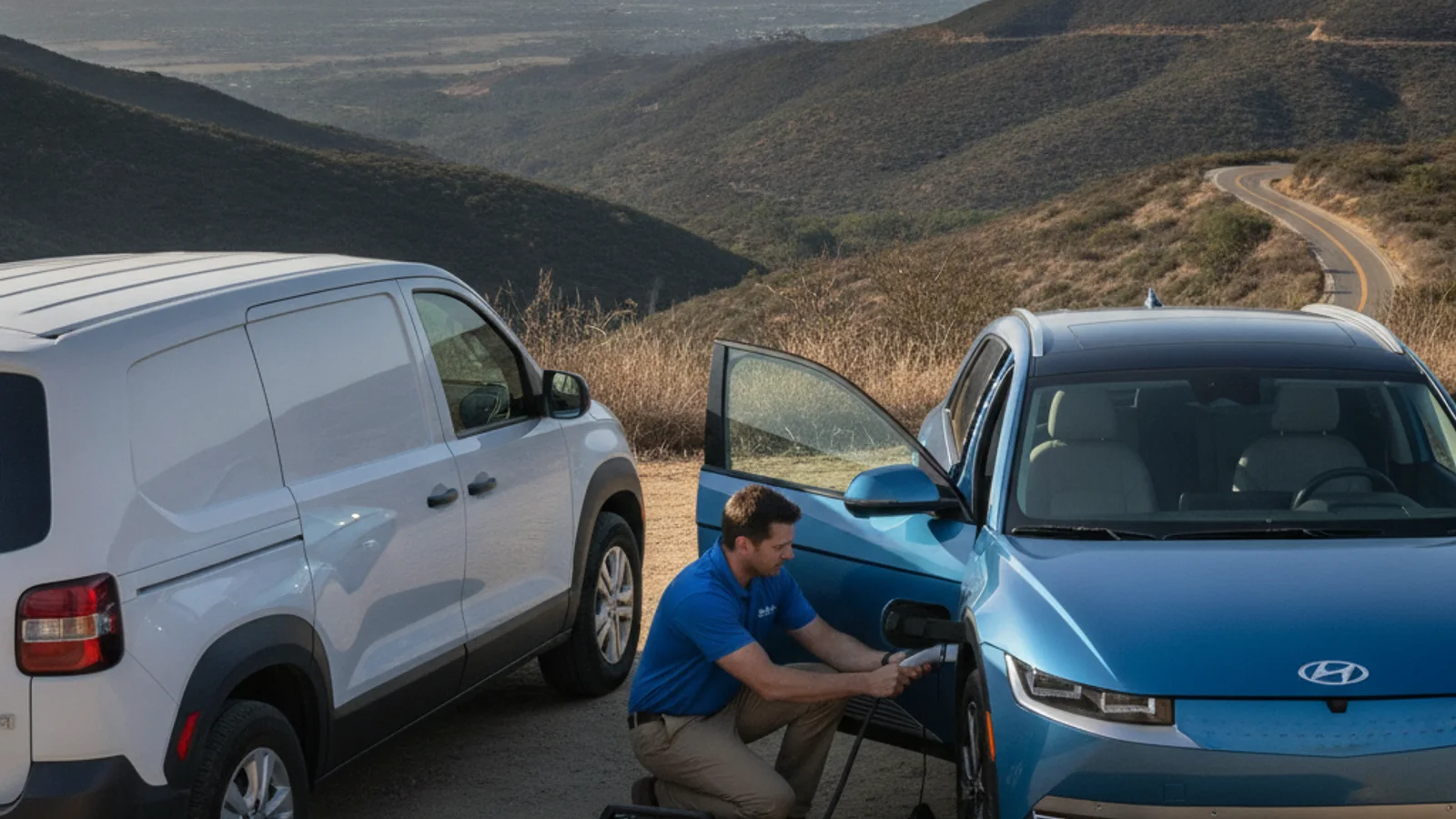
Heat cuts range here. Grade never gives it back
Tampa Bay is flat and near sea level. A long climb never restores what the AC spent. Recurrent also reports roughly 17 to 18 percent loss near 100°F. That hit still varies widely by model and pack. We can’t confirm one number for every EV in this metro. Tesla, Rivian, Ford, Hyundai, and Chevy packs don’t age as one fleet. Your owner’s manual and the maker’s app are the sources for your car.
Gulf neighborhoods in St. Petersburg still run the compressor all afternoon. Inland Hillsborough often feels hotter once the bay breeze drops. Westchase, Riverview, Valrico, and Plant City sit in that inland heat. South county towns like Ruskin, Apollo Beach, and Gibsonton add humidity. Pasco trips on the Suncoast Parkway and US-19 carry the same AC load. There’s no elevation to harvest on the way home.
Cooling comes first on I-275, I-75, and I-4 in summer. That drop is weather, not a failed pack. Tesla owners can start with How long a Tesla charge lasts in Tampa Bay heat.
Salt air, surge, and a soaked pack are different problems
Daily salt spray along Pinellas and the gulf beaches is a corrosion job. Charge ports, door contacts, and underbody hardware live in that air. Wipe the port when you see spray or rain sitting in it. Dry the port before you plug in for the night.
Storm surge is a separate, more serious category. Hurricane Helene in late September 2024 drove record surge at Tampa Bay tidal gauges. St. Petersburg faced a forecast of 5 to 8 feet. Barrier islands from the Dunedin Causeway through Tierra Verde were closed. Hurricane Milton in early October 2024 largely spared Pinellas a second surge. It still dropped at least 18 inches of rain on parts of St. Petersburg. It tore part of the roof off Tropicana Field.
Low-lying Pinellas and the barrier islands sit in evacuation zones. So do Ruskin, Apollo Beach, and Gibsonton in south Hillsborough. Leaving on a low pack during that week is a real local scenario.
Federal and fire-service guidance warns about salt-soaked EVs. A pack soaked in salt water can suffer a lithium-ion fire days later. Keep that vehicle away from structures and other cars until it’s inspected. We could not confirm a specific distance on a readable federal page. Don’t treat a soaked pack as a driveway maintenance item.
Lightning is part of the same long storm season that soaks ports. Vaisala data makes Tampa Bay one of the most lightning-prone metros in the country.
The 12-volt battery fails first more often than the pack
Owners mix the two batteries, then chase the wrong fix. The traction pack is the large battery that moves the car. It shows up as the range number on the dash. When it runs down, you get warnings, then the car stops moving.
The 12-volt battery is a much smaller unit. It runs locks, the screen, and the computer that wakes the pack. When that battery dies, the car can look fully dead with a full pack. Doors may not answer, and the screen stays dark.
Heat in this metro shortens 12-volt life more than owners expect. A car that sits in a garage for days is a classic 12-volt case. Tampa International Airport publishes free EV charging at on-airport parking garages. The cell phone lot publishes charging as well. An EV left there a week that comes back dead is usually the 12-volt. It’s not an empty pack in most of those cases.
If the car is silent and range looked fine, start with the 12-volt. A Tesla 12-volt jump is the roadside path for that failure. The same pattern shows up on non-Tesla EVs too.
Electric vehicle battery maintenance starts in the manual
Every maker publishes its own traction-battery care guidance. Tesla, Rivian, Ford, Hyundai, Chevrolet, and Kia don’t share one charge-limit rule. Chemistry differs by model and by model year. Software updates can change that advice without a shop visit. We can’t confirm a metro-wide degradation rate that fits every pack. We can’t confirm an ideal percentage or a single charging window either. A post that hands you that number is guessing.
Use the glovebox schedule for items that aren’t the pack. Tire rotation, cabin filters, and brake fluid still matter in this heat. Our EV maintenance schedule: what every Tampa Bay owner should track covers those.
Read How long Tesla batteries last when Tampa Bay heat never really lets up next. Warranty questions belong with the maker or an authorized service center. The independent operators we connect you with get you moving again.
Home charging habits matter more than a special chemistry
Florida has no state EV purchase rebate or tax credit. Utility programs are the incentives that actually exist.
Tampa Electric serves the City of Tampa and most of Hillsborough County. It also serves parts of Pinellas and southern Pasco. Its Drive Smart program is a commercial and public charger incentive. A named residential home-charger rebate wasn’t found on TECO’s primary pages. Confirm current offers with TECO before you count on one.
Duke Energy Florida serves Pinellas County and much of Pasco. It publishes a Charger Prep Credit for Level 2 wiring and electrical upgrades. That credit doesn’t cover the charger hardware or permits. It also publishes an Off-Peak Charging Credit for charging in off-peak windows. Confirm the current credit and windows with Duke before you plan around them.
North and central Pasco is often Withlacoochee River Electric Cooperative. Call WREC if that’s the co-op on your bill.
Westchase, Fish Hawk, and Lakewood Ranch have very little pre-1980 housing. 240-volt home charging is near-universal in those master-planned streets. Older stock in Lealman and St. Petersburg is a different wiring picture. Pinellas condos and beach HOAs often share parking. A charger in that lot takes a process. Florida Statute 718.113(8) covers a condo owner’s EV charging-station right. It has to sit within the limited common element or an exclusive parking space. A declaration can’t be enforced to prohibit a properly submitted request. The owner pays for installation, operation, maintenance, insurance, and separately metered electricity.
Park in shade when you can find it. Precondition the cabin while you’re still plugged in. Follow the charge limit your maker publishes for daily use. None of that is a verified life-extension percentage. It’s the habit set that matches this climate.
Empty pack, dead 12-volt, or a shop visit
A range drop on a 95°F afternoon is often weather and AC. Plug in if you can, and cool the cabin. See if the estimate returns as the pack cools. If you’re already on the shoulder, that’s a recovery call. It’s not the moment for a maintenance lecture.
Florida Statute 316.194 covers a disabled vehicle on a highway. You may stay on the pavement when you can’t get the car off. A dead EV on a shoulder qualifies under that rule. FDOT Road Rangers in District 7 patrol I-4, I-75, and I-275. They also cover the airport interchange on that beat. Reach Road Rangers at *347 from a mobile phone. They publish flat-tire help, a 12-volt jump, fuel, and water. They also publish two local calls and a move to a safer spot. Their published services don’t include charging an EV.
The Sunshine Skyway is a bad place to learn any of this. The main span sits 432 feet above the channel. Florida Highway Patrol closes the bridge when winds reach sustained 40 mph. It also closes when fog cuts visibility below about 100 feet. The span is about 4 miles of bridge with no place to stop.
If the traction pack is empty, ask for out-of-charge recovery. Independent operators bring a 240-volt Level 2 source to the car. They use a native NACS plug on Teslas. Non-Tesla EVs get a CCS or J1772 adapter. They typically add 10 to 20 miles of range. That takes 15 to 30 minutes of charging, not travel time. The operator quotes you before work starts and bills you directly. The operator decides on scene whether a charge gets you to a compatible station.
If the 12-volt is the problem, a jump on site is usually faster. If the car charges, drives, and wakes normally, pack-health questions belong at a shop. State of health tests, warranty claims, and pack replacement sit with the manufacturer. Roadside help doesn’t replace that shop visit at all.
Use EV running low on battery: what to do in Tampa Bay heat next.
When to call
If the pack is empty somewhere in Tampa Bay, that’s a roadside situation. So is a car that won’t wake when you suspect the 12-volt. Charge Pro TPA matches you with independent local mobile rescue operators. We don’t own trucks, and we don’t set prices. Call (813) 536-4545 to reach the referral line. We’ll connect you with a local operator who quotes before starting.