The usual reason a Hyundai Kona Electric won’t start after sitting between errands is a dead 12-volt. That pattern is common in Tampa Core and Pinellas neighborhoods. The traction pack can still hold a healthy charge. The computers that wake the high-voltage system lost their small battery. A jump often brings the car back once the terminals are connected.
Hyundai sells the Kona as a gas car, a hybrid, and a battery EV. This page is only for the electric Kona. If yours has a fuel door and a real engine, treat it like a stalled gas car. A standard jump or tow is the right call, not an EV charge truck.
Older Kona Electrics, especially 2018 through 2021, go dark after a sit more often than newer EVs. Tampa Bay heat ages an AGM 12-volt faster than a mild climate. Recurrent Auto’s published research finds an EV loses about 5 percent of range at 90°F. Loss climbs to 20 to 30 percent above 95°F. Cabin electronics still sip 12-volt power while you run the AC on short hops through Tampa or across the peninsula. The small battery takes the hit first. The pack you worry about is often still fine.
Dark dash or empty pack: tell them apart
You waste a call if you ask for a mobile charge when you need a 12-volt jump. You also waste a jump if the traction pack is empty. Use the car’s behavior, not a guess.
A dead 12-volt usually means nothing wakes. The dash stays black. The fob doesn’t unlock. Interior lights ignore the door. The charge-port door may not even unlatch. You press Start/Stop and get silence.
An empty traction pack still talks to you. Warning lights come on. Range messages showed up before you stopped. The car may have driven a few miles, then quit. The port will often still accept a cable.
Both problems can keep the Ready light off. That’s why the rest of the cluster matters. For a wider picture of this failure, read what happens when an EV 12-volt battery dies.
If you still have dash warnings about low drive battery, you need mobile EV charging, not cables on the posts.
Where the 12-volt sits on a Kona Electric
Many EVs hide the auxiliary battery in the frunk or under the cargo floor. The Kona Electric puts it in the engine bay, driver’s side, toward the rear of the compartment. It’s a standard 12-volt AGM, about the size of the battery in a compact gas car.
If the 12-volt is only weak, the interior hood release still works. If it’s fully dead, the latch may not fire. Check the owner’s manual for the emergency hood release. It’s often a pull cord near the driver-side fender, reached through the grille.
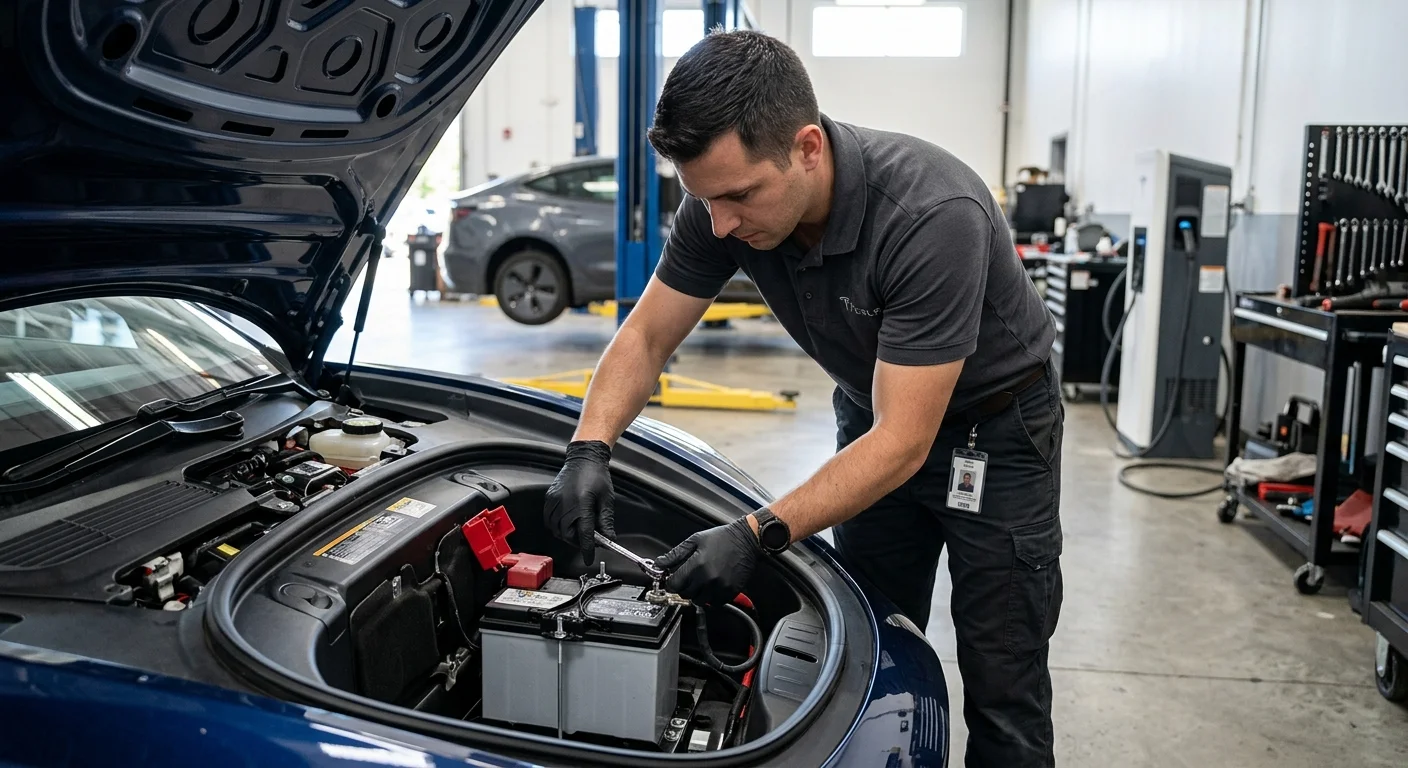
Once the hood is up, look to the rear driver’s side of the bay. The battery sits in a plastic tray with a strap or bracket. The positive post has a red cap. The negative is usually bare or under a black cap. The space is tight. Gloves and eye protection are worth the extra minute.
The Kona is easier to jump than many EVs because you can actually see the battery. Still, Hyundai wants you on the dedicated jump terminals, not the battery posts, when you can use them.
The 12V Battery Save setting
Starting with the 2019 model year, Hyundai added a 12V Battery Save function on the Kona Electric. It tries to stop a full drain from leaving the car unable to wake.
Look under Settings, then Vehicle, then Charge Settings. The label reads 12V Battery Save on most trims. Wording shifts a little by year.
When it’s on, the car pulls a little current from the high-voltage pack. That tops up the 12-volt if it falls too low. That’s a rescue, not a lifestyle. It’s meant to get you to a charger or a service appointment.
It won’t appear on a black screen. If the 12-volt is already dead, the display has no power. You need an external jump first. The feature also doesn’t replace a failing battery. If you keep turning it on, the 12-volt is aging out. After a jump on an older battery, turn Save on for the drive home. Then plan a replacement.
Sleep-mode behavior on early Kona Electrics is less aggressive than on some later EVs. Background systems can keep sipping power after you park. Software updates have changed that behavior on some cars. If a recent update was followed by a 12-volt that dies within days, tell the Hyundai dealer. Bring the date of the update with you.
How to jump a Kona Electric
Use a portable jump pack or a gas car with standard cables. Don’t use a second EV as the donor. EVs aren’t built to source current that way, and the donor can throw fault codes.
The Kona uses dedicated jump terminals under the hood.
- Open the hood. Use the emergency release if the interior handle does nothing.
- Pull the red cap off the positive terminal on the fuse box cover, driver’s side of the bay.
- Find a clean, unpainted metal ground on the chassis. A bolt on the shock tower works. Skip the battery’s negative post if you can.
- Clamp positive to the Kona’s positive terminal, then to the pack or donor positive.
- Clamp negative to the pack or donor negative, then to the Kona chassis ground.
- Let current flow for a couple of minutes before you try Start/Stop.
- Foot on the brake, then press Start/Stop. The Ready light should come up in a few seconds.
Once it’s awake, drive to a Level 2 charger and leave it plugged in for at least an hour. The traction pack trickle-charges the 12-volt while you’re connected. If the 12-volt dies again within a day or two, the battery itself is done. A jump is only a bridge.
Safety notes that apply across brands are in how to jump start an electric car without damage.
Short trips in Tampa Core and Pinellas
The pattern that kills older Kona 12-volts here isn’t a long highway run. It’s the opposite. You park at home, run an errand, sit in heat, then the car refuses to wake.
Short hops in Tampa Core, Carrollwood, Town ‘n’ Country, or across St. Petersburg often last under twenty minutes. The traction pack never gets a long session to top up the 12-volt. Cabin cooling still runs hard. Recurrent Auto’s heat numbers are about range, but the same climate cooks an AGM in the bay. A battery that’s three or four years old can drop without a warning you noticed.
Pinellas housing is older in places like Lealman and much of St. Petersburg. Many condos still depend on a shared pedestal or public charging. Florida Statute 718.113(8) gives a condo owner the right to install a station in their exclusive space. The board can’t block a properly submitted request. The owner pays for install, power, and insurance. A Kona that only sees short public sessions and long sits is a 12-volt candidate.
Newer pockets like Westchase, Fish Hawk, and Lakewood Ranch usually have Level 2 at home. The 12-volt still dies if the car sits through a hot afternoon between school runs. Overnight charging helps. A week in a dark garage does not.
TECO serves Tampa and most of Hillsborough. Duke Energy Florida serves Pinellas and much of Pasco. North and central Pasco drivers are often Withlacoochee River Electric Cooperative members. Home programs like Duke’s Charger Prep Credit and Off-Peak Charging Credit help overnight Level 2. None of that helps in a dark lot. It does change whether your 12-volt gets a full overnight top-up.
Tampa International Airport publishes free EV charging in on-airport garages and the cell phone lot. Level 1 J1772 sits in the Economy Garage and Long-Term Parking. Level 2 is at the Cell Phone Lot. A car that sat a week and comes back dark is almost always the 12-volt, not a drained pack. A failed 12-volt won’t let the car accept a session even if a cable is waiting.
If you’re stuck on a Tampa Bay road
A dead Kona on a shoulder is a disabled vehicle. Florida Statute 316.194 wants you off the paved travel lanes outside a municipality when you can move. Subsection (2) exempts a vehicle disabled on the pavement when you can’t avoid leaving it. Stay out of live lanes. Put the hazards on if they still work.
FDOT Road Rangers in District 7 patrol I-4, I-75, and I-275, plus the airport interchange. Dial *347. They publish flat-tire help, a 12-volt jump, fuel, two local calls, and moving a disabled vehicle to a safer spot. Their published list doesn’t include charging an EV. Use them for a jump and for traffic control. The District 7 desk is the Tampa Bay SunGuide Center.
Florida Highway Patrol Troop C covers disabled vehicles on the interstates. On the Selmon Reversible Express Lanes there is no local surface shoulder on the elevated segment. Those lanes are cleared of all traffic before each reversal. A dark Kona up there is a hazard, not a wait-it-out moment. The Sunshine Skyway is a long, high span with nowhere useful to sit. If the car dies on I-275 between Tampa and Pinellas, stay with the vehicle if it’s safe.
Private lots follow Florida Statute 715.07. Property owners can tow unauthorized vehicles when the signs meet the statute. Confirm the posted yard rates with the county and the yard before you pay. Call for help that can work on the car where it sits.
Independent operators in the Charge Pro TPA network handle non-Tesla EVs, including every Kona Electric year. They can jump the 12-volt on site. They can bring a 240-volt Level 2 source if the pack is the problem. Native NACS, CCS, or J1772 adapters cover the plug. Typical on-site charging adds about 10 to 20 miles of range in 15 to 30 minutes of charging time. That’s charging time, not an arrival time. The operator quotes you before work starts and bills you directly.
Non-Tesla EV rescue is the service page if the Kona is the car. If a Hyundai Ioniq 5 in the same driveway has the same dark-dash pattern, see what to check when a Hyundai Ioniq 5 won’t start.
Federal and fire-service guidance warns that an EV soaked or submerged in salt water can suffer a lithium-ion fire later. Keep it away from structures and other vehicles until it’s inspected. A 12-volt jump isn’t the fix for a flooded pack.
If a proper jump still does nothing, the 12-volt may not hold any charge. A blown fuse in the junction box is another common stop. A BMS communication fault is less common, and it keeps the high-voltage system from enabling. Those cases usually need a tow to a Hyundai dealer or an EV shop. Ask the operator on site whether the car will move under its own power before you authorize a hook.
After it starts, stop the next sit from killing it
Enable 12V Battery Save. Plug into Level 2 when you can, even after a short errand day. Replace a 12-volt that’s already failed once in this heat. Waiting for a second failure is how people get stuck in a Clearwater lot or a Tampa garage after dark.
If the Ready light returns and then the car dies again a block later, the battery isn’t holding. Drive it to a shop if it will stay awake. Don’t keep jumping it in place.
Charge Pro TPA matches stranded EV drivers with independent local mobile rescue operators. We don’t own trucks and we don’t do the work. If the Kona is dark and you’re in Tampa Bay, call (813) 536-4545. Tell the operator whether the dash is black or full of warnings. That one detail decides jump versus a roadside charge.
Frequently asked questions
How do you jump start a Hyundai Kona Electric?
Use a portable jump pack on the dedicated positive terminal under the fuse box cover in the driver-side engine bay. Ground the negative clamp on clean chassis metal, not the battery post if you can avoid it. Wait a couple of minutes, then press Start/Stop with your foot on the brake. Don’t use another EV as the donor. After it starts, plug into Level 2 so the system can recharge the 12-volt.
Why does the Kona Electric 12-volt drain so fast here?
Early Kona Electrics, especially 2018 through 2021, keep more background systems awake than some later EVs. Short errand loops in Tampa Core and Pinellas never give the pack a long session to top the 12-volt. Tampa Bay heat ages AGM batteries. Recurrent Auto’s research is about range loss in high temperatures, but the same climate is hard on the small battery in the bay. If Save mode is on all the time, replace the 12-volt.
What does 12V Battery Save do on a Kona Electric?
It pulls a little power from the high-voltage pack to keep the 12-volt above a minimum. You’ll find it under Settings, Vehicle, Charge Settings on most trims. It’s protection, not a new battery. If the dash is already dark, the menu isn’t there. Jump first, then turn it on for the drive to a charger or the dealer.