A Hyundai Ioniq 5 that won’t start after a short Tampa Bay trip almost always has a heat-soaked 12-volt battery. The traction pack can still hold plenty of miles. The small battery boots the computers that bring the high-voltage system online. When that 12-volt pack sags in the heat, the car stays fully silent. A local operator can jump the underhood posts on site. They can also swap the battery if it won’t hold a charge.
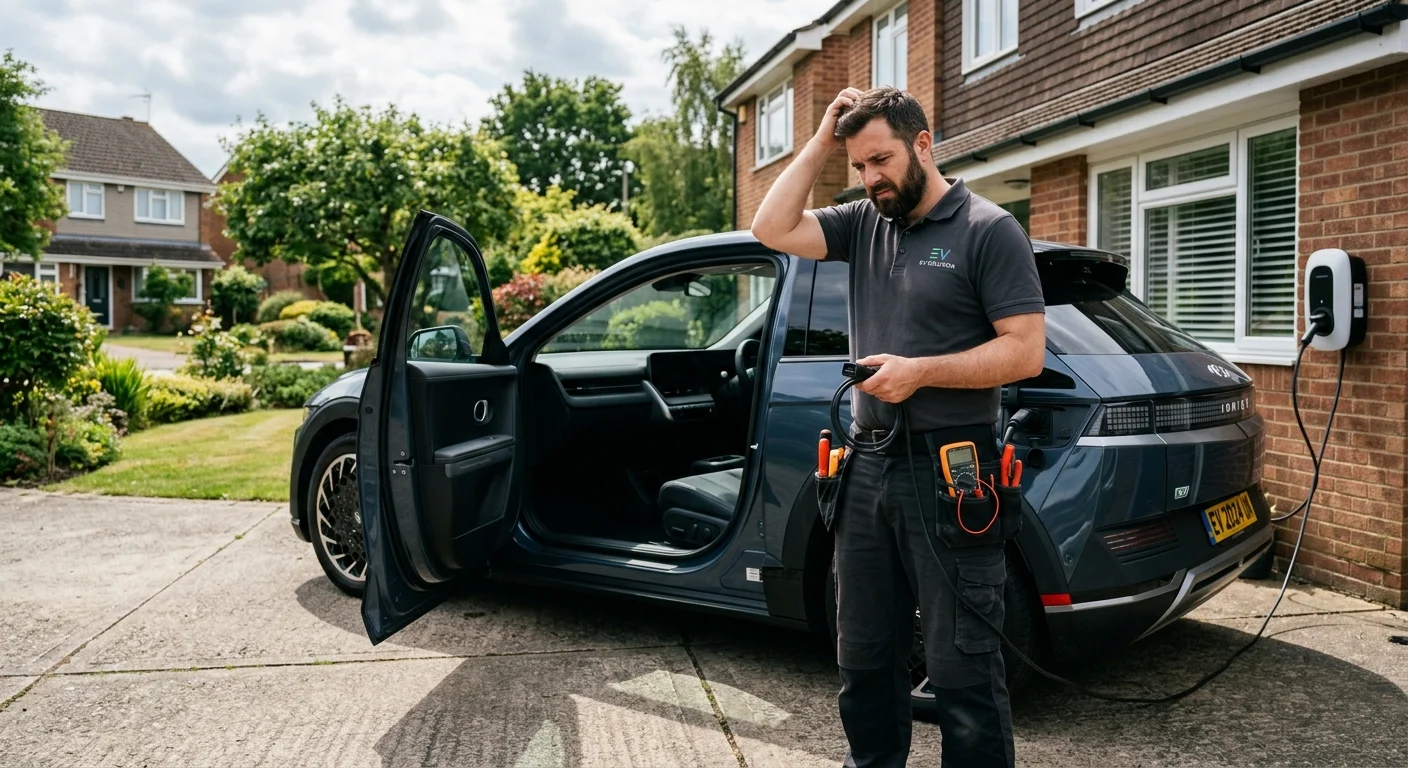
Heat-soaked 12-volt batteries after short Tampa Bay trips
Tampa Bay runs a long air-conditioning season, from spring into late fall. Recurrent Auto’s published range-loss research finds an EV loses about 5 percent of range at 90°F. Loss climbs to 20 to 30 percent above 95°F. It sits around 17 to 18 percent near 100°F. Drivers feel that on I-275, I-75, and the Veterans Expressway. They often blame the big pack when the Ioniq 5 later won’t wake.
The 12-volt story is separate. On a short hop through Town ‘n’ Country, Egypt Lake-Leto, or Carrollwood, runtime is short. The car may only run ten or fifteen minutes. The DC-DC converter that tops up the 12-volt battery never gets a long window. Then the Ioniq 5 sits in a driveway that holds afternoon heat. By the next morning, voltage can drop below what the computers need to boot.
That’s why a car that showed range an hour ago now shows nothing. The main pack didn’t dump its charge in the parking lot.
Westchase and Fish Hawk often have 240-volt home charging. That keeps the traction pack healthy. It doesn’t save a tired 12-volt battery that sat in heat. St. Petersburg and Lealman have much older housing, so more cars sit outside. Pinellas condo owners in assigned stalls face the same sitting-car pattern. Florida Statute 718.113(8) lets a unit owner install a charger in an exclusive space. Until that charger exists, the Ioniq 5 still sits, and the 12-volt still ages.
Heat is the range story here because the land is flat and near sea level. Short trips plus heat is a hard cycle for a small 12-volt battery. For the wider climate wear on packs here, read how Tampa Bay heat and salt air wear down an EV battery.
How a silent Ioniq 5 differs from a low pack
A dead 12-volt battery looks like a brick. No cluster. No infotainment. No click when you press Start. The fob may not unlock the doors. You then use the physical key hidden in the fob. That pattern is a 12-volt failure. It isn’t an empty Ioniq 5 traction pack.
A critically low high-voltage pack still usually shows life. You may get a low-charge message. Accessories may work. The car may refuse to roll, but the computers woke. They’re telling you the range is gone. That’s a charging problem, not a 12-volt boot problem.
Flickering lights, then a black dash, sit in between. The 12-volt is collapsing under load. It has a little voltage left. It doesn’t have enough to finish the boot. Treat that as a dying 12-volt battery.
The same lights-out pattern shows up on other EVs in this climate. What happens when an EV 12-volt battery dies in Tampa Bay covers the shared symptoms. Don’t guess from the last range number on your phone app. The app can show yesterday’s pack percentage while the 12-volt is already dead. If the cabin is dark, believe the cabin.
Checks you can do from the driver’s seat
Rule out Hyundai’s start sequence before you open the hood. Press the brake, then press Start. Accessories can wake without the brake. Ready mode won’t. If the screens come on but the car won’t go into Ready, you may have skipped the pedal. That isn’t a failed battery.
Try the spare fob if you carry one. A weak fob cell can look like a no-start. Place the fob in the in-car backup slot or console sensing area your manual shows. The closer signal sometimes wakes a car that ignored a pocket fob.
Hold Start for about ten to fifteen seconds with your foot off the brake. That can clear a hung module. Give the car a minute after the lights flicker. Then brake and press Start again.
Confirm Park is selected and the charge door is closed. None of those steps help a battery already below boot voltage. If the cabin is fully dark, skip the reset and go to the jump posts. Or stop and call for an on-site jump if you aren’t set up to do it.
How to jump the Ioniq 5 from the underhood posts
Hyundai doesn’t want you on the 12-volt case itself. The Ioniq 5 puts dedicated jump terminals under the hood. Use those posts.
Pop the hood. On the driver’s side, find the black fuse-box cover. Lift it. Look for the red positive cover or the marked plus terminal. That’s the red clamp point.
The black clamp goes to a clean, unpainted metal ground on the body, or to a marked ground stud. Don’t put the negative clamp on the battery’s negative post if you can see it.
Connect red to the Ioniq 5 first. Then red on the jump pack or donor. Then black on the pack or donor. Then black to the Ioniq 5 ground. Let it sit a couple of minutes so the 12-volt system can take a charge. Brake and Start. If Ready appears, leave the car on. The converter can keep feeding the small battery while you drive toward a shop or home. Polarity and clamp order matter more than speed. How to jump start an electric car without damage covers what not to touch.
You may be on a paved shoulder outside a city. Florida Statute 316.194 treats a disabled vehicle as an allowed stop when you can’t get off the roadway. Stay out of the travel lane. Put the hazards on. Don’t stand on the traffic side of the car on I-275 or I-75.
FDOT Road Rangers in District 7 patrol I-4, I-75, and I-275, plus the airport interchange. Dial *347. Their published help includes a 12-volt jump, a tire, fuel, two local calls, and a move to a safer spot. Those materials don’t list charging an EV. A Ranger jump can wake a dark Ioniq 5. It won’t refill a traction pack.
Don’t try a driveway-style jump on the Sunshine Skyway. That span is about four miles with no place to stop. The Selmon reversible lanes are the other bad DIY spot. There’s no local surface shoulder on the elevated segment. Wait for help there.
If it starts, then dies again
A jump that lasts one parking lot then fails at the next light is a warning. The battery won’t hold a charge. Heat-soaked 12-volt packs do this after months of short Tampa, St. Petersburg, and Clearwater trips. Voltage comes back under a pack. It collapses when the clamps come off.
Don’t keep jumping it between errands. That cycle is what an EV that starts, then dies again after a jump is describing. The converter can’t rebuild a failed battery on a ten-minute drive to Brandon. A loop through Westchase or a Plant City I-4 hop isn’t a charge cycle for a dying 12-volt.
Warning lights after a successful jump also mean stop. You woke the computers. They’re now reporting a charging fault, a module that didn’t come up, or a 12-volt already on the way out. That’s an on-site swap or a shop diagnosis. It isn’t another clamp session in a Wesley Chapel parking lot. If the car stays in Ready and drives normally, get the 12-volt tested as soon as you can.
Sitting in heat, salt air, and airport parking
An Ioniq 5 left for a week in Tampa International Airport parking is a classic 12-volt case. TPA publishes free EV charging at on-airport garages and the cell phone lot. Level 1 J1772 sits in the Economy Garage and the Long-Term Parking Garage. Level 2 is at the Cell Phone Lot. The traction pack can sit on a charger all week. The 12-volt can still go flat from heat and parasitic draw. Drivers come back, tap Start, and get a dark cabin next to a charged pack.
Salt air along Pinellas and the south Hillsborough bayfront, including Ruskin and Apollo Beach, adds corrosion on terminals and grounds. A dirty ground looks like a dead battery. When you jump, clean the ground point if it’s crusted. Then decide if the battery itself is finished.
If the Ioniq 5 took on salt water in a storm, don’t treat it as a simple 12-volt job. Federal and fire-service guidance warns that an EV soaked in salt water can face a lithium-ion fire risk later. Keep it away from structures and other vehicles until a qualified shop inspects it. That’s not a driveway jump. Dry heat after a normal summer day is the common case.
On the interstate versus in a driveway
A silent Ioniq 5 in a Lutz or Land O’ Lakes driveway is an inconvenience. The same car on the Suncoast Parkway, US-19 in Pasco, or SR-60 in East Hillsborough is a safety problem.
Charge Pro TPA is a referral line. We match stranded EV drivers with independent local mobile rescue operators. We don’t own trucks. We don’t employ technicians. We don’t set prices, and we don’t promise an arrival time. The operator quotes you before any work starts and bills you directly.
Those operators bring a 240-volt Level 2 source for an empty pack. That typically adds 10 to 20 miles of range in 15 to 30 minutes of charging. That’s charging time, not a clock on the truck. For a dark Ioniq 5, the usual job is a 12-volt jump or an on-site replacement. They handle Hyundai and every major EV brand. CCS or J1772 adapters cover non-Tesla charge ports when the pack itself is empty.
Non-Tesla EV rescue is the page if the Ioniq 5 won’t wake. If you already know the traction pack is empty rather than silent, start with mobile EV charging.
When a local operator should jump or swap it
Call if the cabin is dark and you don’t want to work under the hood. Call if a jump worked once and the car died again. Call if you’re on I-275, the Courtney Campbell Causeway, or a garage ramp and can’t set clamps safely.
A swap on site beats a tow when the only failure is the 12-volt. Towing a dead EV should be the last resort, not the first call. Hillsborough and Pinellas both cap non-consent tow rates at the county level. Confirm the live schedule with the county before you argue a bill. Don’t turn a 12-volt job into a wrecker if a jump or swap will put the car in Ready.
When you’re ready for a local operator, call (813) 536-4545. We connect you with an independent pro who can jump or swap the 12-volt on site.