The Hyundai Ioniq 5 battery size is 58.0 kWh on Standard Range. Long Range is 77.4 kWh. Usable energy sits closer to 54 kWh and 74 kWh because Hyundai keeps a buffer. EPA stickers still print 220, 303, or 260 miles. On Tampa Bay’s flat interstates you won’t keep all of those miles. Heat and air conditioning take them. There’s no downhill here to give them back.
The pack size is real. The sticker miles are a ceiling.
A kilowatt-hour is stored energy. Treat it as tank size, not trip length. The Standard Range Ioniq 5 carries a 58.0 kWh gross pack. The Long Range carries 77.4 kWh. Most 2022 through 2024 Long Range cars use that larger pack. Rear-wheel drive and all-wheel drive share it.
Hyundai doesn’t let you spend every kilowatt-hour. Gross capacity is the physical pack. Usable capacity is what the car will actually draw. On this model the usable figures are about 54.0 kWh and 74.0 kWh. That gap is intentional. It keeps cells out of the harshest top and bottom of the window. It’s one reason the pack can last under a long warranty. Confirm current warranty terms on Hyundai’s own site. For the Ioniq 5 that coverage has been 10 years or 100,000 miles, whichever comes first.
EPA range splits three ways on the common years. Standard Range rear-wheel drive is listed at about 220 miles. Long Range rear-wheel drive is listed at about 303 miles. Long Range all-wheel drive is listed at about 260 miles.
If you only remember one pair of figures, remember usable kWh and your EPA trim. Then discount them for Tampa Bay heat. That’s the local story.
Rear drive, dual motor, and which tank you actually bought
Trim names on a window sticker can hide the pack. Look for Standard Range or Long Range in the build. Don’t trust a style name alone. A dual-motor Ioniq 5 is still a 77.4 kWh car on those years. It isn’t a bigger battery. It’s a second motor spending the same tank faster.
Rear-wheel drive Long Range is the efficiency trim. It carries the 303-mile EPA number. All-wheel drive trades some of that for launch and wet-road grip. Just don’t expect the 303-mile sticker if you bought dual motor.
Standard Range still uses the same 800-volt architecture. Peak DC input is still listed up to 239 kW. Level 2 AC input is still listed up to 10.9 kW. You didn’t buy a slow-charging car. You bought a smaller tank. On a short Tampa loop that can be enough. On a Suncoast Parkway run through Pasco, the smaller tank leaves less room. AC and speed eat the rest.
The 800-volt system is built for fast DC charging. A healthy Ioniq 5 can go from 10 to 80 percent in about 18 minutes. That’s at a capable DC station in peak conditions. Heat, a busy stall, and a warm pack will slow it. For the time-of-day version of those numbers, read how long an Ioniq 5 takes to charge in this climate.
Tampa Bay is flat, so heat does the job hills would do
This metro sits near sea level. Grade almost never returns energy the way a mountain descent would. Regenerative braking still helps in stop-and-go on I-275. It helps around downtown Tampa too. It doesn’t refill the pack on a long cruise. The Veterans Expressway, the Suncoast Parkway, I-75, and I-4 are mostly flat, fast, and exposed. High speed is a range tax. So is a cabin held at a comfortable temperature for hours.
Recurrent Auto publishes the heat research worth citing here. Their work finds an EV loses only about 5 percent of range at 90°F. Loss jumps to 20 to 30 percent above 95°F. Near 100°F the loss is roughly 17 to 18 percent. The effect varies widely by model. Use Recurrent’s numbers, not a guess, when you talk about summer range. Don’t treat those percentages as a Tampa weather log. Treat them as the best public map of what heat does to an EV.
Apply that map to the Ioniq 5 sticker with honest caveats. A Long Range rear-drive car is rated at 303 EPA miles. It isn’t a 303-mile car at 96°F with the compressor running. A 20 percent haircut on the sticker is about 60 miles. A 30 percent haircut is about 90 miles. That’s arithmetic on Recurrent’s bands, not a local test fleet. Your dash will also move with speed, tires, and how hard you precondition.
The air-conditioning season here runs from spring into late fall. That’s the local climate fact. You aren’t defending range against a short heat wave. You’re defending it for most of the year. Cabin cooling draws from the same pack that turns the wheels. So does battery thermal management when the pack itself is hot. Both loads stack on a long interstate run.
What AC actually takes from you on the long, flat runs
Picture a Long Range Ioniq 5 on I-75 near Wesley Chapel. Climate control is already on from the driveway. The road is straight. The speed is highway. There’s no grade to recover from. Every extra kilowatt the compressor uses is a mile you won’t see. That’s true at the next exit too. The same pattern shows up on the Suncoast Parkway as it runs north through Pasco. Exits are widely spaced. That’s a Florida’s Turnpike Enterprise road, all-electronic with SunPass. It’s a long, fast run. It’s a bad place to learn the sticker was optimistic.
West toward the gulf, I-275 across the peninsula is another stress test. So is the Sunshine Skyway. The Skyway’s main span sits 432 feet above the shipping channel. The bridge run is about 4 miles with no place to stop. Florida Highway Patrol closes it when winds reach sustained 40 mph. It also closes when fog cuts visibility below about 100 feet. All of it is why you don’t enter that span already guessing. Remaining miles should be a known number.
Downtown Tampa has a different trap. The Lee Roy Selmon Expressway’s Reversible Express Lanes run about 10 miles. They sit on an elevated segmental bridge between Brandon and downtown. Direction reverses through the day. Westbound into downtown is roughly 5 a.m. to noon, then eastbound. THEA clears the lanes of all traffic before each reversal. There’s no local surface shoulder on the elevated segment. A pack that hits empty on the REL isn’t a simple pull-off. Plan the charge before you take those lanes.
I-4 through the Tampa side toward the Polk line is flat too. It also sits in a lightning-heavy corridor. Vaisala’s National Lightning Detection Network data, as reported locally, has put Florida among the most lightning-dense states. Treat Tampa Bay as one of the most lightning-prone metros in the country, attributed to Vaisala. A storm cell can reroute you and slow you. It also keeps the AC on longer. Range plans that assume a clean cruise fail in that weather.
The Veterans Expressway is the west-side version of the same physics. Town ‘n’ Country, Citrus Park, and Westchase feed it every weekday. A Standard Range pack with AC on can look fine leaving a driveway in Carrollwood. It looks different after a stalled merge and a detour. If remaining miles are already thin, don’t wait for zero. Read what to do when an EV is running low in this heat before the dash becomes a warning.
Speed still matters on flat ground. Drive the car you have, not the sticker.
Home charging is how most Ioniq 5 packs actually refill
Daily range is a home-charging problem for a lot of owners. It isn’t a public-charging problem until the home circuit fails. Level 2 at 240 volts is the practical overnight refill. The Ioniq 5 is listed at up to 10.9 kW on AC. From empty, a Long Range pack is often an overnight job. That’s on the order of 7 to 8 hours at that rate. Level 1 on a household 120-volt outlet is a trickle. It may add only a few miles per hour. It won’t rebuild a 74 kWh usable tank before morning.
New master-planned stock is the easy case. In Lakewood Ranch, Fish Hawk, and Westchase, only a tiny share of homes predates 1980. Census figures put those pre-1980 shares at 0.7 percent, 0.8 percent, and 1.0 percent. 240-volt home charging is near-universal in that newer construction. Older pockets are the opposite. Lealman has 56.6 percent of housing built before 1980. St. Petersburg sits at 51.5 percent. A 240-volt circuit may not already exist there. A panel conversation comes first. That’s a house fact, not a car fact.
Which utility you call depends on where you sleep. Tampa Electric serves the City of Tampa, most of Hillsborough County, and parts of Pinellas and southern Pasco. Residential schedules include tiered Residential Service. They also include RSVP-1, a time-of-use plan. TECO’s Drive Smart program is a commercial and public charger incentive. The AFDC lists it as Level 2 and DC fast purchase rebates for non-residential sites. A specific residential home-charger rebate wasn’t confirmed on TECO’s primary pages. TECO points owners to tampaelectric.com/electricvehicles/evsforhome and [email protected]. Ask them for the current residential picture. Don’t assume a rebate you can’t see.
Duke Energy Florida serves Pinellas County and much of Pasco. In 2025 it launched a Charger Prep Credit. That credit goes toward wiring and electrical upgrades for a Level 2 charger. It doesn’t cover the charger hardware. It doesn’t cover permit fees. Duke also launched an Off-Peak Charging Credit for charging in published off-peak windows. Those windows in the 2025 launch materials ran 10 a.m. to 6 p.m. on weekdays. They also ran 11 p.m. to 5 a.m. on weekdays. Weekends and holidays were off-peak all day. Confirm the current credit and windows with Duke before you plan around them.
North and central Pasco is often Withlacoochee River Electric Cooperative, not TECO or Duke. WREC reports 280,000-plus accounts across Pasco, Hernando, Citrus, Sumter, and Polk. If you live in that band, call WREC. Don’t call TECO out of habit.
Pinellas condo and HOA owners have a Florida-specific right that matters. Florida Statute 718.113(8) lets a condominium unit owner install an EV charging station. It has to sit within the boundaries of their limited common element or an exclusively designated parking space. A declaration can’t be enforced to prohibit a properly submitted request. The board can’t deny that request. The owner pays for installation, operation, maintenance, insurance, and separately metered electricity. Many beach and peninsula owners still live on public charging because the parking layout never got a plug. The statute is the path to a home tank. It isn’t a free install.
Florida doesn’t offer a state EV purchase rebate or tax credit. Incentives, when they exist, are utility programs. Florida also added an extra annual registration fee for battery-electric vehicles under SB 28, effective January 1, 2026. A later bill that would’ve raised that fee died in committee in March 2026. Confirm the current amount with the Florida DHSMV before you budget for it. Don’t trust a number you saw in an old post.
Fast charging is for trips. It isn’t your daily tank.
Peak DC input up to 239 kW is the Ioniq 5 headline. CCS is the native fast-charge port. With an adapter, many NACS stalls can also feed the car. That includes a large share of Tesla Superchargers. Regular DC use is convenient. It also heats the pack more than overnight Level 2. In a metro with a long AC season, extra pack heat isn’t free. Save the DC stops for travel. Save them too for days the home circuit failed.
Tampa International Airport is the local charging fact that surprises people. The airport publishes that EV charging is free at all on-airport parking garages and the cell phone lot. The Economy Garage has Level 1 J1772 stations on the first floor. Level 1 is also in the Long-Term Parking Garage. Level 2 sits at the Cell Phone Lot. Exact stall counts weren’t confirmed here against a live airport page. Check tampaairport.com/parking/electric-charging before you count on a specific stall. SkyConnect ties the main terminal to the Economy Garage and the Rental Car Center. A car left for a week in those garages that won’t wake is often a 12-volt failure. It often isn’t an empty traction pack.
Public charging elsewhere in the metro exists. This page won’t guess at a port count. It also won’t call any corridor empty. Open a charging app, confirm the stall, and have a backup. If a public stall fails you in Clearwater or Largo, that’s a stall problem. It isn’t proof the Ioniq 5 pack is too small.
Precondition while you’re still plugged in at home. The pack and cabin then aren’t starting from a hot soak on the first mile. That first mile is where a lot of dash estimates drop. You’re paying for that cooling from wall power, not from the tank you need on I-75.
When the car won’t wake, check the small battery first
The traction pack is the 58 or 77.4 kWh unit. The 12-volt battery is a separate, much smaller battery. It wakes the computers, the contactors, and the door logic. Heat is hard on 12-volt batteries. A car that sits in a Sun City Center driveway can look dead. So can a car in airport parking. The main pack can still hold tens of kilowatt-hours.
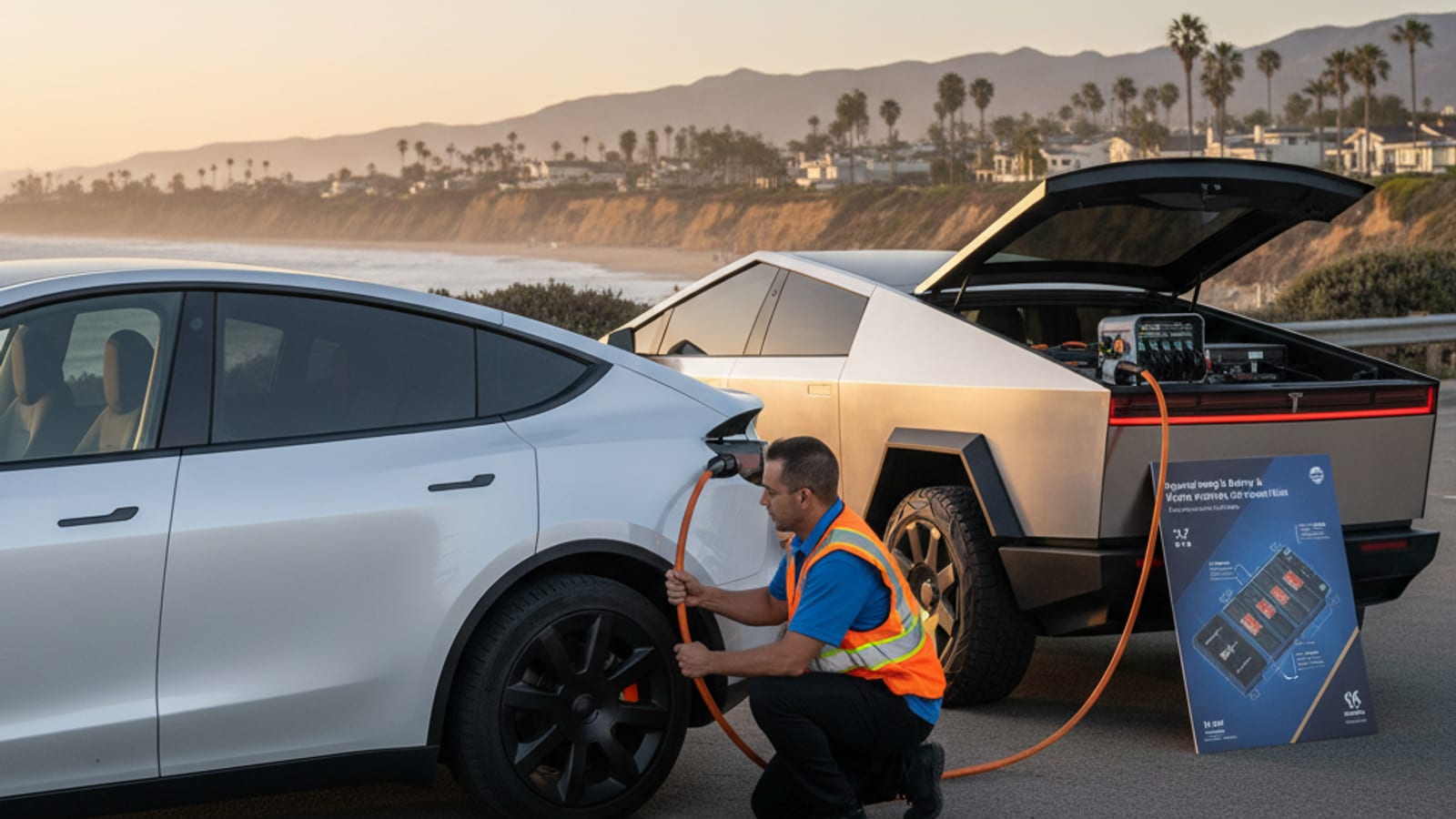
If the Ioniq 5 won’t start, screens stay dark. The charge port may not cooperate either. Work through what to check when an Ioniq 5 won’t start. A 12-volt jump or replacement is a different job from feeding the high-voltage pack. The operators we connect you with can jump or replace a dead 12-volt on site. They can also bring a 240-volt Level 2 source to the car. For a Hyundai that means a CCS adapter on a truck that also carries a native NACS plug. Typical charging add is 10 to 20 miles of range in 15 to 30 minutes of charging. That’s charging time. It isn’t an arrival time.
If the cable won’t release, that’s a port lock, not a pack-size issue. Use Hyundai’s release steps, then a shop if the latch still won’t move.
Keep daily charge away from the floor and the ceiling when you can. Many owners target a 20 to 80 percent window for ordinary days. Charge to 100 percent when you truly need the whole tank. Hold tire pressures at the door-jamb spec. Smooth speed on the interstate wastes less than repeated full-throttle merges. None of that changes the kWh number on the spec sheet. It changes how much of it becomes miles. For the slower wear from heat and salt air, read how Tampa Bay heat and salt air wear down an EV battery.
Storms, surge, and a pack you already ran down
Hurricane Helene in late September 2024 drove record storm surge at Tampa Bay tidal gauges. St. Petersburg faced a forecast of 5 to 8 feet of surge. Pinellas barrier islands from the Dunedin Causeway through Tierra Verde were closed. Hurricane Milton in early October 2024 largely spared Pinellas a second catastrophic surge. It still dropped at least 18 inches of rain on parts of St. Petersburg. It also tore part of the roof off Tropicana Field. Low-lying Pinellas, the barrier islands, and south Hillsborough communities like Ruskin, Apollo Beach, and Gibsonton sit in evacuation zones. Leaving with a thin pack is a planning failure. It isn’t a mystery of battery chemistry.
Federal and fire-service guidance warns that an EV submerged or soaked in salt water can suffer a lithium-ion battery fire days later. Keep that car away from structures and other vehicles until it’s inspected. Follow the inspection advice you get from emergency officials and your insurer.
A Standard Range car with 220 EPA miles looks adequate on a calm Tuesday. It looks different when you add AC, a slow contraflow, and a detour around standing water. Charge before the evacuation order, not after. The Long Range pack buys you margin. It doesn’t buy you a pass on planning.
If you’re already on the shoulder
Florida Statute 316.194 covers stopping outside a business or residence district. You shouldn’t stop on the paved travel lane when you can get off the roadway. A vehicle disabled on that pavement is exempt when it’s impossible to avoid stopping there. An empty EV on a shoulder is a disabled vehicle under that exemption. Put on hazards. Stay out of the travel lane if you can.
On I-4, I-75, I-275, and the airport interchange in District 7, FDOT Road Rangers patrol. Dial *347. They can help with a flat, a 12-volt jump, fuel, and water. They can also make two local calls and move a disabled vehicle to a safer spot. Their published materials describe fuel and a jump. They don’t list charging an EV. Florida Highway Patrol Troop C covers disabled vehicles and incidents on the interstates. None of those programs replace a mobile charge.
Charge Pro TPA connects you with independent local mobile rescue operators. The operator quotes before starting. What moves that quote is distance, time of day, and how many miles you need to add. The brand doesn’t set the price. It doesn’t promise when someone arrives. If the high-voltage pack is empty, ask for mobile EV charging. If you’re truly at zero, that’s out of charge recovery. For a Hyundai, you want a non-Tesla EV rescue so the truck brings the CCS path, not only NACS.
Towing is the last resort. Non-consent tow rate caps exist at the county level. Hillsborough County sets them through the Tax Collector’s vehicle-for-hire authority. Pinellas County sets them by ordinance. Current maximum rates weren’t confirmed against the live schedules, so they aren’t printed here. Check hillstaxfl.gov or the Pinellas ordinance if a private lot already towed the car. Florida Statute 715.07 governs removal from private property, including signage rules and how far the car may be stored. Hillsborough and Pinellas both sit over 500,000 population, so the storage-radius rule is the tighter 10-mile version.
Frequently asked questions
What is the Hyundai Ioniq 5 battery size?
Standard Range is 58.0 kWh gross, about 54.0 kWh usable. Long Range is 77.4 kWh gross, about 74.0 kWh usable. EPA range is about 220 miles on Standard Range. It’s about 303 on Long Range rear-wheel drive. It’s about 260 on Long Range all-wheel drive. Those are spec and EPA figures. Tampa Bay heat and AC still cut the miles you actually see.
How much range does heat take off an Ioniq 5 here?
Recurrent Auto finds about 5 percent range loss at 90°F and 20 to 30 percent above 95°F. Tampa Bay’s AC season runs from spring into late fall. The terrain is too flat to earn those miles back. Apply Recurrent’s bands to your EPA sticker. Don’t treat the result as a lab test of your exact car.
What do I do if the Ioniq 5 hits empty on a Tampa Bay road?
Get off the travel lane if you can. A disabled EV on the shoulder is covered under Florida Statute 316.194. Road Rangers at *347 can jump a 12-volt and help with traffic. Their published services don’t include charging an EV. Charge Pro TPA will match you with a local operator. The operator quotes you before any charging starts.
If the pack is already empty, Charge Pro TPA matches you with independent local operators. We serve Tampa Bay. The pros we connect you with bring Level 2 charging and 12-volt help. Call (813) 536-4545 when you’re already stopped and you need that match.