A Pinellas condo stall and the Selmon REL aren’t the same dead-EV job. One can become a private-property removal under Florida Statute 715.07. The other is a disabled vehicle on an elevated reversible lane. That lane has no local surface shoulder. In Tampa Bay, the cost to tow an EV follows county rate caps. It also follows a storage-radius rule, and whether you even need a hook. A Level 2 charge on site often ends the stall where you already sit.
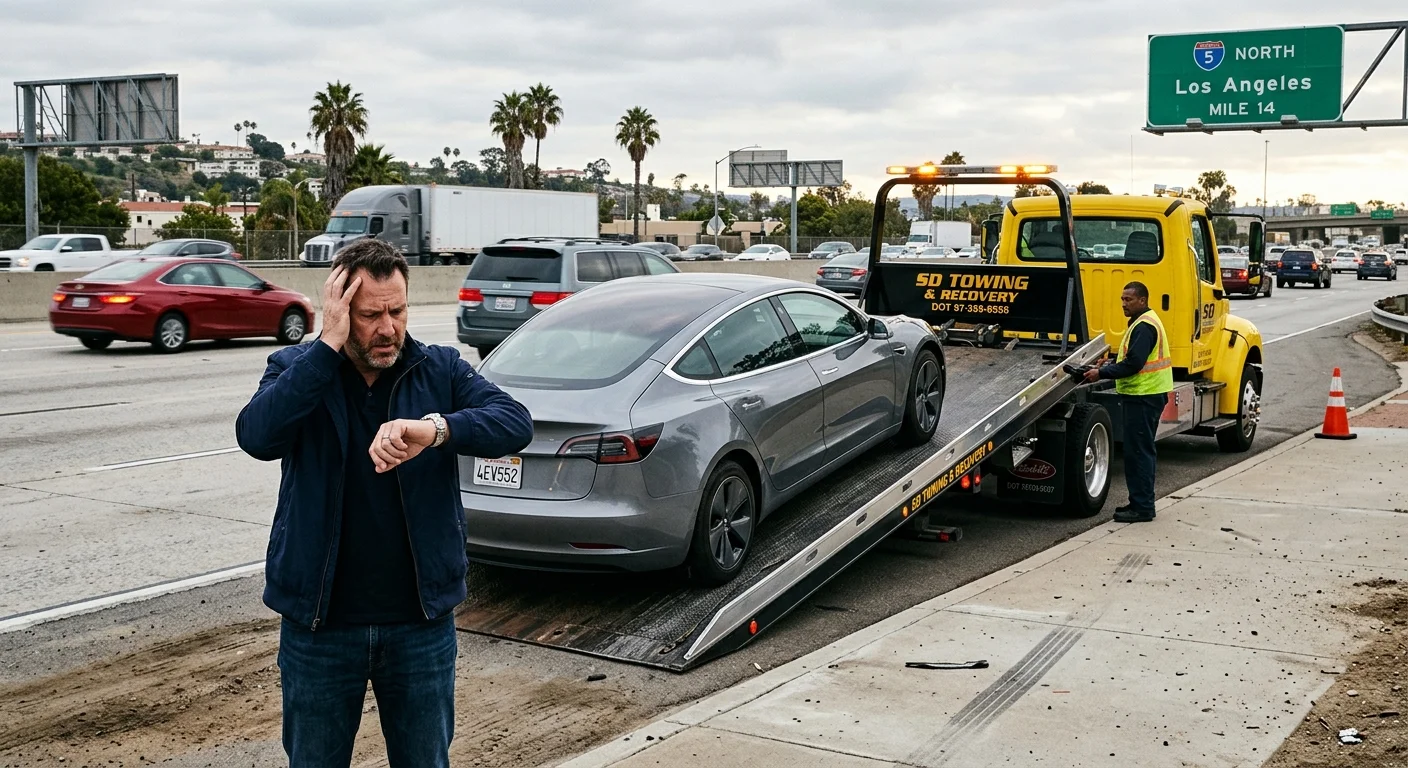
Consent tows and trespass tows aren’t priced the same
There’s no single cost to tow an EV in Tampa Bay. A tow you request from a shoulder on I-275 is a consent job. A tow from a posted lot you didn’t authorize is different. That’s a non-consent or trespass removal. Those two bills live under different rules.
Hillsborough County caps non-consensual and trespass tows. The Hillsborough County Tax Collector’s vehicle-for-hire authority sets those maximums. Pinellas County sets them by ordinance, under Ordinance 19-39. You’ll find it in Code of Ordinances Chapter 122, Article II.5, section 122-42. Secondary writeups quote flat rates, per-mile add-ons, daily storage, and hourly recovery. Those dollar figures weren’t confirmed against the live ordinance schedule. That check was dated 18 September 2026. Treat any copied number as unverified. In Hillsborough, confirm with the Tax Collector before you pay. In Pinellas, read the county’s posted schedule.
Florida Statute 715.07 uses population for storage distance. Hillsborough and Pinellas both exceed 500,000 people. In those counties the car must be stored within ten miles of removal. Smaller counties use a fifteen-mile radius. If the car left a Tampa or St. Petersburg lot, the yard should be close. Confirm the address on the tow slip. Don’t treat the first line on the invoice as the legal maximum.
The tower must file its current rates with the local law-enforcement agency. It must post an identical schedule at the storage site. If the slip and the board don’t match, photograph both.
Florida 715.07 is why a private lot can move your EV
Florida Statute 715.07 lets a property owner or lessee remove an unauthorized vehicle. They aren’t liable for the cost. Your dead pack in a posted space can still be towed.
Signage has to use light-reflective letters not fewer than two inches high. Those letters must say vehicles will be towed at the owner’s expense. “Tow-away zone” must appear in letters not fewer than four inches high. The tower’s name and current phone number have to be on the sign. The sign sits three to six feet above ground. Look at that board before you leave a low-charge car overnight. That’s true at Pinellas beach condos and other posted private lots.
Florida Statute 718.113(8) lets a condo owner install a charging station in their exclusive space. Pinellas and the beaches have a large condo and HOA population. Many of those drivers still live on public charging. A car that goes quiet in a shared lot is a 715.07 problem first.
A mobile operator can charge in place if the property lets them in. A trespass tow doesn’t wait for that conversation. Once the hook is on, you’re in storage-radius math. Then you make a second trip to retrieve the car. County caps still apply to the non-consent bill.
On the interstate, 316.194 treats you as disabled
Florida Statute 316.194 bars stopping on the paved highway outside a municipality. That applies when you can get the car off the roadway. Subsection (2) exempts a vehicle disabled there when you can’t avoid leaving it. A dead EV on a shoulder is a disabled vehicle under that subsection. You’re a disabled vehicle, not a parked one.
FDOT Road Rangers in District 7 patrol I-4, I-75, and I-275 here. Dial *347 on a mobile phone to reach them. Published free services include flat-tire help, a jump-start, and fuel. They can move a disabled vehicle to a safer spot. Florida Highway Patrol Troop C covers disabled vehicles on the interstates.
Road Rangers materials reviewed describe fuel, jump-start, and tire help, not EV charging. That’s an observed absence in the published list. The free state patrol can jump a 12-volt battery and can carry fuel. Its published services don’t include charging an EV. That’s why a mobile EV charge or a tow is the real fork.
Get the car as far right as you can and put the hazards on.
Some Tampa Bay roads make the tow harder than the paperwork
The Lee Roy Selmon Expressway is all-electronic, SunPass or toll-by-plate. Its Reversible Express Lanes run about ten miles. They’re an elevated segmental bridge in the median between Brandon and downtown Tampa. Westbound into downtown runs from about 5 a.m. to noon, then eastbound. The Tampa Hillsborough Expressway Authority clears all traffic before each reversal. That sweep is so nobody is stranded or going the wrong way. There is no local surface shoulder on the elevated segment. An empty pack on the REL is a high-stakes stall.
The Sunshine Skyway on I-275 runs four miles. There’s no place to stop on that span. The main span sits 432 feet above the shipping channel. Florida Highway Patrol closes it when winds reach sustained 40 mph. It also closes when fog cuts visibility below about 100 feet. A high-wind advisory for high-profile vehicles typically starts around 20 mph gusts. Being stuck on that span is uniquely bad. A flatbed still has to work on a narrow, high deck.
A dead EV often needs a flatbed, and Neutral may not exist
Towing an EV isn’t towing a gas car. Most makers want all four wheels off the ground. A wheel-lift that leaves drive wheels spinning can heat the motors. When the 12-volt is dead, the car may not shift to Neutral. The safe sequence is in how to tow a Tesla with no power.
A flatbed is the usual right tool. County caps on non-consent jobs still sit on the filed schedule. They don’t make a botched drivetrain tow cheap. Damage after a drag lands on you and the shop. It doesn’t land on the county’s rate board.
Heat makes the 12-volt story worse. Recurrent Auto finds about 5 percent of range gone at 90°F. Loss runs 20 to 30 percent above 95°F. Tampa Bay’s air-conditioning season runs from spring into late fall. The metro is flat and near sea level, so grade never gives range back. A pack that looked fine at breakfast can be empty by the Skyway. That’s a jump or a charge in place, not automatically a wrecker.
What a roadside charge actually buys you
Charge Pro TPA is a referral line. It matches stranded EV drivers with independent local mobile rescue operators. It doesn’t own trucks, employ technicians, or set prices. It doesn’t promise an arrival time. The operator quotes you before starting and bills you directly.
The operators we send bring a 240-volt Level 2 source to the bumper. Tesla cars take a native NACS plug. CCS or J1772 adapters cover non-Tesla EVs. Typical charging time adds 10 to 20 miles of range. That takes 15 to 30 minutes of charging. That’s charging time, never an arrival time. For a lot of stalls, that window is enough to leave the shoulder. It can also clear the REL before a reversal.
If the 12-volt is the failure, a jump on site can wake the car. A replacement on site can wake it without loading it. That’s a different job from an empty high-voltage pack. Walk through the charge, jump, or tow fork before anyone hooks a strap.
Mobile EV charging is the in-place option. Out-of-charge recovery is the empty-pack version of the same idea.
When towing is still the last resort you should take
A charge doesn’t fix a bent control arm. It doesn’t dry a pack that took salt water. Hurricane Helene in late September 2024 drove record storm surge at Tampa Bay tidal gauges. St. Petersburg faced a forecast 5 to 8 feet of surge. Pinellas barrier islands from the Dunedin Causeway through Tierra Verde were closed. Low-lying Pinellas and the barrier islands sit in evacuation zones. So do south Hillsborough communities like Ruskin, Apollo Beach, and Gibsonton.
Federal and fire-service guidance warns about salt-soaked EVs. A lithium-ion battery fire can start later. Keep it away from structures and other vehicles until it’s inspected. Don’t treat a flooded EV as a simple range problem. That’s a tow to a qualified shop, not a roadside top-off.
How to decide before you authorize the hook
Ask what kind of tow this is: consent, or a 715.07 removal. Ask where the car will be stored. Measure that against the ten-mile rule in Hillsborough and Pinellas. Use the fifteen-mile rule in smaller counties. Ask to see the posted rate schedule. If nobody can show the filed rates, you don’t have a verified number.
Then ask whether the car needs miles or a 12-volt wake-up. If it needs miles, a Level 2 visit is often the smaller disruption. If it needs a shop, a flatbed is the honest tool.
Charge Pro TPA serves Tampa Bay. The pros we connect you with are licensed and insured. If you’re stuck, call (813) 536-4545. We’ll match you with a local operator.