If your Tesla dies on I-275, the screen may stay black. Florida already has a name for that car. Statute 316.194 treats a stalled EV on the pavement as a disabled vehicle. The no-stop rule still has an exemption for it. You’re stranded on the shoulder, not parked in traffic. A 12-volt jump often restores Neutral and Transport Mode. That step comes before anyone needs a flatbed.
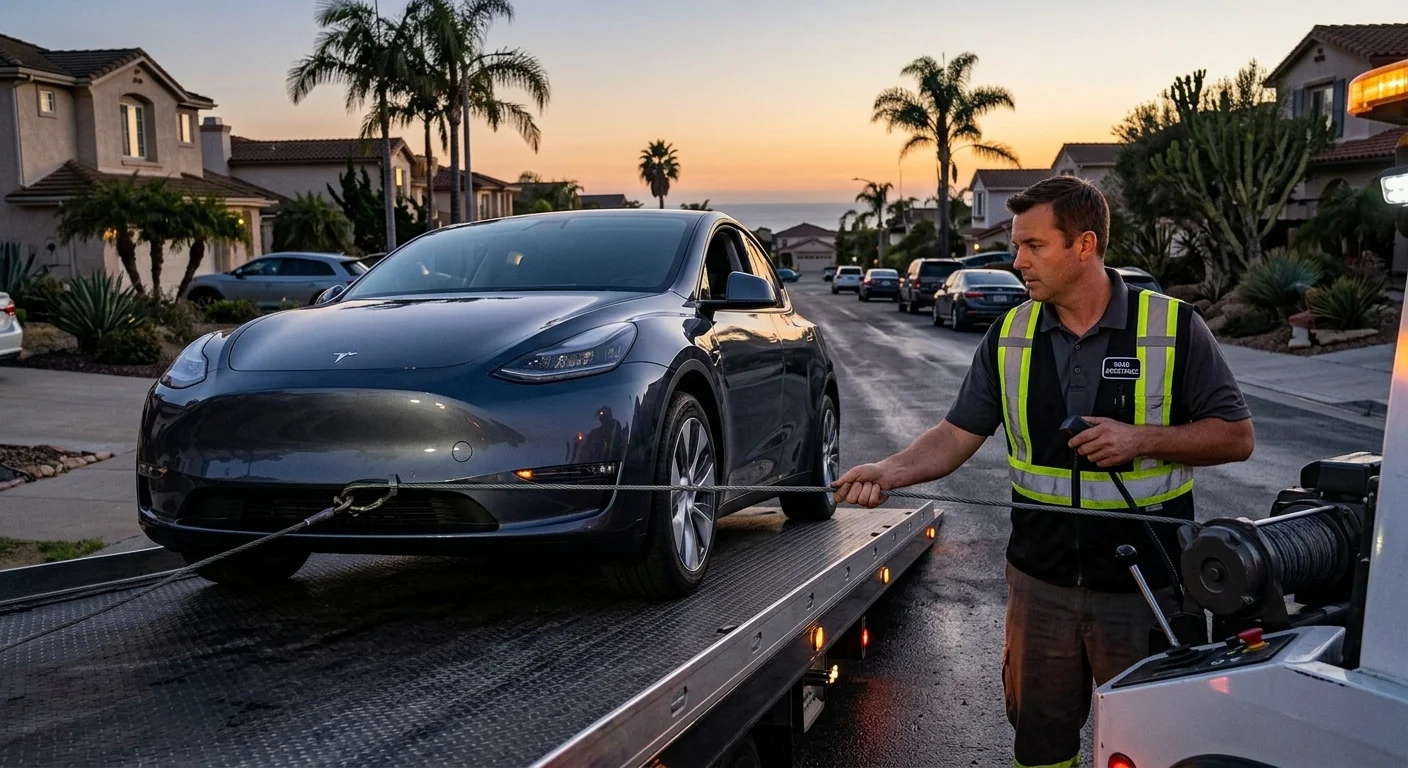
Florida law already covers a dead EV on the shoulder
Florida Statute 316.194(1) bars stopping on the paved highway outside a municipality. That’s when you can still get the car off the roadway. Subsection (2) exempts a vehicle disabled on that pavement. That’s when you can’t avoid leaving it there. A Tesla that won’t go into Neutral fits that exemption. So does a car sitting at zero on the pack. Hillsborough and Pinellas still want you off the travel lane. That’s if the car can roll at all.
Florida Highway Patrol Troop C covers disabled vehicles on the interstates in this metro. FDOT Road Rangers in District 7 patrol I-4, I-75, and I-275, plus the airport interchange. Dial *347 from a mobile phone to reach them. The Tampa Bay SunGuide Center is District 7’s regional traffic desk.
Rangers can jump a 12-volt battery. They can relocate a disabled vehicle to a safer spot. They can help with a flat tire too. They also carry fuel and water for gas cars. The published Road Ranger list includes those jumps, fuel, and tire help. It doesn’t list charging an EV in that written set of services.
Florida 511, also called FL511, shows backups around you. District 1 runs its own Road Rangers on I-75 through Manatee and Sarasota.
Two ways a Tesla has no power
Owners mix up the two batteries, then call for the wrong truck. The high-voltage pack turns the wheels. The 12-volt battery runs the computers, the locks, and the touchscreen. When the 12-volt dies, the car looks fully dead. Doors can stick, and the app can go quiet. The gear selector never appears because the screen never wakes.
Tampa Bay heat is rough on that small battery. Recurrent Auto’s published research finds an EV loses about 5 percent of range at 90°F. Loss rises to 20 to 30 percent above 95°F. Cabin AC runs from spring into late fall here. Sitting after a week away is when the 12-volt fails most often.
Tampa International Airport publishes free EV charging at on-airport parking garages. There’s also charging at the cell phone lot. A Tesla that sat in those garages can come back dark. That’s almost always a 12-volt failure, not an empty pack. The same sitting-car pattern shows up after a long stay in a Pinellas lot.
If the display still showed miles and then hit zero, that’s the drive pack. If nothing lights, start with the 12-volt.
A jump is often the whole job
Charge Pro TPA is a referral line. It matches stranded Tesla drivers with independent local mobile rescue operators. It doesn’t own trucks, and it doesn’t set a price. The operator quotes you before work starts and bills you directly.
Those operators can jump or replace a dead 12-volt on site. They can also bring a 240-volt Level 2 source to the car. Teslas take a native NACS plug. Typical add is 10 to 20 miles of range. That takes 15 to 30 minutes of charging at the bumper. That’s charging time, not an arrival window.
Once the 12-volt wakes the screen, open Controls, then Service. Turn Transport Mode on from that menu. You may not need a wrecker at all. You may drive to a charger under your own power. That’s why a jump often beats a flatbed on a Tampa Bay shoulder. The Tesla 12-volt jump page is the path for that call. If the doors won’t open, read Tesla dead and locked out.
A wrecker is the last tool. Why towing a dead EV is the last resort explains the rest of that choice.
Roads here that punish a sloppy tow
The Selmon Expressway’s Reversible Express Lanes sit on a roughly 10-mile elevated segmental bridge. That median run ties Brandon to downtown Tampa. THEA reverses direction through the day. Westbound into downtown runs from about 5 a.m. to noon, then eastbound. Crews clear every vehicle before a reversal. There’s no local surface shoulder on that elevated segment. A Tesla on the REL has no grass to roll onto. That’s if it won’t go into Neutral. Get the electronics awake, or get a flatbed that can work that span. Out of charge on the Selmon reversible lanes is the dedicated walkthrough.
The Sunshine Skyway on I-275 is about 4 miles of bridge. There’s no place to duck off the span. The cable-stayed main span sits 432 feet above the channel. Florida Highway Patrol closes the bridge when winds reach a sustained 40 mph. It also closes when fog cuts visibility below about 100 feet. High-profile advisories often start around 20 mph gusts, per local FHP reporting. If the car has to move without power up there, use a flatbed. All four wheels come off the deck.
I-75 through Wesley Chapel is a long, fast run. The Suncoast Parkway through Pasco has widely spaced exits. North and central Pasco drivers are often Withlacoochee River Electric Cooperative members. Don’t call TECO or Duke for that home meter without checking. It doesn’t change how you tow a Tesla. I-4 toward Plant City adds heat and stop-and-go. SR-60 through east Hillsborough does the same to a dead 12-volt.
Veterans Expressway traffic stacks the same way on the Pinellas-Hillsborough edge. Stay in the car with hazards on if you’re in a travel lane. Get to the shoulder if the car can still roll a few feet.
After Hurricane Helene’s 2024 surge and Hurricane Milton’s rain, a saltwater-soaked Tesla is a different problem. Federal and fire-service guidance warns about saltwater-soaked lithium-ion packs. Those packs can fail later, even after the storm. Keep that car away from buildings and other vehicles until it’s inspected. Don’t treat it like a simple no-power Neutral issue.
Transport Mode, then a flatbed, in that order
Tesla motors connect to the drive wheels through a single-speed gearbox. They aren’t a gas engine you can drop into a free-spinning gear. If those wheels turn while the car is off, the motors generate current. That current has nowhere safe to go. Heat builds in the drivetrain when unpowered wheels spin. Regenerative braking can load the system too. That’s why a dolly or a wheel-lift is the wrong tool.
Transport Mode is the software step that releases the parking brake. It lets the wheels roll without driving the motors. You turn it on from the Service menus when the screen is alive. When the 12-volt is dead, jump the front bumper posts first. The tow-eye cover on the passenger side of the front bumper usually hides those points. The jump only wakes low-voltage electronics. It doesn’t fill the drive pack.
Then insist on a flatbed. All four wheels stay off the pavement and pointed straight. Winch to Tesla’s designated tow points. Not the control arms. Not random underbody metal. If Transport Mode still won’t enable, say that before anyone pulls. The operator should confirm the recovery steps for your model. Don’t let the car get dragged along I-275 or the Selmon.
What you say before a strap goes on
Name the model, and say whether the screen is black. Ask for a 12-volt jump before a winch. Say you need a flatbed, not a two-wheel lift. Confirm Transport Mode is on, or that it can’t be turned on. If the operator hesitates, stop the hookup and wait.
Private lots use a different statute. Florida Statute 715.07 covers removal from private property. The owner, lessee, or an authorized person can have an unauthorized vehicle taken. Signs must use light-reflective letters not fewer than 2 inches high. The words tow-away zone must appear in letters not fewer than 4 inches high. The tower’s name and current phone belong on that sign. Signs mount 3 to 6 feet above ground. Hillsborough and Pinellas both sit over 500,000 people. Storage there must sit within a 10-mile radius of the removal. Smaller counties use 15 miles. The tower files current rates with local law enforcement. It posts the same schedule at storage.
Non-consent tow prices are capped by county, not by a statewide sticker. Hillsborough sets maxima through the Tax Collector’s vehicle-for-hire authority. Pinellas sets them in Ordinance 19-39, at Code of Ordinances Chapter 122, Article II.5, §122-42. A current dollar cap wasn’t confirmed against the live ordinance schedule for this page. Confirm the posted rate with the tower and the county before you pay.
When a mobile charge replaces the wrecker
An empty drive pack still doesn’t always need a flatbed. Independent operators in this network can bring Level 2 power to the bumper. They add enough miles to roll under your own power. See when you need a mobile EV charge, and when you need a tow. Tesla-specific dispatch lives on Tesla roadside rescue and mobile EV charging.
Frequently asked questions
How do you tow a Tesla with no power?
Use a flatbed, and get Transport Mode on if the screen can wake. Keep all four wheels off the road for the move.
What if Transport Mode won’t turn on?
Don’t drag the car, and tell the operator Transport Mode isn’t available. They should confirm the recovery method for your model before the winch tightens.
Does a dead 12-volt mean you need a tow?
Usually it doesn’t, because a low-voltage jump can restore the screen and Neutral. It doesn’t recharge the drive pack. It may still let you enable Transport Mode.
Charge Pro TPA connects Tampa Bay drivers with independent operators. Call (813) 536-4545 when you’re ready for a quote.