When your electric car died, start with the message on the dash. An empty traction pack points to a mobile charge. Dark screens and silent locks usually mean the 12-volt battery. A crash or an unnamed fault points to a tow. So does a spot no service truck can reach. On a Tampa interstate shoulder you sit as a disabled vehicle under Florida Statute 316.194. That exemption lets you stay off the travel lane until help arrives.
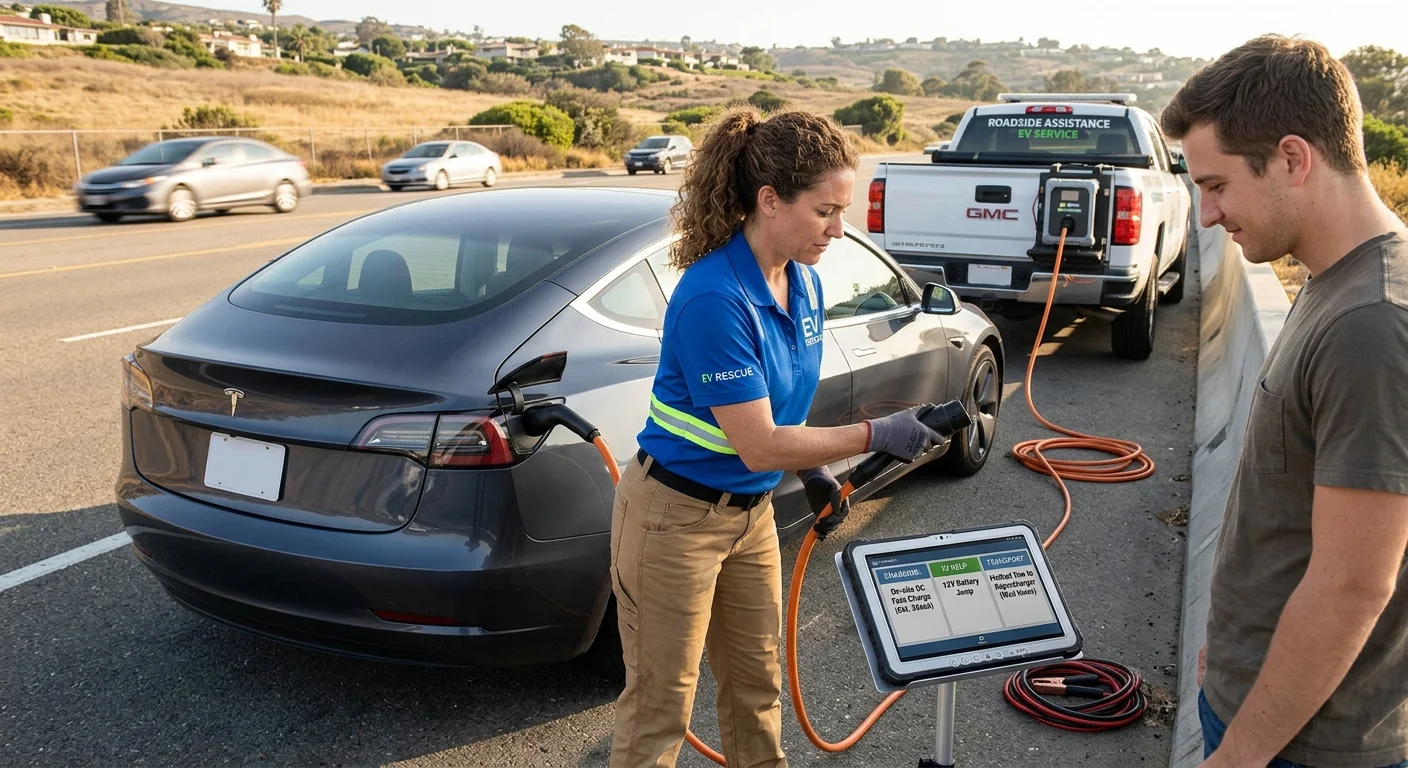
Start with what the car still shows
“Died” is a driver’s word, not a diagnosis. One car shows zero miles and a depletion warning. Another sits dark after a week in an airport garage. Those are different jobs for the operator who reviews the car.
Read every warning exactly as written, and don’t translate it into a guess. Note whether the cluster, cabin lights, locks, or phone app still answer. If a percent remains on the screen, say that number. Don’t decide what it means for the pack.
Tell the operator if the car quit while moving. Also say if it sat, then refused to wake. A shutdown on I-275 is a different scene from a silent driveway. Both still need the displayed message, not a guess.
Your owner’s manual is the authority for your model year. Open the roadside, low-voltage, charging, and towing chapters. If you don’t have the manual, say so before anyone opens a panel. A generic jump video isn’t a procedure for your car.
Blank glass and dead handles often track a 12-volt failure. That still isn’t a green light to pop the frunk. Designs and approved clamp points differ by brand. Our note on what happens when an EV 12-volt battery dies helps you sort the symptoms. It can’t name the fault in your specific vehicle.
Sit legally, then worry about the battery
Safety and traffic come before any diagnosis. If people are in danger, call emergency services first and follow their directions. Don’t use a blog to decide whether to roll a disabled car.
Florida Statute 316.194 is the rule that covers this stop. Subsection (1) bars leaving a vehicle on the paved travel way outside a municipality when you can pull off. Subsection (2) exempts a vehicle that’s disabled on that pavement and can’t avoid stopping. A dead EV on the shoulder is that disabled vehicle.
If the car still rolls, follow the dash and the manual. Those sources say whether a short crawl to the shoulder is allowed. If it won’t move, don’t invent a push or a Neutral release. Tell the operator what still works, then describe the lane.
Name the road the way a dispatcher hears it. “Northbound I-75 near Wesley Chapel” beats a vague Pasco pin. The same is true for I-275 between Tampa and Pinellas, and for I-4 at the airport interchange. Add the direction and the nearest exit you can read.
FDOT Road Rangers in District 7 patrol I-4, I-75, and I-275, plus the airport interchange. You reach them by dialing *347. They publish flat-tire help, a 12-volt jump, fuel, two local calls, and a move to a safer spot. Their published services don’t include charging an EV. That’s an observed gap in the written list, not a claim they refuse every electric car. Florida Highway Patrol Troop C handles disabled vehicles on these interstates.
Two Tampa Bay roads change the whole conversation. The Selmon reversible express lanes run about ten elevated miles between Brandon and downtown. THEA clears every vehicle before each reversal, and there’s no local surface shoulder on that span. A dead pack on the REL is a tow talk first. The Sunshine Skyway is four miles of bridge with nowhere to stop. The main span sits 432 feet above the channel. If you stall on the span, stay in the car and wait for official direction.
The Veterans Expressway and the Suncoast Parkway are Turnpike Enterprise roads with SunPass. The Suncoast runs long and fast through Pasco with widely spaced exits, so say which exit you last passed. A driver in north or central Pasco is often a WREC member, not a TECO or Duke customer. If officers already own the scene, their instructions beat phone troubleshooting.
Charge the pack, jump the 12-volt, or request a tow
“My electric car died” starts a call. It doesn’t finish the diagnosis. The operator matches symptoms, the manual, and the stop.
Choose a charge when the traction pack looks empty
Share the displayed percent, the warning text, and the make, model, year, and charge-port state. The operator then checks whether a mobile charge fits that car and that spot. Don’t assume the plug, the adapter, or the access steps.
Independent operators in this network bring a 240-volt Level 2 source to the bumper. Tesla cars take a native NACS plug. Other brands use a CCS or J1772 adapter. A typical session adds about 10 to 20 miles of range in 15 to 30 minutes of charging time. That’s charging time, never an arrival time.
A charge isn’t always the fit. The car may sit behind a gate the truck can’t enter, refuse a charge, or show a fault that isn’t stored energy. Our comparison of a mobile EV charge and a tow lists the questions to ask first. For a confirmed empty pack, discuss out-of-charge recovery.
Heat is part of every Tampa Bay range story. Recurrent Auto’s published research finds about 5 percent range loss at 90°F, and 20 to 30 percent above 95°F.
Choose a jump only after the 12-volt story is clear
Dark screens don’t automatically mean you should jump it. The operator should match your symptoms to the manufacturer’s steps. Don’t copy clamp photos from another model, and don’t open a panel the manual never names.
A Tesla left for a week at Tampa International Airport is the local version of this. TPA publishes free EV charging in every on-airport garage and at the cell phone lot. A car that still shows miles and still won’t wake is usually the 12-volt, not an empty pack. Ask the operator about Tesla 12-volt jump help after that pattern is clear.
Choose a tow when roadside work can’t finish the job
Transport belongs in the first talk when the cause is unknown, the car won’t accept a charge, or the stop is blocked. Collision damage belongs there too. The Selmon REL and the Skyway sit in this bucket more often than a quiet driveway.
Florida non-consent tow rates are capped by county. Hillsborough posts its maxima through the Tax Collector’s vehicle-for-hire authority. Pinellas sets them in Ordinance 19-39, inside Code Chapter 122. A live dollar figure wasn’t confirmed against the current schedule, so ask the tower for the filed rate before you pay.
On private lots, Florida Statute 715.07 controls a trespass tow. Required signs must name the tower and say the lot is a tow-away zone. In Hillsborough and Pinellas, a towed car must be stored within a ten-mile radius. Confirm the posted rate at the yard. Never tell a tower how to handle wheels or Neutral unless the manufacturer said so. Hand them the manual instead.
Give the operator a usable scene
Start with make, model, year, and the number on the battery gauge. Read warnings word for word, and skip your own diagnosis. Say what happened just before the car quit, and list what still works. Pin the stop with the road, direction, exit, or garage level. Name Tampa, St. Petersburg, or Clearwater when that’s where you sit. Gates and height bars decide whether a service truck can legally reach you.
After the immediate stop, the metro Tampa Bay charging hub is the place to plan the next trip. The operator in front of you still owns today’s call.
How Charge Pro TPA connects you
Charge Pro TPA is a referral line. We match stranded drivers with independent local mobile rescue operators. We don’t diagnose the car, own trucks, employ technicians, or set a price. We serve cities across Tampa Bay. The pros we connect you with are licensed and insured. They quote you before they start, and they bill you directly. Ask them to confirm scope, price, and credentials before you authorize work.
Share the vehicle and location notes you already gathered. We use those notes to make the connection. The operator then decides whether mobile EV charging, a 12-volt jump, or transport fits. Our EV roadside assistance page explains that referral for stranded drivers.
If the cause is still unknown, say unknown. If the first service can’t finish the job, ask what the manufacturer requires next.
Call when the car has stopped, won’t wake, or shows a message you can’t classify. Call (813) 536-4545 and we’ll connect you with a local EV rescue operator.