Your Mach-E sat in airport parking while you flew out. You tap the fob on the way back and nothing happens. The screen stays black. The handles may not unlatch. A Ford Mustang Mach-E that won’t start here is usually a dead 12-volt. It isn’t usually an empty high-voltage pack.
Heat and sitting still kill the small battery first
Tampa Bay runs a long air-conditioning season from spring into late fall. Recurrent Auto’s published research finds an EV loses about 5 percent of range at 90°F. Loss climbs to 20 to 30 percent above 95°F. Near 100°F, the loss sits around 17 to 18 percent. That’s range on a hot drive, and it varies by model.
The 12-volt fails for a quieter reason. It powers the computers, locks, lights, and the contactors that connect the traction pack. If that small battery is flat, the Mach-E can’t wake. The big pack can still be full.
A week in a garage is enough in this climate. Tampa International Airport publishes free EV charging at its on-airport garages. The cell phone lot has charging too. Level 1 J1772 sits on the first floor of the Economy Garage. Long-Term Parking has Level 1 as well. Level 2 is at the Cell Phone Lot. SkyConnect links the main terminal to Economy and the Rental Car Center. Leave the car plugged in if you can. If it still won’t wake after a trip, treat it as a 12-volt job. A parked week that ends with a dark car is rarely a pack at zero. More on that garage pattern is in Tampa International Airport EV charging.
Newer streets in Westchase, Fish Hawk, and Lakewood Ranch are recent builds. 240-volt home charging is near-universal in those garages. That keeps the traction pack healthy. It doesn’t keep a neglected 12-volt alive after the car sits. Older housing in St. Petersburg and Lealman leans more on public charging. Florida Statute 718.113(8) lets a condo owner install a charger in their exclusive space. The board can’t deny a proper request. None of that helps if the 12-volt is already dead in the lot.
How to tell 12-volt from an empty pack
The two failures don’t look the same.
A dead 12-volt leaves the Mach-E asleep. No screen. No interior lights. The fob gets no reply. You might hear a single click. The contactors never close, so the traction pack never comes online.
An empty pack usually lets the car power up. You get a display and a low-charge or limited-power warning. It may block Drive. It still looks awake.
If FordPass still shows a healthy state of charge, the pack didn’t hit zero. Start with the 12-volt. The wider pattern is in what happens when an EV 12-volt battery dies.
Read the screen before you assume a tow
If the display still has enough power to talk, use it.
“System Off to Save Battery” points at a weak 12-volt. A shutdown countdown is the same idea. The car is trying to hold the last bit of charge.
“Key Fob Not Detected” can be a spent coin cell in the fob. Swap that battery first. If a spare fob fails the same way, the car’s 12-volt is the better bet. A weak 12-volt can’t run the receivers.
“Stop Safely Now” is a harder warning. It often means a high-voltage or other critical fault. Get out of the travel lane if you can. Don’t keep driving on that message.
“Service Vehicle Soon” is a general shop flag. It doesn’t always block a start. It still needs diagnosis, not a roadside guess.
A blank screen is the classic dead 12-volt. The car never had power to write a warning at all.
Stay legal on the interstate, then try the simple checks
Get out of the travel lane first. Florida Statute 316.194 covers stopping outside a business or residence district. You can’t leave the car on the paved highway when you can get it off. Subsection (2) exempts a vehicle disabled on the pavement. You may leave it there when you can’t avoid it. Hazards on. Stay off the painted lanes.
The Selmon reversible lanes between Brandon and downtown are a different problem. That elevated segment has no local surface shoulder. THEA clears every vehicle before each reversal. Westbound into downtown runs from about 5 a.m. to noon, then the lanes turn eastbound. If you stall on the REL, stay in the car with hazards on. Don’t walk the deck.
FDOT Road Rangers in District 7 cover I-4, I-75, I-275, and the airport interchange. Dial *347 from your phone. They publish jump-starts, tire help, fuel, and water. They also offer two local calls and a move to a safer spot. The materials reviewed don’t list charging an EV. A 12-volt jump on a Mach-E still fits the jump-start help they already describe. The Tampa Bay SunGuide Center runs that district. Florida Highway Patrol Troop C handles disabled vehicles on the interstates.
On the Veterans Expressway or the Suncoast Parkway, use the same play. Stand off the travel lane. Then try the fob from a few feet. Try the spare. Look for any dash flicker if a door opens. No flicker and no latch is still the 12-volt pattern.
Vaisala data puts this metro among the most lightning-prone in the country. Don’t stand in a storm holding jumper cables.
The 12-volt lives in the frunk, and a jump only wakes that battery
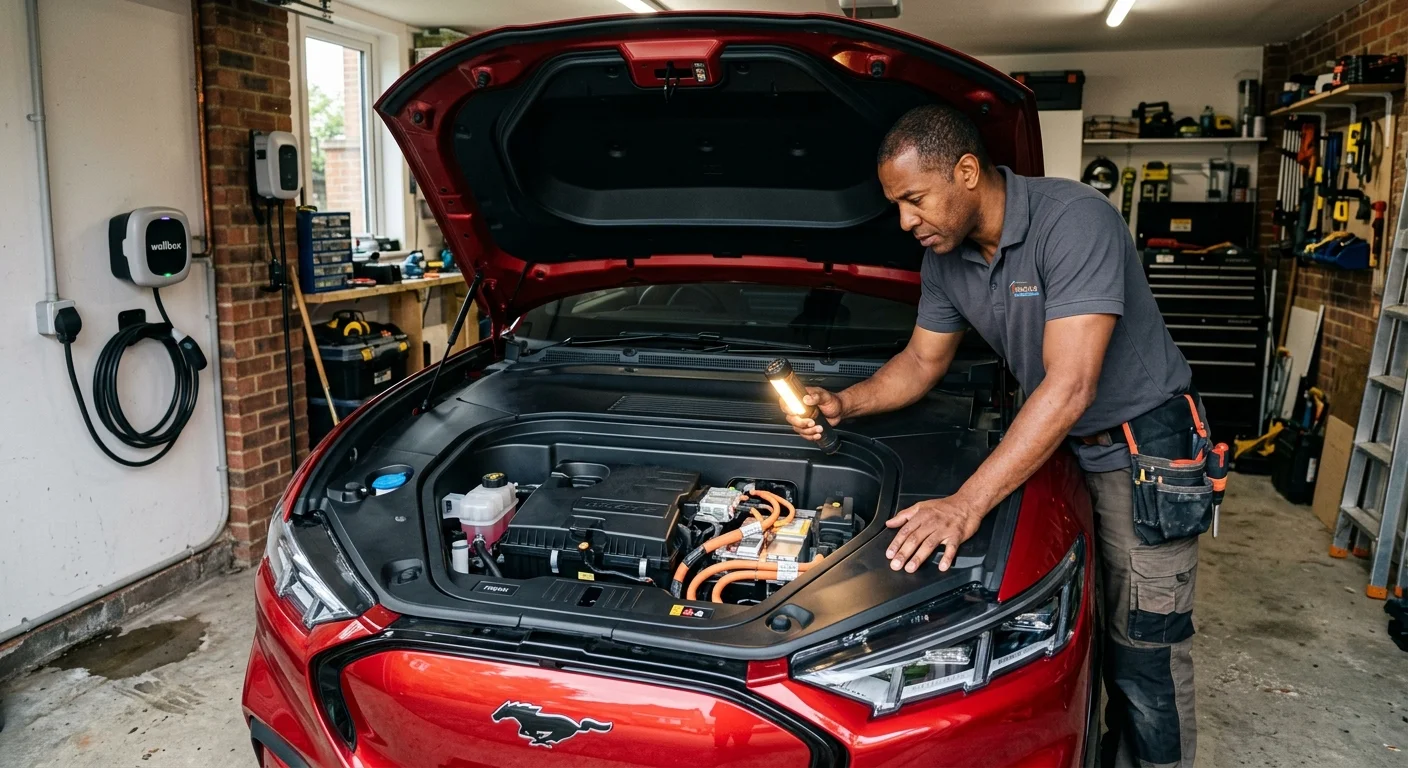
Ford put the Mach-E 12-volt under the hood, in the front trunk. A cover on the passenger side of that bay hides it. The owner’s manual shows the clips for your year. You’re not jumping the high-voltage pack. You’re only feeding the small battery that lets the car think.
Ford also gives jump posts in that frunk. The positive post sits under a red cap. The negative is usually a chassis ground nearby, a bare bolt or bracket. Use those posts, not a guess at other metal.
If you have a jump pack or another 12-volt vehicle, clamp with both cars off. Red to the Mach-E positive post first. Black to the Mach-E ground point next. Then red to the donor positive. Then black to the donor negative or ground. After the pack or donor is feeding the circuit, try to wake the Mach-E. Disconnect in reverse order.
Once it wakes, keep it on. Plug in if you have a charger. Drive it so the DC-DC converter can refill the 12-volt. If it dies again after a short sit, plan on a replacement. Signs and next steps are in EV 12-volt replacement. A careful method is in how to jump start an electric car without damage. Ford Lightning owners hit the same stall: Ford F-150 Lightning won’t start.
Skip the jump if you smell sulfur or see a swollen case. Skip it if the car sat in floodwater. Hurricane Helene drove record surge in late September 2024. Milton followed in early October with heavy rain on parts of St. Petersburg. Low Pinellas and the barrier islands sit in evacuation zones. So do south Hillsborough streets in Ruskin, Apollo Beach, and Gibsonton. Federal and fire-service guidance warns that an EV soaked in salt water can fail later. That includes a battery fire risk. Keep that car away from buildings and other vehicles until a shop inspects it.
When a jump can’t help, and what a mobile charge actually does
A Mach-E that wakes, shows near-zero range, and refuses Drive needs energy in the traction pack. A 12-volt jump won’t add miles.
Charge Pro TPA is a referral line. It matches stranded drivers with independent local mobile rescue operators. It doesn’t own trucks, employ technicians, or set prices. The operators it connects you with bring a 240V Level 2 source to the bumper. They use CCS or a J1772 adapter on a non-Tesla like the Mach-E. They typically add 10 to 20 miles of range in 15 to 30 minutes of charging. That window is charge time at the car, not an arrival estimate. The operator quotes you before starting and bills you directly. Start on non-Tesla EV rescue if you want that dispatch path.
A tow is the last resort. Use a flatbed if the car can’t go into Neutral. Use one if the 12-volt won’t recover. Hillsborough County caps non-consent tows through the Tax Collector’s vehicle-for-hire authority. Pinellas sets caps by Ordinance 19-39. Confirm the live schedule with those offices. Exact cap amounts weren’t confirmed here.
TECO serves the City of Tampa, most of Hillsborough, and parts of Pinellas and southern Pasco. Duke Energy Florida serves Pinellas and much of Pasco. Withlacoochee River Electric Cooperative serves north and central Pasco outside the Dade City area. A Pasco driveway is often WREC, not TECO or Duke. Those utilities run home and public charging programs. TECO’s Drive Smart program is a commercial and public charger incentive. Duke publishes a Charger Prep Credit and an Off-Peak Charging Credit. Confirm current terms on each utility’s own site. None of them send a 12-volt truck to a dark Mach-E in a lot.
If you’d rather not open the frunk, call (813) 536-4545. We’ll connect you with a local operator. They quote before they start.