A Tampa EV that sits dark in the driveway often still has a charged pack. The 12-volt battery that wakes the computers is the part that failed. That’s the local ev 12v battery replacement story. Heat and a long sit leave a screen that never comes back.
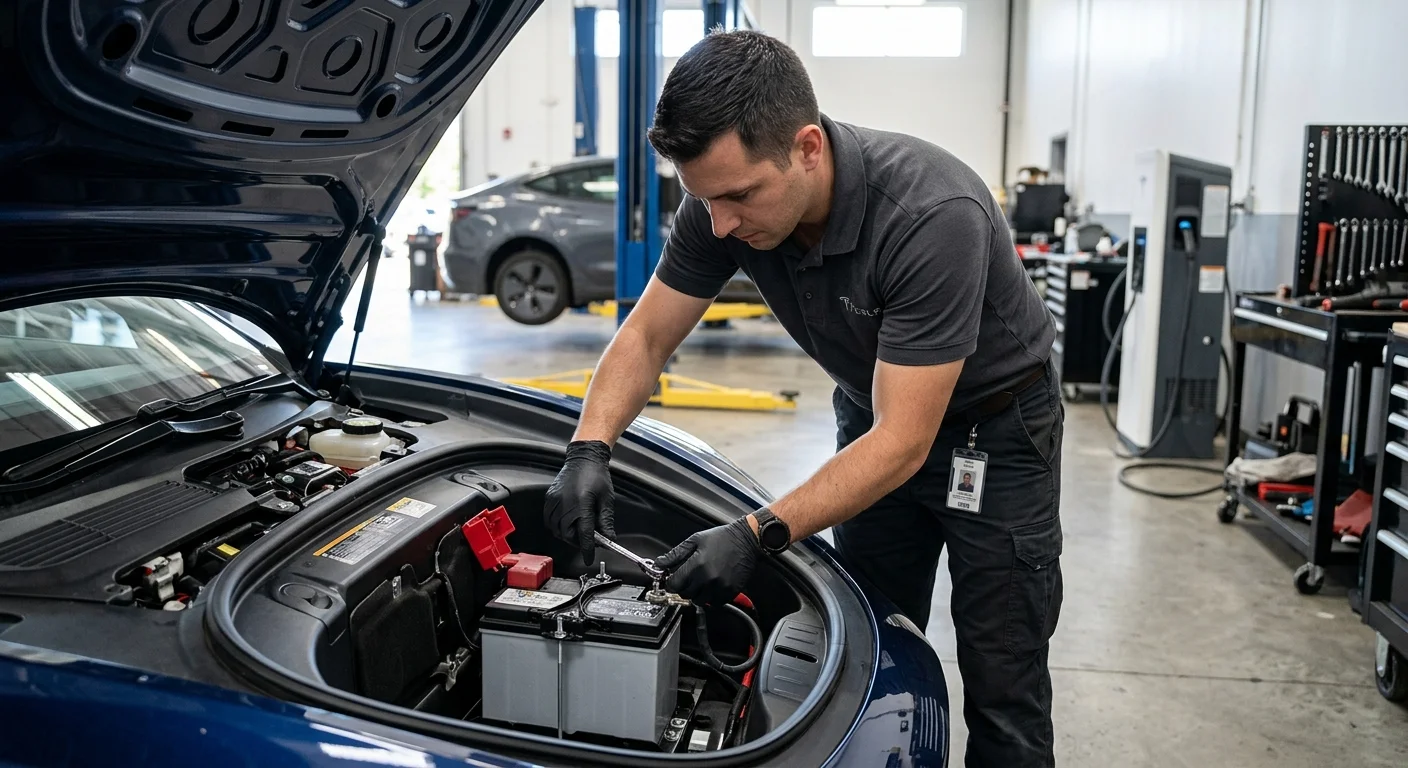
The 12-volt is the wake-up circuit, not the motor
The traction pack turns the wheels. The 12-volt runs the computers that make the car usable. Cabin screens, door handles, lights, and pack contactors all draw from that small battery. If voltage sags, those computers never boot. You get a blank display and a fob that does nothing. The door handle may stay flush. It looks like the EV died. The pack may still be fine.
There’s no engine to crank here. There’s a computer that won’t power on. Until it wakes, you can’t shift into Drive. You may not open the charge port. You may not pop the frunk. Owners then assume the main battery is empty. Many Tampa Bay “won’t start” calls are this mix-up.
What happens when an EV 12-volt battery dies in Tampa Bay walks through that cabin behavior.
Heat, sitting cars, and salt air
Tampa Bay’s air-conditioning season runs from spring into late fall. Recurrent Auto’s published research finds an EV loses about 5 percent of range at 90°F. Loss climbs to 20 to 30 percent above 95°F. It’s about 17 to 18 percent near 100°F, and it varies by model. That data is traction range, not a 12-volt spec. The same heat still sits on the little battery. It lives under a frunk, a seat, or a cowl.
Salt air along Pinellas and the bayfront is slower wear. Terminals corrode and trays hold moisture after summer storms. That doesn’t show up as a range number. It shows up as a car that won’t unlock after a hot afternoon in a coastal lot.
Sitting is the failure mode people miss. Tampa International Airport publishes free EV charging at on-airport garages and the cell phone lot. Level 1 J1772 stations sit on the Economy Garage’s first floor and in the Long-Term Parking Garage. Level 2 is at the Cell Phone Lot. Drivers still return from a week away to a car that won’t wake. The airport says the pack had a place to charge. A dark Tesla, Rivian, or Mach-E after that trip is almost always the 12-volt. See Tampa International Airport EV charging for the garage layout.
Storm weeks make sitting worse. Hurricane Helene in late September 2024 drove record storm surge at Tampa Bay gauges. St. Petersburg faced a forecast 5 to 8 feet of surge. Pinellas barrier islands from the Dunedin Causeway through Tierra Verde were closed. Hurricane Milton in early October 2024 soaked parts of St. Petersburg. Parts of the city saw at least 18 inches of rain. It tore part of the roof off Tropicana Field. Cars that sat through those evacuations came back to flat 12-volts. If an EV took on salt water, treat it as a fire risk. Federal and fire-service guidance warns of delayed lithium-ion trouble after saltwater soaking. Keep it away from buildings and other vehicles until a qualified shop inspects it. A 12-volt jump isn’t that inspection.
Signs it’s the 12-volt, not an empty pack
An empty pack and a dead 12-volt feel similar from the driver’s seat. A few local tells separate them.
You plugged in overnight in a Tampa driveway and the app still showed range. Then the car went dark. That isn’t an empty pack. You left it in an airport garage with published free charging, and the handles won’t present. That isn’t an empty pack either. The phone app still reports a state of charge, but the car won’t unlock. Low-voltage power is the suspect.
Before it dies for good, many EVs throw a 12-volt or “replace battery” message. Teslas are direct about that alert. Don’t clear it and keep driving. Screens that boot slowly and handles that stay flush are earlier tells. Dim cabin lights and a brake pedal that does nothing belong here too. A nest of unrelated error codes can show up too. Control modules are starving for stable voltage.
See Tesla 12V warning signs before you’re stuck in Tampa Bay for the brand-specific list. A jump that works, then fails after a short drive, is the last sign. The battery can’t hold a charge. Get it tested and replaced. EV starts, then dies again after a jump is that 12-volt pattern.
What a local operator can do in the driveway
Charge Pro TPA is a referral line. It matches stranded drivers with independent local mobile operators. It doesn’t hold a trade license, own trucks, or employ technicians. It doesn’t set prices or promise an arrival time. The operator quotes you before starting and bills you directly. The operators we connect you with are licensed and insured.
They can jump a dead 12-volt where the car sits. They can replace it on site when they have the right battery. Tesla and every major EV brand still use that small battery. The high-voltage pack is a separate problem. If the pack is also empty, the operator can bring a 240-volt Level 2 source. That’s a native NACS plug, or a CCS or J1772 adapter. That charge typically adds 10 to 20 miles of range. That’s 15 to 30 minutes of charging time, never an arrival time.
Don’t mix those jobs up. A 12-volt jump wakes the computers. A Level 2 session feeds the pack. Some stranded cars need both.
Chemistry matters if you’re swapping, not jumping. Newer Model 3 and Model Y cars moved to a lithium 12-volt. Older ones used AGM. Rivian, Mach-E, ID.4, Ioniq 5, and Leaf layouts all differ. Confirm the part in the owner’s manual or with the dealer. A lithium car doesn’t want a random AGM from a parts shelf.
If you need the car awake for a dealer visit, a jump may be enough. If the dash already says replace the battery, a driveway swap saves the second trip. Ask what the operator can do before they open a panel.
Tesla drivers who need the systems back can start at Tesla 12-volt battery jump. Jump posts are in how to jump start an electric car without damage. Never try to jump from the high-voltage system. Use the 12-volt terminals the manual names. They’re often behind a front cover or in the frunk.
New suburbs, old streets, and condos
Where you park changes how this failure shows up. It doesn’t change the battery.
Westchase, Fish Hawk, and Lakewood Ranch are new master-planned stock. Pre-1980 housing is about 1.0 percent in Westchase and 0.8 percent in Fish Hawk. Lakewood Ranch is about 0.7 percent. 240-volt home charging is near-universal there. The pack stays topped up. A car that won’t wake on those driveways is usually the 12-volt. Heat cooked it after a short sit.
St. Petersburg and Lealman sit at the other end of the age chart. About 51.5 percent of St. Petersburg homes were built before 1980. About 56.6 percent of Lealman homes were too. Plenty of those streets were never wired for a wall charger. Owners use a garage outlet or public charging. The pack can still be fine in the morning. The 12-volt ages in the heat either way.
Pinellas condos add a third version. Florida Statute 718.113(8) covers condo EV chargers. A unit owner may install one in their limited common element or assigned space. The owner pays for install, power, and insurance. A declaration can’t block a proper request. Many owners still haven’t installed, so those cars sit on shared lots. Sitting is hard on a 12-volt.
Highway, the Selmon REL, and the Skyway
A dead 12-volt on a quiet street is a driveway job. A dead 12-volt on the interstate is a disabled vehicle.
Florida Statute 316.194 covers stopping outside a business or residence district. Get off the paved travel lane when you can. Subsection (2) exempts a vehicle disabled on the pavement when you can’t avoid leaving it there. A dark EV on a shoulder fits that exemption. Hazards on. Keep people out of the travel lanes.
FDOT Road Rangers in District 7 patrol I-4, I-75, and I-275, plus the airport interchange. Dial *347. Published help includes a flat tire, a jump-start, fuel, and water. They also offer two local calls and moving a disabled vehicle to a safer spot. The materials reviewed don’t mention charging an EV. A 12-volt jump is in their published toolkit. A pack charge isn’t. Florida Highway Patrol Troop C covers disabled vehicles on those interstates.
The Lee Roy Selmon Reversible Express Lanes are a special case. THEA runs that roughly 10-mile elevated segment between Brandon and downtown Tampa. It’s westbound into downtown from about 5 a.m. to noon, then eastbound. Lanes are cleared of all traffic before each reversal. There’s no local surface shoulder on the elevated stretch. A car that won’t wake there isn’t a place to crawl under a frunk. Stay with the vehicle if you can’t walk to a safe exit. Wait for Road Rangers or FHP.
The Sunshine Skyway on I-275 is worse if the battery dies on the span. The cable-stayed main span sits 432 feet above the shipping channel. FHP closes the bridge at sustained 40 mph winds. It also closes when fog cuts visibility below about 100 feet. There’s no good workspace over the water. Treat a Skyway stall as a safety incident first.
A tow should be the last move. Hillsborough County caps non-consent and trespass tow rates through the Tax Collector’s vehicle-for-hire authority. Pinellas sets them by Ordinance 19-39 and County Code Chapter 122, Article II.5. Current dollar caps weren’t confirmed against the live ordinance schedule. Ask the county or the tower for the posted rate. A consented jump or swap is a different deal. The operator quotes you first.
Timing a replacement without a made-up number
No verified Tampa Bay average for EV 12-volt life turned up for this page. Forums love a round figure. Heat, chemistry, and sitting all change it. Treat those round figures as unconfirmed.
Use the car’s own alerts. A “12V battery replacement” message is the schedule. A jump that only lasts a day is the schedule. A week in the Economy Garage that ends with a dark cabin is a test-and-replace.
Ask whoever does the work for a quote before they order a part. Charge Pro TPA doesn’t publish battery prices. No Tesla, Rivian, or Mach-E parts or labor figure was confirmed against a primary source here. Ask OEM versus aftermarket. Ask lithium versus AGM. Some brands want a scan tool to register a new 12-volt. Confirm that step with the manual or the dealer. It wasn’t verified brand by brand for this page.
Some owners swap the battery themselves. Tesla often hides it under frunk trim. Follow the manual. Many EVs want service mode before you pull a cable. Disconnect in the order the manual states. If any of that feels unclear, don’t start. A wrong pull can damage modules. A local operator or a shop is the safer swap in that case.
After a successful jump, get the battery replaced. Don’t treat the wake-up as the repair.
If you’re already stranded
In a driveway, stay with the car. Check the app for remaining range. Try the manual key path if the handles won’t present.
If you own a 12-volt jump pack and you know the posts, try a wake-up. If you don’t know the posts, don’t pry at the bumper.
On I-275, I-75, or I-4, get as far onto the shoulder as the car will roll. If it won’t roll, you’re under 316.194(2). Call *347. Road Rangers can jump a 12-volt. They don’t publish an EV charge. Then call for a local operator if you need a replacement where you sit. Call them too if the car won’t stay awake.
On the Selmon REL or the Skyway, don’t walk the elevated deck. Wait for the highway agencies.
When to pick up the phone
If the 12-volt has quit, you need a jump or a swap on site. Charge Pro TPA connects you with an independent local operator for that work. Call (813) 536-4545. The operator quotes before they start and bills you directly. This line doesn’t promise when someone arrives. You’ll hear the price before any clamp goes on.