A Mercedes EQE that won’t start is almost always a dead 12-volt battery, not a failed drive pack. The MBUX screen stays dark. Flush handles stay in. Ready never shows, even when the high-voltage percentage looks fine. Jump the dedicated terminals under the hood. Let the low-voltage side recover. The car usually wakes. If it dies again after a short sit, the 12-volt is done. That’s a workshop replacement.
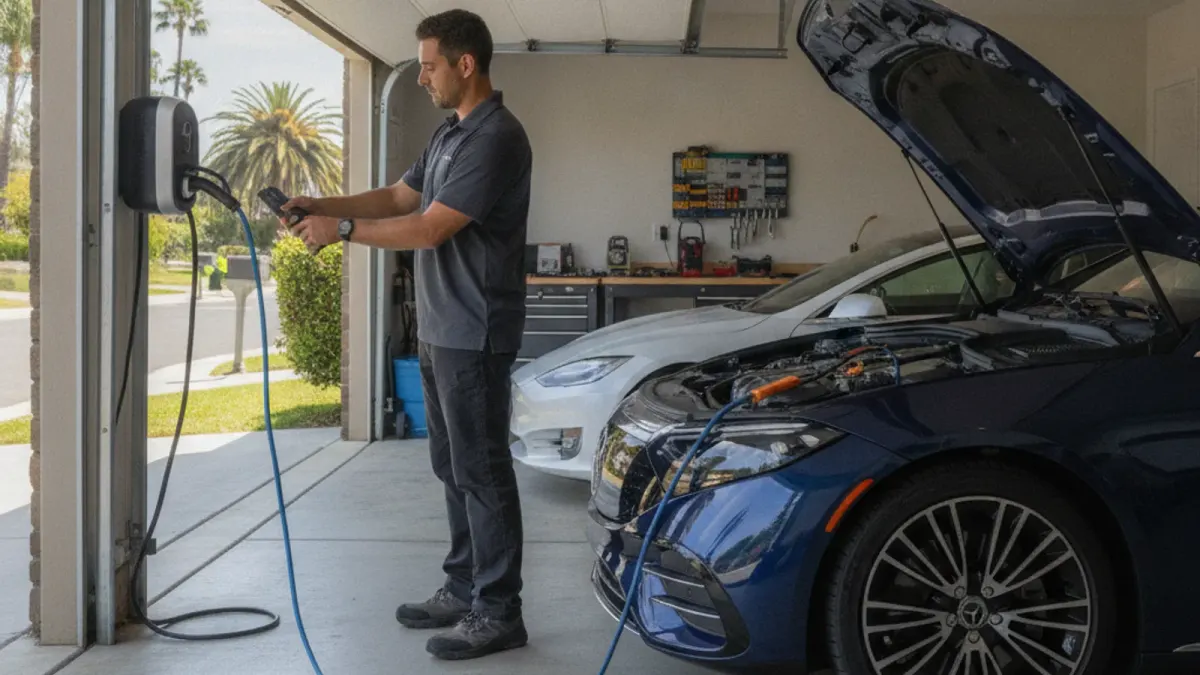
Heat soaks the 12-volt before the pack looks empty
Tampa Bay’s air-conditioning season runs from spring into late fall. An EQE that sat through that heat, then refuses to wake, is a 12-volt story. It isn’t a mystery pack failure.
Recurrent Auto publishes the range numbers owners quote. An EV loses about 5 percent of range at 90°F. Above 95°F the loss is 20 to 30 percent. Near 100°F it’s roughly 17 to 18 percent. The effect varies by model. That’s the drive pack working under AC load. The 12-volt takes a quieter beating. Cabin electronics still sip power while the car soaks. Parked modules don’t take a summer off.
Florida is one of the most lightning-prone metros in the country, per Vaisala. Storm weeks mean more days the EQE sits. Sitting is what pulls the 12-volt down. Salt air along the bay doesn’t help aging electrical connections. That’s climate, not a scare line. Heat plus idle time is the pairing that actually strands you.
The pack moves you, the 12-volt wakes the car
The EQE’s high-voltage battery turns the motors. A separate 12-volt AGM battery powers everything that has to come alive first. Flush door handles run on it. So does the MBUX display. Ambient lighting runs on it too. So do driver-assistance sensors. So do the control units that handshake with the high-voltage pack.
When 12-volt voltage falls too far, the handshake never finishes. The car looks bricked. The pack can still read 80 percent or more. Nothing failed on the expensive battery. The small one just can’t bring the car online. If your phone app last showed a healthy drive battery, treat this as 12-volt.
Parasitic drain is the usual path. The EQE keeps a long list of modules partly awake. The connectivity gateway stays in the mix. So do radar and camera units. Over-the-air update systems and MBUX electronics keep sipping too. Park it for a couple of weeks without a drive. The 12-volt can drop below the start threshold. A car that lives unplugged in a hot driveway gets there faster. A car that stays plugged in at home often keeps the 12-volt healthier. The vehicle stays awake on the charger.
The EQE shares the EVA2 platform with the EQS. It shares the same low-voltage layout too. An EQS no-start is the same failure and the same jump. The Mercedes EQS 12-volt battery guide walks that sibling. The EQE SUV uses this layout too. The EQB and EQA sit on a different platform. Their 12-volt packing isn’t identical. A dark screen still points at the 12-volt. A no-start from a dead 12-volt still gets the same kind of jump.
What a dead 12-volt looks like on the EQE
There’s no single cartoon that says the 12-volt is gone. You get a cluster of symptoms. They all point at low voltage.
The car is fully silent. Handles won’t extend. The fob does nothing. That’s a flat 12-volt. You need a jump, not a charge for the drive pack.
The screen boots part way, then freezes or dies before Ready. The 12-volt had just enough to start the sequence. It didn’t have enough to finish.
A 12-volt vehicle electrical system warning shows. Then the display goes dark. Voltage fell under what the control units need.
It unlocks but won’t leave Park or enter drive. Low-voltage modules can’t bridge to the high-voltage pack.
None of those mean the drive battery failed. They all mean the 12-volt can’t deliver. For the wider version of that split, read what happens when an EV 12-volt dies.
Jump under the hood, don’t pull the trunk apart
Owners get this backwards. The 12-volt battery lives in the rear, under a trunk floor panel. Replacing it is a workshop job. You pull the cargo liner and the load floor. You don’t do that in a parking lot. A dead 12-volt also tends to kill the powered tailgate. The rear is a bad place to start.
For a jump, you never touch that rear battery. Mercedes puts dedicated jump terminals under the hood.
- Use the interior hood release near the driver’s door sill. It’s a mechanical cable, so it still works with the 12-volt dead. If the doors won’t open electrically, slide the mechanical key blade out of the fob. Unlock the driver’s door by hand.
- Open the hood. On the driver’s side you’ll see a black plastic fuse and relay box.
- Lift the fuse box cover. Under a red protective cap is a marked positive (+) stud. That’s the jump positive.
- For negative, use an unpainted metal bolt or bracket on the chassis, or a strut-tower ground. Don’t run the negative lead back to the rear battery.
Connect in the usual order. Positive to the EQE jump stud, then to the donor. Negative to the donor, then to chassis ground on the EQE. Give the low-voltage side a couple of minutes to recover. Then start. The display should boot, run its sequence, and enter Ready.
| Battery detail | Mercedes EQE |
|---|---|
| 12-volt location | Rear cargo area, under the trunk floor panel |
| Jump terminals | Engine bay, driver’s-side fuse box |
| Typical type | 12-volt AGM lead-acid |
| Common failure | Parasitic draw from MBUX, radar, and OTA modules |
| Dark screen | 12-volt system, not the high-voltage pack |
| Replacement | Workshop job: rear disassembly and battery registration |
Short version: the battery is in the trunk. The jump points you actually use are in the driver’s-side fuse box under the hood. Those are two different places.
A parking-lot jump still has to be done right. If you want the general EV sequence, use how to jump start an electric car without damage. The pros we connect you with already know the EQE studs. That’s what non-Tesla EV rescue is for.
Where this actually happens around Tampa Bay
The classic EQE call is a car that sat. It isn’t a pack that ran to zero on a long trip.
Tampa International Airport is the clearest version. The airport publishes free EV charging at all on-airport parking garages and the cell phone lot. The Economy Garage has Level 1 J1772 stations on the first floor. Level 1 charging is also in the Long-Term Parking Garage. Level 2 is at the Cell Phone Lot. That’s useful when you plan the trip. It doesn’t save a 12-volt that sat for a week. An EV left in those garages that comes back silent is almost always a 12-volt failure. It isn’t a depleted pack. SkyConnect still gets you between the main terminal, the Economy Garage, and the Rental Car Center. It doesn’t wake a dead 12-volt. More on that setup is on our Tampa International Airport EV charging page.
The same sit-and-die pattern shows up after a multi-day cruise. Port Tampa Bay parking and any charging there weren’t verified on a primary page. Treat a silent EQE in cruise parking as a 12-volt problem. Don’t treat it as a charging-map problem.
Lakewood Ranch, Fish Hawk, and Westchase are the newest housing in the metro. Census figures put pre-1980 stock at about 0.7 percent, 0.8 percent, and 1.0 percent there. 240-volt home charging is near-universal on those master-planned streets. An EQE that still dies in a Lakewood Ranch garage usually sat too long. Or the 12-volt is aged. It isn’t because the house lacks a charger.
Pinellas is the other texture. St. Petersburg’s housing stock is old, with 51.5 percent built before 1980. Lealman is older still at 56.6 percent. Plenty of water-adjacent owners live in condos. Florida Statute 718.113(8) lets a condo owner install an EV station in their limited common element or exclusive space. The board can’t deny a properly submitted request. The owner pays for installation, operation, and separately metered electricity. Until that station exists, the car may sit on public charging and long idle stretches. That’s hard on a 12-volt.
A short errand can do it too. You park. You grab food. You come back, and the car won’t wake. That’s low 12-volt. The pack didn’t empty in twenty minutes.
If you’re stopped on a Tampa Bay road
A dead EQE on the shoulder is a disabled vehicle under Florida Statute 316.194. Get off the travel lane if you can. The statute bars stopping on the paved way outside a municipality when you can leave it, and it exempts a vehicle that’s disabled and can’t be moved. Hazards on. Stay out of traffic.
FDOT Road Rangers in District 7 patrol I-4, I-75, and I-275, plus the airport interchange. Dial *347. Published services include flat-tire help, a jump-start, fuel, diesel or water, two free local calls, and moving a disabled vehicle to a safer spot. The materials reviewed describe fuel, jump-start, and tire help. They don’t mention charging an EV. A Road Ranger can often jump a 12-volt. Don’t count on them to refill the drive pack. Florida Highway Patrol Troop C covers disabled vehicles on the interstates. Florida 511 is the traffic feed.
The Lee Roy Selmon Expressway’s reversible express lanes are a special case. THEA’s REL is a roughly 10-mile elevated segmental bridge in the median between Brandon and downtown Tampa. Direction reverses through the day, westbound into downtown from about 5 a.m. to noon, then eastbound. The lanes are cleared of all traffic before each reversal. There’s no local surface shoulder on the elevated segment. If the EQE dies there, you’re in a managed, elevated lane, not a wide breakdown bay. Stay in the car if that’s the safe choice. Call for help rather than walking the structure.
The Sunshine Skyway on I-275 is four miles of bridge with no good place to stop. The main span sits 432 feet above the shipping channel. FHP closes it when winds reach sustained 40 mph, or when fog cuts visibility below about 100 feet. A no-start on that span is a 12-volt or a pack problem in the worst geometry. Don’t try to self-rescue on the bridge.
Veterans Expressway and the Suncoast Parkway are all-electronic Turnpike roads. The Suncoast is a long, fast run north through Pasco with widely spaced exits. A silent EQE there is still a 12-volt jump if the pack has energy.
Towing is the last resort, not the first. Hillsborough and Pinellas cap non-consent tow rates at the county level. Hillsborough does it through the Tax Collector’s vehicle-for-hire authority. Pinellas does it by ordinance. Exact dollar caps weren’t confirmed against the live schedule. Confirm with the county before you pay. Under Florida Statute 715.07, a towed vehicle in a county of 500,000 or more must be stored within a 10-mile radius. Hillsborough and Pinellas both qualify.
Once it starts, you’re not done
Once you’re moving, the 12-volt recharges from the main pack through the DC-DC converter. If the battery is old or failed internally, it won’t hold that charge. You’ll be dark again in a few days. A jump that works once and fails after the next sit is a replacement, not another jump.
Replacement isn’t a roadside DIY. The battery sits under the trunk floor. It usually needs registration to the car’s battery management system with a compatible diagnostic tool. Get mobile first. Then book a Mercedes dealer or an independent EV shop.
Heat and salt air wear the whole electrical system down over years. That’s a local climate fact. The longer version is how Tampa Bay heat and salt air wear down an EV battery. For signs and sequencing, use EV 12-volt replacement.
Hurricane weeks make the sit-and-die pattern worse. Helene in late September 2024 drove record storm surge at Tampa Bay gauges. Milton in early October 2024 dropped at least 18 inches of rain on parts of St. Petersburg. Cars sit. 12-volts sag. Low-lying Pinellas and south Hillsborough towns like Ruskin, Apollo Beach, and Gibsonton sit in evacuation zones, and storm weeks mean more sitting cars.
If an EQE was submerged or soaked in salt water, federal and fire-service guidance warns that a lithium-ion pack can be a delayed fire risk. Keep it away from structures and other vehicles until it’s inspected. That’s the high-voltage pack. It isn’t a reason to skip a 12-volt jump on a dry car that simply won’t wake.
What to do in the lot, in order
- See whether the doors respond. If not, use the mechanical key in the fob on the driver’s door.
- Look for any 12-volt sign: a dome light, hazards, a flicker on the screen. Nothing means you need a jump.
- Pull the mechanical hood release.
- Find the red-capped positive stud in the driver’s-side fuse box.
- Use a jump pack or a donor. Negative goes to chassis ground. Wait a couple of minutes before you try Ready.
- If a 12-volt fault stays after the jump, the battery is failing internally. That’s a workshop replacement.
Charge Pro TPA is a referral line. It matches you with independent local mobile rescue operators. It doesn’t perform the work, own trucks, or set prices. The operator quotes you before starting and bills you directly. The pros we connect you with can jump the EQE on those underhood terminals. They can replace a 12-volt on site when that’s the right call. They also bring a 240-volt Level 2 source when the real problem is an empty pack, typically adding 10 to 20 miles of range in 15 to 30 minutes of charging. That’s charge time, not an arrival time.
If you’re stranded with a Mercedes EQE that won’t start, call (813) 536-4545.
Frequently asked questions
How do you jump a Mercedes EQE?
Use the dedicated positive stud under the hood, inside the driver’s-side fuse box cover. Positive cable on that stud. Negative on a chassis ground, not the rear battery. Wait a couple of minutes, then start. The real 12-volt lives under the trunk floor and isn’t a parking-lot jump point.
Where is the 12-volt battery in a Mercedes EQE?
In the rear, under a panel in the trunk floor, not in the engine bay. You wake the car through the underhood jump terminals: a red-capped positive stud and a nearby chassis ground. That matters when the dead 12-volt has already disabled the powered tailgate.
Why won’t the EQE start if the main battery is charged?
Because two different batteries do two different jobs. The high-voltage pack can read 80 percent or more. The small 12-volt battery powers the handles, the screen, and the control units that bring the car online. Jump the 12-volt and it wakes. The drive pack was never the problem.