A Lucid Air that won’t start in Tampa Bay is usually a dead 12-volt. It’s not an empty luxury pack. Heat and a long garage sit flatten that small battery. The traction pack can still hold plenty of range. Screens stay dark, flush handles never present, and the fob does nothing. Jump the 12-volt and wait a couple of minutes. The Air often wakes as if nothing failed.
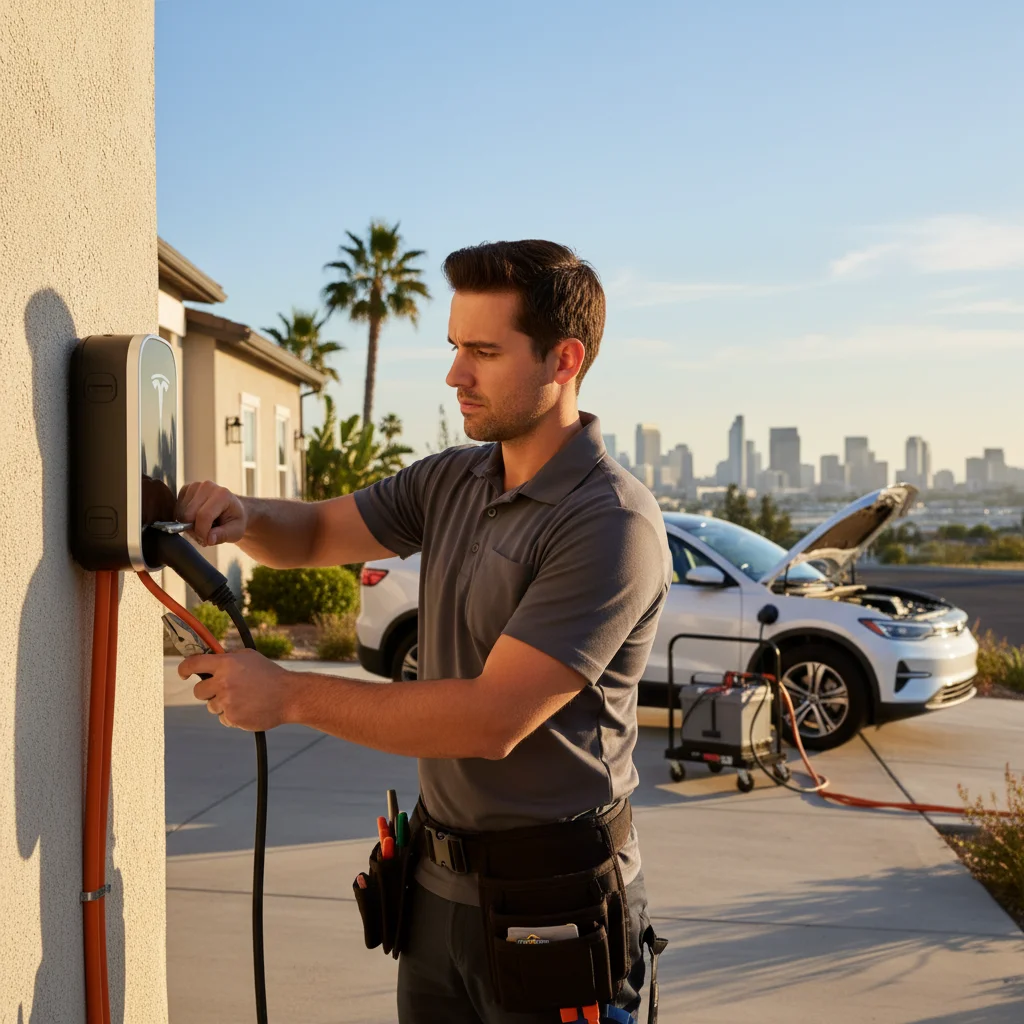
Owners miss this because the pack is huge. That pack doesn’t run the door handles or the glass cockpit. It doesn’t run the modules that connect drive power. Those live on 12 volts. When that battery drops, the Air looks dead. It usually isn’t. Work the checks below in order. The same pattern shows up in a Lakewood Ranch garage. It also shows up after a week in parking at Tampa International.
The 12-volt wakes the car, not the pack
Every modern EV boots from a low-voltage battery. The Air follows that design. The 12-volt feeds the flush handles, the displays, the power closures, and the control modules. None of that runs straight off the traction pack.
The pack can sit at a healthy charge and still leave you locked out. That’s what happens when an EV 12-volt battery dies. The car never finishes the startup handshake. Drive-ready never arrives.
Three looks all point at the same fault.
- Total silence. No lights. Handles stay flush. The fob won’t unlock.
- Screens flash a 12-volt or system warning, then go dark.
- The car partly wakes, then drops out of drive-ready.
If it never lit up, treat it as 12-volt first. If it woke, showed low range, and then quit, that’s the traction pack. Those are different jobs.
Heat and a long sit flatten the 12-volt here
Tampa Bay isn’t a mild garage climate. Air-conditioning season runs from spring into late fall. Recurrent Auto’s published research finds an EV loses about 5 percent of range at 90°F. Loss climbs to 20 to 30 percent above 95°F. It sits near 17 to 18 percent around 100°F. Those numbers describe the traction pack and cabin cooling. The 12-volt pays a second tax.
A luxury sedan keeps many modules on standby. Connectivity, sensors, and keyless entry keep listening for the fob. Park the Air two or three weeks without a drive. Those modules can pull the 12-volt below the voltage the car needs to wake. The high-voltage pack normally tops the 12-volt back up through a DC-DC converter. That only happens when the car is awake or charging. A sleeping car in a closed garage isn’t replenishing anything.
Lakewood Ranch, Fish Hawk, and Westchase are mostly new housing. Census figures put pre-1980 stock at about 0.7, 0.8, and 1.0 percent. Home 240-volt charging is common there. That still doesn’t save a 12-volt that sat through a two-week trip.
Pinellas condos add another sit. Florida Statute 718.113(8) gives a unit owner charger rights. That covers a limited common element or exclusive space. Plenty of beach and downtown owners still charge in public between trips. The Air then sits. Same 12-volt failure. Different driveway.
Check the outside of the car first
Don’t start yanking panels. Confirm the simple stuff first.
Decide whether the fob is dead or the whole car is dark. A weak fob still lets handles present if 12-volt is alive. If nothing on the body responds, the 12-volt is the suspect.
Look at how it died. A car that drove this morning may not wake after a hot lunch stop. That’s classic 12-volt sag. A week in Tampa International parking is the same story. Garage charging there is free on the airport’s published pages. Level 1 J1772 sits in the Economy Garage and Long-Term Parking. Level 2 sits at the Cell Phone Lot. Those ports help the traction pack. They don’t always keep a tired 12-volt from going flat while the car sleeps.
If you can get a screen, read it. A 12-volt or low-voltage warning is the tell. A range warning on a car that still boots is the pack.
If you stalled on an interstate, stay off the travel lane. Florida Statute 316.194 lets a disabled vehicle sit on the shoulder. That applies when you can’t get it off the roadway. On I-4, I-75, and I-275, FDOT Road Rangers in District 7 answer *347. They publish jump-starts, tire help, fuel, and a shove to a safer spot. Their materials don’t list charging an EV. A 12-volt jump from a Ranger may wake the Air. An empty pack still needs a mobile charge from an operator.
Getting in when the handles stay flush
Flush handles need 12-volt power to motor out. A dead auxiliary battery means you open the door the old way.
Use the physical key card on the driver’s door. You can also use the mechanical blade inside the fob. Once you’re in, the powered frunk release won’t work. The Air has a manual frunk release for this. It’s a pull or a cable. The exact path changes by model year. Read the owner’s manual for your year before you tug on anything.
With the frunk open, find the dedicated positive jump post under its cap. Pair it with a chassis ground for the negative. Don’t map Tesla or German layouts onto this car. Lucid’s posts are its own.
If you can’t get the frunk open without forcing trim, stop. That’s the moment to call for non-Tesla EV rescue. The operator who shows up brings the gear and knows the jump points.
Jump the Air without cooking a module
Use the same order you’d use on any EV with a dedicated post. The careful sequence is in how to jump start an electric car without damage.
Connect positive to the Air’s jump post first. Then positive on the donor pack. Then negative on the donor. Last, negative to the Air’s chassis ground. Skip random painted bolts. Wait two full minutes. Don’t crank anything. There’s no starter motor.
After those minutes, try a wake. Screens should boot. Handles should present. Drive-ready should arrive. If a 12-volt fault stays on the screen, the battery is failing inside. That’s a replacement. A mobile operator can often do that on site.
If the Air wakes, then dies again on the next sit, the 12-volt can’t hold. That’s not an empty pack. It’s a battery that needs replacement, not another jump.
Don’t clamp unmarked cables. Don’t treat a dark Air as an empty pack and wait for a tow first. A jump is the faster test. Charge Pro TPA doesn’t install home chargers. If the car never gets plugged in, call a licensed electrician.
When the luxury pack is actually empty
Most “won’t start” Airs are 12-volt. Not all. If the car woke and showed a low state of charge, that’s the pack. A jump won’t help once usable range is gone. You need energy in the traction pack.
Tampa Bay heat makes that easier than people expect. Cabin cooling on I-75, the Sunshine Skyway, or a slow crawl on the Veterans Expressway eats range. The metro is flat and near sea level. Grade never gives range back.
An empty pack needs out-of-charge recovery. The operator brings a 240-volt Level 2 source to the car. A CCS or J1772 adapter fits a non-Tesla like the Air. Typical on-site charging adds about 10 to 20 miles of range. That takes 15 to 30 minutes of charging time. That’s charging time. It’s not a promise of when someone arrives. It’s usually enough to reach a public fast charger or get home.
If you’re on the Selmon reversible lanes, there’s no local surface shoulder. That’s on the elevated segment. THEA clears those lanes before each reversal. Stay in the car. Don’t walk the span. The Skyway is a four-mile bridge with no place to stop. If the Air dies on that span, stay with the car and wait for Troop C or a Ranger.
Where a dark Air shows up around Tampa Bay
Lakewood Ranch is the local match for this car. New construction, estate garages, and weeks between flights. EV roadside help in Lakewood Ranch is built around that luxury-sit pattern. Sarasota and Bradenton see the same sedan on gulf weekends. The Air looks fine in the garage until Saturday morning, when nothing wakes.
Tampa International is the other high-volume version. Leave the Air in the Economy Garage or Long-Term Parking for a week away. Come back to a pack that still has charge and a 12-volt that doesn’t. Free garage charging helps the traction pack. It doesn’t rewrite a tired auxiliary battery.
On the interstates, Florida Highway Patrol Troop C handles disabled vehicles. Road Rangers still cover the jump and the shove to a safer spot. Neither published program is a mobile EV charge. If the Air is dark, a 12-volt jump is the first test. If the screens already told you the pack is empty, you need an operator with a Level 2 source.
An EV soaked in salt water after surge is a different call. Hurricanes Helene and Milton in 2024 pushed flooding into low-lying Pinellas and south county towns such as Ruskin, Apollo Beach, and Gibsonton. Federal and fire-service guidance warns that a soaked EV can be a delayed battery-fire risk. Don’t jump that car in a garage.
What the operator actually does
Charge Pro TPA is a referral line. It matches you with an independent local mobile rescue operator. It doesn’t own trucks, employ technicians, or set prices. The operator quotes you before any work starts and bills you directly.
For a dead 12-volt, the operator jumps the Air’s dedicated post, lets it recover, and confirms the car boots and drives. If the battery won’t hold, they can often replace that 12-volt on site. For an empty traction pack, they deliver a short Level 2 charge so you can reach a charger or home.
The same non-Tesla rescue path covers the Air along with Rivian, Ford, Hyundai, Kia, and most other CCS or J1772 cars. For the brand-by-brand roadside picture, read Tesla, Rivian, and Lucid roadside compared.
Frequently asked questions
Why won’t my Lucid Air start if the pack still has charge?
The number on the display is the high-voltage pack. The car wakes on a separate 12-volt battery. When that 12-volt is flat, handles, screens, and modules never power up. The pack can be full and the car still sits dark. A jump on the 12-volt is the first fix.
How do I open the frunk on a Lucid Air with a dead 12-volt?
The normal frunk button needs 12-volt power, so it won’t work. Use the mechanical key to get in. Then use the manual frunk release in the owner’s manual for your year. Jump posts sit in that frunk. If you can’t reach the release without forcing trim, stop and wait for the operator.
Is it a dead 12-volt or did the Air run out of range?
If the car never lit up, it’s the 12-volt. If it woke, warned you about range, then stopped, it’s the traction pack. A jump helps the first case. The second case needs a mobile Level 2 charge, not a jump.
A Lucid Air that won’t start anywhere in Tampa Bay still needs a local operator, not a guess. Call Charge Pro TPA at (813) 536-4545. You’ll get matched with an independent pro who quotes before they start.