A luxury EV that won’t start in Lakewood Ranch is usually a simple problem. The car isn’t ruined. The high-voltage pack often still holds miles. What failed is the small 12-volt battery that wakes the computers. Or the pack ran empty after a long I-75 trip. EV roadside assistance here starts with that split. Then an independent operator meets you. That may be the driveway, the UTC lot, or the shoulder.
Lakewood Ranch isn’t a Tampa suburb with a new name
Lakewood Ranch is a 46-square-mile master-planned community. It straddles the Manatee-Sarasota line. Census figures for 2019-2023 put this unincorporated CDP at 39,434 people. Only 0.7 percent of the housing stock was built before 1980. That last number is the home-charging story. Almost every house can take a 240-volt circuit. Most luxury EVs here sleep on a wall unit, not a shared parking post.
The community is new, spread out, and inland. Neighbors are Bradenton, Sarasota, Palmetto, and South Bradenton. Tampa sits well to the north. People picture the Sunshine Skyway when they talk about the south county crossing. Lakewood Ranch sits east of that bridge, inland from the Gulf. A pin in Waterside isn’t a short hop from Del Webb. They’re real miles on local boulevards.
Named areas include Waterside, Country Club, Central Park, and Del Webb. Waterside Place is the waterfront hub on the community map. The UTC mall sits on University Parkway. Premier Sports Campus pulls weekend traffic onto that east-west spine. Those names aren’t decoration. They’re where a Taycan, Lucid, or Model S sits through lunch. Then the car won’t wake.
This is one of the newest large communities in the Tampa Bay service area. Lakewood Ranch is the far southern version of that new-housing story. It’s a long inland run from the Hillsborough core. Charge Pro TPA still covers the Ranch. The operator who accepts your pin quotes the job before any cable comes out.
For local charging context and neighborhood geography, start with the Lakewood Ranch city page. There’s also a companion piece on Lakewood Ranch EV ownership, estate charging, and rescue.
Start with the 12-volt, then check the pack
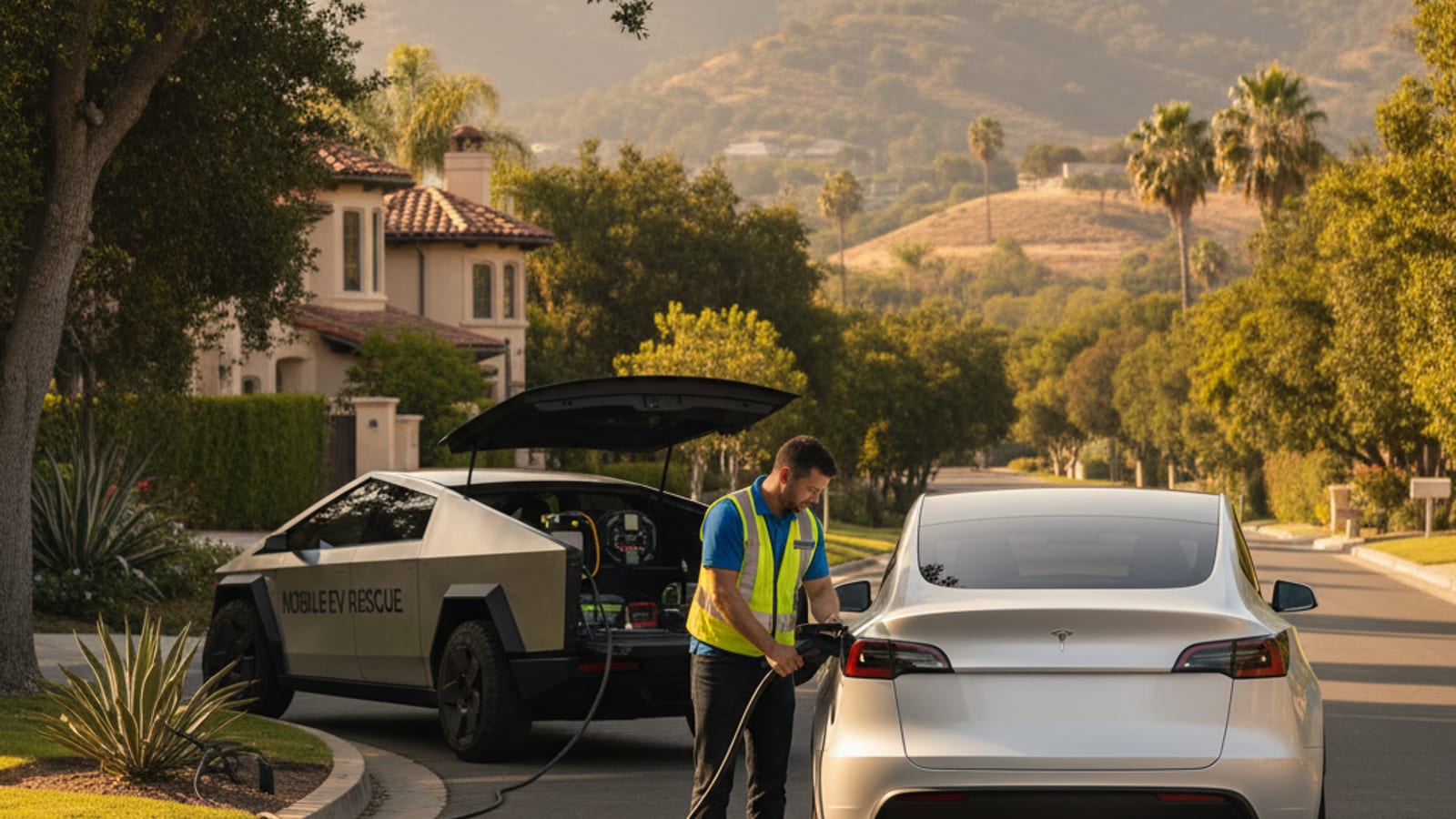
Owners call when the car is a brick. The screen is black. Doors may not open on the first try. The app stays silent. That scene has two common causes. They need different help.
The 12-volt battery let the car sleep too hard
Every EV still uses a small 12-volt battery. It runs lights, locks, and accessories. It also wakes the computers that close the high-voltage contactors. When that battery is tired, the pack can be full. The car still won’t start. Heat is hard on those little batteries. Lakewood Ranch is flat and hot. Air-conditioning season runs from spring into late fall. A Taycan, Lucid, EQS, Rivian, or Tesla can sit all week. Then it goes dark. The range display never hit zero. The small battery just quit.
A Tesla 12-volt jump is the usual first move on a Tesla. Other brands fail the same way. The operator jumps or replaces that 12-volt on site. That’s work on the small battery. It isn’t a pack swap. It isn’t a dealer wrecker by default.
Symptoms lean 12-volt when the car is fully dark. There’s no climate, no dash, and no Bluetooth handshake. The charge port may not release. The app may show the vehicle offline. A car that still paints a live range number is pointing elsewhere.
The traction pack is actually empty
The other call is an empty pack. University Parkway after UTC. I-75 after a Tampa appointment. SR-70 across the Ranch. Lakewood Ranch Boulevard between neighborhoods that don’t sit next door. Heat and AC chew range on every one of those runs. Recurrent Auto’s published research finds an EV loses about 5 percent of range at 90°F. Above 95°F the loss is 20 to 30 percent. Near 100°F it’s roughly 17 to 18 percent, and the hit varies by model. Grade never gives range back here. The land is flat.
Mobile EV charging brings a 240-volt Level 2 source to the bumper. Operators use a native NACS plug. CCS or J1772 adapters cover non-Tesla EVs. A typical stop adds 10 to 20 miles of range. That takes 15 to 30 minutes of charging. That’s plug time. It isn’t a promise of when someone arrives.
If the dash is alive and reads zero, treat it as an empty pack. If nothing is alive, treat it as 12-volt first. You can correct a wrong guess on site. You can’t un-tow a car you never needed to load.
The places these cars actually stall
UTC, Waterside Place, and Premier Sports Campus
The pattern this community sees is the return-to-a-dead-car case. You shop at the UTC mall on University Parkway. You come back. The car doesn’t wake. That’s often the 12-volt after a long sit in the heat. Cabin electronics nap. The small battery is already weak. The same pattern shows up after a morning at Premier Sports Campus. The same pattern shows up in a stall near Waterside Place.
If you’re on private pavement, read the tow signs before you walk off. Florida Statute 715.07 lets an owner, lessee, or authorized person remove an unauthorized vehicle. Signage has to use light-reflective letters at least 2 inches high. It has to state that vehicles will be towed at the owner’s expense. The words “tow-away zone” must be at least 4 inches high. The tower’s name and current phone number must be on the sign. The sign mounts 3 to 6 feet above ground. Hillsborough and Pinellas both sit over 500,000 people. A towed vehicle there must be stored within 10 miles of removal. Smaller counties use a 15-mile radius. Manatee and Sarasota set tow rules at the county level. No current Manatee or Sarasota tow cap was confirmed on a live ordinance page. Read the posted sign. Call the number on it if the car is already gone.
A long driveway on the far side of the Ranch
The CDP covers about 46 square miles. A dead car in Country Club or Del Webb can be a long inland run. Central Park isn’t next door to Waterside on the ground. Tell the operator the nearest named road. Lakewood Ranch Boulevard, University Parkway, and SR-70 are the local spines. Give the nearest cross street so the operator can find the bumper.
Charge Pro TPA still takes that far-corner call. The operator who accepts it quotes you before work starts. You aren’t buying a mystery invoice. You’re buying a Level 2 charge, a 12-volt jump, or a 12-volt replacement on site.
I-75, SR-70, University Parkway, and Lakewood Ranch Boulevard
Those four names are the major corridors. A disabled EV on the paved highway outside a municipality is covered by Florida Statute 316.194. Subsection (1) bars stopping on the paved or main-traveled part when you can get off it. Subsection (2) exempts a vehicle that’s disabled on that pavement when you can’t avoid leaving it. A dead EV on a shoulder is a disabled vehicle under (2). Pull off the travel lane if you can. Hazards on. Stay out of the travel lanes.
FDOT Road Rangers in District 1 patrol I-75 through Manatee and Sarasota. District 7 covers I-4, I-75, and I-275 farther north in the Tampa Bay core. It also covers the airport interchange. The Ranch’s I-75 stretch is the District 1 side. You reach Road Rangers by dialing *347. Published services include tire help, a 12-volt jump, fuel, diesel, or water. They also include two free local calls and moving a disabled vehicle to a safer spot. They also maintain traffic at incidents. Reviewed Road Rangers materials don’t mention charging an EV. That’s an observed absence in the published list. The free patrol can still help with a jump or a safer position. It doesn’t replace a Level 2 rescue.
Florida Highway Patrol Troop C covers disabled vehicles on Tampa Bay interstates. Florida 511, branded FL511, is the state’s traffic-information system when lanes are blocked.
If you’re on the Sunshine Skyway instead of inland I-75, that’s a different shoulder. The main span sits 432 feet above the shipping channel. Lakewood Ranch calls are usually inland. I-75, University Parkway, SR-70, and the boulevards inside the planned communities are the routine pins.
Heat, AC, and a 240-volt garage that still isn’t enough
Almost every Lakewood Ranch house can support a 240-volt charger. That’s the 0.7 percent pre-1980 housing figure working in your favor. You aren’t fighting a 1960s panel the way older core neighborhoods do. The car still dies. Weekend traffic to Premier Sports Campus burns more AC than a short loop around Central Park. A Tampa run on I-75 can empty a pack that looked fine at breakfast. A week away, then a dark dashboard in the garage, is usually the 12-volt. It isn’t a depleted pack.
Home 240-volt charging versus a roadside charge is a real choice here. The wall unit is already in most garages. The wall unit wins when the car will still roll into the garage. The roadside charge wins when the car is already dead on University Parkway. Our note on home 240-volt charging versus a roadside charge walks through that split.
Peace River Electric Cooperative and Florida Power & Light serve parts of Manatee and Sarasota. Exact service boundaries for Lakewood Ranch weren’t verified on a primary utility page. Don’t assume a Tampa-core utility. Check the name on your own bill. Florida doesn’t have a state EV purchase rebate. Utility programs, where they exist, are the local incentive path. Confirm yours with the utility printed on your statement.
What a mobile rescue brings to the bumper
Charge Pro TPA is a referral line. It matches stranded EV drivers with independent local mobile rescue operators. It doesn’t hold a trade license. It doesn’t own trucks. It doesn’t employ technicians. It doesn’t set prices. It doesn’t publish hours. It doesn’t promise an arrival window. The operator quotes you before starting. The operator bills you directly.
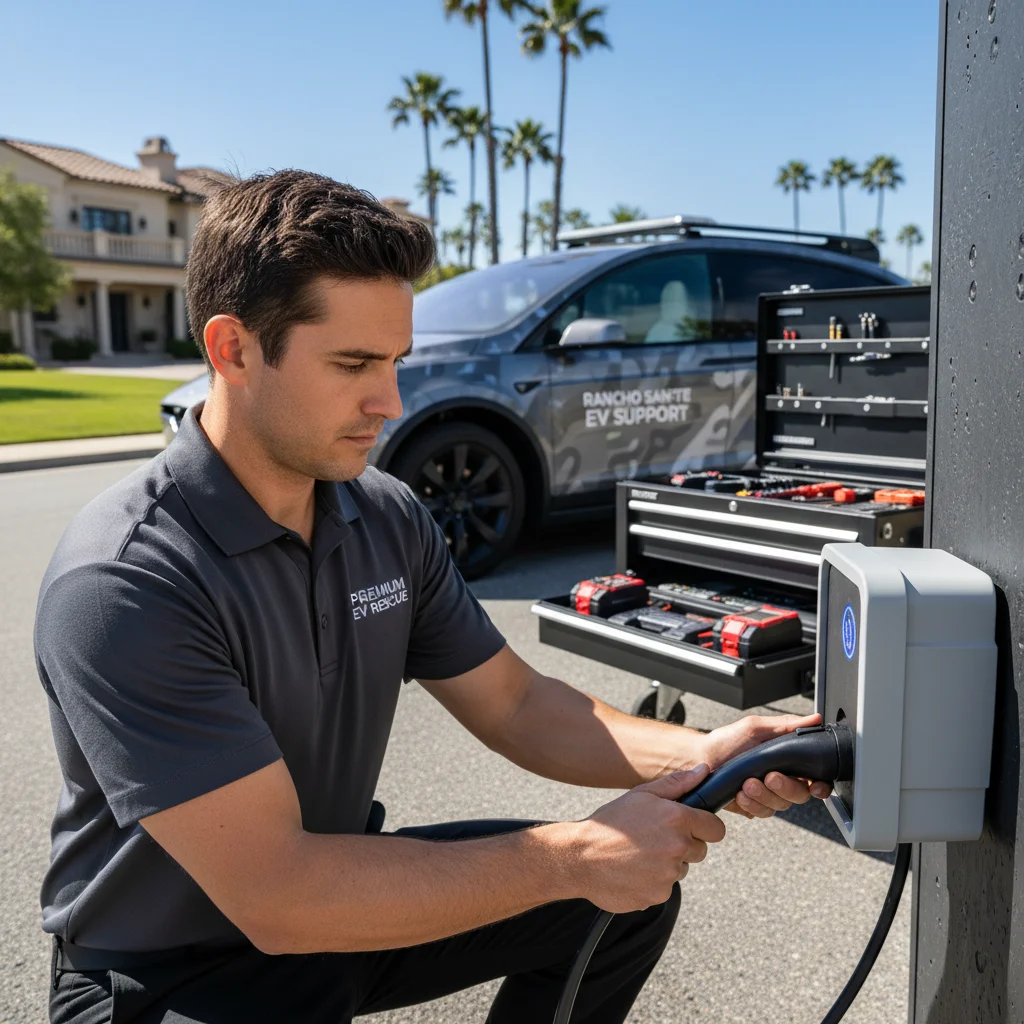
What those operators do is narrow and useful. They bring 240-volt Level 2 charging to the car. Native NACS for Tesla. CCS or J1772 adapters for everyone else. Ten to 20 miles of range is the typical add. That takes 15 to 30 minutes of charging. That’s often enough to roll home to the wall unit in the garage. Or it’s enough to reach a public charger you already had in the plan. Confirm that charger in your own app. This page doesn’t guess at a site.
They jump or replace a dead 12-volt on site. Teslas. Lucid. Rivian. Porsche Taycan. Mercedes EQS. Cadillac. BMW. The non-Tesla EV rescue path uses the same 12-volt logic. The plug on the bumper is the part that changes.
They handle out-of-charge recovery without making a wrecker the first option. A tow is still right after a crash, or a motor or tire failure. For a silent luxury EV with a healthy body, charge or jump first.
The pros we connect you with are licensed and insured. Charge Pro TPA isn’t the licensed trade on the bumper. The independent operator is.
When a tow is the wrong first move
Towing a dead EV is a last resort for a reason. Many EVs need a flatbed. All-wheel-drive models can be damaged if a driveline is dragged. Neutral may be unavailable if the 12-volt is dead. A generic wheel-lift is the wrong tool on a dual-motor SUV. Ask what equipment is coming before anyone hooks a luxury EV. If the only problem is sleep or an empty pack, skip the wrecker. Take the charge instead.
County non-consent tow rates are capped in Florida at the county level. Hillsborough publishes caps through the Tax Collector’s vehicle-for-hire authority. Pinellas sets caps by ordinance. Exact current dollar figures weren’t confirmed against the live schedules. This page doesn’t invent them. A consent tow you request is a different conversation. The operator quotes that before the car is loaded.
Tesla, Lucid, Porsche, and the rest
A Lucid Air and a Model S fail in the driveway the same way. The expensive car still needs a cheap 12-volt to boot. Owners sometimes assume a high-voltage fault because the badge is rare. Check the simple battery first. If the dash is alive and range reads zero, that’s the pack. If nothing is alive, start with 12-volt help.
Charge ports that won’t release, software loops, and tire punctures are real. They aren’t the first diagnosis when the car is fully dark. A stuck cable is a different job. A luxury low-rolling-resistance tire may not have a spare. Many Teslas ship without a spare or a jack. That tire call isn’t the same as a charge call. Say so when you phone so the operator who accepts knows what to bring. Published operator work here is the 240-volt charge and the 12-volt jump or replacement. Don’t assume a tire patch is on the truck.
What to do before you call
Stay with the car if you’re on I-75 and walking would be unsafe. If you can pull fully off the travel lane, do that. Hazards on. Keep passengers away from traffic.
Open the car’s app. Note whether the car is online. Note displayed range if any appears. Note a 12-volt or low-voltage warning if one exists. Those four facts change which operator gear matters.
If you’re in a driveway, try the handle in your home 240-volt unit. A car that accepts a charge and still won’t drive is pointing at the 12-volt. It can also be a wake issue. A car that won’t take a charge and shows zero miles is an empty pack.
Don’t jump from another EV’s traction pack. Don’t guess at orange high-voltage service plugs. The 12-volt has its own jump points. If you don’t know them, wait for the operator. On I-75, *347 reaches Road Rangers for a safer position or a 12-volt jump. Then call for mobile charging if the pack is empty.
How Charge Pro TPA handles the call
You call. You describe the car, the street, and whether the dash is alive. The line forwards you to an independent operator who can take Lakewood Ranch. That operator quotes the job. You accept or you don’t. Nothing starts before that quote.
Service covers Lakewood Ranch and the rest of the Tampa Bay map. University Parkway spills into Sarasota. SR-70 and I-75 connect Bradenton. Palmetto sits closer to the Skyway landing. South Bradenton sits between the Ranch and the older west-side streets. A pin that says Lakewood Ranch can still be a Sarasota or Manatee address. That’s fine. The operator goes to the pin, not the marketing name.
A dealer wrecker is the slow path when the car only needs a wake-up. At home, a 12-volt jump often puts the car back on the wall unit. An empty pack on University Parkway is often a Level 2 top-up. Then you drive to the garage that already has 240-volt service.
Frequently asked questions
What should I do if my luxury EV is out of charge in Lakewood Ranch?
Stay out of the travel lane if you can. Then call for a mobile Level 2 charge. The operator brings 240-volt power to the bumper. Typical plug time adds 10 to 20 miles in 15 to 30 minutes of charging. That is charging time, not an arrival estimate. If the dash is dark and the app is dead, ask for a 12-volt jump first.
Can an operator jump a Tesla 12-volt in a Lakewood Ranch driveway?
Yes. The operators in this network jump or replace a dead 12-volt on site. Tesla is a common version of that call. The same 12-volt failure hits Lucid, Rivian, Porsche, Mercedes, and the rest. The operator quotes you before any work starts.
Do you help non-Tesla luxury EVs in Lakewood Ranch?
Yes. The network isn’t Tesla-only. Operators carry NACS plus CCS or J1772 adapters. A Taycan, Air, EQS, or Rivian gets the same on-site charge or 12-volt help. Charge Pro TPA doesn’t do the work. It connects you with the operator who does.
For a Lakewood Ranch no-start, call Charge Pro TPA at (813) 536-4545. The operator who takes the job quotes you first, then bills you directly.