Your Kia EV6 won’t start a charging session when the public post never wakes. The handle is in. The lights look normal. The car still sits there. Most of the time it’s the stall, a 12-volt, or a timer. Work those three before you assume the pack is dead.
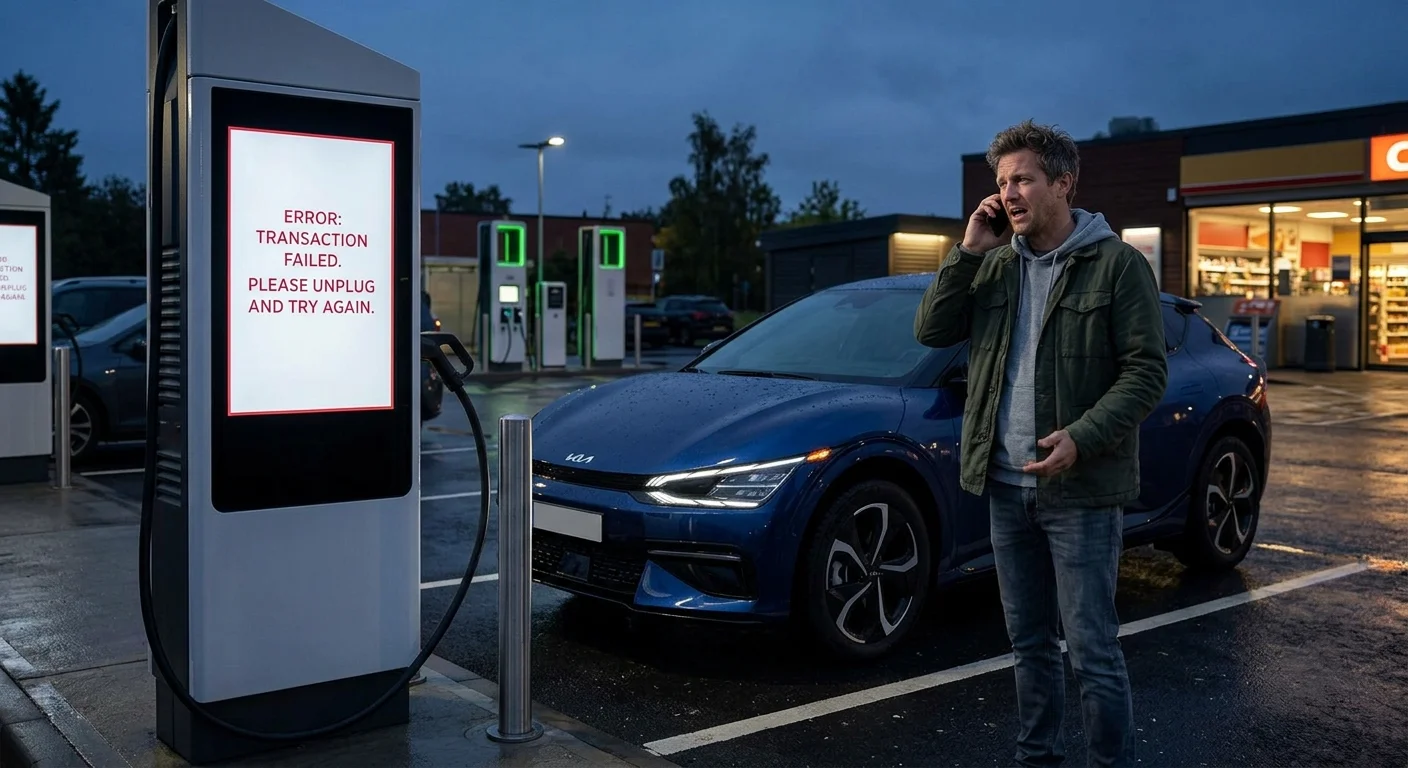
Begin at the stall, not the high-voltage pack
A session that never starts is a handshake miss. The EV6 waits for the station. The station waits for the car. Until both sides agree, no current moves.
Read the station screen. A blank panel or a frozen spinner is a stall fault. A pay error after you tap a card is a stall fault too. Unplug. Wait a few seconds. Seat the CCS handle until it clicks and the latch holds.
If that stall still won’t start, walk to the next one on the same island. One dead stall doesn’t prove the car is broken. Confirm the stall in a charging app before you keep retrying. Our note on a public charger that says connected but won’t charge covers that exact stall.
U.S. EV6 cars use a CCS Combo inlet. The extra DC pins have to sit fully home. A handle that looks seated can still fail the handshake. Don’t force the latch. Pull out, check for debris, and try again.
Rain and bay spray leave water in the inlet. Wipe the port with a clean dry cloth. Don’t poke metal into the pins. After a storm, a stall that lost power will refuse every car, not just yours.
How Tampa Bay heat changes a charge
Tampa Bay runs a long air-conditioning season from spring into late fall. The car cools the pack while you charge. That extra load can slow a session. It can pause one if the pack is already hot from sitting in the sun.
Recurrent Auto’s published research finds an EV loses only about 5 percent of range at 90°F. Loss climbs to 20 to 30 percent above 95°F. Near 100°F the loss is roughly 17 to 18 percent, and it varies by model. The pack is protecting itself. That’s not a failed charger.
If you parked in the sun along I-275, I-75, or I-4, the pack can be hot before you plug in. Give the car a few minutes with the cabin set to cool, if you still have some charge. Then retry the stall.
Vaisala ranks this metro among the most lightning-prone in the country. After a cell moves through, a stall can reboot, drop a session, or stay dark. Try a second stall before you decide the EV6 is at fault.
Grade never gives range back here. The land is flat and near sea level. Heat and AC are the whole range story on a summer afternoon.
Timers, limits, and the breaker at home
The EV6 will sit at a working stall and take nothing if a schedule is on. Open the charging menu in the infotainment. Look for a departure time. Look for a max state of charge. Look for a window that hasn’t started yet.
A charge limit you set for daily use is easy to forget. If the pack is already at that number, the car won’t take more. Turn the schedule off for this session. Raise the limit if you actually need the miles. Then plug in again.
At home the same car can look dead when the wall unit is the problem. Check the breaker that feeds the charger. A tripped EV breaker looks like a car that won’t charge. Reset it once. If it trips again, stop. Call an electrician. Don’t keep resetting a hot breaker.
Tampa Electric, TECO, serves the City of Tampa, most of Hillsborough County, and parts of Pinellas and southern Pasco. Duke Energy Florida serves Pinellas County and much of Pasco. A driver in north or central Pasco is often a Withlacoochee River Electric Cooperative member, not a TECO or Duke customer. Call the utility that actually prints on your bill.
Duke publishes a Charger Prep Credit toward the wiring and electrical upgrades a Level 2 install needs. It doesn’t cover the charger hardware or permit fees. Duke also publishes an Off-Peak Charging Credit for charging in off-peak windows. Confirm the current credit with Duke before you count on it. TECO’s home EV pages point owners to charging and installation guidance. A specific residential home-charger rebate amount wasn’t confirmed on a primary TECO page.
Newer master-planned streets in Westchase, Fish Hawk, and Lakewood Ranch were built with 240-volt home charging as the default. Older housing in Lealman and much of St. Petersburg was not. Condo owners in Pinellas have a Florida right under Statute 718.113(8) to install a charger in their limited common element or exclusive parking space. The board can’t deny a properly submitted request. The owner still pays for install, power, and insurance. If you live on public charging, a stall that won’t start a session is how your morning fails.
The 12-volt that blocks the handshake
The EV6 has a high-voltage pack and a small 12-volt battery. The 12-volt wakes the computers that talk to a charger. If that battery is low, the car never starts the session. The pack can still hold plenty of miles.
Watch for a dark screen, a slow lock, or a car that ignores the cable. A 12-volt warning on the cluster is the giveaway. The same pattern shows up across brands. Read what happens when an EV 12-volt battery dies if you want the longer version.
A jump on the 12-volt posts can wake the car. Use the procedure in the Kia owner’s manual. Don’t guess at terminal order. If the car wakes and then charges, plan a 12-volt replacement soon. A jump is a temporary wake, not a repair.
Tampa Bay heat and salt air wear 12-volt batteries faster than a mild climate. A car that sat a week in a garage is a classic 12-volt case, not an empty pack.
Tampa International Airport publishes free EV charging at all on-airport parking garages and the cell phone lot. Level 1 J1772 sits in the Economy Garage on the first floor and in Long-Term Parking. Level 2 is at the Cell Phone Lot. An EV6 that sat through a trip and won’t wake is often the 12-volt. Charge what’s left of the pack after the 12-volt is up, then leave.
FDOT Road Rangers in District 7 can jump a 12-volt on I-4, I-75, I-275, and the airport interchange. Dial *347. Their published list includes a jump, fuel, a tire, water, two local calls, and moving a disabled vehicle to a safer spot. The materials reviewed don’t mention charging an EV. Use them for a 12-volt jump and traffic control. Don’t expect a pack top-up from that patrol.
Cluster warnings and a reset you shouldn’t force
A charging fault, a battery lamp, or a Check EV System message means the car stored a code. Read the cluster text against the owner’s manual. Don’t clear codes and keep driving as if that fixed it.
Some owners pull the 12-volt negative cable to force a reboot. That can clear a glitchy module. It can also leave you darker than you started if you miss the reconnect order. If you’re not sure where the 12-volt sits, skip the pull. A mobile operator can test that battery without you opening the bay.
An OBD-II reader can pull stored codes. Many parts counters will read them. A charging-control code that returns after a reset still belongs at a Kia dealer. High-voltage diagnosis isn’t a driveway job.
If you’re already on the shoulder
Stay with the car on a limited-access road. Florida Statute 316.194 says you should leave the paved travel lane when it’s practicable. A disabled EV on the shoulder is a disabled vehicle under subsection (2). Hazards on. Stay behind a barrier if one exists.
Florida Highway Patrol Troop C covers disabled vehicles on those interstates. Florida 511, FL511, is the state’s traffic feed if you need to warn someone behind you.
The Selmon Expressway reversible lanes run about 10 miles between Brandon and downtown Tampa. They sit on an elevated deck with no local surface shoulder. Traffic is cleared before each reversal so no car is left facing the wrong way. If you stall on that deck, stay in the car with hazards on and call for help. Don’t walk the span.
The Sunshine Skyway on I-275 is about 4 miles of bridge with no place to stop. The main span sits 432 feet above the channel. Florida Highway Patrol closes it when sustained winds hit 40 mph, or when fog cuts visibility below about 100 feet. A stall there is a call, not a walk to the next stall.
The Veterans Expressway and the Suncoast Parkway are all-electronic SunPass roads. The Suncoast is a long, fast run north through Pasco with widely spaced exits. If the pack is empty there, you need energy brought to the bumper.
Open charging apps to check before you’re stranded while you still have phone battery. A second working stall nearby is the cheapest exit. If every stall you try fails the handshake, stop swapping plugs and call.
A mobile Level 2 top-up so you can leave
Charge Pro TPA is a referral line. We match stranded EV drivers with independent local mobile rescue operators. We perform no work. We own no trucks. We employ no technicians. We set no prices. The operator quotes you before starting and bills you directly.
The operator brings a 240-volt Level 2 source to the car. Native NACS is for Teslas. Your EV6 takes CCS, or a J1772 adapter path. A typical top-up adds 10 to 20 miles of range in 15 to 30 minutes of charging time. That’s charging time, never an arrival time.
Those miles are enough to leave the stall, the driveway, or the shoulder. You can then reach a working public post or home. It’s not a full pack. What a mobile EV charging truck actually does shows the hardware in plain terms.
This is the same help we route for other non-Tesla EVs. Start with mobile EV charging or non-Tesla EV rescue. If you’re in the core, the Tampa city charging page is the local map of how we connect drivers.
The pros we connect you with are licensed and insured. They handle Tesla and every major EV brand, including Kia. They can jump or replace a dead 12-volt on site when that’s the actual fault. They don’t repair a high-voltage pack on the shoulder. That work stays with the dealer.
When the checks are done and you still can’t charge
If the next stall still won’t start a session, call. If the 12-volt won’t hold a wake, call. If you’re on the Skyway, the Veterans, or the Suncoast with an empty pack, call. Don’t wait for a random stall to come back.
Call (813) 536-4545 and we’ll connect you with a local operator. Ask for the quote before they start. The operator bills you. We don’t.