FL511 tells you if I-275 is stacked. It’ll also flag a crash on I-75 through Pasco. It won’t put miles back in the pack. Apps for EV charging help only while you still have range to spend. Once the gauge hits zero, those maps stop being useful. They’re a picture of a plug you can’t reach.
What FL511 and Road Rangers actually cover
Florida 511 is the state’s traffic feed. Use it for backups, closures, and travel time. The Tampa Bay SunGuide Center runs District 7’s traffic desk. That desk watches I-4, I-75, I-275, and the airport interchange. None of that feed charges a car.
FDOT Road Rangers patrol those same District 7 roads. You reach them by dialing *347. Published help includes a jump-start, a tire, fuel, water, and two local calls. The materials we reviewed don’t list charging an EV. A 12-volt jump can wake some cars. It doesn’t refill a high-voltage pack.
Florida Highway Patrol Troop C handles disabled vehicles on the interstates here. Florida Statute 316.194 covers a disabled EV on the paved shoulder. You can stay there when you can’t get the car off the roadway. Stay out of live lanes. Put the hazards on. Then stop burning range on a guess.
Start with the app that talks to your car
Open the app your automaker built for that vehicle. It can see your actual state of charge. A third-party map usually can’t. That’s the one real advantage of the factory tool. It routes from the battery you have, not a generic guess.
We’re not going to name a maker’s app here. Feature lists change with software updates. We can’t verify what every model shows today. Check the owner’s manual, or the maker’s current site.
Treat that route as a plan, not a confirmation. The app can point you at a stop. It can’t promise a free, working plug when you arrive. Verify before you spend the miles to get there.
Cabin cooling changes the math in this metro. Tampa Bay runs a long air-conditioning season, from spring into late fall. Recurrent Auto’s published research finds about 5 percent range loss at 90°F. Loss jumps to 20 to 30 percent above 95°F, and it varies by model. If the car’s app doesn’t know the AC load, the estimate can run high.
Check the network that owns the hardware
Most public charging networks run their own app or site. That feed is usually the freshest view of their own stations. Use it as a second check after the vehicle app. Do that while you still have buffer.
The limit is scope. A network app only knows its own plugs. Tampa Bay charging is a mix of networks, not one brand. Checking two or three before a longer trip is more useful. Don’t rely on the one you already have out of habit.
We won’t rank those apps, or describe their current screens. Coverage and reliability change. If you want current features, use the network’s own site.
For a map of reported public sites, the DOE Alternative Fuels Data Center keeps a station locator. It’s a government inventory, not a live occupancy feed. Use it to see what has been reported. Don’t treat it as a promise that a stall is free.
Our Tampa Bay EV charging hub is the local context page for the same planning.
Crowd pins go stale in this heat
Aggregator maps mash several networks into one view. Some add driver notes about whether a plug worked last time. Those notes can surface a site a single network app would hide.
A pin isn’t a reservation. A station can be listed and still be occupied, broken, or removed. A three-week-old comment describes one visit, not this afternoon. That’s how listings work when someone else owns the hardware.
This matters more when you’re already watching the percentage fall. If you’re doing that math, stop guessing. Read what to do when an EV is running low in Tampa Bay before you spend the last miles.
Pinellas condo and HOA drivers often live on public plugs. Florida Statute 718.113(8) gives a unit owner the right to install a charger. That covers a limited common element or an exclusive parking space. The owner pays for install, operation, and separately metered power. Until that charger exists, those drivers depend on the same apps as visitors.
Local routes where a wrong pin hurts
Don’t keep driving toward a listing you haven’t confirmed. These Tampa Bay stretches make that habit expensive. A charger can exist nearby and still be useless from where you sit.
On the Selmon Expressway’s Reversible Express Lanes, there’s no local surface shoulder on the elevated segment. THEA clears those lanes of all traffic before each reversal. Westbound into downtown runs about 5 a.m. to noon, then the lanes flip eastbound. A pin on a surface street in Brandon or downtown doesn’t help while you’re on that bridge. If that’s where the pack is dying, read out of charge on the Selmon reversible lanes.
I-275 across Tampa and Pinellas is the other high-speed trap. Shoulder space is tight, and traffic is dense. An empty pack on I-275 is a safety problem first, then a charging problem.
The Sunshine Skyway is about four miles of bridge with no place to stop. FHP closes it when sustained winds hit 40 mph, or when fog drops visibility below about 100 feet. An app that shows a plug on the far side doesn’t get you across. If you’re already on the span, stay in the car with hazards on. Don’t hunt a pin from the travel lane.
The Suncoast Parkway is a long, fast run north through Pasco with widely spaced exits. A stale listing that forces you past an exit is a long recovery. Veterans Expressway drivers see the same all-electronic toll rhythm. FL511 will show the backup. It still won’t charge the car.
Tampa International Airport publishes free EV charging at on-airport garages and the cell phone lot. That’s a listed option if you’re parked there. It isn’t a backup for a stall on I-4. A car that sits a week in those garages and won’t wake is often a 12-volt issue, not an empty pack. The charging apps won’t diagnose that.
When a listed charger won’t start
Apps solve finding a station. They don’t fix a plug that won’t start a session. They also don’t fix a car that won’t accept a charge.
If you arrive and the session never begins, that’s a hardware or account problem. Try the steps in public charger connected but not charging before you assume the trip is over.
Keep a second option noted before you leave. That can be another listed site along the same route. It can also be a phone number for when both listings fail. Do that on the driveway, not on the shoulder.
When every app shows nothing you can reach
Sometimes every map agrees: nothing reachable, or nothing confirmed working, from where you sit. Checking one more app isn’t a plan. That’s the moment to stop rolling.
Don’t spend the last miles chasing an unverified pin. Pull off where it’s legal and safe.
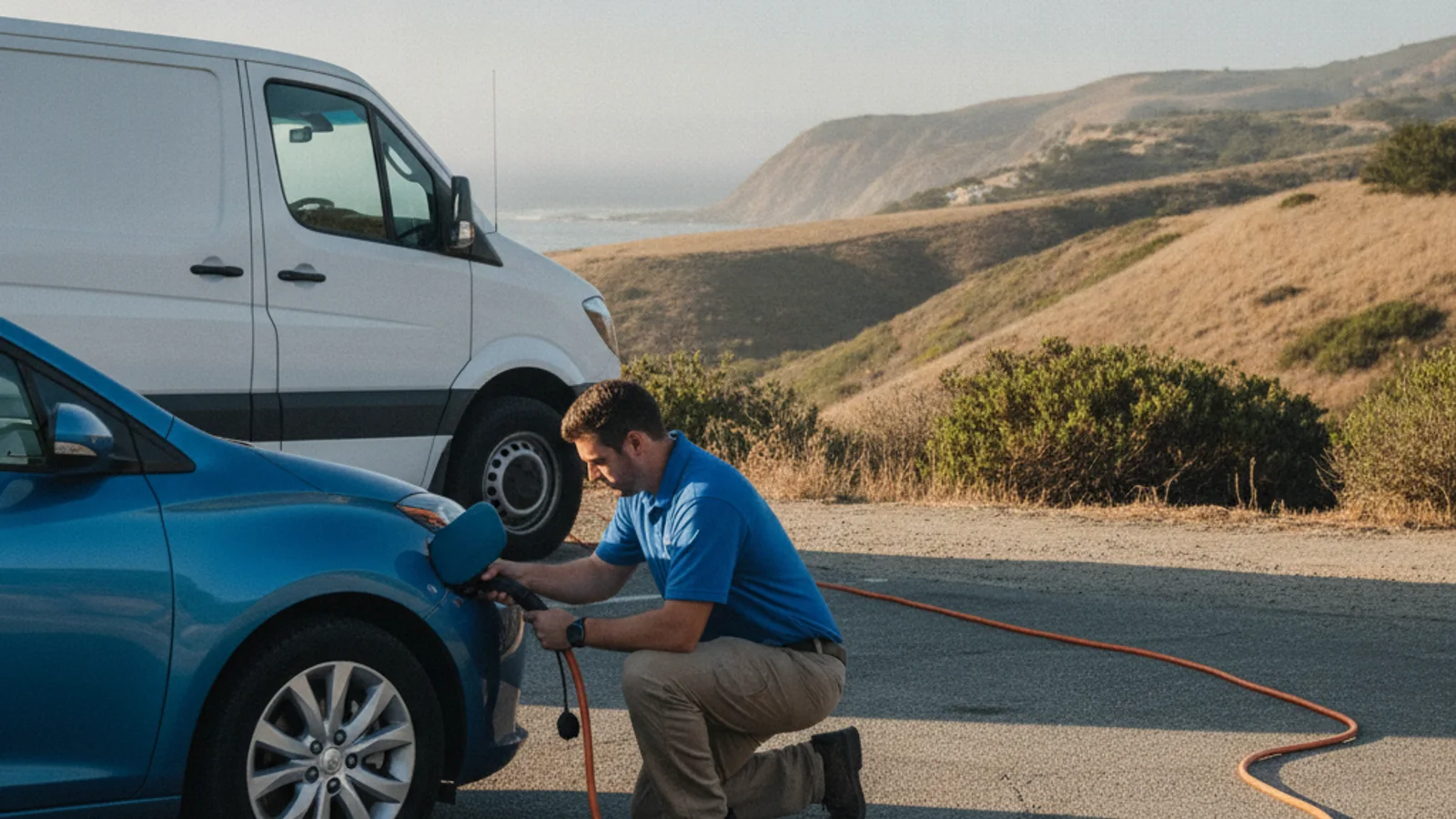
The independent operators we match you with can bring a 240-volt Level 2 source to a car that’s parked safely but can’t reach a working public plug. See mobile EV charging for how that visit works. Typical charging time is 15 to 30 minutes for about 10 to 20 miles of range. That’s charging time, not an arrival time. Tesla gets a native NACS plug. Other brands use a CCS or J1772 adapter. The operator quotes you before starting and bills you directly.
If the pack is already at zero, or the spot is a bad place to sit and charge, ask about out-of-charge recovery. The operator you’re matched with looks at the car and the location first. Charge Pro TPA doesn’t own trucks, set prices, or do the work. We connect you with local pros.
When planning has run out of road
If the apps have failed to turn up a working, reachable charger, and the battery is critical, you’re past map-checking. Call (813) 536-4545. We’ll match you with an independent local rescue operator. The operator handles Tesla and every major EV brand. That includes a 12-volt jump or replacement on site when that’s the actual fault.
Save that number before you need it. FL511’s still useful for the traffic around you. It still won’t bring you miles.