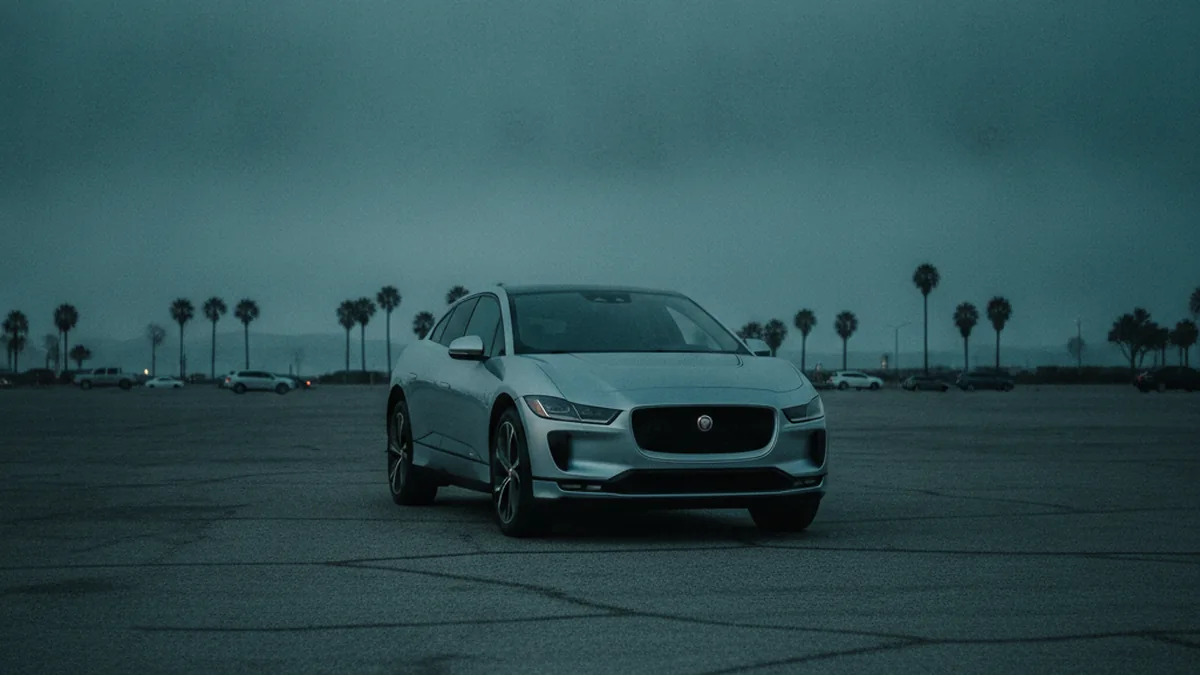
A Jaguar I-Pace that sat in Tampa Bay heat often won’t wake. You tap the fob. Handles stay flush. Screens stay dark. When a Jaguar I-Pace won’t start, the 12-volt is the first check. It’s a dead 12-volt battery in most cases, not an empty traction pack. The pack can’t come online until the small battery boots the computers. If the pack is also low, the CCS port is how you add energy. A mobile operator feeds that port on site.
Two power systems, and which one actually failed
The I-Pace is two electrical systems sharing one body. A high-voltage pack turns the motors. A conventional 12-volt battery runs locks, screens, and control modules. Those modules have to boot before the pack is allowed to work. A dark cabin after a normal drive is the 12-volt talking.
People blame the traction pack first. That’s the wrong layer. The 12-volt simply never woke the car. Other EVs fail the same way. The I-Pace adds a trap. The 12-volt lives in the frunk. A dead 12-volt is also what keeps the frunk latched.
For the brand-wide version of this failure, read what happens when an EV 12-volt battery dies.
Heat here is harder on the small battery than the pack
Tampa Bay runs air conditioning from spring into late fall. Cabin cooling and pack thermal systems pull energy while you drive. Recurrent Auto publishes the range numbers worth using. An EV loses about 5 percent of range at 90°F. Loss climbs to 20 to 30 percent above 95°F. It sits around 17 to 18 percent near 100°F. The hit varies by model.
That’s the pack on a hot trip. The 12-volt has a quieter failure. A lead battery left warm and undercharged starts to sulfate. Sulfation is permanent capacity loss. Park the I-Pace on a Westchase driveway through several hot days. A St. Petersburg garage does the same work. The small battery ages even if you barely drove.
Early cars have a documented 12-volt habit. Pre-2021 I-Pace models are the 2018 through 2020 years. Those are the ones owners replace sooner than they planned. Jaguar revised the low-voltage setup for the 2021 model year. Pre-2021 cars also use two 12-volt batteries under the frunk panel, not one. A weak battery can drag the whole low-voltage system down. A jump has to land on the right post.
If you drive a 2018 to 2020 car, watch a slow wake. Treat it as a warning if the 12-volt has never been changed. A load test settles it. EV 12-volt replacement: signs, timing, and what to do stranded covers the next step after a jump.
Heat and salt air wear more than the 12-volt. How Tampa Bay heat and salt air wear down an EV battery is the climate piece.
Signs that point at the 12-volt
Walk around the car before you call.
- Flush door handles stay retracted when you walk up.
- The fob doesn’t unlock the car.
- Dash, touchscreens, and interior lights stay dark.
- There’s no welcome chime and no lock clunk.
Those four signs are the 12-volt. If the dash lights, throws a warning, then quits, stop jumping. That’s a high-voltage or DC-DC fault. It needs a dealer scan, not another boost.
The car starts, then dies again in a few days. That’s a 12-volt at the end of its life. Another jump is a delay, not a fix.
Use the hidden key, not a pry bar
A dead 12-volt leaves the handles retracted. You can’t grab a door the usual way. The metal key blade lives inside the fob. Slide the release and pull the blade out of the fob body.
The lock cylinder is hidden in the driver’s door handle. Push the front of the handle inward, near the small button. The back edge should pivot out. Pull the handle out as far as it travels. The cylinder sits behind it. Insert the blade and turn it clockwise. The door unlocks with zero power in the car.
Don’t pry a flush handle. Don’t force the blade if it won’t turn. Wrong pressure cracks the handle or the cylinder.
Open the frunk by hand, then jump the right post
The I-Pace 12-volt sits in the frunk under a removable center panel. A dead 12-volt is what keeps that frunk shut. Cabin first, then the manual release.
Look in the right-side footwell for a black plug. Behind it is the frunk release cable. Pull the cable. The frunk should pop. Lift the center panel. Pre-2021 cars show two batteries. Positive posts wear red caps.
Jump in this order:
- Red clamp on the exposed positive post with the red cap.
- Black clamp on bare, unpainted chassis metal, not the battery negative.
- Let the donor source feed the battery for two to three minutes.
- Then try to power the car and bring it to READY.
Grounding to the body keeps a spark off the battery. Confirm the post and the panel against your own model-year manual. Pre-MY21 and MY21 layouts aren’t the same. How to jump start an electric car without damage is the full walk-through.
If you have no donor car and no jump pack, stop there. A packed garage aisle is a poor place to improvise.
CCS charging when the pack is actually low
A clean 12-volt jump that still leaves the car dark isn’t a 12-volt story anymore. Don’t keep boosting. Call for a diagnosis or a tow.
Sometimes the 12-volt is fine and the pack is low. Tampa Bay heat plus air conditioning will do that on a longer day. Recurrent’s range loss above 95°F is why a March trip fails in August. The I-Pace takes CCS, not a Tesla NACS plug. A mobile operator who does non-Tesla work brings a 240-volt Level 2 source. They use a CCS adapter on the I-Pace. Typical add is 10 to 20 miles of range. That takes 15 to 30 minutes of charging. That’s charging time on the car. It isn’t a promise of when someone arrives.
Charge Pro TPA is a referral line. It matches you with an independent local operator. The operator quotes you before any work starts and bills you directly. Who helps when your stranded EV isn’t a Tesla is the I-Pace service page.
Where this actually happens around the bay
A week in a garage at Tampa International Airport is a classic 12-volt death. TPA publishes free EV charging at on-airport garages and the cell phone lot. Level 1 J1772 sits in the Economy Garage and the Long-Term Parking Garage. Level 2 is at the Cell Phone Lot. The SkyConnect people mover links the main terminal to the Economy Garage. You can leave the car on a charger. You can still come home to a dead 12-volt. The pack held. The small battery didn’t. Tampa International Airport EV charging walks that garage problem.
On the road, a disabled I-Pace is a disabled vehicle under Florida Statute 316.194. You may leave it on the paved highway only when you can’t get it off. Get it onto the shoulder if you can. Put hazards on. Stay out of the travel lane.
FDOT Road Rangers in District 7 patrol I-4, I-75, and I-275, plus the airport interchange. Dial *347. Published services include a 12-volt jump, a tire, fuel, and water. They also include two local calls and moving a disabled vehicle to a safer spot. The materials reviewed don’t list charging an EV. Use them for traffic control and a 12-volt jump. Don’t expect a CCS charge from that patrol. Florida Highway Patrol Troop C covers disabled vehicles on the same interstates.
The Lee Roy Selmon Expressway Reversible Express Lanes are a special case. THEA runs about 10 miles of elevated lanes between Brandon and downtown Tampa. Direction reverses through the day. Westbound into downtown from about 5 a.m. to noon, then eastbound. Lanes are cleared of all traffic before each reversal. There’s no local surface shoulder on the elevated segment. If the I-Pace dies on the REL, you’re in a closed box. Help and the Tampa Bay SunGuide Center have to sort it. Don’t try a driveway jump up there.
The Sunshine Skyway on I-275 is the other bad stretch. Four miles of bridge. The main span sits 432 feet above the channel. Florida Highway Patrol closes it at sustained 40 mph winds. Fog closures come when visibility drops below about 100 feet. A high-profile wind advisory often goes out around 20 mph gusts. An I-Pace that won’t start on that span isn’t a driveway project.
Newer streets in Westchase, Fish Hawk, and Lakewood Ranch default to 240-volt home charging. That doesn’t save a 12-volt that already died in the frunk. The I-Pace failure mode is still the small battery. Use the CCS port if the pack is low.
Pinellas condos and beach buildings add one more wrinkle. Florida Statute 718.113(8) lets a unit owner install a charger. It has to sit in their limited common element or exclusive space. The board can’t deny a properly submitted request.
Hurricanes Helene and Milton in 2024 pushed surge and rain across Pinellas and south Hillsborough. Ruskin, Apollo Beach, and Gibsonton sit in evacuation zones. Federal and fire-service guidance is blunt on salt water. An EV that was submerged or soaked should stay away from structures. Keep it away from other vehicles until it’s inspected. Don’t jump a flooded I-Pace. Don’t charge it.
When to stop and pick up the phone
Stop if the mechanical key won’t turn. Stop if the frunk cable doesn’t pop the hood. Stop if a clean jump doesn’t wake the car. Stop on the REL or the Skyway. Stop on a live shoulder of I-275. Stop in a packed garage aisle.
The operator who takes a Charge Pro TPA referral can open a locked I-Pace. They can jump the correct 12-volt post and load test on the spot. They can add CCS energy if the pack is low. They confirm the work and the price with you before they start.
Frequently asked questions
Why won’t my Jaguar I-Pace start after sitting in the heat?
The usual cause is a dead 12-volt battery, not the traction pack. The I-Pace needs that small battery to boot its computers. Jump the 12-volt first. If a clean jump still leaves the car dark, you need a dealer scan.
How do I open the doors when the handles won’t present?
Use the metal key inside the fob. Push the front of the driver’s handle in so the back pivots out. Pull the handle fully to uncover the lock cylinder. Turn the blade clockwise. That unlocks the cabin with no power in the car.
Where is the I-Pace 12-volt, and how do I jump it?
It sits in the frunk under the center panel. Pull the manual release cable behind a black plug in the right footwell. Do that after you’re in the cabin. Red clamp to the red-capped positive post. Black clamp to bare chassis metal. Wait two to three minutes, then bring the car to READY.
If the I-Pace is dark in a Tampa driveway, a St. Petersburg garage, or on the shoulder of I-75, call Charge Pro TPA at (813) 536-4545. The line matches you with a local operator. The operator quotes before any work starts.