Hyundai Ioniq 5 charging time at home is an overnight Level 2 job. A Long Range pack usually fills in about six to seven hours. Hyundai’s published specs put 10 to 80 percent at around 18 minutes. That’s on a DC fast charger that can actually match the car. Already on a Tampa Bay shoulder, you’re on a third clock. Independent operators we refer bring a 240-volt Level 2 source to the bumper. That top-up typically adds 10 to 20 miles in 15 to 30 minutes of charging. Those minutes are charging time, never an arrival window.
Public DC and home Level 2 are different machines
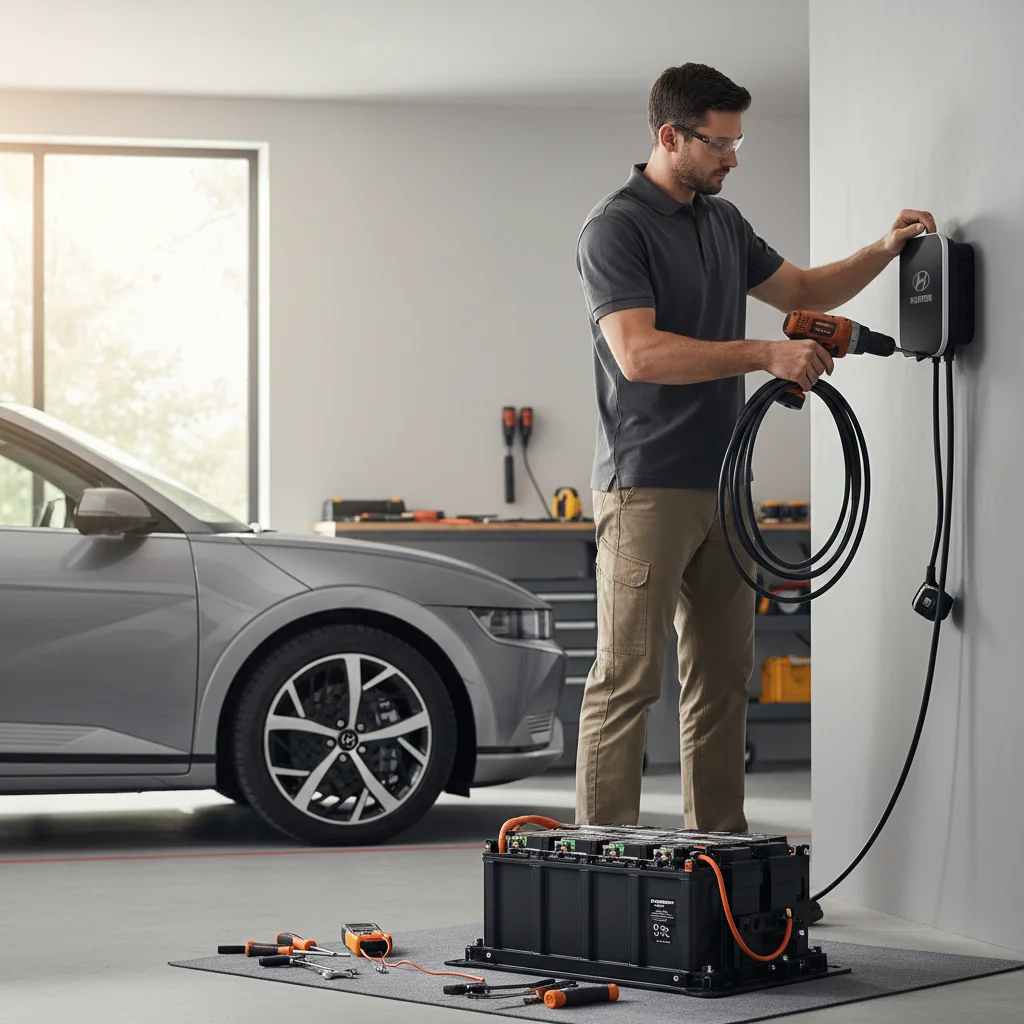
Most mainstream EVs still use a 400-volt battery system. The Ioniq 5 is built on 800 volts instead. A matching DC stall can push more power without cooking the cables. It doesn’t make your garage wall box any faster. A Level 2 home charger still feeds a fixed 240-volt circuit. Pack size and the onboard charger set the overnight window. The 800-volt design only shows up when the public stall can feed it. So the same Ioniq 5 has three honest answers. Home, public DC, and a roadside 240-volt top-up aren’t the same job.
Overnight charging on TECO or Duke
A 120-volt outlet will charge an Ioniq 5, but Level 1 is a backup. A fill from empty can stretch past a full day. Daily driving here wants a 240-volt Level 2 circuit. On Level 2, the Standard Range pack typically finishes in about five to six hours. The Long Range pack is usually about six to seven hours. Starting percentage and charger output both move those windows.
Who bills the kilowatt-hours depends on the house. Tampa Electric, TECO, serves the City of Tampa and most of Hillsborough County. It also covers parts of Pinellas and southern Pasco. Residential schedules include tiered Residential Service and RSVP-1, a time-of-use plan. TECO’s home EV pages cover charging and installation at [email protected]. A named residential home-charger rebate wasn’t found on those primary pages. Confirm any incentive with TECO before you budget around it.
Duke Energy Florida serves Pinellas County and much of Pasco. Duke publishes a Charger Prep Credit toward wiring upgrades for a Level 2 charger. It doesn’t cover the charger hardware or permit fees. Duke also publishes an Off-Peak Charging Credit for residential charging in off-peak windows. Confirm the current credit and windows on Duke’s own site. Don’t plan around a figure you haven’t checked.
North and central Pasco is often Withlacoochee River Electric Cooperative territory, except around Dade City. A WREC member shouldn’t expect a TECO or Duke EV program to apply.
Newer streets in Westchase, Fish Hawk, and Lakewood Ranch often have 240-volt service ready. Older blocks in Lealman and St. Petersburg often predate 1980. A licensed electrician still has to read the panel. Charge Pro TPA doesn’t install chargers and doesn’t hold a contractor license.
Pinellas condo owners can install a charger under Florida Statute 718.113(8). It has to sit in the limited common element or an exclusive parking space. The owner pays for installation, operation, maintenance, insurance, and separately metered electricity. The board can’t deny a properly submitted request.
Read home 240-volt charging versus a roadside charge in Tampa Bay.
Heat is what uses the range you just bought
Tampa Bay runs air conditioning from spring into late fall. The metro is flat and near sea level, so grade never gives range back. Recurrent Auto published the range-loss numbers used here. An EV loses about 5 percent of range at 90°F. Above 95°F the loss is 20 to 30 percent. Near 100°F it’s roughly 17 to 18 percent, and it varies by model. Heat doesn’t rewrite Hyundai’s charging-time spec. It does mean you plug in more often. A hot pack can also taper a DC session earlier than the brochure. Treat the 18-minute figure as Hyundai’s ideal, not a July afternoon promise.
DC fast charging is where 800 volts pays off
Hyundai’s published specs list 10 to 80 percent at around 18 minutes. That’s under ideal conditions on a stall that matches the car’s peak rate. Ideal means a mild pack temperature and a charger delivering rated power. A busy public stall often runs under its rating. Speed isn’t constant from 10 to 80 either. The Ioniq 5 accepts power fastest in the mid-charge. It slows as the pack nears full. That’s why most highway stops target 80 percent. The last 20 percent can take nearly as long as the first 80.
The Ioniq 5 ships with a CCS port. Adapters exist for NACS chargers. Throughput through an adapter can vary by model year. Confirm what your year supports before you count on a stall.
Tampa International Airport publishes free EV charging at on-airport parking garages and the cell phone lot. Level 1 J1772 is in the Economy Garage and the Long-Term Parking Garage. Level 2 is at the Cell Phone Lot. A car left for a week that won’t wake is usually the 12-volt.
Standard Range and Long Range packs don’t charge on the same clock. See the Ioniq 5 battery size guide for both packs.
A roadside 240-volt top-up is 10 to 20 miles
Empty on I-275 or the Veterans Expressway is a different job. Same for a Westchase street after a commute. You’re not rolling to a DC stall from a dead car. Independent operators matched through Charge Pro TPA bring 240-volt Level 2 to the car. For an Ioniq 5 they use a CCS adapter. Typical charging adds 10 to 20 miles of range. That’s 15 to 30 minutes of charging at the bumper. That window is time on the plug. It isn’t a promise of when the truck arrives. Charge Pro TPA performs no work, owns no trucks, and sets no prices. The operator quotes you before starting and bills you directly. The pros we connect you with are licensed and insured.
A dead EV on a paved shoulder is a disabled vehicle under Florida Statute 316.194. FDOT Road Rangers in District 7 patrol I-4, I-75, and I-275. Dial *347. Their published services include a jump-start, tire help, and fuel. Those materials don’t list charging an EV. They can still jump a 12-volt battery.
On the Selmon Reversible Express Lanes, the elevated segment has no local surface shoulder. THEA clears every vehicle before each reversal. If the pack dies there, stay put with hazards on. Move only if a trooper or Road Ranger directs you. Don’t walk the span.
Call for mobile EV charging when the Ioniq 5 needs range at the bumper. That includes a dead pack in Tampa.
When the session isn’t slow, it’s stopped
If the percentage never moves, that isn’t a charging-time issue. A cable locked in the port is a known Ioniq 5 complaint. Follow these stuck charge cable steps. If the car won’t take a charge, check the 12-volt first. Same if it won’t start after a session. The Ioniq 5 no-start checks cover that path.
Charge Pro TPA covers Tampa Bay. Call (813) 536-4545 and we’ll connect you with an independent operator. They quote before they start.
Frequently asked questions
How long does a Hyundai Ioniq 5 take to charge at home?
On Level 2, a Standard Range pack typically fills in about five to six hours. A Long Range pack is usually about six to seven hours. Starting charge and charger output both matter. Level 1 on a 120-volt outlet can run past a day from empty.
How fast does an Ioniq 5 charge on a DC fast charger?
Hyundai’s published specs list 10 to 80 percent at around 18 minutes. That’s under ideal conditions. The stall has to match the car’s peak rate. Real sessions often run longer on a busy stall. A hot pack slows it too.
What does a roadside 240-volt charge add?
Independent operators bring a 240-volt Level 2 source to the Ioniq 5. They use a CCS adapter. Typical charging adds 10 to 20 miles in 15 to 30 minutes of charging. That’s plug time, not an arrival time. The operator quotes you before they start.