Your traction pack is dying on the Sunshine Skyway. Don’t sit on the main span and hope. If the car can still roll, leave the bridge. Then have help meet you in St. Petersburg or Palmetto. The Skyway is 4 miles of I-275 with no place to stop. A mobile operator can charge you once you’re off it. That’s the whole answer for out of charge sunshine skyway searches.
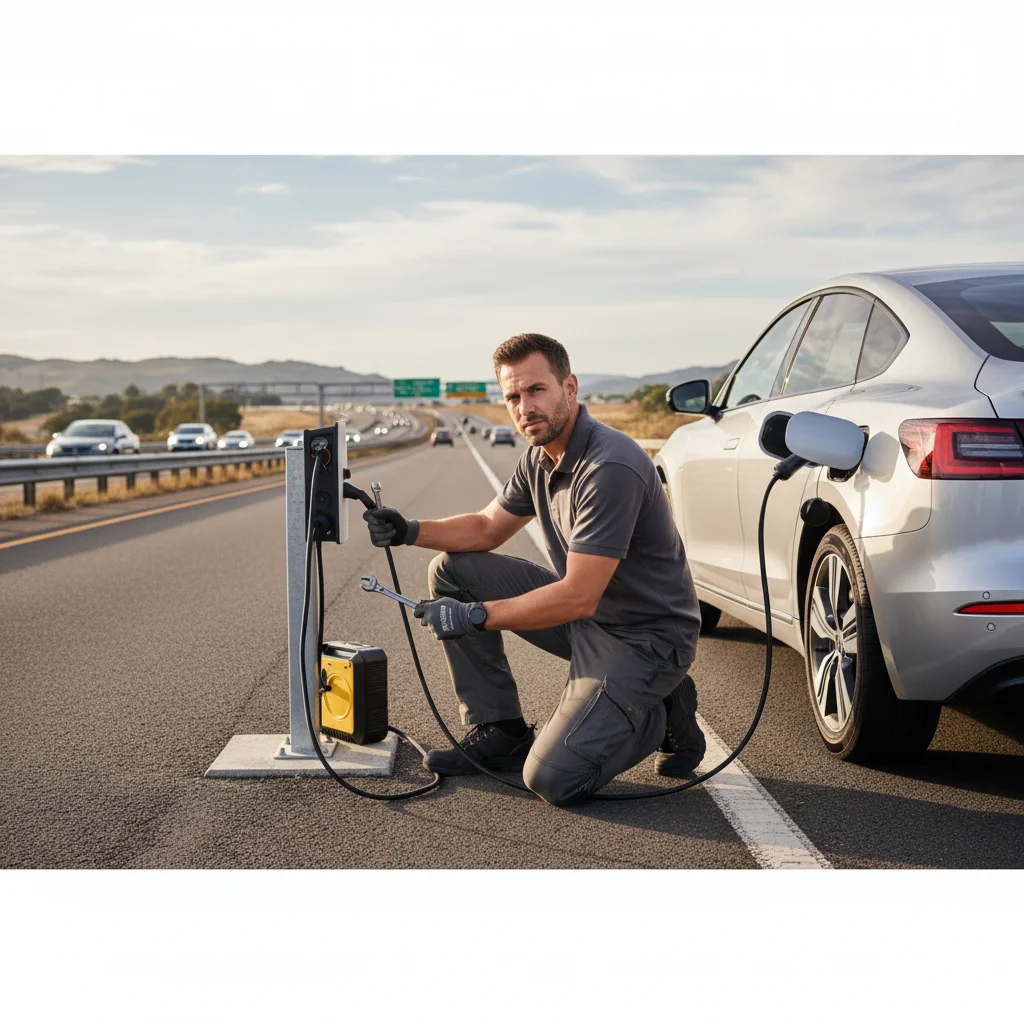
The Skyway is 4 miles of bridge with no place to stop
The Sunshine Skyway carries I-275 across Tampa Bay. It’s a toll crossing operated for FDOT. The cable-stayed main span sits 432 feet above the shipping channel. That height is why wind and fog close this road. A dead EV here is a worse stall than one on a surface freeway.
There’s no place to stop on those 4 miles. You’re not on a suburban arterial with a parking lane. You’re on a high span over open water, in live traffic. Other drivers are still at highway speed. Your car is quiet, dark, and easy to miss.
Most of Tampa Bay is flat and near sea level. Grade almost never gives range back on a normal commute. The Skyway is the exception you feel in the pack. The climb to 432 feet costs energy on the way up. Heat and cabin AC take more after that.
Recurrent Auto’s published research finds an EV loses only about 5 percent of range at 90°F. Loss jumps to 20 to 30 percent above 95°F. It’s roughly 17 to 18 percent near 100°F. Tampa Bay’s air-conditioning season runs from spring into late fall.
Florida Highway Patrol closes the Skyway when winds reach sustained 40 mph. It also closes when fog cuts visibility below about 100 feet. A high-wind advisory for high-profile vehicles is typically issued around 20 mph gusts. That’s FHP practice as reported by WFLA and Bay News 9. If the span is closed, you’re on one side of the bay. Check Florida 511 before you spend the last bar on a closed crossing.
Leave the span if the car can still roll
The useful move is location, not a charger scavenger hunt. If you still have miles, use them to reach an approach. Northbound, that’s Pinellas and St. Petersburg. Southbound, that’s Manatee: Palmetto first, then Bradenton.
Hit your hazards as soon as the car warns you. Ease right. Don’t wait for a true zero. A slow crawl off the span beats a silent stop over the channel. Once you’re stopped and truly disabled, a different rule applies. Florida Statute 316.194 covers a vehicle that can’t avoid stopping on the traveled way. It treats that car as a disabled vehicle. That statute doesn’t make the Skyway a good place to sit. It only means you shouldn’t keep rolling until you stall in a live lane.
Stay in the car with your seatbelt on. Don’t walk the span. Don’t stand at the barrier to flag traffic. Call 911 if you’re in a travel lane or you feel unsafe. Florida Highway Patrol Troop C covers disabled vehicles on Tampa Bay interstates. Let them own the traffic problem first.
Then call FDOT Road Rangers. District 7 patrols I-275 in the Tampa Bay area, plus the airport interchange. From a mobile phone you dial *347. Published free services include flat-tire help and a 12-volt jump-start. They also carry fuel and can make two local calls. They can relocate a disabled vehicle to a safer spot. The District 7 Regional Traffic Management Center is the Tampa Bay SunGuide Center.
That relocate item is the Skyway-specific one. If Rangers can move you to a safer spot, use that. That’s how you leave a span with no place to stop. The Road Rangers materials we reviewed describe fuel, a jump-start, and tire help. They don’t mention charging an EV. The free patrol can still jump a 12-volt battery. It can still help with the scene. Charging the traction pack is a different job, done after you’re off the bridge.
District 1 runs its own Road Rangers on I-75 through Manatee and Sarasota. If you’ve rolled south toward I-75, that may be the district you hear named.
Help meets you after you’re off the bridge
Charge Pro TPA is a referral line. We match stranded EV drivers with independent local operators. We don’t own trucks. We don’t employ technicians. We don’t set prices, and we don’t promise an arrival time. The operator quotes you before starting and bills you directly.
They bring a 240-volt Level 2 source to the car. Teslas get a native NACS plug. Other EVs use a CCS or J1772 adapter. This isn’t DC fast charging. In 15 to 30 minutes of charging, they typically add 10 to 20 miles. That’s charging time, never an arrival time. We don’t publish when someone will show up because we can’t.
Those 10 to 20 miles are why the meet belongs off the span. It’s enough to reach a charger you already know. It can also limp you a short way home. It isn’t a full pack. Read out-of-charge recovery for what that top-up is for. Mobile EV charging explains the truck-side charge in more detail.
If the car won’t wake at all, it may not be an empty pack. Many EVs fail from a 12-volt battery. Then they look like they have no range. Operators can jump or replace a dead 12-volt on site. They handle Tesla and every major EV brand. EV roadside assistance is the wider playbook for that call.
A driver who makes the south end is often already in Palmetto. That’s a surface-street town, not a 432-foot span. EV roadside assistance in Palmetto covers that landing. Northbound, you’re rolling onto the St. Petersburg peninsula. If the car is a Tesla that won’t wake, see A Tesla that won’t start in St. Petersburg. If you emptied out on I-275 before or after the bridge, see empty pack on I-275. If you’re actually on the Courtney Campbell, that’s a different causeway: stuck on the Courtney Campbell Causeway.
Don’t plan on a Level 2 session on the main span. The workable meet is a safe spot once you’re off. A confirmed public-charger directory for this span wasn’t in the sources we checked. If you already have a stall in mind, tell the operator. If you don’t, the Level 2 top-up is what gets you rolling again.
Heat, wind, and a 432-foot climb
Gulf air on that high span isn’t driveway weather. Crosswinds shove the car. You hold a lane and use more energy than a flat inland cruise. Pair that with cabin AC on a Tampa Bay afternoon. The display drops faster than the map suggested.
Heat is still the range story on this climb. If FHP has the span closed, you’re not almost there. You’re parked on the Pinellas side or the Manatee side. A high-wind advisory around 20 mph gusts is a warning for tall vehicles. Sustained 40 mph is a closure. Fog under about 100 feet is a closure too. None of those are EV faults. They’re Skyway faults that strand a car that was counting on one more exit.
Salt spray is part of this crossing. After a storm, keep water out of the charge port before anyone plugs in. Federal and fire-service guidance warns about EVs soaked in salt water. They can be a delayed fire risk. The car should be inspected before it sits next to a house or another car. Hurricane Helene in late September 2024 drove record storm surge at Tampa Bay tidal gauges. If your car took salt water, say so when you call.
What to tell whoever you call
Say which way you were heading. North is St. Petersburg. South is Palmetto and Bradenton. Say whether you’re still on the span or already off it. Give the car’s make and model. Say if the screens are dead or if you still have a range number. That split is how an operator tells a 12-volt failure from an empty traction pack.
Stay in the car until Road Rangers or FHP tell you to move. If Rangers can relocate you to a safer spot, let them. Then the mobile operator meets you there. That’s the Skyway version of roadside help.
Frequently asked questions
Can an operator charge me on the Skyway span itself?
The span is 4 miles of bridge with no place to stop. A Level 2 top-up needs a parked, safe meet. Leave the span if you can. If you can’t, Road Rangers may relocate a disabled car to a safer spot. Then an operator plugs in off the bridge. Don’t plan a shoulder charge at 432 feet over the channel.
Should I call Road Rangers or a mobile EV rescue first?
If you’re on the span, call *347, and call 911 if the scene requires it. Road Rangers can jump a 12-volt battery and relocate a disabled vehicle. Their published list doesn’t include charging an EV. Once you’re off the bridge, a mobile operator can add 10 to 20 miles on Level 2. Those are two different jobs.
What if wind or fog has the Skyway closed?
FHP closes the crossing at sustained 40 mph winds, or when fog drops visibility below about 100 feet. Check Florida 511. You’ll be on the Pinellas side or the Manatee side, not mid-span. Call for a mobile charge where you actually are, in St. Petersburg, Palmetto, or Bradenton.
If you’re already off the Sunshine Skyway and the pack is done, call (813) 536-4545. Charge Pro TPA will connect you with a local operator. That operator quotes you before starting and bills you directly. We won’t promise an arrival clock. We won’t pretend the main span is a safe workshop. Get off the bridge. Then get a charge.