Your EV just hit empty on I-275. Treat it as a shoulder stop first. Get fully right, lights flashing, then call for help. This interstate is the urban spine through Tampa and Pinellas. It includes the airport interchange and the Sunshine Skyway. A dead traction pack doesn’t change Florida’s disabled-vehicle rules. You still need to leave the travel lanes as soon as you can.
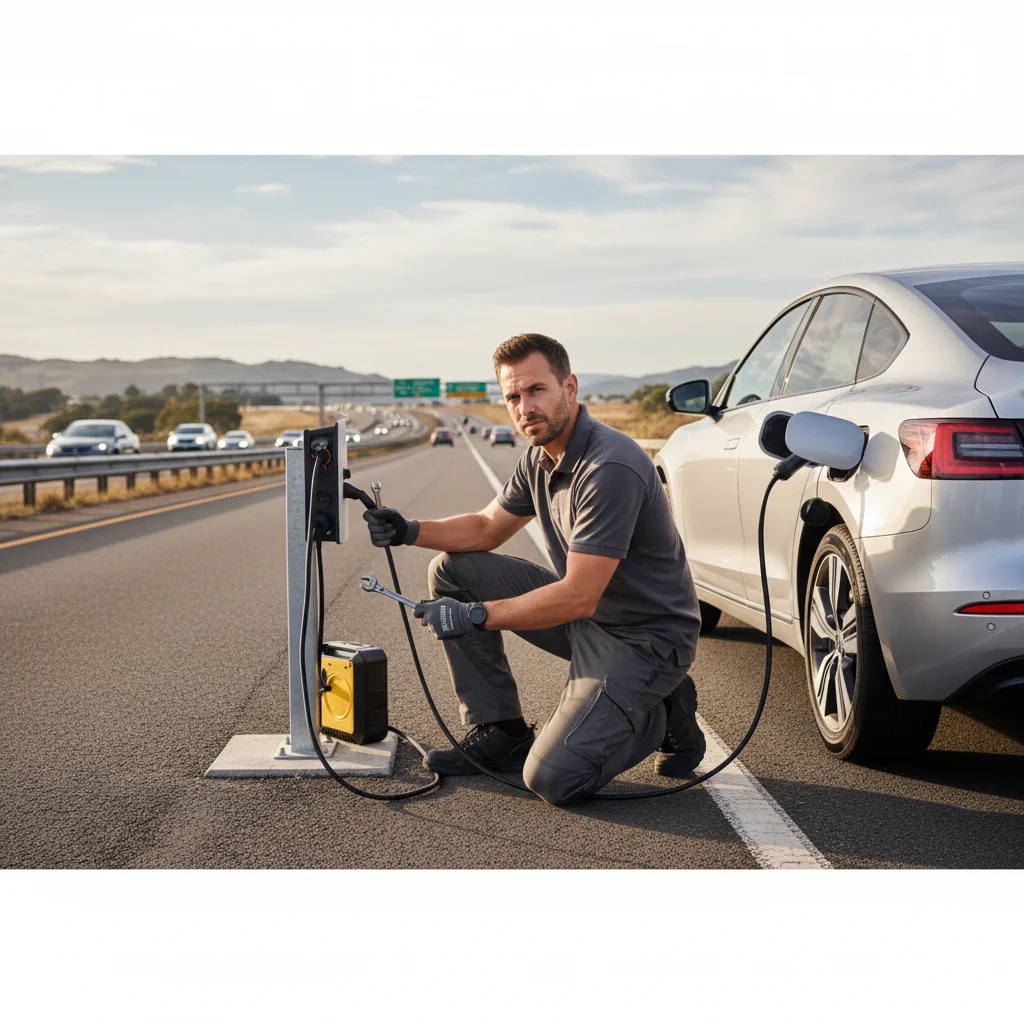
I-275 is Tampa Bay’s urban interstate
I-275 isn’t a quiet beltway around the metro. It’s the through-town freeway that stitches Tampa to Pinellas. Census ACS figures for 2019-2023 put Tampa at 393,389 people. The 2024 population estimate is 414,547. St. Petersburg sits at 260,646 in that ACS window. The 2024 estimate is 267,102. Those two cores explain the traffic you feel on this route.
FDOT Road Rangers in District 7 patrol I-275. They also cover I-4, I-75, and the airport interchange. Dial *347 on a mobile phone to reach them. The District 7 Regional Traffic Management Center is the Tampa Bay SunGuide Center. Florida Highway Patrol Troop C covers disabled vehicles on these interstates. Florida 511 is the state’s traffic-information system if your phone still loads.
Road Rangers publish a free menu that still matters when the pack is dead. They can work a flat tire. They can jump-start a 12-volt battery. They can bring fuel, diesel, or water. They can place two free local calls. They can relocate a disabled vehicle to a safer spot. They also handle maintenance of traffic at incidents. The Road Rangers materials reviewed describe those jobs. They don’t mention charging an electric vehicle. That’s an observed absence in the published list. The free patrol can protect the scene and jump a 12-volt. It isn’t a traction-pack fill.
Tampa Electric, known as TECO, serves the City of Tampa. It also serves most of Hillsborough County. Parts of Pinellas and southern Pasco sit on TECO as well. Duke Energy Florida serves Pinellas County and much of Pasco. A Pinellas driver who stalls in Tampa may still be a Duke customer. That’s a home-charging fact for later. It doesn’t change the shoulder sequence.
The Sunshine Skyway is still this same interstate
South of St. Petersburg, I-275 becomes the Sunshine Skyway. It’s tolled and operated for FDOT. The cable-stayed main span sits 432 feet above the shipping channel. Florida Highway Patrol closes the Skyway when winds reach sustained 40 mph. It also closes when fog cuts visibility below about 100 feet. A high-wind advisory for high-profile vehicles is typically issued around 20 mph gusts. That’s from WFLA and Bay News 9 reporting of FHP practice.
A stall on that span is uniquely bad. You get four miles of bridge with no place to stop. Don’t hunt for a hidden turnout. Don’t walk for help on the structure. If you’re already stopped, stay with the vehicle. Wait for a trooper or Road Ranger to move you. Tampa Bay is one of the most lightning-prone metros in the country. That’s according to Vaisala. Standing outside on an exposed bridge during a storm adds a second emergency.
A separate page covers out of charge on the Sunshine Skyway. Read that if you’re already on the span. The steps below are for the urban I-275 run. They also cover the same first safety moves on any segment.
Heat is why the gauge falls on this route
Tampa Bay is flat and near sea level. Grade never gives range back. Heat and air conditioning are the whole range story. The AC season runs from spring into late fall. Recurrent Auto’s published research is the source to cite. An EV loses only about 5 percent of range at 90°F. Loss rises to 20 to 30 percent above 95°F. Near 100°F the loss is roughly 17 to 18 percent. The effect varies widely by model. Don’t treat a winter range number as a July number on I-275.
That’s how a Tampa errand plus a Pinellas hop turns into a shoulder stop. Cabin cooling never clocks out in this climate. Stop-and-go through the urban core spends energy you planned to keep. The car isn’t mysterious. The weather took a cut.
First moves on the shoulder
Florida Statute 316.194 is the rule that applies. It covers stopping outside business or residence districts. You may not stop on the paved or main-traveled part of a highway. That’s when it’s practicable to stop off the roadway. Subsection (2) exempts a vehicle disabled on that pavement. The exemption applies when it’s impossible to avoid stopping and temporarily leaving the vehicle. A dead EV on a shoulder is a disabled vehicle under that exemption. You aren’t parking. You’re disabled. Act like it.
Move right as soon as the low-range warning is real. Don’t wait for the car to coast to a stop in a travel lane. I-275 carries commuter and through traffic in both counties. Other drivers won’t gift you a quiet merge.
Pull completely onto the right shoulder. Get as far from the travel lane as the surface allows. If a concrete barrier is there, sit tight to it. Don’t straddle the line.
Turn on the hazard lights before you’re fully stopped. Your speed drop is the first signal. The flashers are the second.
Exit through the passenger-side door if you can. The driver’s door opens toward live lanes. Stay between the car and the barrier. Never stand between the car and traffic. Don’t walk the shoulder toward an exit. Stay near the vehicle, well behind the rear tire, unless a responder relocates you.
Then report the stop. Dial *347 for Road Rangers. Give your direction of travel, the last exit you passed, and a vehicle description. Use Florida 511 if the app or site still loads. FHP Troop C is the patrol for disabled vehicles on this interstate. Logging the stop matters if someone clips the car from behind.
After the scene is reported, call for a charge. Charge Pro TPA is a referral line. It matches stranded EV drivers with independent local mobile rescue operators. It performs no work and owns no trucks. It employs no technicians and sets no prices. It promises no arrival time. The operator quotes you before starting and bills you directly.
Empty pack or a dead 12-volt
Confirm what actually failed. Plenty of EVs on I-275 look dead with miles still in the pack. The 12-volt battery runs computers, contactors, lights, and locks. When that small battery quits, the car can refuse to wake. Road Rangers’ published jump-start help is for that 12-volt. It isn’t a fill for the traction battery.
Operators in the network can jump or replace a dead 12-volt on site. They handle Tesla and every major EV brand. If the pack is truly empty, they bring a 240-volt Level 2 source to the car. Tesla owners get a native NACS plug. Other EVs use a CCS or J1772 adapter. Typical add is 10 to 20 miles of range. That takes 15 to 30 minutes of charging. That number is charging time at the bumper. It isn’t how long anyone takes to arrive.
A mobile EV charging call is how you request that bumper session. Out-of-charge recovery is the service aimed at a pack that’s actually empty. Drivers stuck in the Tampa core can use the Tampa EV roadside assistance page. It covers streets off this freeway. Drivers who left the St. Petersburg side can use the St. Petersburg EV roadside guide.
Tell the operator five facts. Direction of travel. Last exit or nearest milepost. Year, make, model, and color. Current battery percentage, if the screen still wakes. Whether the car is still powered on. That lets the independent pro bring the right connector. It also lets them quote the job before they start.
Don’t invent a clock in your head. I-275 through Tampa and the airport interchange changes by the hour. The operator sets the plan. The referral line doesn’t.
If you still have a few miles, say so on the call. Getting off at the next exit beats a stop in a travel lane. A surface street or a legal stall is easier for a mobile charger. That’s better than a narrow shoulder. Tampa International Airport sits on the interchange District 7 also patrols. The airport publishes free EV charging at on-airport parking garages and the cell phone lot. Level 1 J1772 stations are on the first floor of the Economy Garage. Level 1 charging is also in the Long-Term Parking Garage. Level 2 is at the Cell Phone Lot. Confirm the current layout on tampaairport.com before you count on a specific stall. That airport charging helps only if you can still drive there. It isn’t a reason to limp a zero-percent car through a ramp.
A tow off I-275 is the last resort
Many drivers treat a tow as the default freeway backup. On this corridor it usually leaves you with a still-empty car in a lot.
A live interstate stop often needs patrol coordination before a wrecker works the shoulder. That’s a safety step. EVs generally need a flatbed. Dolly tows can hurt all-wheel-drive gear and regenerative hardware. The drop-off is the wrecker’s lot, not a planned charge stop. You then start a second problem from a storage yard.
Florida doesn’t publish a statewide tow price you can trust here. Non-consent tow rates are capped at the county level. Hillsborough County sets maximum non-consensual and trespass tow rates. Those caps run through the Tax Collector’s vehicle-for-hire authority. Pinellas County sets them by ordinance. That’s Ordinance 19-39. It sits in Code of Ordinances Chapter 122, Article II.5, section 122-42. Exact current maximum dollar figures were not confirmed against the live ordinance schedule. Confirm the posted cap with the county before you argue a bill. Don’t guess a number.
The longer write-up on hidden costs of towing a dead EV covers the wrecker path. On I-275, get a bumper charge that restores enough range to exit. That’s how you avoid a storage yard.
How a mobile rescue reaches this freeway
Charge Pro TPA serves Tampa Bay, including I-275 through Tampa and Pinellas. Service-area language is about matching, not a brand-owned fleet. There isn’t one. Independent operators do the work. They quote before they start. They bill you directly.
EV roadside assistance is the umbrella when you aren’t sure. Use it if you need a jump or a charge. The operator figures that out at the bumper. Non-Tesla drivers are in scope. Referred rigs bring NACS plus CCS or J1772 adapters.
Use Road Rangers first for traffic safety. Use the operator for the pack. Don’t wait for the free patrol to become a rolling charger. Their published list doesn’t include that job. Name I-275 when you call, not I-75, so responders look in the right place.
Once you have enough range to leave the shoulder, take the first safe exit. Don’t sit on the interstate to top off. A Level 2 roadside session is recovery. It isn’t a full charge.
Frequently asked questions
What should I do first if my EV dies on I-275?
Get fully onto the right shoulder with hazards on. Report the stop to Road Rangers at *347. Give direction, last exit, and a description. Then call for a mobile charge. A bumper session that adds 10 to 20 miles is how you exit. A tow still leaves you with an empty car.
Do Road Rangers charge an EV on I-275?
District 7 Road Rangers patrol I-275 and can jump a 12-volt battery. Their published free services include tire help and fuel. They also list relocating a disabled vehicle and two local calls. Those materials don’t mention charging an EV. Treat that as an observed absence. Call them for the scene. Call an operator for the pack.
Who can charge a Tesla or another EV on this interstate?
Independent operators in the Charge Pro TPA network handle Tesla and every major EV brand. They bring a 240-volt Level 2 source with a native NACS plug. CCS or J1772 adapters cover other EVs. The operator quotes before work starts and bills you directly. Charge Pro TPA doesn’t perform the work.
If the pack is empty on I-275, call (813) 536-4545. Call the same number if you won’t make the next exit. That line connects you with a local operator who can charge at the bumper. No brand-owned truck. No promised arrival window. You get a quote before anything starts.