An EV maintenance schedule in Tampa Bay is short, and it’s tilted toward the 12-volt. Humid summers park cars in heat for days. That sitting wears the small battery harder than a commute does. You still skip oil changes. You don’t skip 12-volt tests, tire rotations, or a cabin filter.
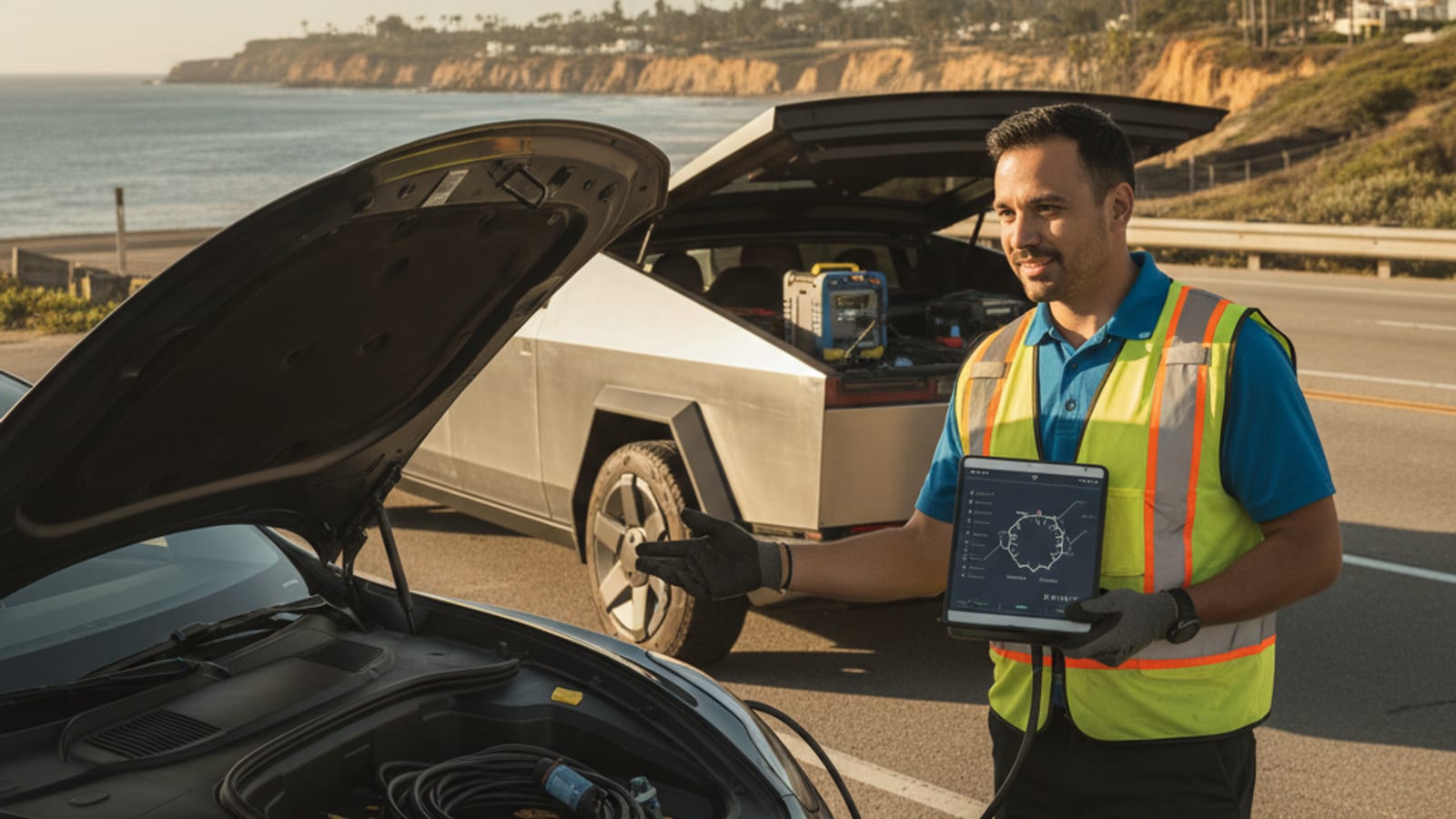
Sit time is the interval that matters here
Gas cars taught everyone to watch the odometer. Electric cars in this metro teach you to watch idle time. A pack sitting at half charge can still leave you locked out. The 12-volt runs the locks, the screens, and the computers that close the high-voltage contactors. When it sags, the car looks dead. The traction battery can be fine.
That pattern shows up after a week away from the driveway. Tampa International Airport publishes free EV charging in the on-airport garages and the cell phone lot. Level 1 J1772 stations sit on the first floor of the Economy Garage. Level 1 charging is also in the Long-Term Parking Garage. Level 2 is at the Cell Phone Lot. A live port count was not confirmed on the airport’s page, so don’t plan around a number. Plan around the failure mode instead. A car that won’t wake after a trip is almost always the 12-volt, not an empty pack.
Multi-day cruise parking produces the same sit. Port Tampa Bay terminal lots and any chargers there were not verified on a primary page. Treat a cruise week as a 12-volt watch. Don’t treat this paragraph as a charging directory.
Humidity is the other half of the wear. The small battery cooks while the car sleeps. Alarms and connectivity still draw a trickle. Afternoon storms keep the air sticky. You won’t get an oil-life alert. You’ll get slow handles, a blank display, or a car that ignores the app.
If the car is silent in the driveway, start with that small battery. What happens when an EV 12-volt dies walks through the signs. The pros we connect you with jump or replace it on site. They cover Tesla and every major EV brand.
The jobs that actually disappeared
There’s no engine oil. There’s no oil filter either. Spark plugs are gone. So is a fuel filter. There’s no timing belt. Many EVs use a single-speed drive unit. Some manuals never call for fluid in that unit. Others want a look at high mileage. Read yours before you skip it.
The motors are sealed. They don’t get a seasonal service. What remains is tires, brakes, coolant, the charge port, cabin air, and the 12-volt.
Treat the pack for this heat, not for a mountain grade
The high-voltage pack is still the part you can’t shrug off. Daily charging habits belong in the owner’s manual, not in a guess from a blog. Many books prefer a mid-level daily charge over a 100 percent fill every night. Follow the brand page for your VIN.
Tampa Bay runs a long air-conditioning season from spring into late fall. Cabin cooling is the range story here. The land is flat and near sea level, so grade never hands energy back. Recurrent Auto’s published research is the heat citation to use. An EV loses about 5 percent of range at 90°F. Loss runs 20 to 30 percent above 95°F. It’s about 17 to 18 percent near 100°F, and it varies by model.
Park in shade when you have it. Pre-cool while the car is still plugged in, so wall power takes the first blast of heat. Keep software current. Battery controls improve through over-the-air updates.
Newest tracts in scope are Lakewood Ranch, Fish Hawk, and Westchase. 240-volt home charging is near-universal there. Overnight Level 2 is the calm way to fill. Oldest stock in scope is Lealman, at 56.6 percent built before 1980. St. Petersburg follows at 51.5 percent. Older streets don’t cancel the 12-volt. They only change where the car sleeps at night.
Heat and salt air wear on an EV battery stays on pack care. This page stays on the calendar.
Humidity still owns brakes, tires, and filters
EVs hit tires with instant torque and extra weight. Rotate on the schedule in the manual. A typical window is 5,000 to 7,500 miles. Alignment still matters because the car is heavy. Have a shop check it after a hard hit.
Regen saves pads. It doesn’t keep calipers free after a month in July. Sitting cars stick hardware. Ask for a pad, rotor, and hose look on the regular visit. Brake fluid absorbs moisture. This climate gives it plenty. Many manufacturers want a fluid change every two to three years, even if the pads look thick. The book is the rule.
The cabin filter works for the whole AC season. Change it when the fan sounds strained or the air smells stale. Wipers and washer fluid earn their keep in storm months. Hurricane Milton dropped at least 18 inches of rain on parts of St. Petersburg in early October 2024. Hurricane Helene, in late September 2024, drove record storm surge at Tampa Bay gauges. St. Petersburg faced a forecast of 5 to 8 feet of surge. Pinellas barrier islands from the Dunedin Causeway through Tierra Verde were closed. After standing water, inspect the charge port before you plug in. Water in an EV charge port after rain is the wet-inlet walkthrough.
If the car sat in salt water, stop. Federal and fire-service guidance warns that a soaked lithium-ion pack can fail later as a fire. Keep the vehicle away from buildings and other cars until a qualified shop inspects it. A specific standoff distance was not confirmed on a readable federal page. Don’t copy a number from memory.
Coolant still matters. Packs and inverters often have their own loops. Some are sealed. Some want a change at a published mileage. Check the reservoirs when you rotate tires.
Vaisala’s lightning data puts this metro among the most lightning-prone in the country. Unplug a home charge during a close cell. That’s port care, not theater.
Build the year around weather, then confirm miles
Use seasons as reminders. Then match them to the intervals in the glovebox.
After a long sit
Wake the car a day before you need it. Confirm it still talks to the app. If the doors are dead, don’t assume you flattened the pack. The 12-volt failed first. Town ‘n’ Country drivers see this after a week at the airport. It isn’t a charging glitch. When you’re already stuck, a Tesla 12-volt battery jump is the on-site version of that test.
Through the hot months
Watch the range estimate against Recurrent’s heat bands. The Sunshine Skyway is a bad place to learn that lesson. The main span sits 432 feet above the shipping channel. Florida Highway Patrol closes it at sustained 40 mph winds. It also closes when fog cuts visibility below about 100 feet. A high-profile advisory is typically issued around 20 mph gusts, per local reporting of FHP practice. The span runs about 4 miles with no place to stop. Keep a usable buffer on hot afternoons.
After a named storm
Dry the port. Skip a charge if you see water in the inlet. If the car floated, treat it as a hold for inspection. Low-lying Pinellas and the barrier islands sit in evacuation zones. So do Ruskin, Apollo Beach, and Gibsonton in south Hillsborough. Leave with range. Leave with a 12-volt you already tested. Milton also tore part of the roof off Tropicana Field. A car that sat through that week is a sit-time case.
On a regular service stop
Rotate tires. Inspect brakes. Swap a dirty cabin filter. Check coolant. Replace tired wipers. Ask for a 12-volt load test. Replacing it before it dies beats a silent car in a Westchase driveway. Fob batteries die too. That’s a small item with a large lockout.
Carrollwood, Lake Magdalene, and Temple Terrace run short trips with lots of AC. The odometer stays low. The 12-volt still ages on the calendar.
At high mileage
Some drive units want fluid. Some coolant systems want a flush. A dealer can read pack state of health. High-voltage warranties run long on most brands. Get the term from your warranty booklet. Don’t take a blog’s word for a year count.
Brand intervals live in EV maintenance schedules by brand. Pair that post with the manual. This article is only the Tampa Bay overlay: sit time, humidity, and heat.
Utilities shape how you charge, not the service book
Tampa Electric serves the City of Tampa, most of Hillsborough County, and parts of Pinellas and southern Pasco. Home rate schedules include Residential Service, which is tiered, and RSVP-1, a time-of-use plan. Drive Smart is TECO’s charger incentive for commercial and public sites. A named residential home-charger rebate was not found on a primary TECO page. Don’t plan a home install around a figure we couldn’t verify. TECO’s home EV pages point to charging and installation guidance. The contact they publish is [email protected].
Duke Energy Florida serves Pinellas County and much of Pasco. In 2025 Duke launched a Charger Prep Credit. It goes toward wiring and electrical upgrades for a Level 2 charger, for homes and businesses. It doesn’t cover the charger hardware or permit fees. Duke also launched an Off-Peak Charging Credit for residential off-peak charging, plus a Fleet Advisory program. Confirm the current credit and the current hours with Duke before you shift a schedule. Hours move.
North and central Pasco, outside the Dade City area, is often Withlacoochee River Electric Cooperative. WREC reports 280,000-plus accounts across Pasco, Hernando, Citrus, Sumter, and Polk. If that’s your bill, call WREC. Don’t call TECO or Duke by default.
Peace River Electric Cooperative and Florida Power & Light serve parts of the southern ring. Exact boundaries and EV programs were not verified on a primary page. Check the name on your own bill in Manatee or Sarasota County.
Pinellas condos and HOAs still have a charging path. Florida Statute 718.113(8) gives a condo unit owner a charging right. They may install a station in a limited common element or an exclusive parking space. A declaration can’t be enforced to block a properly submitted request. The board can’t deny that request. The owner pays for installation, operation, maintenance, insurance, and separately metered electricity. That statute decides whether the 12-volt sleeps on a plug.
Florida doesn’t offer a state EV purchase rebate or tax credit. Utility programs are the local incentives. Under SB 28, battery-electric vehicles also picked up a separate annual registration fee starting January 1, 2026. Confirm the current amount with the state before you renew. A later bill tried to raise that fee. It died in the Senate Transportation committee on March 13, 2026.
When a skipped item puts you on the shoulder
A weak 12-volt leaves you unresponsive in a lot. A pack you ran down leaves you on I-275, I-75, or I-4. Those need different help.
FDOT Road Rangers in District 7 patrol I-4, I-75, and I-275, plus the airport interchange. Dial *347. Published services include a jump-start, tire help, fuel, diesel or water, and two free local calls. They can also move a disabled vehicle to a safer spot. The District 7 desk is the Tampa Bay SunGuide Center. The Road Rangers materials we reviewed describe that jump and that fuel. They don’t mention charging an EV. A jump can wake a 12-volt. It doesn’t refill a traction pack. District 1 runs its own Road Rangers on I-75 through Manatee and Sarasota. Florida Highway Patrol Troop C covers disabled vehicles on the interstates. Florida 511 is the state’s traffic system.
Florida Statute 316.194 covers stopping outside a municipality. You can’t stay on the paved highway when you can get off it. Subsection (2) exempts a vehicle that’s disabled and can’t be moved. A dead EV on a shoulder fits that exemption. Get it out of live lanes as soon as you can.
If the pack is empty, we match you with an independent operator. That operator brings a 240-volt Level 2 source. Tesla gets a native NACS plug. Other brands use a CCS or J1772 adapter. That session typically adds 10 to 20 miles of range in 15 to 30 minutes of charging. That’s plug time. It isn’t an arrival time. The operator quotes before work starts and bills you directly. Charge Pro TPA is a referral line. We don’t hold a trade license, and we don’t own the truck.
Mobile EV charging is the empty-pack call. A tow is what you want when the car can’t go into Neutral, or the pack is damaged.
If the car won’t wake and you need a local match, call (813) 536-4545. That’s the forwarding line. The operator on the other end sets the price.
Keep the 12-volt on the calendar. Keep the manual for everything else. In this climate, that split is the schedule.