Tesla, Rivian, Ford, Hyundai, and Chevy publish national service lists for their EVs. Those mile counts don’t change at the Hillsborough line. The local gap is the 12-volt battery. Tampa Bay heat wears that small battery harder than a national chart admits. So does a long air-conditioning season.
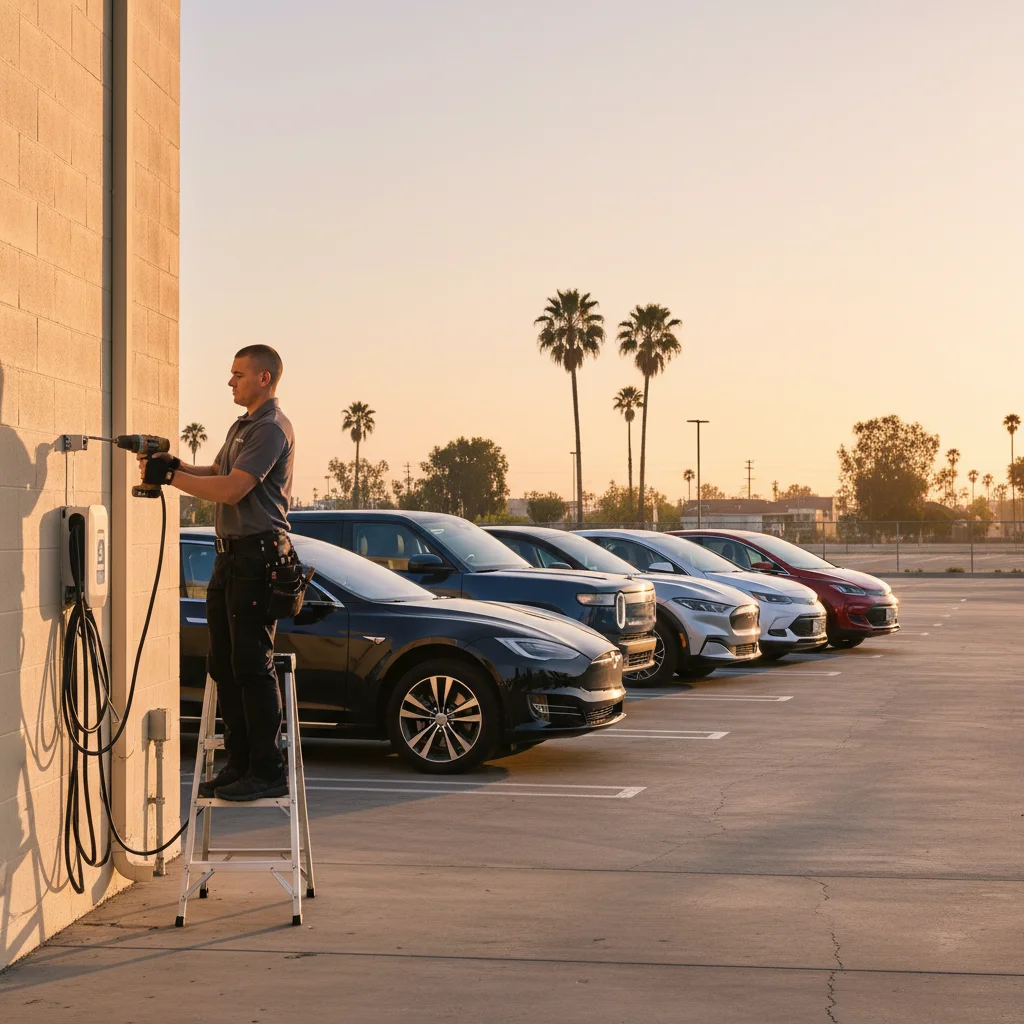
If you want an EV maintenance schedule by brand, open your model-year owner’s manual first. Then add one local habit the booklet barely stresses. Test the 12-volt before a dead module locks you out of a car that still has range.
National lists, local heat
Recurrent Auto’s published research is the range figure people cite. An EV loses about 5 percent of range at 90°F. The loss climbs to 20 to 30 percent above 95°F. Near 100°F, Recurrent puts the hit around 17 to 18 percent, and it varies by model. That’s traction-pack range, not the 12-volt. The same heat still burdens the little battery that wakes computers, pops handles, and closes the high-voltage contactors.
Tampa Bay’s air-conditioning season runs from spring into late fall. Cabins stay cold for months. A car in Lakewood Ranch, Fish Hawk, or Westchase may have easy 240-volt home charging. Those master-planned streets have some of the newest housing in the metro. A Level 2 hookup is common there. That still doesn’t rotate tires or load-test a 12-volt.
A week in a Tampa International Airport garage is the other local pattern. The airport publishes free EV charging in on-airport garages and the cell phone lot. An EV left there for a week that comes back dead is almost always a 12-volt failure, not an empty pack.
Federal and fire-service guidance warns that an EV soaked in salt water needs inspection. Keep it away from a house or another car until a shop looks at the pack. Hurricane Helene’s surge in 2024 and Milton’s rain on St. Petersburg made that more than a brochure line. If floodwater reached the car, pause the normal service calendar and get the pack checked.
For a checklist that isn’t split by badge, use EV maintenance for Tampa Bay owners. This page stays on the brand calendars.
Shared jobs every EV still has
Oil changes are gone. Spark plugs are gone. You still have tires, brake fluid, cabin air, wipers, and a 12-volt. Skip those and the car can refuse to wake with a full traction pack.
Tires take the most ordinary attention. EVs are heavy, and instant torque chews inner or outer edges if you don’t rotate. Each brand sets its own mileage. Heat in a sunny lot raises pressure, so check it when the tires are cold.
Brake pads last longer with regen. Brake fluid still picks up moisture over time. Rotors that rarely work can rust in Pinellas salt air. A visual check belongs on the calendar even when the pads look thick.
Cabin filters clog with pollen, dust, and year-round AC. Wipers still matter in summer storms.
Confirm every interval in the current manual for your VIN. Automakers revise service pages. A 2022 car and a 2026 car in the same lineup can differ. In-car alerts help. They don’t replace a 12-volt that’s already too weak to boot the screen.
Tesla: trust the display, then the small battery
Tesla moved off a mandatory yearly shop visit. Many items now live on the center screen. The published hardware intervals still matter, especially in this heat.
Tesla’s published intervals
Rotate tires every 6,250 miles, or sooner if tread differs by 2/32 inch or more between any two tires. That’s tighter than several rivals. Weight and power are why.
Check brake-fluid health every two years. Replace the fluid if the test shows contamination.
Plan on a cabin-filter swap every two years on most cars. Newer Model S and Model X HEPA and carbon filters are listed at three years.
The A/C desiccant bag is the item owners forget. Tesla’s published window is three to six years by model. Model 3 and Model Y are listed at four years. A 2012 through 2020 Model S is listed at three years. A long Tampa AC season is exactly the climate that bag is meant to handle.
Tesla may fold in a multi-point look when you already have a service visit. There’s no published rule that you must book an annual inspection just to keep a calendar box checked. Keep the tires even. If the car goes dark, treat it as a 12-volt event until proven otherwise. What happens when an EV 12-volt dies walks through that failure.
Rivian R1T and R1S: extra fluids, extra hardware
Rivian’s truck and SUV carry gear a sedan doesn’t. The service list shows it.
Rivian’s published intervals
Rotate tires every 7,000 miles. Check alignment every 14,000 miles, or when wear looks uneven. Don’t wait for the next rotation if the wheel pulls.
Drive unit fluid is the line many EV owners have never heard. Rivian lists a change at 140,000 miles. It lubricates the gearsets in the motor assemblies. The interval is long. Skipping it still matters at that mileage.
Inspect air-suspension parts for leaks or damage every 28,000 miles. Replace the compressor filter at 56,000 miles. That’s hardware a Model 3 doesn’t have.
Replace the cabin filter every year, or every 14,000 miles. Replace brake fluid every three years.
An R1T or R1S that sits in Westchase heat still needs a 12-volt strong enough to wake the truck. The national schedule won’t print a Tampa August next to that battery.
Ford Mach-E and F-150 Lightning: a mileage list, minus oil
Ford kept a checklist that feels closer to a gas-car binder. The oil stamps are gone. The yearly look is still there.
Ford’s published EV checks
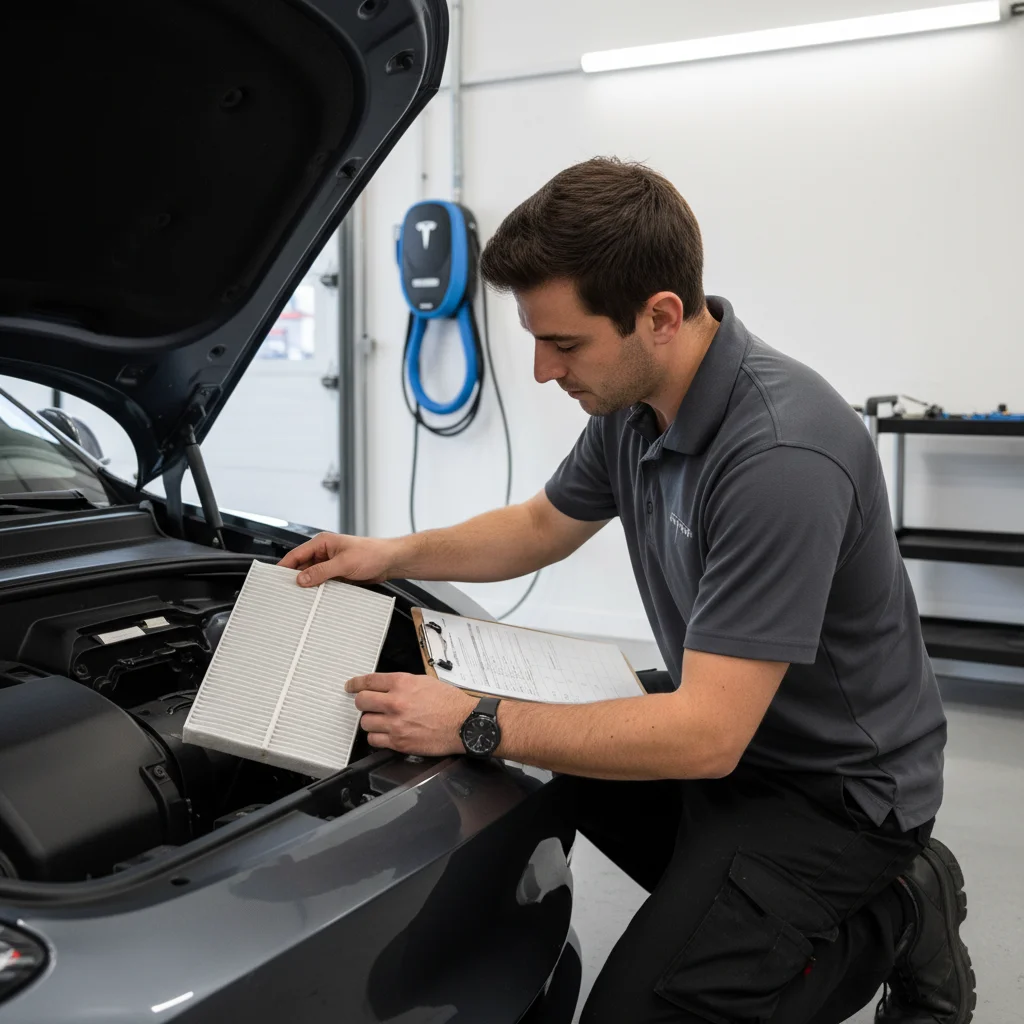
Ford lists a multi-point inspection every 10,000 miles, or at least once a year. That pass includes tire rotation and a brake look: pads, rotors, hoses, and the parking brake. Techs also inspect cooling hoses and connections, half-shaft boots, steering, suspension, and ball joints.
The cabin filter is listed at 20,000 miles. That’s a longer gap than Rivian’s yearly swap.
On the F-150 Lightning, Ford lists rear eAxle fluid at 150,000 miles for the all-wheel-drive truck.
High-voltage battery coolant is the long-horizon item. The first replacement is listed at 100,000 miles. Later changes are listed every 50,000 miles after that. Don’t treat that as a reason to ignore a cooling-hose seep at the annual look.
A Lightning used around Plant City still fails like a Tesla when the 12-volt is tired. So does a Mach-E on the Veterans Expressway. Screens stay off. Doors act stubborn. Drive won’t engage.
Hyundai Ioniq 5: 8,000-mile blocks
Hyundai built the Ioniq 5 calendar on 8,000-mile steps. It’s a light shop plan if you actually keep the steps.
Ioniq 5 published steps
Every 8,000 miles, rotate the tires.
Every 16,000 miles, inspect brakes, steering, and suspension.
Every 24,000 miles, replace the cabin filter.
Every 40,000 miles, inspect battery coolant. Hyundai lists the first coolant replacement at 120,000 miles, then every 40,000 miles after that.
Every two years, flush and replace brake fluid.
Year-round AC in this metro will load that cabin filter. Don’t stretch a 24,000-mile swap if the vents smell musty or the fan sounds strained.
Chevy Bolt EV and Bolt EUV: 7,500-mile blocks
Chevrolet’s Bolt plan is plainer still. Short visits, long coolant gaps.
Bolt published steps
Every 7,500 miles, rotate tires and run a multi-point inspection.
Every 22,500 miles, replace the cabin filter.
Every five years, flush and replace brake fluid.
At five years or 150,000 miles, drain and fill the coolant circuits. The Bolt uses separate loops for the battery, power electronics, and cabin heater. That’s the big shop visit. It isn’t a substitute for a 12-volt that already failed in a hot garage.
Lealman and St. Petersburg have some of the oldest housing in this metro. A 240-volt home circuit is less of a given there than in Fish Hawk or Westchase. Florida Statute 718.113(8) lets a condo owner install a charger in a limited common element or an exclusive parking space. The owner pays install, upkeep, insurance, and separately metered power. A board can’t block a properly submitted request. That statute still doesn’t test the 12-volt.
Utility programs don’t replace a shop visit
Tampa Electric serves the City of Tampa, most of Hillsborough, and parts of Pinellas and southern Pasco. TECO’s Drive Smart program is a rebate path for non-residential Level 2 and DC fast sites. TECO’s home EV pages point owners to install guidance and [email protected]. A named residential home-charger rebate amount was not confirmed on TECO’s primary pages. Ask TECO for what’s current. Don’t budget a figure this page can’t verify.
Duke Energy Florida serves Pinellas and much of Pasco. Duke publishes a Charger Prep Credit toward wiring for a Level 2 hookup. It also publishes an Off-Peak Charging Credit and Fleet Advisory. Confirm current credit amounts on Duke’s own pages before you count on a bill number.
North and central Pasco often sits on Withlacoochee River Electric Cooperative, not TECO or Duke. Call the co-op on your bill. None of those programs rotate tires. None of them load-test a 12-volt. How Tampa Bay heat and salt air wear an EV battery covers pack care in this climate.
Shop work versus a shoulder stall
Charge Pro TPA doesn’t do the maintenance in this guide. We’re a referral line. We match stranded drivers with independent local operators. We don’t own trucks, we don’t employ techs, and we don’t set prices.
Those operators bring a 240-volt Level 2 source to the car. They use a native NACS plug, plus CCS or J1772 adapters for non-Tesla EVs. They typically add 10 to 20 miles of range in 15 to 30 minutes of charging. That’s plug time, never an arrival time. They can also jump or replace a dead 12-volt on site. They quote before they start and bill you directly.
Florida Statute 316.194 treats a dead EV that can’t leave the pavement as a disabled vehicle. FDOT Road Rangers in District 7 patrol I-4, I-75, and I-275, plus the airport interchange. Dial *347. Their published list includes tire help, a jump-start, fuel, water, two local calls, and moving a disabled car to a safer spot. That list doesn’t include charging an EV. A 12-volt jump may be on the menu. Filling the traction pack isn’t in the materials they publish.
Florida Highway Patrol Troop C covers disabled vehicles on those roads. Florida 511 is the traffic feed.
When you need a mobile charge or a 12-volt rescue, start with EV roadside assistance or mobile EV charging. Hub pages for Tampa Bay EV charging map the cities we serve.
If the calendar didn’t catch it
A brand schedule cuts down on surprises. It isn’t a lock. A 12-volt can still fail between tests. Tires still pick up screws in work zones.
If the car is awake but the pack is empty, that’s a charge problem. If the car is a brick and you remember miles on the last screen, think 12-volt first.
We don’t hold a shop license and we don’t perform licensed work. The pros we connect you with handle Tesla and every major EV brand. Call (813) 536-4545 when you’re already stranded. The operator quotes before any work starts.