A public stall that won’t start still leaves you sitting in Largo. Your pack is already low. The city runs on Duke Energy Florida, not Tampa Electric. A dead kiosk doesn’t care whose name is on your home bill. You still need a working plug, or a charge brought to the bumper.
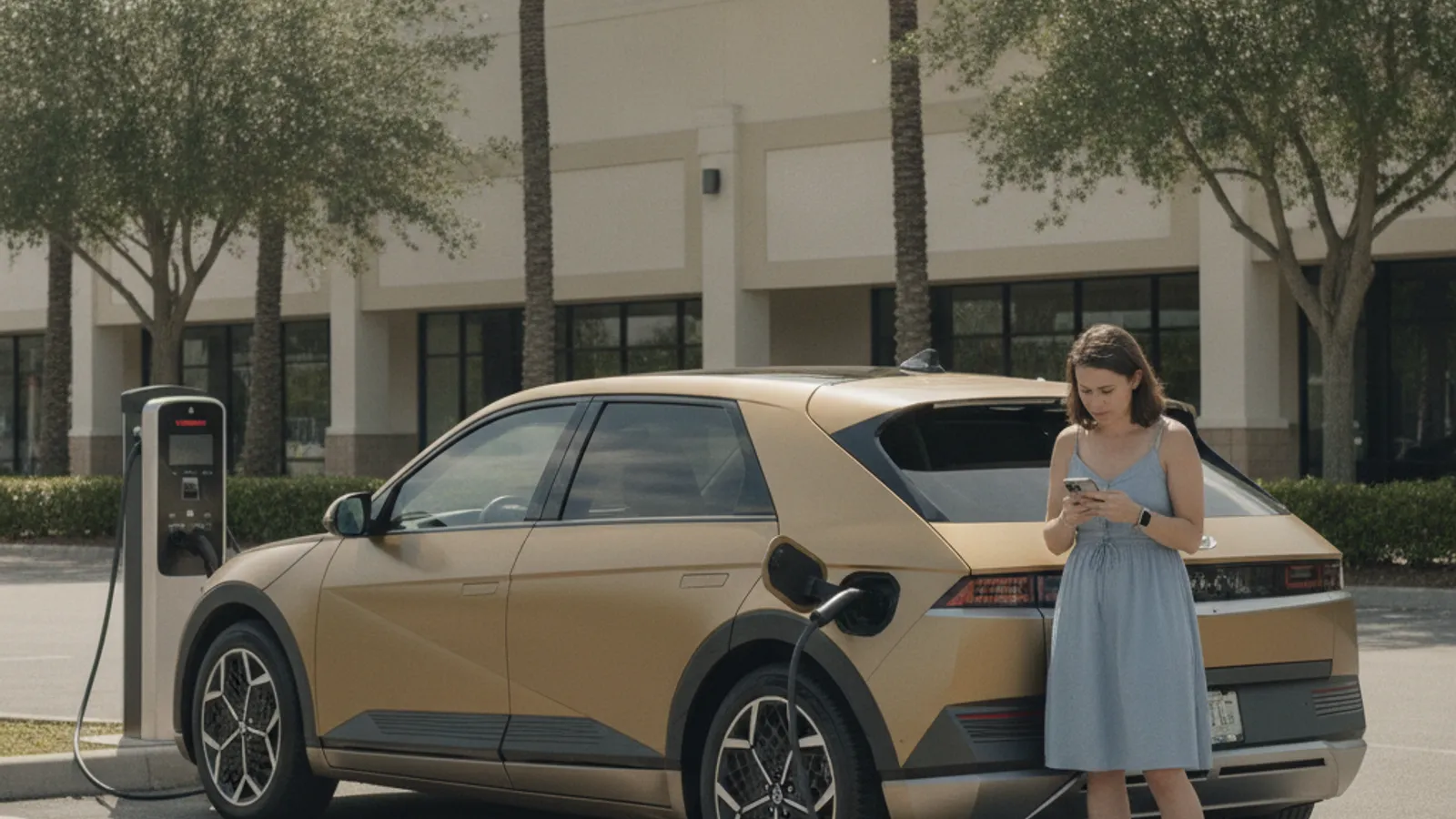
Start with the stall, not the next city
This usually hits on Ulmerton Road, US-19, East Bay Drive, Missouri Avenue, or Seminole Boulevard. Those are Largo’s commercial spines. Errands stack there. Air conditioning spends range there too.
Do the physical checks first. Pull the connector all the way out. Look at the pins for grit or a bent contact. Seat it again until it clicks. A half-seated CCS or NACS plug is the usual culprit. A loose seat is why a lot of sessions never start.
Then move one stall over if a post is free. Cabinets often feed more than one stall. One screen can throw an error while the post beside it still works.
Open the network app on your phone. Force-close it. Start the session from the app, not the kiosk. ChargePoint, EVgo, and Electrify America all handshake through that phone link. A frozen screen is often software, not a fried cabinet.
If the stall already shows unavailable before you plug in, believe it. Check the network’s own status page. Try a second card or an RFID fob once. A declined payment looks exactly like dead hardware.
Give that sequence a few minutes. Then stop. Sitting in the lot while the estimate ticks down isn’t a plan.
Largo’s utility and housing shape this problem
Largo is a large central-Pinellas city. ACS 2019-2023 puts the population at 82,506. The 2024 Census estimate is 82,337. The land area is 18.63 square miles of flat ground. Hills won’t give range back here. Heat and AC set the story. Recurrent Auto’s published research finds an EV loses about 5 percent of range at 90°F. Loss climbs to 20 to 30 percent above 95°F. It’s roughly 17 to 18 percent near 100°F. The effect varies by model. Credit Recurrent for those figures, not a carmaker.
A lot of Largo housing is older. ACS 2019-2023 puts 22.1 percent of units built before 1980. That stock is a rough signal that a 240-volt home circuit isn’t a given. Renters and condo owners add another layer. Florida Statute 718.113(8) gives a condominium unit owner the right to install a charging station. It has to sit in their limited common element or exclusive parking space. A board can’t deny a properly submitted request. The owner still pays for the install, the meter, and the power. Until that work is done, those drivers live on public stalls. Apartment renters are in the same spot.
Duke Energy Florida serves Pinellas County. In 2025 it launched three EV programs: the Charger Prep Credit, the Off-Peak Charging Credit, and Fleet Advisory. The Charger Prep Credit is a one-time credit toward wiring and electrical upgrades for a Level 2 charger, for homes and businesses. It doesn’t cover the charger hardware or permit fees. The Off-Peak Charging Credit is a residential monthly bill credit for charging in Duke’s published off-peak windows. Confirm the current credit and the current windows with Duke before you count on them. None of those programs help you in a shopping-center stall that won’t authenticate.
Florida has no state EV purchase rebate. The programs that exist are utility programs. Under SB 28, battery-electric vehicles also pay an extra annual registration fee starting January 1, 2026. That fee doesn’t buy you a working public post.
So the Largo pattern isn’t mysterious. Fleet EVs sit in the Ulmerton light-industrial belt. Apartment and condo drivers hunt public plugs. Older houses skip a home Level 2. When a stall fails, those drivers don’t have a home charger waiting in the driveway. The same is true on the Belleair edge, in Ridgecrest, and in Harbor Bluffs. Largo Central Park and the Pinellas Trail are where people spend a Saturday, not where a dead kiosk gets fixed. Home power is Duke’s domain. A dead public post is still your problem in the lot.
What a failed public session usually is
Tesla Superchargers are a closed loop. Tesla builds, owns, and services that hardware. ChargePoint, EVgo, and Electrify America often sit on a split model. A property owner buys the cabinet. The network runs software and billing. When something breaks, two companies can point at each other. A repair can sit.
The cable itself takes a beating. Dozens of drivers a day yank the same connector, drop it, and jam it. Pinellas heat cooks the electronics. Salt air works on contacts. That’s wear, not a mystery.
The other failure is quieter. A DC fast charger has to reach a server to start billing. If that link drops, a mechanically fine stall still won’t start. Restarting the app is how you test that, before you assume the hardware is junk.
If the kiosk says connected and still won’t add energy, that’s a different failure. Our write-up on a public charger that says connected but won’t charge walks through that handshake.
Lightning is part of the climate here too. Vaisala’s network data puts Florida among the most lightning-prone places in the country. A storm can knock a cabinet offline without leaving a mark you can see. Treat a dark stall after a cell as down until the app says otherwise.
Confirm the next stall before you roll
Don’t trust the in-car map as your only source. Open PlugShare, or the network’s own app, and read recent check-ins. Driver reports often flag a dead post before the car’s software does. Our list of charging apps to check before you’re stranded is the order to use while you’re still parked.
If you’re in a Tesla and the Supercharger you wanted is down or full, treat that as its own problem. The steps are in Supercharger down or full. Some Supercharger sites now take non-Tesla cars at Magic Dock stalls. Check the Tesla app for that stall type before you write the site off. Don’t assume every site has one.
Clearwater sits on Largo’s north edge. Seminole, Pinellas Park, and Dunedin wrap the rest of the city. A failed stall in Largo isn’t a reason to drive those cities on a guess. Confirm a live session in the app first. The Clearwater playbook is in public charging in Clearwater failed. Stay in the lot while you do this. A parked car with a plan is safer than a rolling search on a thin estimate.
Low range is a different problem than a dead stall
If you still have a comfortable buffer, a confirmed hop to another station can make sense. If you’re already in the low teens or worse, the remaining-miles number is an estimate, not a promise. Tampa Bay is flat, so grade won’t give range back. AC will take it. Ulmerton traffic will take it. Heat will take it the way Recurrent describes.
Chasing a rumor of a working plug is how a kiosk error becomes a shoulder stop. Florida Statute 316.194 treats a disabled vehicle on the paved highway as an exception to the usual no-stopping rule when you truly can’t get off the roadway. That’s the legal shape of a dead EV on US-19. It isn’t a comfortable place to wait.
On the interstates, FDOT Road Rangers in District 7 can be reached by dialing *347. They patrol I-4, I-75, and I-275, plus the airport interchange. Published services include flat-tire help, a 12-volt jump, fuel, two local calls, and moving a disabled vehicle to a safer spot. The materials we reviewed don’t list charging an EV. Use them for safety and a jump. Don’t expect a pack fill from that patrol.
Florida Highway Patrol Troop C handles disabled vehicles on those same interstates. Florida 511 is the traffic feed. None of that replaces a working charge.
If the car won’t wake at all, you may not have an empty pack. You may have a dead 12-volt. That’s a different rescue. A public charger won’t close contactors that a 12-volt battery can no longer hold.
When you should stop hunting and call for a charge at the bumper
Call for a mobile charge instead of another station when any of these are true.
You’ve already tried two stalls, or two networks, at this lot, and nothing starts.
Your remaining range is already tight, and you can’t confirm a live stall before you move.
You have a clock. A shift, a pickup, a slot you can’t slide.
You don’t want to keep circling Ulmerton or US-19 after dark, or in an unfamiliar lot, while the estimate drops.
That’s the job mobile EV charging is built for. Charge Pro TPA is a referral line. We match you with an independent local operator. We don’t own trucks. We don’t set the price. The operator quotes you before work starts and bills you directly.
What the operator brings is a 240-volt Level 2 source to the car. Teslas take a native NACS plug. Other brands use a CCS or J1772 adapter. A typical session adds 10 to 20 miles of range in 15 to 30 minutes of charging time. That’s charging time, not a promise of when someone arrives.
If the stall was never the real problem, you may have a dead 12-volt, or a pack that won’t take charge. For Largo routing on US-19 and Ulmerton, start with EV roadside assistance in Largo. The city page for charging context is EV charging in Largo.
Private lots still follow Florida Statute 715.07 on tows from private property. Signage rules and storage-radius rules sit in that statute. Pinellas County caps non-consent tow rates by ordinance. Confirm the current cap with the county before you argue a bill. Getting charged in place is usually simpler than a tow if the car can take energy.
Hurricane season makes this sharper. Helene in late September 2024 drove record surge at Tampa Bay gauges. Milton in early October 2024 dropped heavy rain on Pinellas. Federal and fire-service guidance warns that an EV soaked in salt water needs inspection before it sits near structures or other cars. If your stall failed after a storm, treat water in the port as its own stop. Don’t keep forcing a wet connector.
Make the call before the pack is a guess
A dead public charger isn’t on you. If you’ve reseated the cable, tried the next stall, and restarted the app, you’ve done the useful work. Call before the remaining miles become a story you tell from the shoulder.
Call (813) 536-4545. Charge Pro TPA will connect you with an independent operator who can bring a charge to the lot you’re already in.
Frequently asked questions
Why does a Largo public charger refuse to start?
Loose connectors, a dropped network handshake, a payment that won’t clear, or a stall that’s actually broken. Work the cable, the next stall, and the phone app before you leave the lot.
How do I tell if it’s the charger or the car?
If the same car charges at home or at a different public site, the fault is almost always the stall or the network. A true vehicle fault usually throws a message on your own dash.
Can a mobile operator charge a non-Tesla at a dead public stall?
Independent operators in this network bring a CCS or J1772 adapter and a 240-volt source. You stay parked. You don’t have to find another working kiosk first.