The public stall is occupied, and your session never started. That’s when EV roadside assistance in Clearwater matters. Don’t hunt the next pin on the last miles.
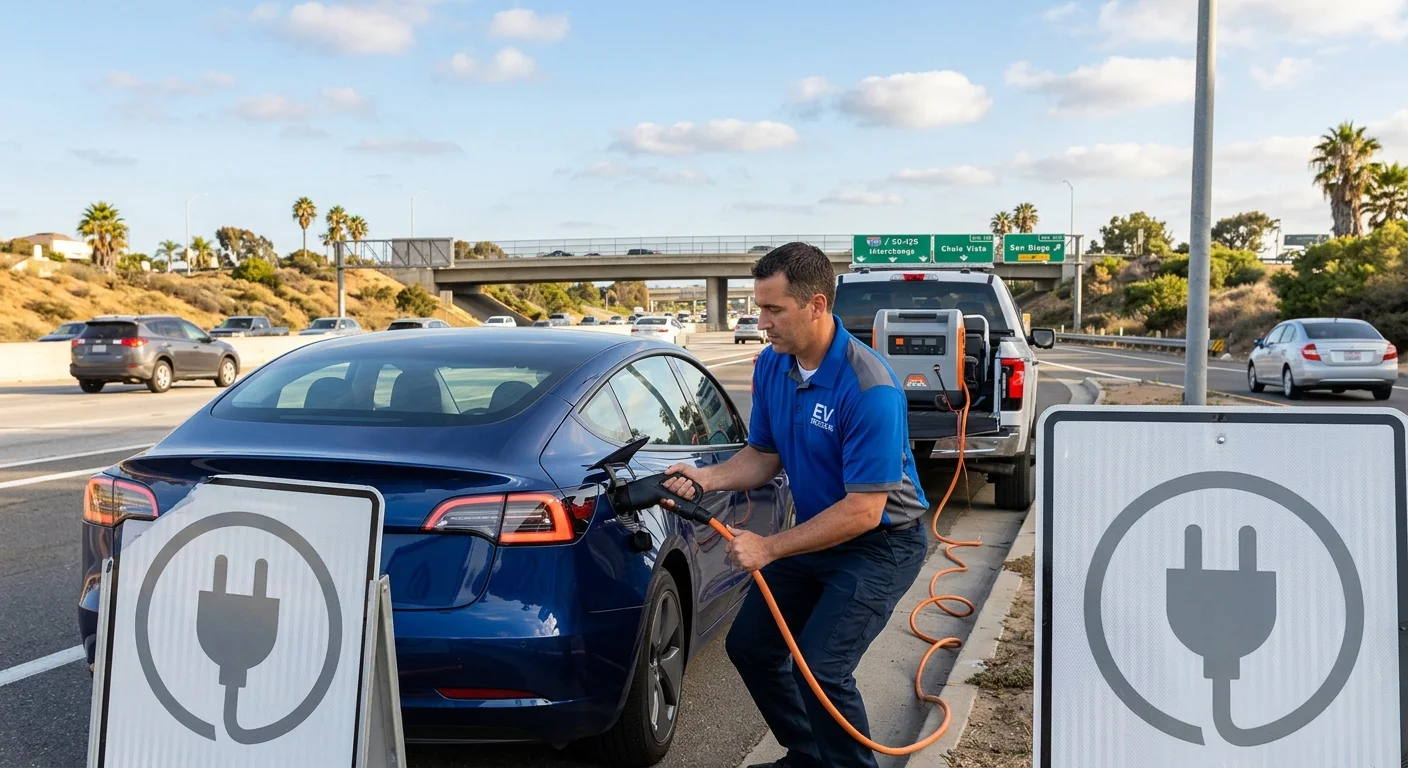
Why a Clearwater stall fails on a real trip
ACS 2019-2023 counts 117,075 people in Clearwater. The mainland and the barrier islands aren’t the same trip. Heat, humidity, and cabin AC cut range here. Recurrent Auto’s published research finds about 5 percent range loss at 90°F. Above 95°F the same work finds 20 to 30 percent. A beach afternoon with climate control running spends that margin.
You might have aimed at a stall near Clearwater Beach. Downtown by Coachman Park is another common stop. So is a visit to the Clearwater Marine Aquarium. The listing looked fine in the app this morning. Status, access, and hardware still change without notice. Charge Pro TPA doesn’t run those stalls. We don’t confirm Tesla’s live map for you. Tesla’s current official tools are the source for Supercharger status. Other networks publish their own apps. Check the listing that’s live now.
Duke Energy Florida serves Pinellas County. Home programs include the Charger Prep Credit and the Off-Peak Charging Credit. ACS 2019-2023 shows 28.6 percent of housing here was built before 1980. That older stock is a weak fit for a 240-volt circuit. Beach condos add another limit. Florida Statute 718.113(8) covers condo charging rights. A unit owner may install a station in exclusive parking or a limited common element. The board can’t block a properly submitted request. The owner still pays for install, operation, insurance, and separately metered power. Until that work exists, public stalls cover a lot of overnight charging. When one of those stalls fails, you aren’t almost home. You’re stuck in the space.
Read the stall before you leave the space
Keep the car parked. Don’t start a new route on a guess. Read the charger screen and the screen in the car. Save the exact wording.
Confirm you’re at the pin you selected. Property names repeat along US-19. A connector in the next aisle isn’t automatically the unit in your listing. If a second stall is open, follow the instructions on that unit. Don’t force a damaged handle. Don’t pry a locked cable.
A connected plug that never starts a session is a common stall. See our note on a public charger that says connected but won’t charge. It walks through the usual checks. Separate a station fault from a vehicle fault before you drive.
Write this down before you call anyone:
- Remaining pack percentage shown by the car
- Exact error text on the stall or the dash
- Whether the charge port opens and latches
- Whether the car powers on and shifts
- Any gate, time limit, or customers-only sign you can see
- How long you’ve already sat in the space
That last line matters in a private lot. Florida Statute 715.07 covers tows from private property. An owner or lessee can remove an unauthorized vehicle. Required signs must be posted for that process. Pinellas County caps non-consent tow rates by ordinance, including Ordinance 19-39. Current maximum dollar figures weren’t confirmed against the live schedule. Posted tow-away lots aren’t waiting rooms. A dead stall in one of those spaces is a towing risk.
Mainland, beach, or the causeway
Clearwater covers 26.175 square miles. Your next move depends on which piece you’re in. Downtown Clearwater, Countryside, Island Estates, Sand Key, and Clearwater Beach aren’t interchangeable. Largo, Dunedin, Safety Harbor, and Palm Harbor sit close on a map. Close on a map isn’t the same as reachable. The energy you have left is the real limit.
Name the corridor you’re on. US-19 is the north-south spine. SR-60, Gulf-to-Bay Boulevard, runs toward the Courtney Campbell Causeway and the beach. Drew Street and McMullen-Booth Road help a dropped pin. The Memorial Causeway is the beach run. An operator who only hears Clearwater still has to guess. Say whether you’re on the island or the mainland.
If you’re already on the Courtney Campbell Causeway with a failing pack, stay put. Don’t invent a new public stop from the span. Read our guide for an empty EV on the Courtney Campbell Causeway. It covers how to stay put and describe the span. Florida Statute 316.194 covers disabled vehicles on the traveled way. You’re allowed to stop there when you can’t get off the pavement. A dead EV on a shoulder fits that exemption. Move occupants to a safer spot if traffic allows. Call 911 if anyone is in immediate danger.
District 7 Road Rangers patrol I-4, I-75, and I-275. You reach them at *347. Their published list includes fuel, a 12-volt jump, and tires. They can also move a disabled car to a safer place. It doesn’t list charging an EV. Use them for traffic safety on those interstates. Don’t treat *347 as a mobile charge. US-19 and Gulf-to-Bay aren’t those patrol routes.
Hurricane season adds a second clock. Helene in late September 2024 pushed record surge at Tampa Bay gauges. Pinellas barrier islands were closed. Clearwater Beach, Sand Key, and Island Estates sit in that surge and evacuation pattern. Milton in early October 2024 largely spared Pinellas a second catastrophic surge. If an evacuation order is live, don’t shop for another public plug. Federal and fire-service guidance warns about saltwater-soaked EVs. They can be a delayed fire risk. Keep a flooded car away from structures and other vehicles until it’s inspected.
Stop hunting when the margin is gone
Another listing isn’t a plan. Compare the full driving route with the range the car currently shows. Tampa Bay is flat. Heat and AC are the whole range story.
If the remaining miles and the required route are too close, stay put. Rolling to zero while you search makes the roadside job harder. Confirm four things before you leave the space:
- The next site is live in the network’s current tool, not in memory
- You can name the property entrance from where you sit
- The car shows enough energy for that whole drive
- You still have a backup if that site also fails
If any item is fuzzy, request help. Mobile EV charging is the referral for a car that needs energy. Some cars need transport instead. An operator decides that after seeing access, warnings, and the vehicle. Out-of-charge recovery is the referral path for that conversation.
Don’t guess how many miles the truck will add. Don’t guess how long the charging portion will take. The independent operator quotes you before work starts. The operator bills you directly.
What a mobile Level 2 does at the bumper
The pros we connect you with bring a 240-volt Level 2 source. It meets the car where it sits. Tesla owners get a native NACS plug. Other brands use a CCS or J1772 adapter. A typical session adds about 10 to 20 miles of range. That takes 15 to 30 minutes of charging. That’s charging time, not an arrival time. Charge Pro TPA doesn’t promise when someone shows up. We don’t own the trucks. We don’t employ the technicians. We match you with a licensed, independent local operator.
That bump is often enough to leave a failed stall. Then you can reach a site you’ve verified as live. If the 12-volt battery is the real problem, pack charging won’t help. Operators can jump or replace a dead 12-volt on site. That covers Tesla and other major EV brands. If screens are dark and doors are fussy, say so. Our walkthrough of how a mobile EV charging truck works shows the difference. A pack top-off and a 12-volt rescue aren’t the same job.
Tell the operator where you actually are
Start with a dropped pin. A copied charger address is a weak substitute. Say whether you’re on Clearwater Beach, Sand Key, Island Estates, downtown, or Countryside. If you’re on US-19 or Gulf-to-Bay, give direction of travel. Mention a visible property name, a garage level, a gate, or a height bar.
Then describe the car without diagnosing it:
- Make and model, if you know them
- Remaining percentage on the display
- Exact warning text
- Whether the car powers on and shifts
- Whether the charge port opens
- Whether a connector is still latched
- What happened on the last charging attempt
- Whether you need enough range to reach a verified stall, or another recovery option
Send a screenshot if the operator asks. Don’t touch damaged equipment to make a better photo.
The city page for EV charging in Clearwater helps when you’re planning the next trip.
Charge Pro TPA is a referral line. The customer contracts with the operator. Confirm price, scope, and access with that operator before you authorize work.
When to pick up the phone
Call when the stall in front of you won’t start a session. Call when the remaining energy can’t cover a verified backup. Call when you’re on the Memorial Causeway and further driving is a hope. The same is true on Island Estates or Sand Key. Call when a 12-volt warning has the car locked or dark.
Call (813) 536-4545. We’ll connect you with a local EV rescue operator.