A dead EV on a Lealman curb often started as a home charging problem. This unincorporated Pinellas community has the oldest housing in our Tampa Bay scope. ACS 2019-2023 figures put 56.6 percent of homes as built before 1980. Small lots, street parking, and 120-volt outlets are the daily pattern. When the pack is empty, you need a different kind of help. The same is true when the 12-volt dies in the heat. EV roadside assistance is how the car moves again.
Why Lealman’s housing stock changes the call
Lealman covers about four square miles. About 21,026 people live here per ACS 2019-2023. The housing age is the fact that shapes EV life. A renter on a small lot near the Kenneth City edge rarely controls the panel. An owner on an older block toward Rio Vista may still have original service.
Look at the contrast across Tampa Bay. St. Petersburg’s pre-1980 share is 51.5 percent. Lealman is older still at 56.6 percent. Lakewood Ranch is 0.7 percent. Fish Hawk is 0.8 percent. Westchase is 1.0 percent. Those planned communities were wired for a wall charger. Inner Pinellas wasn’t. A 240-volt circuit is possible here. It isn’t the default.
Duke Energy Florida serves Pinellas County. Duke publishes a Charger Prep Credit. It applies to the wiring and electrical upgrades a Level 2 charger needs. The credit doesn’t cover charger hardware or permits. On a pre-1980 panel, that work is a licensed electrician’s job. Confirm the current credit with Duke before you plan around it. Charge Pro TPA doesn’t install chargers. We don’t hold a contractor license.
Florida Statute 718.113(8) helps a condo owner. It covers a station in a limited common element. It also covers an exclusive parking space. The board can’t deny a proper request. The owner pays for install, power, and insurance. A street-parked renter in Lealman doesn’t get that statute. Most people have a household outlet. Others use a public stall they already know.
Overnight charging is often a 120-volt trickle. Read what a Level 1 charger actually does. It can add miles. It often can’t keep up with AC season driving.
Heat, AC, and a car that sat in the sun
Tampa Bay runs air conditioning from spring into late fall. Recurrent Auto publishes range-loss research. An EV loses about 5 percent of range at 90°F. Loss rises to 20 to 30 percent above 95°F. Recurrent finds about 17 to 18 percent near 100°F. The effect varies by model. Cabin cooling is the whole range story on this flat peninsula. Grade never gives miles back.
A car that sat on 34th Street through a hot afternoon can fail two ways. The high-voltage pack may be low. Yesterday’s drive plus AC used more than the overnight trickle replaced. Or the 12-volt battery may have cooked. Then the car won’t wake at all. Those are different jobs. Name the symptom when you call.
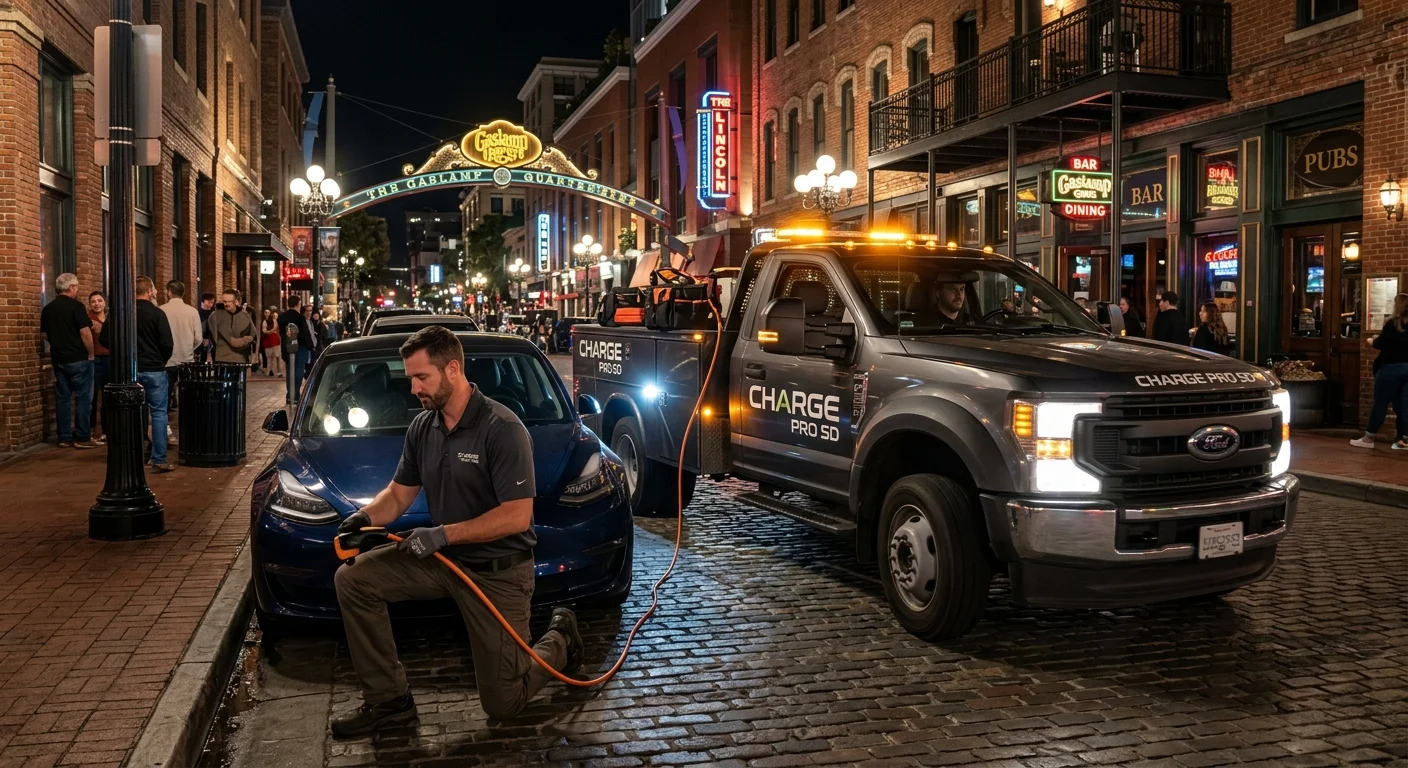
Dark screens, dead door handles, and a silent computer usually mean the 12-volt. A car that powers up and shows zero miles means the pack. Operators in the network jump or replace a 12-volt on site. They also bring a 240-volt Level 2 source. Native NACS for Tesla. CCS or J1772 adapters for everyone else. Typical charging time is 15 to 30 minutes. That often adds about 10 to 20 miles of range. That’s time on the plug, never a promise of when someone arrives.
US-19, I-275, and the inner Pinellas grid
The corridors through Lealman are US-19, I-275, 54th Avenue, and 34th Street. A stall on US-19 is public, hot, and loud. Get the car as far right as you can. Turn the hazards on. Occupants stay with the vehicle if the shoulder is thin.
Florida Statute 316.194 covers a disabled vehicle on I-275. You may stay on the paved part when you can’t get it off. FDOT Road Rangers in District 7 patrol I-275. Dial *347. They publish jump-starts, tire help, fuel, and water. They also offer two local calls and a move to a safer spot. The Tampa Bay SunGuide Center runs that district. The published list doesn’t include charging an EV. A Ranger jump may restore a 12-volt. It won’t refill a pack.
Florida Highway Patrol Troop C handles interstate incidents here. Florida 511 is the traffic feed. Use both if you’re blocking a lane. Then you still need a mobile EV charging operator if the pack is empty.
Apartment lots and curb spots are the quieter version of the same call. Older central-Pinellas blocks often have street parking, not a garage. You park on the street or in a tight lot. A rescue operator can work at the bumper there. You don’t have to push the car to a charger. Pinellas County sets non-consent tow caps by ordinance. Confirm the live rate with the county or the tower. Florida Statute 715.07 governs private-property tows. Signs have letter-size rules. Pinellas storage must stay within a 10-mile radius. A hook is the long path for a car that only needed miles.
What a roadside charge is for
Out-of-charge recovery is a top-off so you can drive. It isn’t a full fill. The operator quotes before work starts and bills you directly. Charge Pro TPA is a referral line. We own no trucks, employ no technicians, and set no prices. We match stranded drivers with independent local operators across Tampa Bay, including Lealman.
Use a roadside charge when the pack is too low. You need enough miles to reach a charger you already trust. Use it when the 12-volt is dead and the car won’t go into drive. Use it on a curb, in a lot, or on a shoulder. A tow is usually the worse option.
Skip a roadside charge, and call a shop, when the car was in salt water. Hurricane Helene in late September 2024 drove record surge at Tampa Bay gauges. Federal and fire-service guidance warns about salt-soaked packs. A lithium pack can be a delayed fire risk. Keep that vehicle away from buildings and other cars until it’s inspected. Milton hit in early October 2024. It dropped at least 18 inches of rain on parts of St. Petersburg. Standing water in a charge port is a dry-and-inspect problem, not a force-charge problem.
The daily habit and the emergency top-off are different jobs. Home 240-volt charging versus a roadside charge lays out the split.
Neighbors, public plugs, and what we won’t guess
Lealman sits against Pinellas Park, St. Petersburg, Largo, and Seminole. Drivers here often already have a public stall they use in one of those cities. We won’t invent a nearest charger. Open the app you already use. Confirm the stall is online. A Level 2 truck add is often enough to reach that stall. It can also get you home to the 120-volt outlet you actually have.
Duke’s Off-Peak Charging Credit is a residential bill credit. It applies when you charge in Duke’s published off-peak windows. Confirm hours and the current credit on Duke’s site. TECO’s Drive Smart program is a commercial and public charger incentive. Lealman is Pinellas, so start with Duke unless your bill says Tampa Electric.
Florida has no state EV purchase rebate. Utility programs are the local layer. A panel upgrade remains on you and a licensed electrician. That’s a separate path from a rescue call.
If you drive south into the peninsula core, help looks similar. EV roadside assistance in St. Petersburg covers the city that borders this community. Local context for this place lives on the Lealman EV charging page.
What to have ready before you call
Make the call useful. The operator needs the pin, the port type, and the symptom.
Tesla or not, and NACS, CCS, or J1772. Zero on the display, or a car that won’t wake. Nearest named road: US-19, 54th Avenue, 34th Street, or a cross street. Curb, lot, or interstate shoulder.
Stay out of the travel lane. If you’re on I-275, *347 still helps with traffic. EV charging isn’t on the Ranger list. Vaisala’s lightning data puts this metro among the most lightning-prone in the country. Wait in the car if a storm cell is on top of you. Don’t stand at the bumper with a cable in the rain.
Charge Pro TPA serves Lealman and the rest of Tampa Bay as a matchmaker. We’re not the crew on scene. When you want an operator quoted, call (813) 536-4545. The quote comes first. The operator bills you.