Use a confirmed EV rapid charger near me if the car can still reach it. Tampa Bay heat burns range while you hunt that pin. Cabin AC runs from spring into late fall here. The metro is flat, so grade never gives miles back. Confirm a DC stall you can actually reach. If you can’t reach it, stop somewhere legal. Treat a mobile Level 2 charge as the backup.
Heat already spent some of those miles
Recurrent Auto’s published research finds about 5 percent range loss at 90°F. Loss jumps to 20 to 30 percent above 95°F. Recurrent also reports roughly 17 to 18 percent loss near 100°F. Results vary widely by model. Don’t treat that as a Tesla number. It’s Recurrent’s dataset.
Your dash estimate often hasn’t fully priced the AC load. Every extra garage loop spends miles you thought you had. So does a crawl on I-275. Read the Tampa Bay low-battery guide before you burn the last buffer.
Westchase, Fish Hawk, and Lakewood Ranch owners often start from 240-volt home charging. Home Level 2 is near-universal on those newer streets. Lealman and St. Petersburg hold much older stock. Pinellas condo owners can install in an exclusive space under Florida Statute 718.113(8).
Confirm the stall before you spend the miles
A map result is a lead. It isn’t a working cabinet. Access rules, connector type, and live status change. Open the network’s own app or site first. Then compare that with the car’s navigation.
Check these before you commit remaining range:
- The connector matches this vehicle, not a generic EV icon.
- The operator reports the stall as available right now.
- You can enter the property, garage, or lot when you arrive.
- The cabinet isn’t limited to customers, residents, or employees.
- The car still predicts enough energy for the full approach.
- You’ll see the current session price before you start.
The U.S. Department of Energy charging guide lists CCS, CHAdeMO, and J3400 as DC fast connectors. Your car may not take every one. An adapter doesn’t make every cabinet compatible. Follow the vehicle maker’s current guidance.
Live occupancy is a signal, not a hold. Another driver can take the stall while you’re still on I-4. A cabinet can show online while the screen, cable, or payment reader is dead. If you’re still planning, open more than one source. Our note on charging apps to check before you’re stranded is the local checklist. Save a second compatible option along the same route.
The route can be longer than the pin
Straight-line distance doesn’t tell you if you’ll make it. Chargers here sit on both sides of water, toll lanes, and elevated decks. You have to look at the actual approach.
A downtown Tampa pin can sit on a street or inside a garage. Confirm the entrance, the height limit, and the way back out. THEA’s Reversible Express Lanes are about 10 miles of elevated deck between Brandon and downtown. There’s no local surface shoulder on that segment. Westbound into downtown runs from about 5 a.m. to noon, then the lanes flip. THEA clears every vehicle first. A Brandon listing doesn’t help while you’re up there. If that’s where the pack is dying, read out of charge on the Selmon reversible lanes.
I-275 across Tampa and Pinellas is a dense, high-speed search. Count the exit, the ramp, and the return. The Sunshine Skyway is about four miles of bridge with a 432-foot main span. There’s no place to stop and hunt. FHP closes the span when sustained winds hit 40 mph. It also closes when fog drops visibility below about 100 feet.
The Suncoast Parkway is a long, fast run north through Pasco. Exits are widely spaced. Veterans Expressway drivers get the same all-electronic, SunPass rhythm. Florida 511 will show the backup. It still won’t charge the car.
Tampa International Airport publishes free EV charging at on-airport garages and the cell phone lot. Confirm the current layout on tampaairport.com. A car that sits a week and won’t wake is often a 12-volt issue. Our TPA charging note covers that garage scene.
After Hurricane Helene’s 2024 surge, treat listings as stale. Milton’s rain on St. Petersburg did the same. Confirm live status in the operator’s own app.
Make sure the car can still accept a charge
Treat the dash range as an estimate. Add garage ramps, toll plazas, and the last turn into the lot. If the route leaves no buffer, stop hunting. Keep driving and you may convert a warning into a stopped car.
First, check whether the EV is behaving normally. A reduced-power alert can mean a public stall won’t help. So can a charging-system fault or a locked charge port. Read the exact message. Check the owner’s manual. Don’t guess from a dark screen that the traction pack is empty. A dead 12-volt can look the same from the driver’s seat.
When you arrive and a stall fails, note the screen message. Try another compatible stall only if you can do it safely. Then stop bouncing between uncertain cabinets with almost no energy left.
If no reachable, compatible stall remains, stop hunting a farther pin. Move to a legal, safer spot if the car can still roll. Florida Statute 316.194 covers a disabled vehicle on the paved shoulder. You can stay there when you can’t get off the roadway. Stay out of live lanes. Put the hazards on. Don’t push the car without guidance.
What Road Rangers publish, and what they don’t
FDOT Road Rangers in District 7 patrol I-4, I-75, I-275, and the airport interchange. You reach them by dialing *347. Published help includes a jump-start, a tire, fuel, and water. The Tampa Bay SunGuide Center is the District 7 traffic desk. Florida Highway Patrol Troop C covers disabled vehicles on the interstates here.
The free state patrol carries fuel and can jump a 12-volt battery. Its published services don’t include charging an EV. That’s an observed gap in the materials we reviewed. If you’re in a travel lane, call 911 first.
When a mobile charge is the better next step
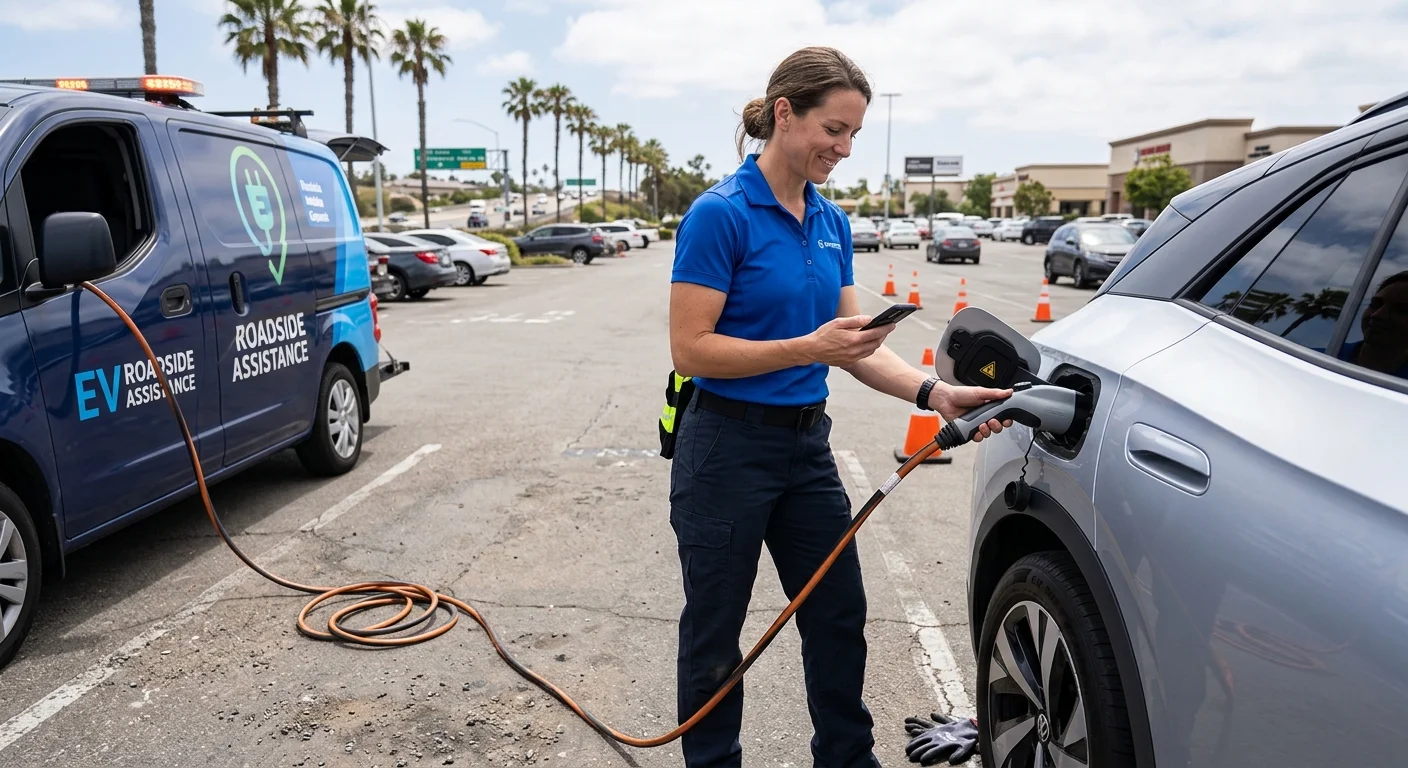
Mobile charging can fit when the car is parked safely. It also fits when the traction pack is low. The usual goal is enough range to reach a confirmed public stall.
The pros we connect you with bring a 240-volt Level 2 source to the bumper. Tesla gets a native NACS plug. Other brands use a CCS or J1772 adapter. Typical charging time is 15 to 30 minutes. That’s about 10 to 20 miles of range. That’s charging time, never an arrival time. The operator quotes you before starting and bills you directly. Charge Pro TPA doesn’t own trucks, set prices, or do the work.
Before you request mobile EV charging, gather what the operator needs:
- Year, make, and model.
- The exact dash message.
- The displayed percentage, if you have one.
- The visible port: NACS, CCS, or J1772.
- A precise pin, not “near Westchase” or “downtown Tampa.”
- Gate, garage height, or HOA access limits.
- Whether the car can shift, steer, and unlock.
“On I-75 north of Wesley Chapel” isn’t enough. Give direction, nearest exit, and a pin when it’s safe. See how a mobile EV charging truck works for the equipment at the bumper.
Mobile charging may not fit when the car won’t accept power. It also may not fit when the port is damaged. Describe symptoms. Don’t diagnose the pack from the driver’s seat. The independent operator confirms whether a charge even applies.
When a move is safer than a charge
Transport can fit when charging won’t fix the immediate problem. That includes a car that won’t accept a charge. It also includes a port that won’t open, or visible collision damage. It can also be safer when the car already stopped in a bad place.
If every verified compatible stall sits beyond remaining range, don’t keep rolling. The pin can look close and still be the wrong route. Ask about out-of-charge recovery. Charge Pro TPA doesn’t tow, set the operator’s price, or warrant the job. Confirm the proposed service, current price, timing, equipment, and destination before you agree.
Follow the vehicle maker’s towing steps. Tell the operator whether the car can enter transport mode.
Call when the stall isn’t one you can reach
Call when the EV can’t safely reach a confirmed rapid charger. A mobile session might still fit. We’ll connect you with an independent local operator. That operator handles Tesla and every major EV brand. That includes a 12-volt jump or replacement on site when that’s the real fault.
Call (813) 536-4545. We’ll match you with a local EV rescue operator. You pay them, not us.