When a Tampa Bay EV dies on the road, EV battery types that matter aren’t chemistry labels. They’re the traction pack and the 12-volt system. Mobile rescue here brings 240-volt Level 2 to the bumper. It’s not a DC fast stall on wheels.
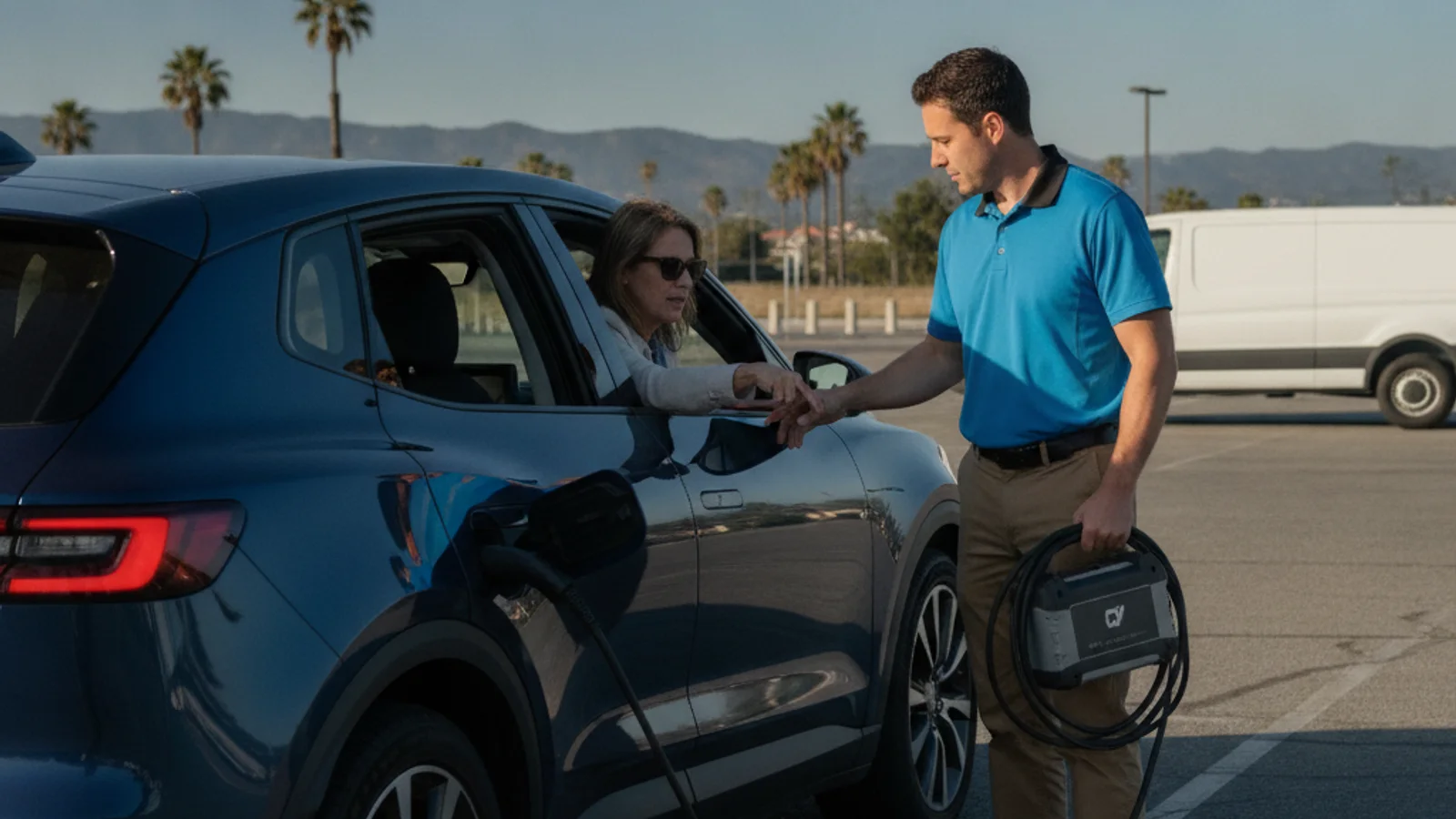
The pack that drives, and the battery that wakes the car
Every EV carries two battery systems. They never do the same job.
The traction battery stores the miles. Drivers also call it the main pack. That’s the battery you charge at home or at a public stall. It’s the percentage on the dash. When that pack is empty, the car needs energy.
The 12-volt battery doesn’t turn the wheels. It runs computers, locks, lights, and screens. It also runs the relays that connect the pack. If it fails, the car can go dark. The traction pack can still be full underneath.
That split decides the call. An empty pack is an energy problem. A dead 12-volt is a low-voltage problem. Some models allow a manufacturer-approved jump. Others don’t. The model year decides that, not the cell chemistry.
Charge Pro TPA is a referral line. It matches stranded drivers with independent local operators. It doesn’t perform the work. It owns no trucks. The operator quotes you before starting. You pay that operator directly.
Chemistry is a buying question, not a roadside one
Forums argue about nickel manganese cobalt and lithium iron phosphate. Those labels shape how a pack ages at home. They don’t change what happens on I-275 tonight.
An operator isn’t reading cell chemistry over the phone. They want the make, model, and year. They want the exact dash wording.
We have no verified figures here for pack size, pack voltage, or cell mix on any model. If you need those numbers, open the current owner’s manual.
Heat, sitting cars, and the Tampa Bay tells
This metro is flat and near sea level. Grade never hands range back. Heat and air conditioning are the whole range story. Tampa Bay runs a long AC season from spring into late fall.
Recurrent Auto’s published research finds an EV loses about 5 percent of range at 90°F. Losses rise to 20 to 30 percent above 95°F. Near 100°F, the loss is roughly 17 to 18 percent, and it varies by model. An empty pack after a gulf-coast day is a traction problem.
A car that sat is often the other problem. Tampa International Airport publishes free EV charging at on-airport garages and the cell phone lot. Level 1 J1772 sits on the first floor of the Economy Garage. Level 1 is also in the Long-Term Parking Garage. Level 2 is at the Cell Phone Lot. Confirm the current stall layout on the airport’s parking page. We didn’t confirm an exact stall count. After a week in those garages, a car that won’t wake is almost always a 12-volt failure. It’s rarely a depleted pack.
Lakewood Ranch, Fish Hawk, and Westchase are among the newest communities in scope. 240-volt home charging is near-universal there. Older housing in Lealman and St. Petersburg is a different mix. Many Pinellas owners live in condos. Florida Statute 718.113(8) gives a unit owner the right to install a charger in their exclusive space. The board can’t deny a properly submitted request.
TECO serves Tampa, most of Hillsborough, and parts of Pinellas and southern Pasco. Duke Energy Florida serves Pinellas and much of Pasco. Withlacoochee River Electric Cooperative serves northern and central Pasco, except the Dade City area. A north Pasco driver is often a WREC member. Don’t call TECO or Duke for that account without checking.
Hurricanes Helene and Milton in 2024 made saltwater a live issue for Pinellas and south Hillsborough. Federal and fire-service guidance warns that an EV soaked in salt water can suffer a lithium-ion fire later. Keep it away from structures and other vehicles until it’s inspected.
What the free patrol publishes
FDOT Road Rangers in District 7 patrol I-4, I-75, and I-275, plus the airport interchange. Dial *347 on a mobile phone. The District 7 center is the Tampa Bay SunGuide Center. The free state patrol carries fuel and can jump a 12-volt battery. Its published services don’t include charging an EV.
Florida Statute 316.194 lets a disabled vehicle sit on the pavement when you can’t get off it. A dead EV on a shoulder counts. Get off the travel lane when you can. Put the hazards on.
The Lee Roy Selmon Expressway’s reversible lanes are a different problem. THEA’s REL run about 10 miles elevated between Brandon and downtown Tampa. There’s no local surface shoulder on that segment. An empty pack up there isn’t a curb-side Level 2 wait. Transport may be the only safe path.
The Sunshine Skyway on I-275 is uniquely hard if you stop. The main span sits 432 feet above the shipping channel. Florida Highway Patrol closes it when sustained winds reach 40 mph. That’s four miles of bridge with no place to stop.
Private lots follow Florida Statute 715.07. Hillsborough and Pinellas both cap non-consent tows. We didn’t confirm current dollar figures against the live ordinance schedule. Confirm the posted county cap before you pay.
Give the operator the car, the year, and the exact warning
Name the make, model, and model year. Jump points and approved steps differ by manufacturer. They often differ by year inside the same brand. A Tesla frunk step doesn’t transfer to a Rivian, a Mustang Mach-E, or a Hyundai Ioniq. That’s why non-Tesla EV rescue is its own category.
Read the warning word for word. A range readout at empty, or “0 miles,” points at the traction pack. A blank screen, a handle that won’t present, or a message that names the 12-volt points at low voltage. “It just died” tells an operator almost nothing. “The screen went black and the door handle won’t present” tells them a lot.
Say what still works. Interior lights, the app, the key fob, and charge-port controls all run on 12 volts. If some of those still function and the car won’t drive, say so.
For the 12-volt failure path, read what happens when an EV 12-volt battery dies in Tampa Bay. After you’re safe, EV 12-volt replacement covers signs and the lasting fix.
Level 2 at the bumper, a jump, or a ride
Once the vehicle and the message are clear, three categories cover most calls.
Charging fits when the traction pack is empty and the car can be reached. Operators in this network bring a 240-volt Level 2 source. Native NACS plug for Tesla. A CCS or J1772 adapter for other EVs. Typical add is 10 to 20 miles of range in 15 to 30 minutes of charging. That’s charging time. It isn’t an arrival time. It isn’t a Supercharger. It isn’t a DC fast stall. See mobile EV charging. EV charging levels for stranded drivers keeps Level 1, Level 2, and DC from getting mixed.
A jump may fit when the 12-volt has failed and the manufacturer supports a jump for that model. This isn’t universal. Some EVs have a jump point behind a bumper cover or in the frunk. Confirm the steps with the operator and the owner’s manual before anyone touches a terminal. The pros we connect you with handle Tesla and every major EV brand. They can jump or replace a dead 12-volt on site when the model allows it.
Transport fits when the cause isn’t confirmed, or the car can’t be reached safely.
EV roadside assistance walks through that triage across Tampa Bay.
Confirm the rest in the manual, not in a forum
A general article can’t name your jump points. It can’t decode every warning. It can’t say whether your manufacturer allows a roadside 12-volt jump. The current owner’s manual for your exact year is the first check.
Once you’re moving again, the Tampa Bay EV charging hub is the local charging map.
If you can’t tell which system failed, say so when you call. An honest “I don’t know if this is the pack or the 12-volt” gives a better start than a guess.
Call when your EV won’t power on, won’t charge, or shows a warning you can’t classify. The matched operator will use the vehicle details and the exact dashboard message. They’ll sort charging, a jump, or transport. Call (813) 536-4545 and we’ll connect you with a local EV rescue operator.