A Tesla charge in Tampa Bay often lasts one workday. Heat and cabin AC spend miles that hills never return. Recurrent Auto’s published tests put the loss at about 5 percent at 90°F. It jumps to 20 to 30 percent above 95°F. Near 100°F the same research shows roughly 17 to 18 percent. That’s today’s remaining drive, not the pack’s whole life.
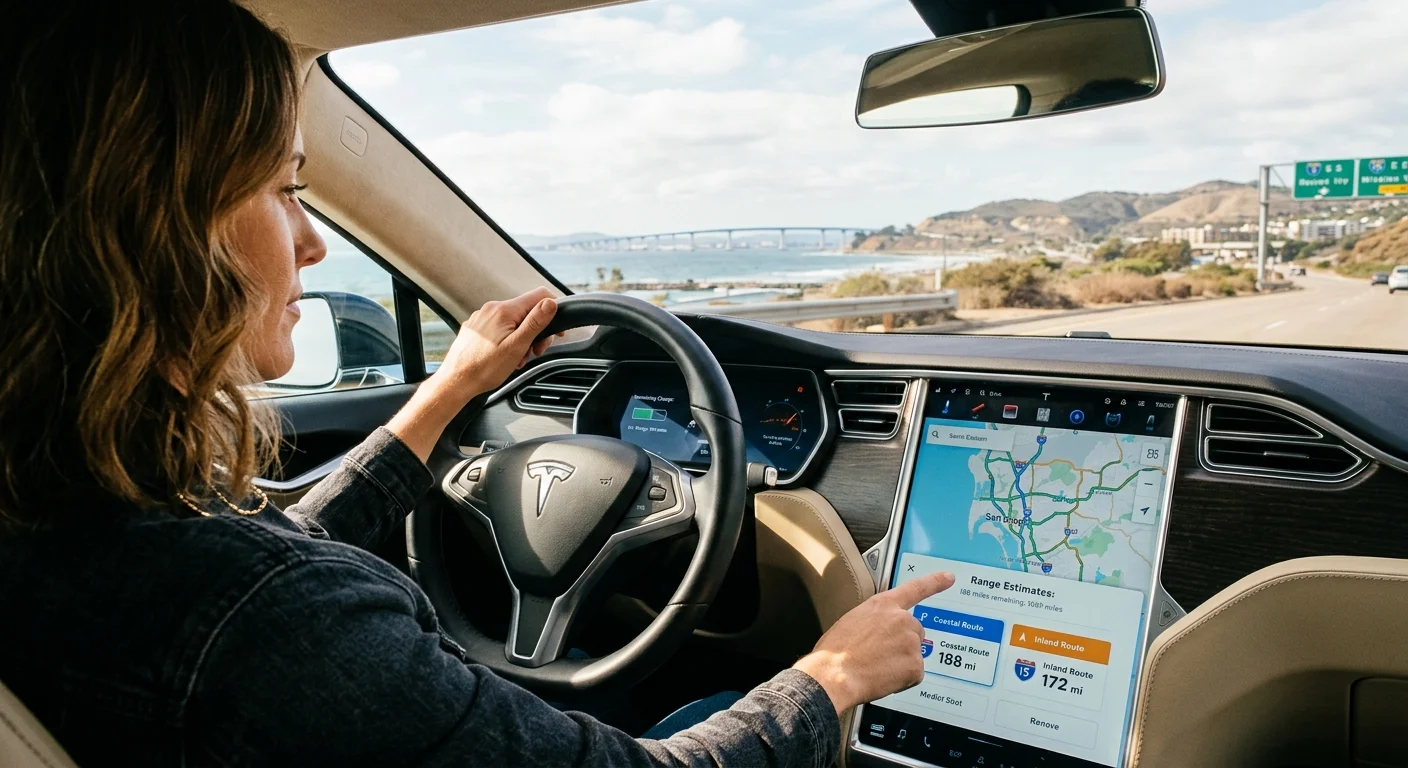
Today’s charge isn’t the same as pack life
People type how long a Tesla battery lasts in a day. They often mix two different clocks in one search. One is remaining range for this afternoon’s trips. The other is how the pack holds up over years. The daily question is the one on your dash right now. We cover the ownership clock in our Tesla pack-life guide. A low-charge Tuesday doesn’t prove the pack is dying. A healthy warranty window doesn’t get you home from Brandon.
Recurrent’s heat numbers, then months of AC
Tampa Bay’s air-conditioning season runs from spring into late fall. Cabin cooling isn’t a July surprise on this peninsula. It’s the default load on I-275, I-4, and I-75. Recurrent Auto measured those range losses in heat, not in our ZIP codes. Those are Recurrent Auto’s figures, not Tesla’s published range. We couldn’t confirm a Tesla-published daily range table for this climate. The heat effect still varies widely by model.
Gulf neighborhoods in St. Petersburg still cool the cabin all afternoon. Inland Hillsborough often feels hotter once the bay breeze fades. Brandon, Temple Terrace, and Plant City sit in that inland heat. Pasco runs on the Suncoast Parkway carry the same compressor load.
Grade never hands those miles back
This metro is flat and near sea level. There’s no long descent that restores spent cooling. East County on SR-60 doesn’t climb into a range refund. The Sunshine Skyway’s main span sits 432 feet above the channel. That’s a wind and clearance fact, not a hill that pays you back. Four miles of bridge also leave no place to stop. Florida Highway Patrol closes the Skyway at sustained 40 mph winds. Plan the crossing with margin, not leftover percent.
The Selmon reversible lanes sit in the median between Brandon and downtown Tampa. They’re a roughly 10-mile elevated segmental bridge. The Tampa Hillsborough Expressway Authority operates those lanes. Direction reverses through the day, then crews clear every vehicle. Westbound into downtown runs from about 5 a.m. to noon. After noon the same lanes run eastbound. There’s no local surface shoulder on that elevated segment. A Tesla that hits zero there isn’t a driveway problem.
Storm weeks change what a day’s charge can cover
Hurricane Helene in late September 2024 drove record surge at Tampa Bay tidal gauges. St. Petersburg faced a forecast of 5 to 8 feet. Barrier islands from the Dunedin Causeway through Tierra Verde were closed. Hurricane Milton in early October 2024 dropped at least 18 inches of rain on parts of St. Petersburg. Low-lying Pinellas and towns like Ruskin, Apollo Beach, and Gibsonton sit in evacuation zones. A day’s charge that week has to cover leaving, not only commuting.
Read the estimate against the whole Tampa Bay day
Start with the car in front of you. Note the model, the percent, and the estimated miles. Recheck that number when you add a stop. Treat the estimate as a plan input, not a promise. A review figure for another configuration isn’t your car.
Then map the actual day, not the commute headline. A Carrollwood to downtown run is one loop. Add school pickup in Town ‘n’ Country, then the drive home. The return trip is part of the same charge. So is the last stretch to a charger you can actually use. A Wesley Chapel I-75 morning looks fine until evening AC is still on. A gulf day in Clearwater still needs the drive back across the bay.
Write every destination in order before you leave. Confirm each charger through its operator or network. Connector type alone doesn’t prove the stall will work. The U.S. Department of Energy describes charging levels, not your day’s miles. Level 1 adds about five miles per hour on a midsize EV. Level 2 at 240 volts adds about 25 miles per hour. Actual speed still depends on the pack, charge state, and temperature. Those DOE figures explain why overnight charging matters. They don’t freeze how far you’ll drive today.
Where the car sits overnight changes the morning number
Westchase, Fish Hawk, and Lakewood Ranch are mostly new housing. 240-volt home charging is near-universal on those streets. Older stock in Lealman and St. Petersburg is a different wiring picture. Pinellas condos and beach HOAs often share parking. Florida Statute 718.113(8) lets a condo owner install a station in an exclusive space. The owner pays installation, operation, insurance, and metered power.
Tampa Electric serves the City of Tampa and most of Hillsborough. Duke Energy Florida serves Pinellas and much of Pasco. North and central Pasco is often Withlacoochee River Electric Cooperative. Don’t call TECO or Duke until you check the bill. A week at Tampa International Airport is a different overnight. TPA publishes free EV charging at on-airport garages and the cell phone lot. Level 1 J1772 sits on the Economy Garage first floor. Long-Term Parking lists Level 1 charging as well. Level 2 is at the Cell Phone Lot. Confirm the current layout on tampaairport.com before you count stalls. Cars that come back silent after a trip are usually the 12-volt.
Act while a charger is still in reach
If the estimate no longer covers the full loop, stop adding stops. Pick a compatible station the car can still reach. Confirm it’s online through the network that runs it. Getting near the shopping center isn’t the same as docking the plug. Count the last streets, the garage entrance, and a floor change. Don’t keep rolling toward a stall you can’t prove you’ll make. Our low-battery guide walks through that sequence. If you’re already very low, record the exact place. Note the road, direction, nearest exit, or parking level. Never stop in a live lane just to make the pin clearer.
Florida Statute 316.194 treats a disabled EV on a shoulder as a disabled vehicle. You still need a safer spot when it’s practicable. FDOT Road Rangers in District 7 patrol I-4, I-75, and I-275. They also cover the airport interchange. Dial *347 from a mobile phone to reach them. They publish flat-tire help, a 12-volt jump, fuel, and water. They can move a disabled vehicle to a safer spot. Their published services don’t include charging an EV.
The Courtney Campbell Causeway and US-19 in Pasco are long, exposed runs. The Suncoast Parkway is a fast northbound with widely spaced exits. Leave more percent for those corridors than for a short Tampa grid hop.
Charging, a mobile boost, or a tow
If usable charge remains and a station is reachable, ordinary charging is simpler. Watch the estimate the whole way to that stall. Session time is in how long a Tesla takes to charge here.
If no reachable station remains, ask whether mobile charging can meet you. Independent operators we connect you with bring a 240-volt Level 2 source. Tesla cars take a native NACS plug on that truck. Other EVs use a CCS or J1772 adapter. Typical on-site charging adds 10 to 20 miles of range. That’s 15 to 30 minutes of charging time, never travel time. The operator quotes before starting and bills you directly. Out-of-charge recovery is the referral path for an empty pack.
A silent Tesla may be a 12-volt failure, not an empty floor pack. Share the exact warning, screen state, and what the doors do. Don’t diagnose the car from one symptom alone. Tesla roadside rescue is how we match Tesla drivers with local operators. Tesla itself directs owners to request roadside through the Tesla app. Tesla says out-of-range help may be available, and that it isn’t financially covered.
Transport is the right call when charging isn’t suitable. Let the independent operator explain the service options. Don’t attempt electrical work or a tow yourself. Ask for the service, price, payment terms, and any warranty they offer. Charge Pro TPA doesn’t set those operator prices. We don’t hold a trade license or own rescue trucks. You contract with the professional, and you pay them. Pack wear from heat and salt is on our battery-care page.
When this referral line is the next step
Call when the remaining estimate won’t make a safe, reachable charger. Call when you need an operator to sort charging versus a tow. Charge Pro TPA matches stranded Tesla drivers with independent local mobile rescue operators. We don’t perform the work, and we promise no arrival window. Call (813) 536-4545 and we’ll connect you.