A Chevy Bolt that won’t charge in Tampa Bay usually fails at a stall. Older Pinellas condos and shared public posts see this first. The pack can still show miles even when the session never starts. St. Petersburg, Lealman, Largo, and Clearwater lots show the same pattern. Work the stall, the building power, and the 12-volt battery before a wrecker call.
Older Pinellas housing is why this query is local
A Bolt in Westchase or Fish Hawk often wakes on a dedicated 240-volt circuit. A Bolt in coastal Pinellas often shares a lot post. Census figures put 51.5 percent of St. Petersburg homes as built before 1980. Lealman is older still, at 56.6 percent. Those panels and outlets were never drawn for an EV.
Lakewood Ranch sits at 0.7 percent pre-1980 stock. Fish Hawk is 0.8 percent, and Westchase is 1.0 percent. Research there calls 240-volt home charging near-universal. Swap the city name and the stall story changes. That’s the local part of this page.
Florida Statute 718.113(8) matters if you own a Pinellas condo. You can install a station in a limited common element or an exclusive space. The board can’t deny a properly submitted request. A declaration can’t be used to block it. You still pay for the install, the meter, insurance, and the electricity. Until that circuit exists, your Bolt lives on a shared stall.
Duke Energy Florida serves Pinellas County and much of Pasco. Duke’s Charger Prep Credit goes toward wiring upgrades, not the charger hardware. Duke also publishes an Off-Peak Charging Credit for residential windows. Confirm both current terms with Duke before you plan around them. Tampa Electric serves the City of Tampa, most of Hillsborough, and parts of Pinellas. Some Pinellas buildings are TECO, not Duke. TECO’s Drive Smart program is a commercial and public charger incentive. A specific residential home-charger rebate amount wasn’t on TECO’s primary pages. Don’t budget a number that isn’t posted.
North and central Pasco is often Withlacoochee River Electric Cooperative. It isn’t Duke or TECO by default. If the Bolt sits in Holiday or Bayonet Point, check the co-op first. Palm Harbor, Dunedin, and Safety Harbor sit on the same Pinellas pattern. Older lots and shared posts are the common setup.
Inland East Hillsborough is a different housing story. Plant City, Valrico, and Bloomingdale have more driveways and fewer beach condos. A charge fault there is more often a home breaker than a shared handle. The car is the same, but the stall is not.
Start with the stall you can see
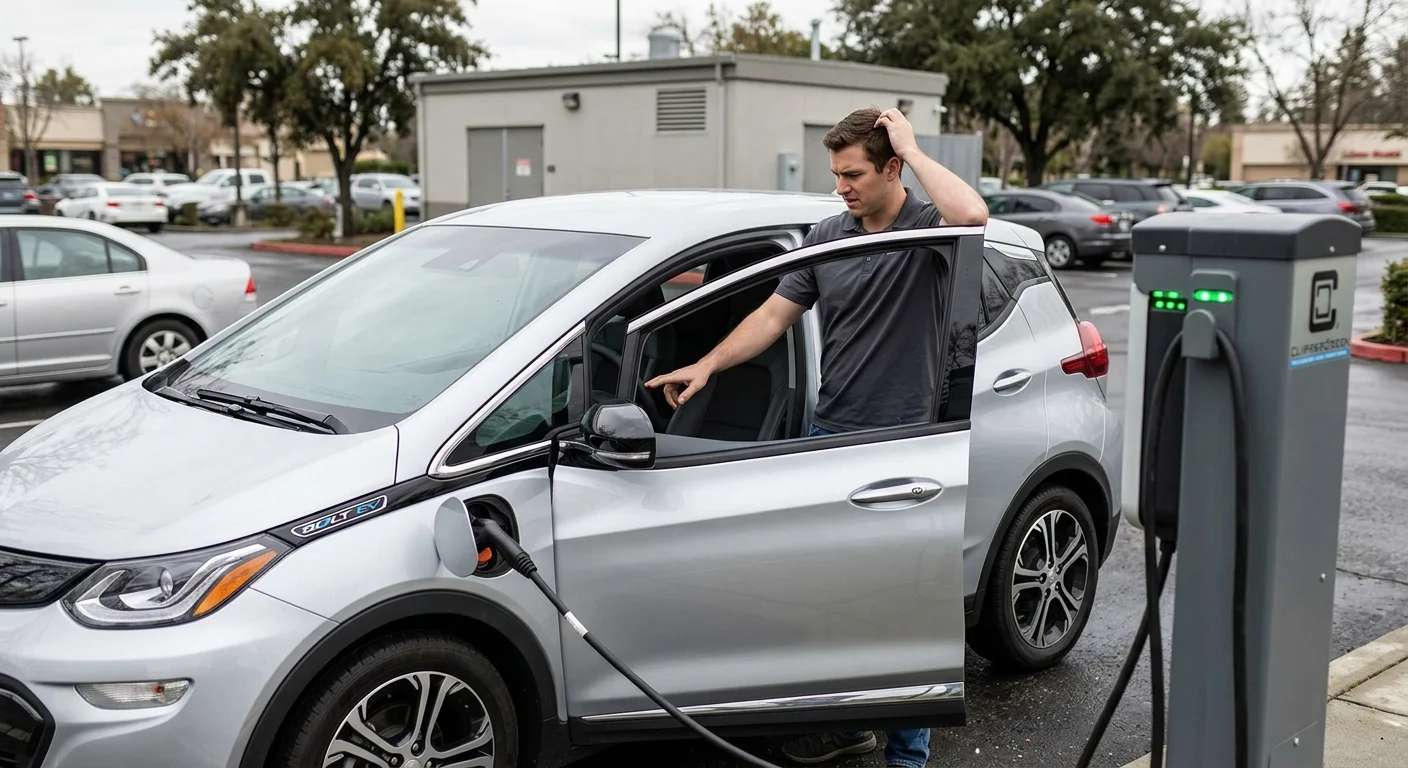
Don’t start this check in a dealer screen. Look at the handle, the latch, and the lights. A Chevy Bolt uses a J1772 port for AC charging and CCS for DC. A Tesla-shaped plug won’t seat in that port. If a cabinet has two handles, try the second one. Then walk to another cabinet in the same lot.
A dark screen or a stuck cable is a stall fault. Your car may still be healthy, so stop retrying a dark unit. Each failed handshake burns time you may need later.
Public stalls in Largo fail in this same way. If you’re already in that lot, use the Largo public charger walkthrough. Pinellas Park and Seminole lots throw the same quiet handle. The car isn’t the first suspect there either.
At a condo pedestal, push the J1772 in until it clicks. Wiggle once so you know the latch caught. A half-seated pin kills the talk between car and box. Check the wall unit’s lights, since no lights usually means no building feed.
If you can reach the panel, look for a tripped breaker on that stall. Shared laundry, a second EV, or an old 120-volt run can knock it out. Reset only a breaker you know belongs to your space. A locked room is a board problem, not a Bolt fault. Panel upgrades for home charging is the longer path if 718.113 work is next.
An overnight Level 1 trickle is a common Pinellas condo setup. If you plugged in and woke to the same percentage, that’s a different failure. An overnight charge that never started covers that case.
Swap the cable if you have a spare. Jacket cuts hide under the strain relief. AC and DC sessions aren’t the same test. A failed DC stall doesn’t prove the condo outlet is dead.
Tampa Bay is one of the most lightning-prone metros in the country, per Vaisala. Don’t stand at a metal stall in a storm. Get in the car and wait it out. Retry the plug when the sky is quiet.
Unable to Charge is a stop, not a parts list
Unable to Charge is blunt on purpose. The Bolt and the stall negotiate before current flows. If that handshake fails, the car refuses the session. You may get no extra code on the dash.
Lot power that sags will trip the same halt. The onboard charger protects the pack from a dirty feed. An old shared condo circuit can dip when an elevator or a dryer starts. The Bolt reads that as unsafe and quits.
Software glitches do the same thing after a hot parked day. Tampa Bay’s AC season runs from spring into late fall. Recurrent Auto’s published research finds about 5 percent range loss at 90°F. Above 95°F, the loss is 20 to 30 percent. Heat also scrambles charge modules on a parked Bolt. A quiet charge port after a gulf afternoon isn’t rare.
If Unable to Charge follows you from stall to stall, the car is the common piece. Condo outlet, public Level 2, and DC are three different tests. One bad stall doesn’t prove a car fault. Two different stalls still don’t prove a pack failure. They do justify a 12-volt check.
Shut the Bolt down, then plug in once more
Sticky modules cause a lot of these quiet sessions. You want the car to sleep, then wake clean.
End the session, or unplug after it has already failed. Power the Bolt fully off, then open the driver’s door and shut it. Wait a few minutes so the modules actually drop. Two to five minutes is enough in most cars. Power back on, seat the plug, and watch the charge lights.
If the session starts, you had a handshake glitch. If it fails on a second known-good stall, stop looping. Move to the 12-volt battery under the hood.
The 12-volt battery can block a charge with miles still showing
The big pack turns the wheels on a Bolt. The small 12-volt battery wakes the computers that allow charging. Port latches, screens, and charge relays all ride on it. A weak 12-volt can print Unable to Charge with a healthy pack.
On a Bolt, that battery sits under the hood, usually on the driver’s side. Corroded terminals can starve the charge relay. A healthy resting 12-volt typically reads a bit over 12 volts with the car off. A reading under 12 volts is a warning. Jumping an EV 12-volt the wrong way can damage modules. Leave the jump or swap to someone who works on these cars.
Heat and salt air here shorten 12-volt life. Hurricane Helene’s 2024 surge closed Pinellas barrier islands from the Dunedin Causeway through Tierra Verde. Hurricane Milton dropped at least 18 inches of rain on parts of St. Petersburg. A wet bay or a soaked port will stop a session. Water in the charge port will fail a session. Dry the port with a clean cloth if it’s only surface wet. Don’t poke metal into the pins.
Federal and fire-service guidance warns about salt-soaked EVs. A soaked pack can be a later fire risk. Keep that car away from buildings and other vehicles until a shop inspects it. We couldn’t confirm a specific distance or wait time on the federal page.
Airport parking is the other 12-volt trap. Tampa International Airport publishes free EV charging in on-airport garages and the cell phone lot. Level 1 J1772 sits in the Economy Garage and Long-Term Parking. Level 2 is at the Cell Phone Lot. Confirm current stall details on the airport’s parking page. Exact stall counts weren’t confirmed here. A Bolt left for a week that won’t wake is often the 12-volt.
What happens when an EV 12-volt dies maps the same hidden failure across brands.
If you’re already on I-275 or a causeway
A quiet stall in a condo lot is a delay. A quiet Bolt on I-275 is a traffic problem first. US-19 and the Courtney Campbell Causeway are the same story. Turn the hazards on and stay out of the travel lane if you can. Florida Statute 316.194 covers a disabled vehicle on the paved highway. You can remain there when you can’t get the car off. A Bolt that won’t take a charge counts as disabled under that rule.
District 7 Road Rangers patrol I-4, I-75, and I-275, plus the airport interchange. Dial *347 for the Tampa Bay SunGuide Center’s Road Rangers. They can jump a 12-volt and move you to a safer spot. Published services include fuel, but they don’t list charging an EV. Use them for safety on the shoulder. Don’t expect a Level 2 cable from the state truck.
Florida Highway Patrol Troop C covers disabled vehicles on these interstates. Florida 511 is the statewide traffic feed.
The Sunshine Skyway is a worse classroom. The main span sits 432 feet over the shipping channel. FHP closes it at sustained 40 mph winds. Fog closures come when visibility drops below about 100 feet. If you’re on the span with a Bolt that won’t charge, stay in the car. Call from there, and don’t walk the bridge.
A mobile charge versus a tow from a private lot
A wrecker relocates the car and leaves the charge fault untouched. Non-consent tow rates in Florida are capped at the county level. Hillsborough sets maxima through the Tax Collector’s vehicle-for-hire authority. Pinellas sets them in Ordinance 19-39 and Code Chapter 122. That’s Article II.5, §122-42 in the county code. Exact current dollar caps weren’t confirmed against the live ordinance schedule. Ask the county or the tower for the posted rates.
Florida Statute 715.07 covers tows from private property. Signs must use reflective letters, a tow-away legend, and the tower’s name and phone. In Hillsborough and Pinellas, storage has to be within a 10-mile radius. A condo can still tow an unauthorized car. If your Bolt is blocking a stall while you troubleshoot, that risk is real.
Charge Pro TPA is a referral line. We don’t own trucks, yards, or chargers. We don’t hold a trade license. We match stranded drivers with independent local operators. The operator quotes you before work starts and bills you directly. The pros we connect you with are licensed and insured. The pros we connect you with bring a 240-volt Level 2 source. For a Bolt, that’s a J1772 or CCS interface. They typically add 10 to 20 miles of range in 15 to 30 minutes of charging. That’s charge time at the bumper, not a promise of when someone arrives. They can also jump or replace a dead 12-volt on site.
If the pack is empty and the stall is dead, start with a mobile EV charge. That can put enough miles on to reach a working post. If the car won’t wake, start with non-Tesla EV rescue. For peninsula context, see EV charging in St. Petersburg.
After the stall checks are done
You’ve tried a second cabinet and checked the breaker you can reach. You’ve reset the car, and Unable to Charge still follows you. The 12-volt looks weak, and guessing stops helping.
Call (813) 536-4545 and we’ll connect you with a local operator. Say whether the car wakes and what the dash shows. Say if you’re in a condo lot or on a shoulder. The operator quotes before starting, and nobody here promises an arrival time.