The search “mobile EV charger for roadside use” mixes two different products. One is a suitcase you keep in the trunk. The other is an independent Tampa Bay operator who already carries a 240-volt Level 2 source to the bumper. They’re not the same tool. Buying the first one doesn’t replace a call for the second.
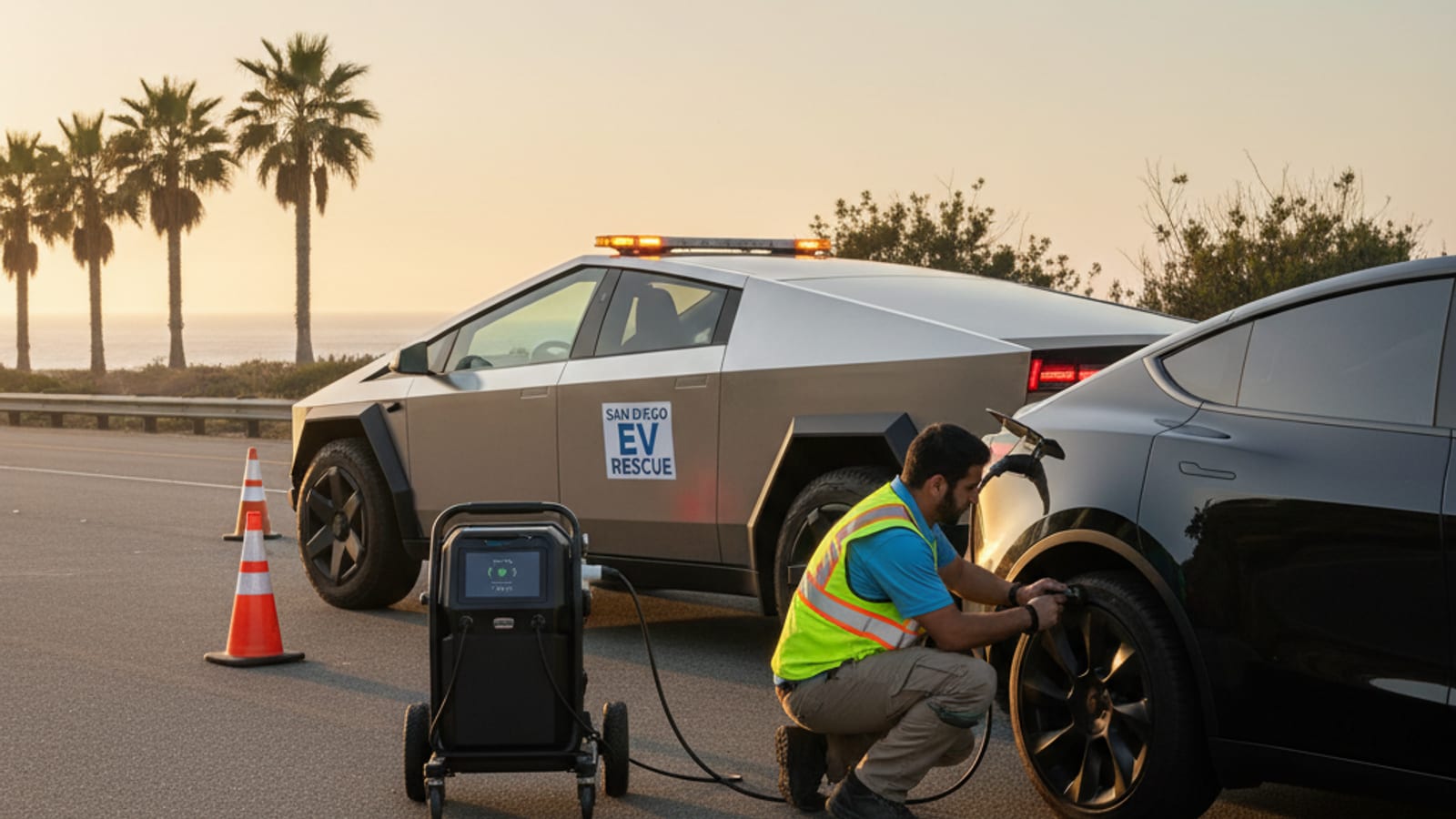
Two things share one search, and only one works on a shoulder
A personal portable charger is a cable and a box. It still needs an outlet. On I-75, I-275, the Veterans Expressway, or the Suncoast Parkway, there’s no dryer plug waiting in the grass. A unit in the frunk can’t invent power.
The other meaning is a charge brought to the car. Charge Pro TPA is a referral line. It matches a stranded driver with an independent local operator. That operator quotes you before starting and bills you directly. The brand doesn’t own trucks. It doesn’t employ technicians. It doesn’t set the price.
If your pack is empty, you need range added where you sit. If the car won’t wake, you may need a 12-volt jump instead. Those are different jobs. A trunk charger does neither when there’s no outlet. It also doesn’t jump a 12-volt battery.
What a personal unit actually is
Most listings that rank for this search are things you buy. Read the plug on the listing, not the headline.
Level 1 in the trunk
Most portable EV chargers sold online are Level 1. They plug into a regular 120-volt household receptacle. That’s the same outlet that runs a lamp. Fine overnight in a driveway. A poor plan on a shoulder. You’d sit for hours to crawl toward the next public stall. That assumes you even have a place to plug in.
For a longer look at why that trickle is a poor roadside plan, read what a Level 1 EV charger is, and why it isn’t enough here.
Level 2 you carry yourself
A portable Level 2 unit wants 240 volts. Think of a clothes dryer, a range, or an RV pedestal. Some kits ship with NEMA adapters so you can match the outlet you find. That helps at a friend’s house in Carrollwood or a workshop in Plant City. It doesn’t help on the Courtney Campbell Causeway. It doesn’t help on the elevated Selmon reversible lanes. There’s no local surface shoulder on that span.
You still have to find the outlet. You still have to run a cord that won’t get driven over. You still have to stay visible. A personal kit doesn’t come with a buffer vehicle or lighting.
What a personal charger can’t do
It can’t charge from nothing. It can’t replace a dead 12-volt. It can’t put the car in Neutral for a tow. It can’t stand between you and traffic. It can’t quote you a plan when you’re already on the grass.
Treat a personal unit as a home or guest-house tool that happens to travel. Don’t treat it as a rescue.
Heat, salt, and why Tampa Bay range math isn’t the brochure
Tampa Bay is flat and near sea level. Grade never gives range back. Heat and air conditioning are the whole story. Recurrent Auto’s published research finds an EV loses only about 5 percent of range at 90°F. It finds 20 to 30 percent loss above 95°F. Loss sits around 17 to 18 percent near 100°F. The effect varies by model. Don’t treat the in-car estimate as a promise after a July afternoon with the AC on.
Florida is one of the most lightning-prone metros in the country, per Vaisala’s National Lightning Detection Network. A storm cell can reroute you, close a span, or leave you sitting with climate control running. Hurricane Helene in late September 2024 drove record storm surge at Tampa Bay tidal gauges. Pinellas barrier islands from the Dunedin Causeway through Tierra Verde were closed. Hurricane Milton in early October 2024 dropped at least 18 inches of rain on parts of St. Petersburg and tore part of the roof off Tropicana Field.
Low-lying Pinellas, the barrier islands, and south Hillsborough communities like Ruskin, Apollo Beach, and Gibsonton sit in evacuation zones. A suitcase charger doesn’t help if the grid is down at the house you planned to plug into.
Federal and fire-service guidance warns that an EV soaked in salt water can be a later fire risk. Keep a flooded car away from structures and other vehicles until it’s inspected. A portable charger isn’t that inspection.
What an independent operator brings to the bumper
The operators Charge Pro TPA connects you with bring a 240-volt Level 2 source to the car. Native NACS for Tesla. A CCS or J1772 adapter for other brands. Typical charging time, never travel time, is 15 to 30 minutes to add about 10 to 20 miles of range. That’s enough to roll to a public stall or home in many cases. It isn’t DC fast charging. It also isn’t a household trickle.
They can jump or replace a dead 12-volt on site. That matters more than people expect. A week in a garage, a month in a driveway, or a car that sat through a storm often fails at the 12-volt first. The high-voltage pack can still have plenty of energy. The computers won’t wake. A trunk Level 2 cable won’t fix that.
For the hardware picture, what a mobile EV charging truck actually does walks through the bed outlet, the plugs, and the buffer setup. For the empty-pack case, see out-of-charge recovery. For Tesla 12-volt work, see Tesla 12-volt battery jump.
The 12-volt trap people buy a charger to solve
A lot of calls about a car that won’t start aren’t empty packs. The 12-volt runs computers, contactors, and door handles. Tampa Bay heat ages that battery. A car that sat at the Economy Garage, at a cruise lot, or in a Fish Hawk driveway through a storm can look dead while the pack is fine. Owners then search for a mobile EV charger for roadside use and buy a Level 1 cable. The cable never gets used, because the car won’t unlock or wake to accept a charge.
If the screen is dark, the handles won’t present, and the app shows the car offline, start with the 12-volt. An operator who carries Level 2 also handles 12-volt jumps on site. A suitcase charger doesn’t.
When buying a unit is the honest answer
A personal charger earns its keep in a few Tampa Bay situations.
You live in a condo or HOA in Pinellas and you finally control a dedicated space. Florida Statute 718.113(8) gives a condominium unit owner the right to install an EV charging station within the boundaries of their limited common element or exclusively designated parking space. A declaration or covenant can’t be enforced to prohibit it. The board can’t deny a properly submitted request. The owner bears installation, operation, maintenance, insurance, and separately metered electricity. A portable Level 2 kit isn’t that install. It’s a stopgap if you already control a legal 240-volt outlet.
You visit family in Land O’ Lakes or Wesley Chapel and they have a dryer outlet they’ll let you use. You work a job site with a known 240-volt receptacle. You want a backup at home if the wall unit faults.
Housing age changes how realistic a home plug is. Lakewood Ranch, Fish Hawk, and Westchase are recent master-planned stock. Census figures put the share of homes built before 1980 at 0.7 percent, 0.8 percent, and 1.0 percent there. 240-volt home charging is common in that housing. Older stock is a different story. Lealman is 56.6 percent built before 1980. St. Petersburg is 51.5 percent. A panel in a 1970s bungalow may not have a spare 240-volt circuit. A portable Level 2 unit doesn’t upgrade the panel.
Utility programs can shape a home install. They don’t change a shoulder stop. Tampa Electric serves the City of Tampa, most of Hillsborough County, and parts of Pinellas and southern Pasco. Residential rate schedules include Residential Service, which is tiered, and Residential Service Variable Pricing, RSVP-1, a time-of-use plan. TECO’s Drive Smart program is a commercial and public charger incentive. A specific residential home-charger rebate name and amount weren’t found on a primary TECO page. Don’t assume a residential rebate exists.
Duke Energy Florida serves Pinellas County and much of Pasco. In 2025 it launched three EV programs: the Charger Prep Credit, the Off-Peak Charging Credit, and Fleet Advisory. The Charger Prep Credit is a one-time credit toward the wiring and electrical upgrades needed for a Level 2 charger, for homes and businesses. It doesn’t cover the charger hardware or permit fees. The Off-Peak Charging Credit is a residential monthly bill credit for charging during Duke’s published off-peak windows. Confirm current windows and terms with Duke before you plan around them. North and central Pasco, except the Dade City area, is often Withlacoochee River Electric Cooperative. WREC reports 280,000-plus accounts across Pasco, Hernando, Citrus, Sumter, and Polk. A driver in north or central Pasco shouldn’t call TECO or Duke about a home charger without checking the bill.
Parts of the Manatee and Sarasota southern ring sit on other utilities. Exact service boundaries and EV programs for those utilities weren’t verified on a primary page for this article. Read the name on your bill.
Florida has no state EV purchase rebate or tax credit. Incentives here are utility programs. Florida has an enacted EV registration fee under SB 28, effective January 1, 2026. Confirm the live amount with the tax collector. This page doesn’t publish a figure.
When calling an operator is the honest answer
Call when the car is already stopped in a place with no outlet you control.
Empty pack on I-75 near Wesley Chapel. Empty pack on I-275 between Tampa and Pinellas. Empty pack on US-19 in Pasco, or on SR-60 through East Hillsborough. Sitting on the Sunshine Skyway. The Skyway’s main span sits 432 feet above the shipping channel. Florida Highway Patrol closes it when winds reach sustained 40 mph, or when fog cuts visibility below about 100 feet. A high-wind advisory for high-profile vehicles is typically issued around 20 mph gusts, per local reporting of FHP practice. Being stuck on that span is a four-mile problem with nowhere good to wait. A suitcase charger doesn’t help.
The Selmon Expressway reversible lanes are a roughly 10-mile elevated segmental bridge in the median between Brandon and downtown Tampa. The Tampa Hillsborough Expressway Authority runs all-electronic tolling, SunPass with a toll-by-plate option. Direction reverses through the day. Westbound into downtown from about 5 a.m. to noon, then eastbound. THEA clears the lanes of all traffic before each reversal so no stranded or wrong-way vehicles remain. There’s no local surface shoulder on the elevated segment. If you run the pack down there, you’re not plugging into anything. You need an operator or a tow. The reversal clock is part of that decision.
A week at Tampa International Airport is a different failure. The airport publishes that EV charging is free at all on-airport parking garages and the cell phone lot. Level 1 J1772 charging is on the first floor of the Economy Garage, and Level 1 is also in the Long-Term Parking Garage. Level 2 is at the Cell Phone Lot. A car that won’t wake after a trip is often the 12-volt, not an empty pack. A personal charger at a garage stall doesn’t jump that battery.
Cruise parking at Port Tampa Bay can produce the same sit-and-die 12-volt pattern. Terminal parking and any EV charging there weren’t verified on a primary page. Don’t assume a stall is waiting.
Shoulder safety if you already have a unit in the trunk
If you’re already on the grass with a portable Level 2 kit, the limiting factor is still the outlet. Don’t walk a cord across a travel lane. Don’t pop a panel on someone else’s building without permission. Don’t stand between traffic and the car while you experiment. Dial *347 on I-4, I-75, or I-275 for Road Rangers if you need the scene made safer. Then decide whether an operator should bring power, or whether a tow is cleaner.
Road Rangers, the law, and what help on the interstate actually means
FDOT Road Rangers in District 7 patrol I-4, I-75, and I-275 in the Tampa Bay area, plus the airport interchange. You reach them by dialing *347. The District 7 Regional Traffic Management Center is the Tampa Bay SunGuide Center. Free published services include flat-tire help, a jump-start, fuel, diesel or water, two local calls, relocating a disabled vehicle to a safer spot, and maintenance of traffic at incidents. The materials reviewed describe fuel, jump-start, and tire help. They don’t mention charging an EV. That’s an observed absence in the published list. It isn’t a claim that Road Rangers refuse to help an EV. They can still jump a 12-volt, move you off the travel lane, and make the scene safer.
Florida Highway Patrol Troop C covers disabled vehicles and incidents on the interstates. Florida 511 is the state’s traffic-information system. District 1 runs its own Road Rangers on I-75 through Manatee and Sarasota.
Florida Statute 316.194 bars stopping on the paved or main-traveled part of a highway outside a municipality when it’s practicable to get off the roadway. Subsection (2) exempts a vehicle disabled on that pavement when it’s impossible to avoid leaving it there. A dead EV on a shoulder is a disabled vehicle under that exemption. Get as far right as you can. Lights on. Stay out of the travel lane.
A personal charging setup on a shoulder adds cords and a person outside the car. That’s more exposure, not less.
Tow versus a charge at the bumper
A tow is the right call when the car can’t take a charge, the 12-volt won’t hold, there’s crash damage, or you’re in a place an operator can’t stage. Hillsborough and Pinellas regulate non-consent tow rates at the county level. Hillsborough does it through the Tax Collector’s vehicle-for-hire authority. Pinellas does it by ordinance, including Ordinance 19-39 and Code Chapter 122. Exact current caps weren’t confirmed against the live schedule. This page doesn’t publish a number. The tower must file rates with local law enforcement and post the same schedule at the storage site. Confirm the live schedule if a private lot already hooked the car.
Florida Statute 715.07 covers removal from private property. The owner or lessee, or an authorized person, may have an unauthorized vehicle removed. Signage has to meet letter-size and height rules, including the tower’s name and phone number. In counties of 500,000 or more, which includes Hillsborough and Pinellas, a towed vehicle must be stored within a 10-mile radius of removal. Storage in smaller counties is within 15 miles. A mall lot in Clearwater or a garage in St. Petersburg can still tow you. A portable charger in the trunk doesn’t stop that.
A charge at the car avoids the Neutral problem, the flatbed, and the second wait at a stall. For the decision tree, read when you need a mobile EV charge, and when you need a tow. Mobile EV charging is the service page for a Level 2 boost where you sit.
What actually moves the operator’s quote
Don’t hunt for a published sticker from this brand. The brand doesn’t set prices. The independent operator quotes you before starting.
What tends to move that quote:
How far the operator has to run, and which county you’re in. A stall on I-4 near the Polk line is a different trip than a driveway in Temple Terrace.
Time of day and traffic. The Veterans Expressway, I-275 across the bay, and the Skyway all change how long staging takes. That’s the operator’s travel. It isn’t a promised clock for you.
How much range you need. A short boost to a nearby stall is a shorter charge than a long crawl home to Valrico or Sun City Center.
Whether the job is a pack top-off, a 12-volt jump, a 12-volt replacement, or a tow after the car won’t accept a charge.
Access. A gated community in Lakewood Ranch, a garage at Tampa International, or the Selmon reversible lanes isn’t the same staging as a wide shoulder.
The operator bills you directly. Ask for the quote before the cable goes in.
Compatibility: Tesla and everyone else
North American roadside charging for this work is Level 2. Tesla uses NACS. Most other brands use CCS or J1772 at Level 2. Operators in this network carry a native NACS plug and adapters for CCS and J1772. Tesla, Ford, GM, Hyundai, Kia, BMW, Mercedes, Rivian, and the rest of the common pack on Tampa Bay roads can take a boost if the car will accept a charge.
If the car is locked out on a dead 12-volt, charging the pack isn’t the first step. Wake the 12-volt first. Door handles, the screen, and the parking pawl all depend on that small battery.
A short buyer’s checklist, without the catalog
If you still want a personal unit, buy for the outlet you actually have. Match the NEMA plug. Confirm the car’s inbound charge rate on Level 2. Store the cable dry. Tampa Bay humidity and salt air are hard on connectors. After a storm, check the port for water before you plug anything in.
Don’t buy a unit because a listing called it a “mobile EV charger for roadside use.” Read whether it needs 120 volts, 240 volts, or claims to be a battery in a box. A pack that claims to charge an EV is a different product, with its own limits. This page isn’t a spec sheet for those.
A personal unit is a reasonable kit next to a home install. It’s a weak substitute for an operator on I-75, the Skyway, or the Selmon reversible lanes.
Home charging still wins for daily miles
Daily charging belongs on a wall, not in a crisis kit. TECO residential schedules include standard Residential Service and RSVP-1 time-of-use. Duke’s Off-Peak Charging Credit is built around published off-peak windows. WREC members should ask WREC, not a Tampa utility. A well-set home routine cuts how often you ever need a roadside boost.
It doesn’t erase a dead 12-volt after a week at the airport. It doesn’t erase a wrong turn on the Suncoast with the AC on high. That’s why the buy-or-call question stays live.
The hub for local pages is EV charging in Tampa Bay. City pages cover Tampa, Pinellas, Pasco, and the southern ring.
How a call works, without a promised clock
You call. You give the location and the car. The line matches you with an independent operator. That operator quotes the job. If you accept, they bring Level 2 to the bumper, or they jump the 12-volt, or they tell you the car needs a tow instead. Charging time at the car, when a boost is the job, is typically 15 to 30 minutes for about 10 to 20 miles. That’s charging time. It isn’t an arrival time.
Stay with the car if it’s safe. If you’re on an interstate, *347 can still get Road Rangers to the scene for traffic control even when charging isn’t on their published list.
If you’re deciding whether to buy a unit or keep that purchase for outlets you already control, do the second thing. Keep the referral number for the shoulder, the bridge, the garage lockout, and the storm.
When you need that call in Tampa Bay, Charge Pro TPA is (813) 536-4545.
Frequently asked questions
Does a personal mobile EV charger for roadside use work without an outlet?
No. A personal unit is a cord and a converter. Level 1 wants a household 120-volt receptacle. Portable Level 2 wants 240 volts. Neither one creates power on I-75 or the Skyway. An independent operator brings the 240-volt source with them.
How much range does an operator add, and how long does the charge take?
Typical charging time is 15 to 30 minutes to add about 10 to 20 miles. That’s time on the cable, not travel to you. It’s Level 2, not a DC stall. The operator quotes you before starting. How much range you ask for is one of the things that moves the quote.
Should I buy a unit if I already have a home charger?
Only if you regularly plug in at places with a known outlet you may use: a second home, a family dryer circuit, a job site. It won’t cover an empty pack on the Selmon reversible lanes, a 12-volt death after a week at the airport, or a car that won’t wake in a Riverview driveway. For those, call for an operator.