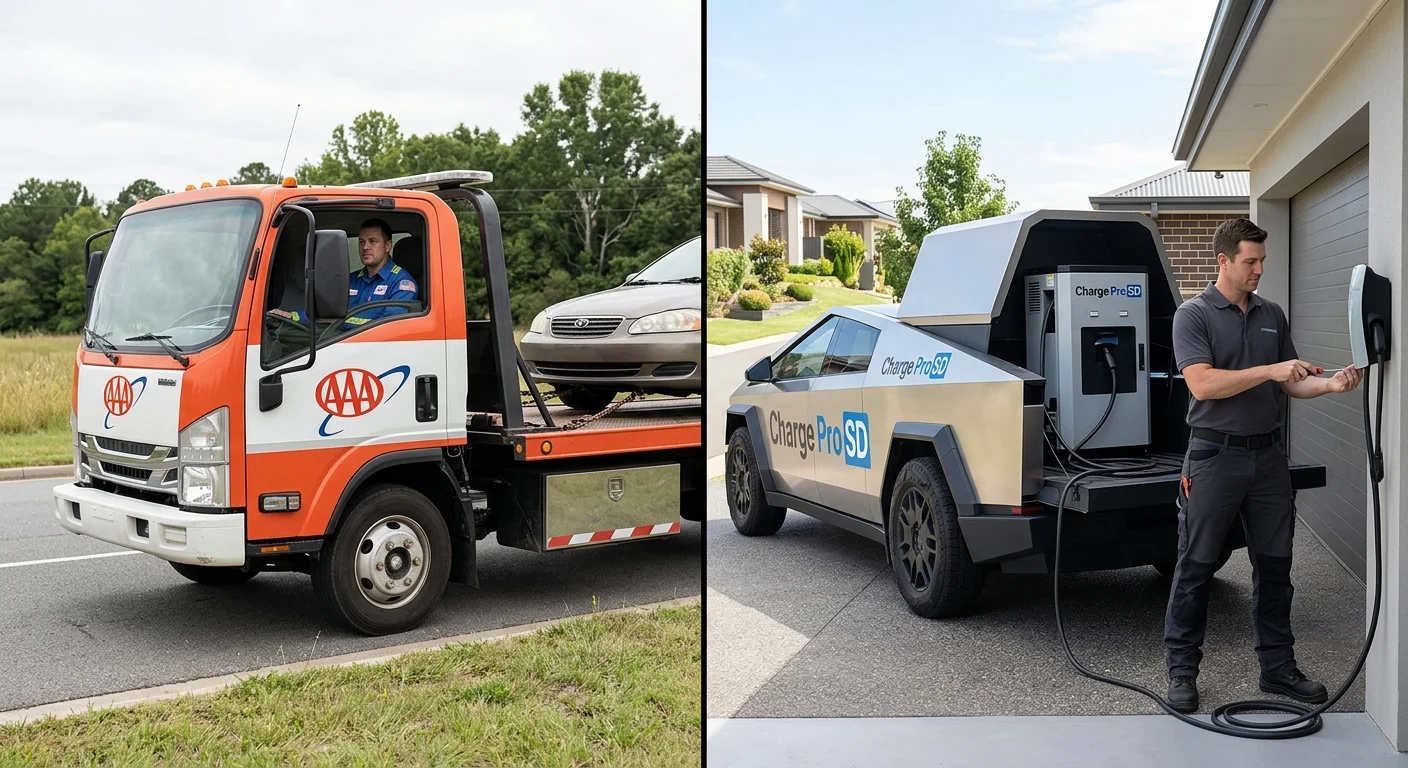
Allstate’s roadside add-on is a national plan. It jumps a dead 12-volt battery and tows an EV that won’t move. It doesn’t send a charger to your bumper. In Tampa Bay, a local mobile operator still quotes you and bills you directly if you want power on the spot.
Allstate’s plan is national. The local bill isn’t
When you add roadside through Allstate, you’re buying a Motor Club-style benefit. The list looks like a gas-car list: tire change, lockout, fuel drop, jump, and a tow. That list doesn’t change because you drive an EV. It also doesn’t change because you live in Tampa, St. Petersburg, or Clearwater. The coverage is the same product nationwide.
What does change is who you pay for a charge at the car. Charge Pro TPA is a referral line. We match stranded drivers with independent local mobile rescue operators. Those operators quote before they start. They bill you directly. Allstate doesn’t pick up that invoice unless your policy says it will. Don’t assume it will.
What the Allstate call actually does for an EV
Start with the 12-volt battery. That’s the small pack that wakes the computers, locks, and screens. If that pack is dead, Allstate dispatches a jump, same as a gas car. If the jump holds, you drive away. If it doesn’t, or the high-voltage pack is empty, the next step is a tow.
The truck that arrives for Allstate isn’t carrying a 240-volt Level 2 source. A native NACS plug, CCS, or J1772 adapter isn’t part of that call. The tow is meant to get you to a shop, or to a place you can plug in. Power stays at the destination. It doesn’t come to you.
FDOT Road Rangers in District 7 work a similar split on I-4, I-75, and I-275. Dial *347 and you can get a jump, a tire, fuel, or a move to a safer spot. Their published services don’t include charging an EV. Florida Statute 316.194 covers a disabled vehicle on the paved highway. You’re allowed to leave it when you can’t get off the road. That covers a dead EV on a shoulder. It doesn’t put charge into the pack.
Check your own tier before you need it
Allstate sells more than one roadside tier. Towing distance and any per-tow cap sit in your documents, not in a blog. We won’t guess a number for you. Open the declarations page, or call Allstate, and ask two questions. What’s my covered towing distance. Is there a separate dollar limit per tow.
Hillsborough and Pinellas both cap non-consent tow rates at the county level. Those caps apply to trespass and non-consent tows. They aren’t a substitute for your Allstate limit. Confirm Allstate’s limit with Allstate. Confirm a private operator’s quote with that operator before work starts.
Why a tow to a plug still burns the day
A successful tow isn’t a full charge. You still sit at the station while the car takes power. On a Level 2 plug that wait is long. Stack dispatch, the ride, and the session, and an empty pack turns into an afternoon. We walked through that pattern in why towing a dead EV in Tampa Bay is the last resort. The same sequence shows up with Allstate, Geico, and AAA. See Geico roadside for an EV in Tampa Bay and AAA membership or a mobile EV charge.
Some Tampa Bay spots make that sequence harder even when chargers exist. The Selmon Reversible Express Lanes have no local surface shoulder on the elevated stretch between Brandon and downtown. The Sunshine Skyway is four miles of bridge with nowhere to wait. The Veterans Expressway and the Suncoast Parkway are all-electronic and fast, with long gaps between exits. A tow dispatcher can still send you to a plug. You still have to get there, then wait.
What a mobile charge does that Allstate does not
A mobile EV charge sends an independent operator to where you already are. That can be a shoulder, a garage, a driveway, or an airport lot. The truck brings a 240-volt Level 2 source to the car. Tesla owners get a native NACS plug. Other brands use CCS or J1772. Typical add is 10 to 20 miles of range in 15 to 30 minutes of charging. That’s charging time only. It’s not a promise of when someone arrives.
You leave under your own power. You skip the flatbed, the ride, and the second wait. For the full rescue picture, see EV roadside assistance in Tampa Bay and what a mobile EV charging truck actually does. If the car is a Tesla, what Tesla roadside covers is the other national plan to compare.
If you’re parked at Tampa International, the airport publishes free EV charging in the on-airport garages and the cell phone lot. A car that sat a week and won’t wake is often the 12-volt, not an empty pack. Allstate can still attempt the jump. A local operator can jump or replace that 12-volt on site as well.
Keep the Allstate add-on. Use it for the right failure.
Don’t cancel Allstate roadside because it won’t charge the pack. It’s the right call for a flat, a lockout, or a car that needs a shop. Save the mobile charge for the case where the EV is otherwise fine and just needs power. They’re two tools. Keep both.
If the high-voltage pack is empty anywhere in the Tampa Bay service area, call Charge Pro TPA at (813) 536-4545. We’ll connect you with a local operator who quotes first and bills you directly.
Frequently asked questions
Does Allstate roadside assistance charge EVs on site?
No. For an empty pack, Allstate’s standard benefit is a tow to a place you can plug in. On-site charging isn’t part of that toolkit.
Who shows up when I call Allstate for my EV?
Allstate Motor Club dispatches a contracted provider. It’s the same network used for gas cars. Confirm a flatbed if the car has to ride.
Do I still pay a Tampa Bay operator if I have Allstate?
Yes, unless your own policy says Allstate will reimburse that invoice. Local mobile rescue operators quote you before they start. They bill you directly.