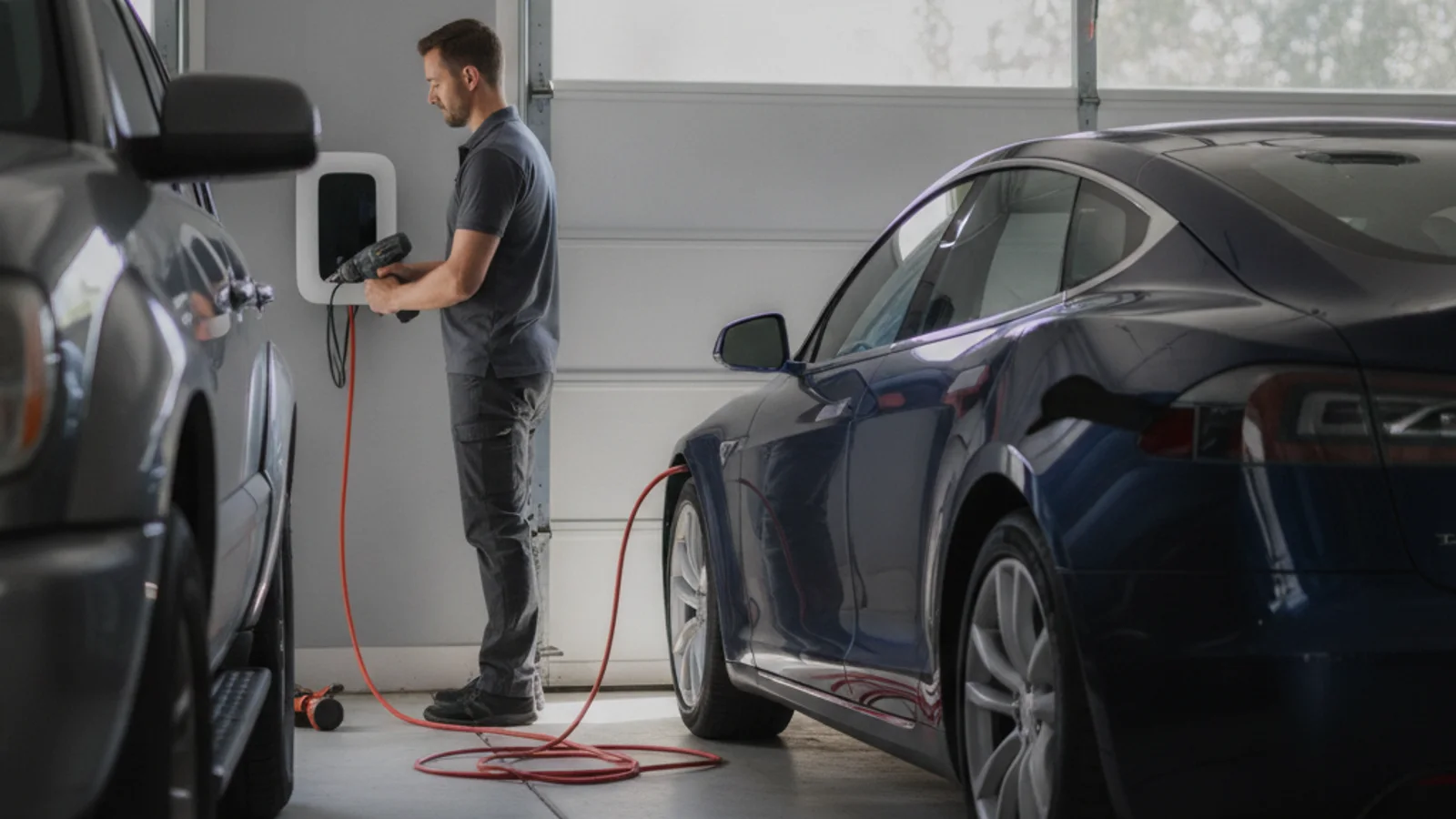
A Tesla 12-volt battery is a small wake-up battery, not a jump box. The same battery that wakes the computers and contactors on a Tesla is not designed to deliver the cranking amps a gas car needs to turn over a starter motor. A Tampa Bay neighbor who asks to jump their Civic from your Tesla should hear no. The risk profile does not match.
What a Tesla 12-volt actually does
The Tesla runs two electrical systems, not one shared pool. The traction pack moves the wheels and sets the range number. The 12-volt battery is the wake-up circuit for everything else. It feeds the screens, cameras, locks, computers, and contactors. While you drive or plug in, the DC-DC converter tops off the 12-volt. Once the car sleeps, that small battery carries the background load.
The Tesla 12-volt is roughly the same physical size as a gas-car 12-volt. It is not the same battery. Lead-acid and lithium 12-volt batteries want different charge profiles. Cranking amps is a gas-car spec. Tesla 12-volt batteries are rated for sustained low current, not peak surge.
For the wider 12-volt pattern, see our Tesla 12V failure symptoms guide.
Why a gas-car jump is different
A gas-car starter draws several hundred amps for a few seconds. The 12-volt battery on a Civic, Camry, or F-150 is rated for that surge. It is built to recover from the surge and keep the lights, ignition, and fuel pump running until the alternator takes over. A Tesla 12-volt is built for a different job. Connecting jumper cables from a Tesla 12-volt to a gas car risks pulling the Tesla 12-volt below its safe operating range. The Tesla may not start after the jump.
There is also the question of polarity. A mis-clamped jumper cable can short the small battery on either car. A Tesla owner who clamps the wrong way can fry the 12-volt and end up needing a tow themselves. That is a worse day than the neighbor’s dead Civic.
A driver who needs to jump a gas car should use a real jump pack, not a Tesla. The jump pack is built for that job. It costs less than the tow for a Tesla with a fried 12-volt.
For the broader charging-vs-tow decision, see our mobile EV charging vs tow guide.
What a Tampa Bay heat pattern does
Recurrent Auto’s research puts range loss at about 5 percent at 90 degrees Fahrenheit. Above 95, the loss climbs to 20 to 30 percent. That is traction-pack range. The same heat ages a small 12-volt faster than a big traction pack. A Tampa Bay driver whose Tesla 12-volt is marginal should not lend it to a neighbor. The neighbor’s Civic may start, but the Tesla may not start after.
Florida is among the most lightning-dense states in the country. Vaisala’s lightning data confirms the pattern. Storms cut power even when they do not bring a hurricane. A driver whose Tesla has been through a power outage should keep the 12-volt topped off. A jump to a neighbor is the wrong move.
For the storm side, see our mobile EV charging vs home battery explainer.
What to do instead
Buy a real jump pack. A lithium jump pack designed for 12-volt systems costs less than a tow. It fits in a glove box. It can jump a gas car or an EV 12-volt. Read the manual before the next storm.
Call a referral line for a Tesla 12-volt jump. Charge Pro TPA is a referral line. It matches stranded drivers with independent local operators. The operator brings a lithium jump pack designed for the 12-volt on a Tesla. The car wakes in seconds. The operator does not replace the 12-volt on site.
What to say on the call
State the model, year, and trim. Say whether the cabin is fully dark or if the screen still shows a range number. The operator uses that to bring the right gear and quote before work starts.
Charge Pro TPA connects Tampa Bay drivers with local operators. Call (813) 536-4545 and we will match you with an independent EV rescue operator who works your part of Tampa Bay.