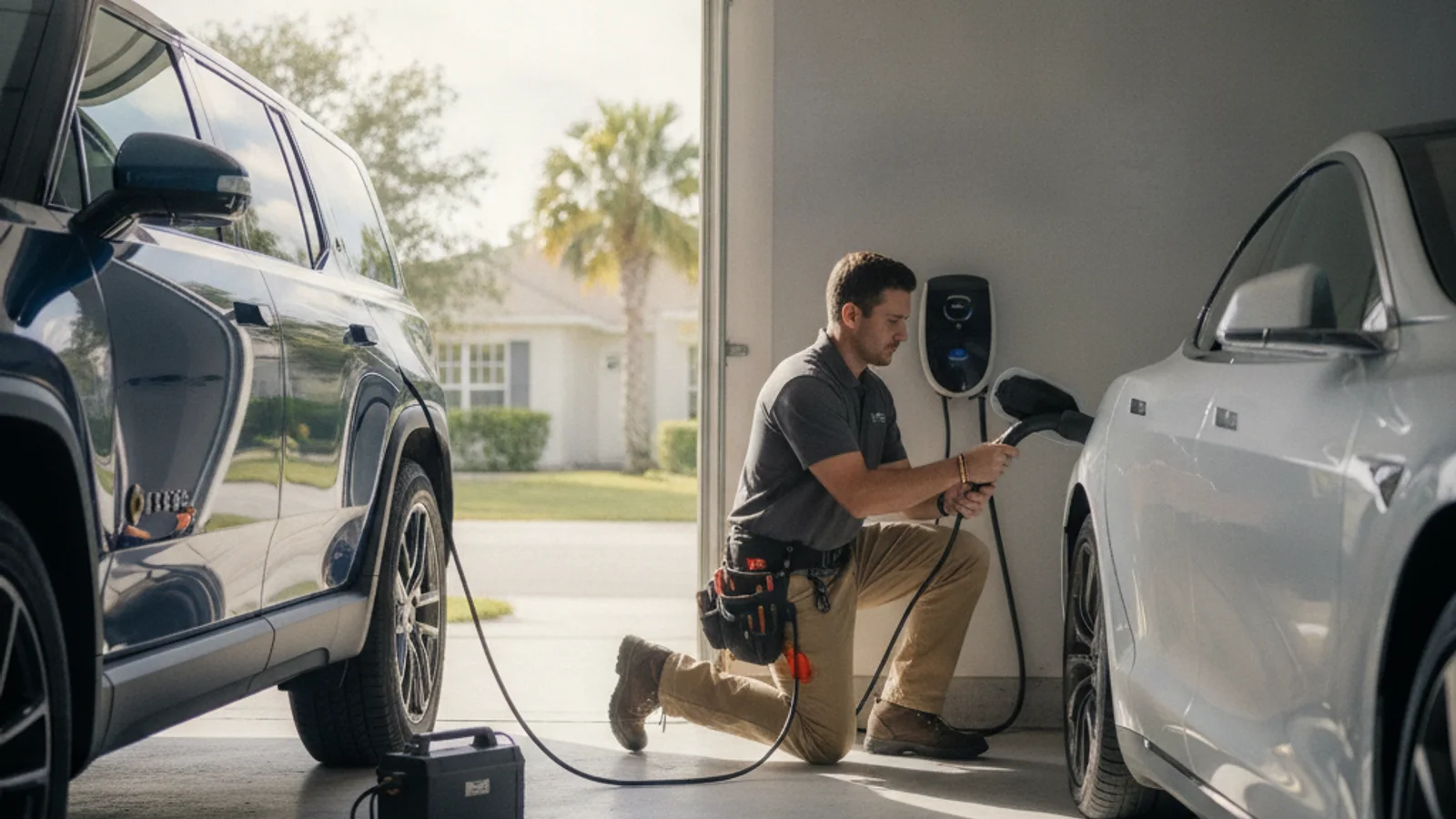
A driver with an empty pack on the shoulder of a Tampa Bay road has two paths. A mobile Level 2 charge brought to the car, or a flatbed to a charger. The right answer depends on the car, the location, and the time of day. Florida Statute 316.194 covers a disabled vehicle that cannot leave the paved highway. Get off the travel lanes when you can. Then decide.
What a mobile Level 2 charge actually does
An independent operator brings a 240-volt Level 2 source on a trailer or in a truck bed. For Teslas, the plug is native NACS. For other EVs, the operator brings a CCS or J1772 adapter. A typical charge adds 10 to 20 miles of range from 15 to 30 minutes of charging. That is charging time, not an arrival time. The driver watches the range number climb, pays the operator, and drives away. No tow needed. No shop appointment.
The catch is access. The operator needs a place to park the truck and run a cable to the car. A shoulder that is wide enough for a service truck works. A shoulder that is too narrow does not. A car stuck in a travel lane on a busy interstate is the wrong job for a mobile charge. A tow is faster and safer in that case.
What a tow actually does
A flatbed moves the car to a charger, a shop, or a home charger. The driver usually pays a tow fee plus mileage. Hillsborough and Pinellas cap non-consent tow rates through the county vehicle-for-hire and the Pinellas County ordinance. Dollar amounts are not confirmed current in our research. Confirm with the tow yard before authorizing work.
A tow is the right answer when the car has no power. A no-power EV cannot be put in neutral on most models without a specific procedure. Some EVs require power to shift. A flatbed avoids the question.
For a deeper look at no-power towing on a Model S, see our Model S no-power tow guide. For the wider interstate pattern, see our Tampa Bay EV roadside guide.
When a mobile charge is the right answer
The car still has power. The screen comes on. The range number is low. The driver is on a shoulder with room for a service truck. The car can be charged enough to reach a nearby charger or to drive home. A mobile charge is the right answer.
This is the most common roadside EV job in Tampa Bay. Most stalls are not zero-power. Most stalls are low-charge with a working computer. The driver sees the warning light, pulls off, and calls. A mobile operator with a Level 2 source is on the way.
When a tow is the right answer
The car has no power. The screen is dark. The handles do not present. The driver cannot shift into neutral. The car is in a travel lane. The shoulder is too narrow for a service truck. A tow is the right answer.
A mobile operator with a lithium jump pack can wake a dark cabin in seconds. That changes a no-power car into a powered car that can be shifted and charged. The operator quotes the jump, wakes the car, and the driver drives home or to a charger. A tow becomes unnecessary.
The exception is a car with a damaged high-voltage system. Saltwater intrusion after Helene or Milton can damage the pack and the contactors. NHTSA publishes saltwater-EV guidance. A car with saltwater intrusion should not be charged. A flatbed to a dealer is the right answer in that case.
What the referral line does
Charge Pro TPA is a referral line. It matches stranded EV drivers with independent local operators. It does not own trucks, employ crews, set prices, or promise an arrival time. The operator quotes before work starts and bills the driver directly. The line itself takes no fee.
For a mobile charge, the line matches you with a Level 2 operator. For a tow, the line points you at a flatbed service or tells you to call your insurance roadside product. For a 12-volt jump, the line matches you with a lithium jump pack operator. The match depends on the job.
What to say on the call
State the model, year, and trim. Say whether the cabin is fully dark or if the screen still shows a range number. Share the exit number or the nearest cross street. Say if the car is in a travel lane or on a shoulder. The operator uses that to bring the right gear and quote before work starts.
Charge Pro TPA connects Tampa Bay drivers with local operators. Call (813) 536-4545 and we will match you with an independent EV rescue operator or point you at the right tow service for the job.