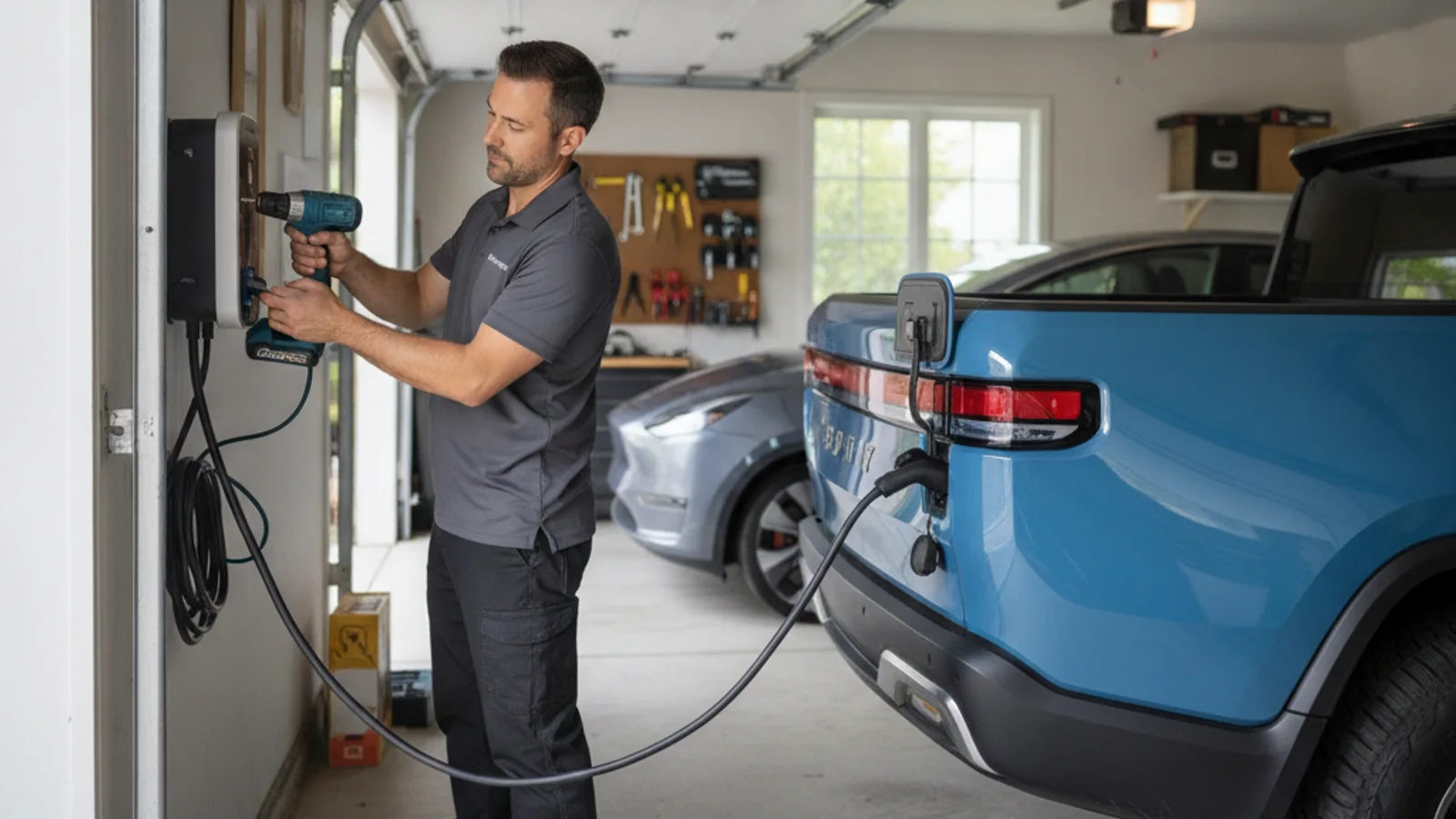
A Rivian R1T or R1S that will not release a charging cable at a Tampa Bay public post is a known pattern. Humidity, salt air, and a latch that has not been cycled recently can stick the cable in place. The driver who tries to drive away with a stuck cable damages the port and the cable. The right move is the manual release first, then a roadside operator if the manual release does not work.
Why the Rivian latch sticks
Rivian’s charge port uses a motorized latch that holds the cable in place during charging. The latch cycles every time the driver plugs in and unplugs. A car that sits at a humid public post for hours, or a car whose owner plugs in infrequently, can have a latch that seizes from corrosion or humidity. Salt air on the Gulf coast accelerates the pattern.
A driver who sees the latch indicator flashing red or who hears the latch motor but cannot release the cable is seeing a seized latch. Forcing the cable out by pulling harder damages the port pins and the cable. Call for help.
For the broader Rivian pattern, see our Rivian R1T or R1S won’t start guide. For the highway-assist-vs-rescue side, see the Rivian highway assist explainer.
What to try first
Rivian publishes a manual release procedure for the charge port. The procedure is in the owner’s manual and on Rivian’s support site. It involves a small access panel or a manual release cable near the port. The exact location depends on model year. Read the manual for your VIN before you need it.
If the manual release works, the cable comes free. The driver should not plug in again at the same charger. The latch needs service. The driver should drive to a known-good charger or to a Rivian service center. If Tampa Bay Rivian service-center locations are not confirmed in our research, do not list any. Confirm with Rivian.
If the manual release does not work, call a roadside operator. The operator brings a release tool designed for that pattern. The operator does not force the cable out by pulling harder.
What a Rivian rescue looks like
For a stuck cable, the operator brings the right release tool and applies the documented manual release procedure. The cable comes free. The driver should not charge at the same post. The operator can recommend a known-good charger.
For a 12-volt no-start, the operator brings a lithium jump pack and clips the small battery directly. The Rivian runs two electrical systems. The traction pack moves the wheels. The 12-volt runs the wake-up circuit. Heat here runs well into the 90s from late spring through early fall. Heat ages a small 12-volt faster than a big traction pack.
For an empty traction pack, the operator brings a 240-volt Level 2 source. The Rivian uses NACS or CCS depending on the model year. Most operators carry both. A typical charge adds 10 to 20 miles of range from 15 to 30 minutes of charging. That is charging time, not an arrival time.
For the charger type side, see our Rivian charger type guide.
What to tell the operator on the call
State the model, year, and trim. The Rivian has had running changes across model years. Tell the operator what the latch indicator shows. Share the charger address or the nearest cross street. The operator uses that to bring the right gear and quote before work starts.
Charge Pro TPA is a referral line. It matches stranded drivers with independent local operators. It does not own trucks, employ crews, set prices, or promise an arrival time. The operator quotes you before starting work and bills you directly.
When to make the call
Call from a safe spot the moment the manual release does not work. Call from home if the 12-volt is marginal. Call from the road if the pack is low. Stay with the car if it is safe to do so.
Charge Pro TPA connects Tampa Bay Rivian drivers with local operators. Call (813) 536-4545 and we will match you with an independent EV rescue operator who works your part of Tampa Bay.