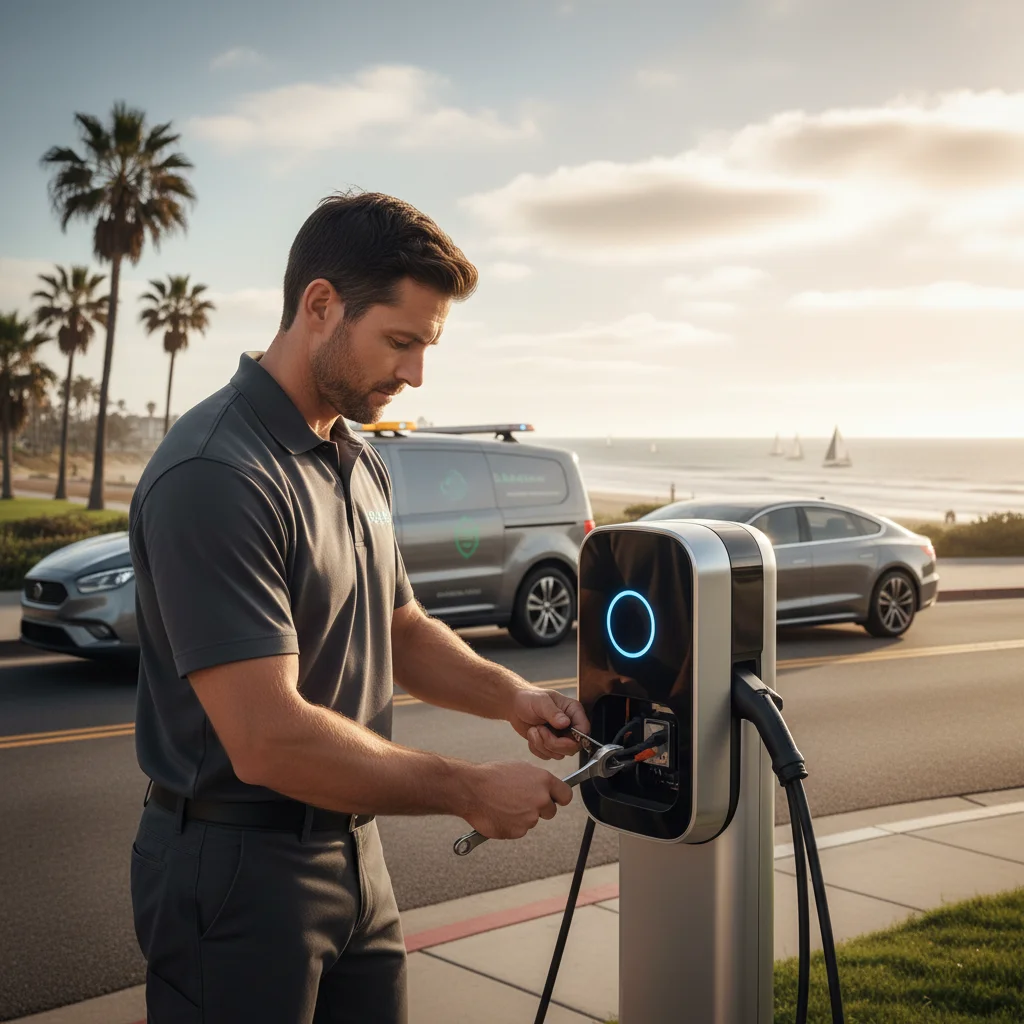
EV roadside assistance in Ruskin is a charge or a 12-volt jump at the car. Charge Pro TPA is a referral line for Tampa Bay. We match you with an independent local operator. That operator brings a 240-volt Level 2 source to the bumper. Tesla cars take a native NACS plug. Other EVs use a CCS or J1772 adapter. A typical session adds 10 to 20 miles of range. That takes 15 to 30 minutes of charging at the car. That’s charge time, never a promise of arrival. The operator quotes you before starting, and bills you directly.
Ruskin sits low, flat, and on the bay
Ruskin is an unincorporated Census Designated Place in south Hillsborough County. The ACS 2019-2023 count is 30,074 people. Land area is 18.229 square miles, and it sits on Tampa Bay’s south shore. Farmland and new subdivisions share the same map. Cypress Creek and the Bahia Beach edge sit in that mix. The Little Manatee River runs through the agricultural district. Apollo Beach, Sun City Center, Wimauma, and Gibsonton sit next door.
This isn’t downtown Tampa, and it isn’t a Pinellas beach town. The ground is flat and near sea level. Hills never hand range back on these roads. Heat, humidity, and AC decide what a pack can do. Storm surge is a planning problem on this shore.
Only 10.1 percent of housing here was built before 1980, per ACS 2019-2023. That’s far below older inner suburbs such as Lealman at 56.6 percent. Most Ruskin homes are post-1980 stock. That’s a proxy for whether a house can even take a 240-volt charger. It doesn’t mean every driveway already has Level 2.
TECO serves most of Hillsborough County, including this south county stretch. A named residential home-charger rebate couldn’t be confirmed on TECO’s primary pages. Confirm any credit with TECO before you budget for one. Drive Smart, the program TECO does publish, is for commercial and public chargers.
I-75, US-41, US-301, and College Avenue
South county strandings follow the roads, not a downtown grid. I-75 is the fast spine toward Tampa. US-41 is the older bayfront line through the agricultural district. US-301 sits farther inland, and College Avenue ties local trips to those corridors. The named junction is the I-75 and State Road 674 interchange.
One pattern is the Tampa commute on I-75 or US-41. You leave a south county driveway with a number that looked fine. Cabin cooling runs the whole way in this heat. Traffic stacks, and the estimate on the dash keeps falling. You reach the core with less range than the morning figure. The return trip is the one that dies. Another pattern is the new-subdivision haul home. Houses sit farther from daily stops than they look on a map. A long run back through the agricultural district uses more than a short neighborhood loop.
If you go empty on this I-75 stretch, stay with the car only when it’s safe. The I-75 south Hillsborough roadside guide covers that shoulder in more detail.
If the car dies on the traveled lanes
Florida Statute 316.194 covers stopping on a highway outside a municipality. Subsection (1) bars stopping on the paved, main-traveled part when you can get off it. Subsection (2) exempts a vehicle disabled there when you can’t avoid leaving it. A dead EV on the shoulder is a disabled vehicle under that exemption. Ruskin is unincorporated, so that outside-a-municipality language applies here.
Get as far right as you can, and turn the hazards on. If the car is in a live lane, call 911. FDOT Road Rangers in District 7 patrol I-75 in the Tampa Bay area. You reach them by dialing *347. Published help includes tire work, a 12-volt jump, fuel, water, and two local calls. They can also move a disabled vehicle to a safer spot. Those materials don’t list charging an EV. Treat that as an observed gap in the published menu. Don’t read it as Rangers refusing an electric car. They can still mark the scene and jump a 12-volt battery. Florida Highway Patrol Troop C covers disabled vehicles on these interstates. Florida 511 is the state traffic feed if you need the picture around you.
Heat is the range story, not hills
Tampa Bay runs a long AC season from spring into late fall. Recurrent Auto’s published research is the range source to cite. An EV loses about 5 percent of range at 90°F. Losses run 20 to 30 percent above 95°F. The same work finds roughly 17 to 18 percent loss near 100°F. That effect varies by model. Cabin cooling is the draw you feel on US-41 in August. A parked car with climate on burns the miles you meant to drive home.
Vaisala’s National Lightning Detection Network repeatedly ranks Florida among the most lightning-dense states. This metro is one of the most lightning-prone in the country, per Vaisala. A cell over south county can knock out a home circuit. It can also flood a lot. That’s weather, not a mystery pack fault. If the dash is already low, cut cabin load. Pick a stall you can actually reach. Then decide whether you need a mobile charge at the bumper.
Hurricane season changes the math
Ruskin, Apollo Beach, and Gibsonton sit in evacuation zones. The land is low-lying, and it floods in storm surge. Hurricane Helene in late September 2024 drove record surge at Tampa Bay tidal gauges. Hurricane Milton in early October 2024 dropped heavy rain across the metro. It also tore part of the roof off Tropicana Field. Those storms are why an empty pack during an order is a south county problem.
If an order comes, range is exit fuel, not an errand budget. Charge before you sleep when a watch is up. Confirm public stalls in an app before you drive to them. Don’t assume a site still has power after a surge. If salt water reached the car, stop treating it as a drive-away rescue. Federal and fire-service guidance warns that salt water in an EV can lead to a lithium-ion battery fire later. Keep that vehicle away from structures and other cars until it’s inspected. Exact setback distances weren’t confirmed on a readable federal page. Confirm the current advice with local fire officials.
The next community along this shore has its own notes in the Apollo Beach bayfront roadside guide.
Silent car, full-looking pack: the 12-volt
Plenty of Ruskin strandings aren’t empty traction packs. Modern EVs use a small 12-volt battery for computers, locks, and the screen. Heat in a closed frunk or under-hood bay wears that battery. The car can sit on a Cypress Creek driveway looking fine. Then it won’t wake, and the fob does nothing. The high-voltage pack may still hold miles.
The operators we connect you with jump or replace a dead 12-volt on site. That’s a different job from a roadside charge. If the dash is dark, say so when you call. Start with what happens when an EV 12-volt battery dies in Tampa Bay. Tesla and every major EV brand can show this failure. Tesla owners whose car won’t boot can also use the Tesla 12-volt jump service page.
What the operator actually does
Charge Pro TPA doesn’t own trucks, yards, or chargers. We don’t employ technicians, set prices, or publish arrival times. We don’t publish business hours. The independent operator you’re matched with brings the 240-volt Level 2 source. Tesla uses a native NACS plug, and other EVs use CCS or J1772 adapters. Expect about 10 to 20 miles of range after 15 to 30 minutes of charging. Use that to reach a charger you’ve already confirmed, or to get home if home is close. The pros we connect you with are licensed and insured.
Mobile EV charging is the charge-at-the-bumper product. Broader EV roadside assistance covers charge, 12-volt help, and out-of-charge recovery. Operators handle Tesla and every major EV brand.
Look up public stalls on the U.S. Department of Energy AFDC station locator. Confirm status in a charging app before you spend remaining miles on a detour. Specific Ruskin port counts and distances weren’t verified for this page. There’s no nearest-charger table here.
A tow is a last resort for an empty pack
A flatbed doesn’t fill the battery. It moves a silent car. On private lots, Florida Statute 715.07 governs non-consent tows and required signage. Letters have to be light-reflective and sized to the statute. The tower’s name and current phone must be on the sign, mounted 3 to 6 feet above ground. Hillsborough County caps non-consensual and trespass tow rates through the Tax Collector’s vehicle-for-hire authority. Current maximum dollar figures weren’t confirmed against the live ordinance schedule. Ask the tower for the filed rate before you sign. In Hillsborough, a towed vehicle must be stored within a 10-mile radius of removal. The statute uses that radius in counties of 500,000 or more.
If the car has collision damage or a mechanical fault, a tow is the right tool. If the only problem is energy, a mobile charge at the bumper ends the stall. For service-area notes on this CDP, use the Ruskin EV charging and rescue page.
Frequently asked questions
Who shows up for EV roadside assistance in Ruskin?
Charge Pro TPA matches you with an independent local operator. We don’t send a company-owned truck. The operator quotes the job before starting, and they bill you directly. Ruskin is inside the Tampa Bay service area. That includes I-75, US-41, US-301, College Avenue, Cypress Creek, and the Bahia Beach edge.
What should I do if I stall on I-75 near State Road 674?
Pull as far right as you can and switch on hazards. Call 911 if you’re in a live lane. Dial *347 for District 7 Road Rangers. Then call a local EV rescue match line. Rangers can help with a 12-volt jump and scene safety. Their published services don’t include charging the high-voltage pack.
If the car is completely dark, do I still need a charge?
Usually not as the first move. A dark car with a pack that still shows miles is often a 12-volt failure. Tell the operator the car won’t wake. They can jump or replace that battery on site. A charge session is for an empty traction pack that still boots.
When you’re stuck on the south county bayfront
If the pack is empty on US-41, call (813) 536-4545. Call the same number if the car won’t wake on a Ruskin driveway. We’ll connect you with an independent operator. That operator quotes the work before it starts. The brand is a match line for Tampa Bay. It doesn’t hold a trade license, and it doesn’t do the work itself.