EV roadside assistance in Tarpon Springs is the call after a Sponge Docks afternoon, when the car sits dark in a tourist lot, or after a US-19 run that used more range than the display promised. Charge Pro TPA is a referral line. We connect you with independent local operators. They quote you before they start, and they bill you directly.
Empty pack or a dead 12-volt
A dead EV at the docks is often two different problems. The high-voltage pack may be empty. Or the small 12-volt battery that wakes the car may have failed. Heat and humidity along the Anclote River make both more likely after a long sit.
Tell the operator the last percentage or range you remember. Repeat the dashboard wording, not your guess. Note whether the screen lights, the doors unlock, and the car will shift. A blank cabin doesn’t prove the pack is empty. A remaining percentage doesn’t prove the 12-volt is healthy.
If the car still rolls a few feet, that’s useful. If it’s locked and silent, say so. The operator reviews those clues before choosing a 12-volt jump or an on-site charge. Don’t pull panels or probe terminals while you wait.
The U.S. Department of Energy explains charging in general terms. It won’t diagnose this stall. Follow your owner’s manual for warnings and towing steps.
Share the make, model, and year so the operator can confirm the connector. Native NACS is common on newer Teslas. CCS or J1772 covers most other brands. Don’t assume your glove-box adapter matches their truck.
If you saw a low-voltage warning before the stall, say that first. If you’d been sitting with climate on, mention how long.
US-19, Alt US-19, and the sponge-dock grid
North Pinellas stalls cluster on a few named roads. US-19 is the fast north-south spine. Alt US-19, Tarpon Avenue, and Pinellas Avenue feed downtown and the waterfront. A call that only says Tarpon Springs isn’t enough.
Give direction of travel first. Then name the nearest cross street or business you can see. Say whether you’re on the shoulder, a ramp, a surface lot, or a curb. If you already left US-19, say which road you used. A map pin from your phone is better than a neighborhood nickname.
Florida Statute 316.194 treats a disabled vehicle on the paved highway as a legal stop when you can’t get off the roadway. That doesn’t make a travel lane a work site. If the car still moves, get out of live traffic when you can do it safely. Turn the hazard lights on. Stay off the travel lanes if a shoulder or lot is available.
Don’t walk around the car in live traffic just to inspect it. Report what you can see from a safe spot. Mention shoulder width, barriers, and nearby driveways. Northbound US-19 and southbound US-19 are different approaches. The operator needs that before they accept the job.
The free FDOT Road Rangers patrol I-4, I-75, and I-275 in District 7. You reach them at *347. Their published help includes a jump-start, a tire change, fuel, and moving a disabled vehicle to a safer spot. Those materials don’t list charging an EV. US-19 through Tarpon Springs isn’t that interstate patrol. Plan on a local operator for a pack charge here.
Sponge Docks parking is a meeting problem
The Sponge Docks, the Greek heritage district, and downtown Tarpon Springs are dense. Color and near the water won’t find you. Give the lot name, the entrance, the row if you have it, and the way the car faces. Say where the charge port sits relative to other cars and the drive aisle.
Gated lots, hotel garages, and posted clearance change the job. Read any height sign you can see from your seat. Share gate codes or a host contact if you have one. The independent operator decides whether their truck and equipment fit. Charge Pro TPA doesn’t own trucks, a yard, or a fleet. We don’t perform the work.
Whitcomb Bayou and Sunset Hills are quieter, but access still matters. A driveway, an HOA gate, and a public curb are three different approaches. Name the actual site. Don’t swap in the nearest famous landmark.
For a city-level overview, see EV charging in Tarpon Springs.
Heat, surge, and what they do to the car
Tarpon Springs is a flat coastal city at the north end of Pinellas. Grade never gives range back. Recurrent Auto’s published research finds an EV loses only about 5 percent of range at 90°F, then 20 to 30 percent above 95°F, and roughly 17 to 18 percent near 100°F. The effect varies by model. Cabin AC is the usual reason the display falls faster than you planned.
The Anclote riverfront sits low. Hurricane Helene in late September 2024 drove record storm surge at Tampa Bay gauges. Pinellas barrier islands farther south closed. Hurricane Milton in early October 2024 dropped heavy rain on the peninsula. If the car sat in salt water or surge, say that before anyone starts work. Federal and fire-service guidance warns that a lithium-ion pack soaked in salt water can fail later. Keep it away from buildings and other vehicles until it’s inspected.
Don’t rinse a soaked pack as a fix. Don’t park it in an enclosed garage as a first move. Tell the operator what the water reached.
Duke Energy Florida, home charging, and the curb
Pinellas County is Duke Energy Florida territory. Don’t call Tampa Electric for a Tarpon Springs home account. Duke publishes a Charger Prep Credit toward the wiring and electrical upgrades for a Level 2 charger. It doesn’t cover the charger hardware or permit fees. Duke also publishes an Off-Peak Charging Credit for charging in off-peak windows. Confirm current program terms on Duke’s site before you count on either one.
About 16.8 percent of Tarpon Springs housing was built before 1980, per ACS 2019-2023. Older panels often need work before a 240-volt home circuit is realistic. Florida Statute 718.113(8) still gives a condo owner the right to install a station in their limited common element or exclusive space. The owner pays install, power, and insurance. That statute doesn’t help you in a tourist lot tonight.
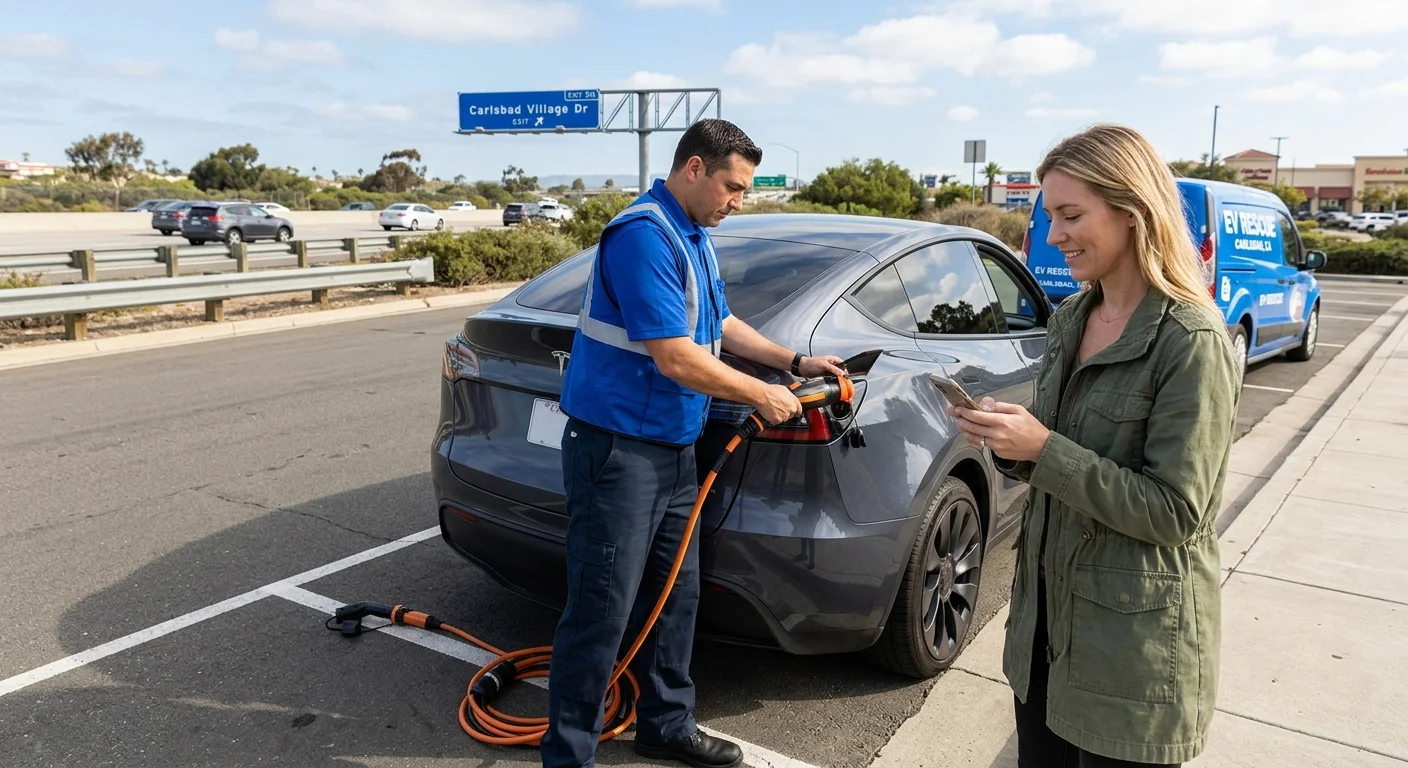
A home circuit is a later project. Mobile EV charging is the curb conversation. Operators bring a 240-volt Level 2 source to the bumper. They use native NACS, or a CCS or J1772 adapter for non-Tesla cars. They typically add 10 to 20 miles of range in 15 to 30 minutes of charging. That’s charging time, not a promise of when someone arrives.
Charge, jump, or a move
The matched operator reviews the car, the warnings, the port, and the stopping place. Out-of-charge recovery fits when the traction pack looks empty and the site supports work. A 12-volt jump or replacement fits when the car won’t wake but the pack may still hold energy. Transport fits when the site is unsafe, the symptoms go past an empty pack, or charging can’t be completed there.
The pros we connect you with are licensed and insured. Charge Pro TPA doesn’t set rates, own equipment, or promise a connector, output, or resulting range. Distance to you, time of day, and how much range you need all move the quote. The operator tells you the amount and the terms before work starts. Ask what the delivered charge is meant to accomplish. Check the display before you roll.
If a tow is on the table, Pinellas County caps non-consent tow rates by ordinance. Ask for the county schedule, not a remembered number. Florida Statute 715.07 also governs private-lot tows, including signage. In Pinellas, a towed vehicle must be stored within a 10-mile radius of removal. Ask where the car would go before you agree.
A small roadside charge isn’t a repair. If the car dies again, stop and call back with the new pin.
EV roadside assistance is the broader request when you aren’t sure which of those three you need.
North along US-19, and the next towns
A Tarpon Springs stall is often the start of a longer coastal run. Holiday and Pasco sit just north on US-19. Palm Harbor, East Lake, and Dunedin sit south along the peninsula. If you died on the Pasco side, see the US-19 Pasco stranded-EV guide. For the next Pinellas city south, see EV roadside assistance in Palm Harbor.
Withlacoochee River Electric Cooperative, not Duke, serves much of north and central Pasco. Don’t assume your neighbor’s utility is yours.
Stay reachable. Operators call back when a lot entrance or a US-19 approach is unclear. Have make, model, year, and port location ready.
When you should call
Call when the car won’t move in Tarpon Springs and you need an operator to assess a charge, a 12-volt jump, or a move. Have the pin, the nearest named road, the last range reading, and any warning text ready. Call (813) 536-4545 and we’ll connect you with a local EV rescue operator.